

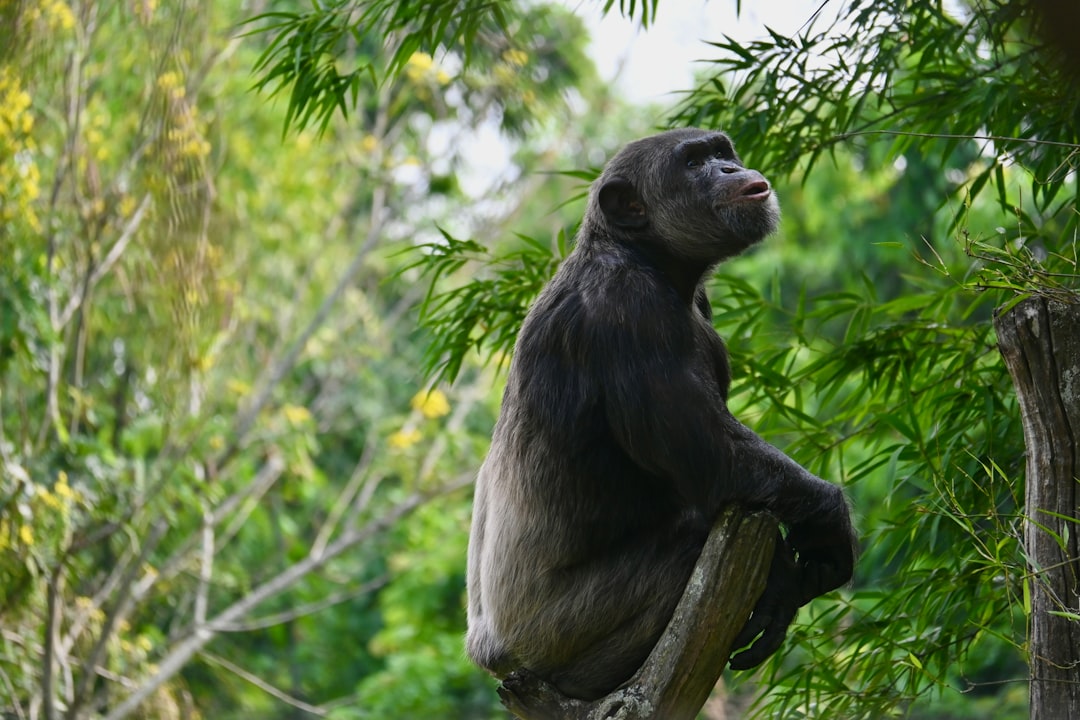
Kyoto, Japan – Researchers at Kyoto University captured a remarkable display of creativity when a chimpanzee named Ayumu transformed simple floorboards into percussive instruments. The 26-year-old alpha male combined rhythmic drumming with vocalizations in ways that echoed complex primate communication. This behavior, documented over years, offers fresh insights into how early musical expression might have emerged in our shared evolutionary past.[1][2]
Ayumu’s Spontaneous Performances Emerge
In February 2023, Ayumu began prying loose floorboards from a walkway in his enclosure at the university’s Center for the Evolutionary Origins of Human Behavior, known as EHUB. He wielded these detached pieces as tools, striking surfaces to create booming rhythms while emitting structured vocal sounds. Scientists recorded 89 such displays across 37 days until March 2025, marking the first time a chimpanzee systematically detached objects for this purpose.[3][1]
No other chimpanzee in the group replicated this exact routine consistently. Ayumu, with his history in cognitive experiments including keyboard tapping, appeared uniquely primed for such innovation. His actions went beyond typical chimp drumming on trees or stones observed in the wild, incorporating deliberate tool preparation.[2]
Dissecting the Drumming Repertoire
Ayumu’s sessions featured up to 14 distinct elements, blending percussion with movement. He drummed on enclosure surfaces, dragged the boards to produce scraping tones, and culminated in throws for climactic effects. These sequences often mirrored the build-up of chimpanzee pant-hoots, starting slow and escalating to intense peaks.[3]
During performances, Ayumu displayed a “play face” – open-mouthed grin signaling joy – and what resembled laughter. Such positive expressions, rare in pure vocal displays, suggested self-rewarding enjoyment rather than solely social signaling. Lead researcher Yuko Hattori noted the surprise: “Chimpanzee drumming-like behavior has been reported before… However, behavior like this – using a stick in a way that closely resembled playing a drum – has not been reported before.”[2]
Rhythmic Precision Under the Microscope
Analysis of the videos revealed non-random patterns. Transitions from drumming to dragging to throwing occurred deliberately, defying chance. Strike intervals maintained an isochronous tempo, akin to a metronome, with tools yielding steadier beats than hands or feet alone.[4][1]
These findings parallel wild chimpanzee tree-drumming, where rhythms vary by subspecies but convey messages over kilometers. Hattori’s team used transition analysis to confirm structure and compared timings, underscoring tool-enhanced stability. “By analyzing the order of the different drumming actions, we found that the behavior was not just a series of random movements,” Hattori explained. “Certain patterns appeared repeatedly.”[2]
- Striking: Primary drumming with floorboards on hard surfaces.
- Dragging: Sustained low tones by sliding tools.
- Throwing: Explosive finale for emphasis.
- Vocal integration: Structured calls syncing with percussion.
- Facial cues: Play face and bared teeth for emotional layering.
Echoes in Human Evolutionary History
The study supports theories that instrumental music arose from vocal emotional expression externalized through tools. Ancient drums, often perishable wood or skins, leave scant fossils, making primate analogs crucial. Ayumu’s fusion of voice and instrument hints at a precursor stage, where feelings once limited to calls expanded via objects.[4]
While captive conditions enabled elaboration, wild parallels exist. Future work will examine group reactions, as some chimps swayed in response. Hattori observed, “One especially interesting aspect… was that Ayumu sometimes appeared to be laughing while drumming… it may also have been enjoyable for Ayumu himself.”[2]
Published in Annals of the New York Academy of Sciences, the research highlights non-human capacity for such expression. Yet limitations persist: a single subject in controlled settings raises questions about generalizability.
- Ayumu’s stable rhythms with tools outpace body-only drumming, mirroring human percussion advantages.
- Non-random sequences resemble vocal pant-hoots, bridging sound production modes.
- Play faces indicate intrinsic joy, akin to musical pleasure in humans.
Ayumu’s floorboard concerts remind us that musicality runs deep in primate lineage, urging protection of these intelligent species for ongoing discoveries. What do you think about these rhythmic revelations? Tell us in the comments.

- Urban Coyotes Show Remarkable Adaptability, Learning to Thrive in City Environments - July 22, 2026
- Beavers Are Nature’s Engineers, Creating Vital Habitats for Other Wildlife Species - July 21, 2026
- The Recovery of the California Condor Offers Hope for Other Critically Endangered Birds - July 21, 2026