

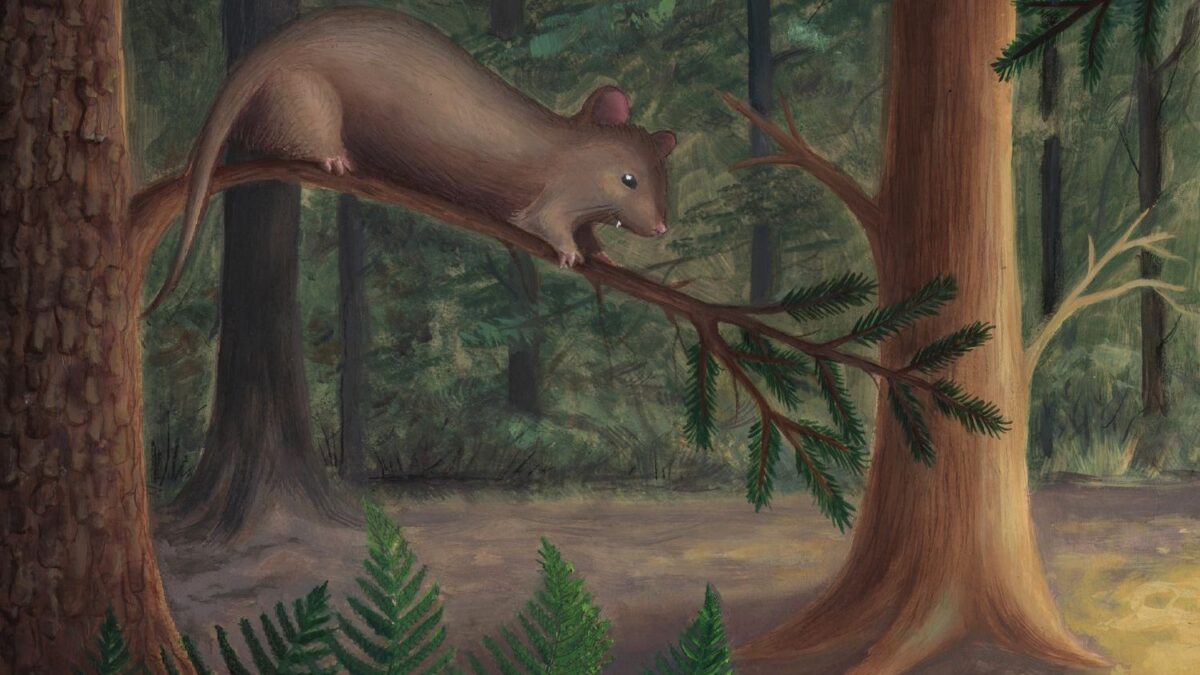
Baja California — A small tooth protruding from a rocky crevice caught the eye of a field assistant in 2009 amid the sun-baked terrains of this Mexican peninsula.[1][2] That modest clue led to the unearthing of a remarkably complete fossil, introducing scientists to Cimolodon desosai, a hamster-sized mammal that roamed alongside dinosaurs some 75 million years ago.[3] Researchers now see in this creature early signs of the adaptations that enabled some mammals to endure the cataclysm that wiped out non-avian dinosaurs.[1]
The Unexpected Find in El Gallo Formation
Michael de Sosa VI spotted the tooth during an expedition led by Gregory Wilson Mantilla, a University of Washington professor of biology and curator at the Burke Museum.[1] Further inspection revealed more bones embedded in the crack, marking a rare haul from the Upper Cretaceous El Gallo Formation’s El Disecado Member.[3] This Campanian-stage site, dating to roughly 75 million years ago, yielded specimen IGM 14691: a partial skull, mandible, teeth, ulna, femur, and vertebrae.[2]
Wilson Mantilla recalled the moment vividly. “If he had just found that, I would have been over the moon. But then when we looked inside the crack of the rock, we could see there was more bone.”[1] The specimen honors de Sosa, who passed away during the analysis phase, through its species name, Cimolodon desosai.[2] Such completeness stands out, as multituberculate fossils from the area typically consist of isolated teeth.
Unpacking the Anatomy of Cimolodon desosai
Comparable in size to a modern golden hamster, Cimolodon desosai belonged to the extinct multituberculate order, known for specialized teeth.[1] Its dental structure featured multiple rows of cusps suited for grinding diverse foods, confirming an omnivorous diet.[2] Limb bones indicated agility, with adaptations for scampering across forest floors and possibly climbing into low vegetation or trees.
Advanced imaging clarified these features. The team employed micro-computed tomography (micro-CT) scans to generate high-resolution 3D models without damaging the bones.[1] Comparisons with other Cimolodon species, like C. nitidus, highlighted distinctions in premolar shape and molar cusp patterns, solidifying its status as a new species.[3] Co-authors including UW students Isiah Newbins and Meng Chen, along with experts from the University of Rhode Island and Universidad Nacional Autónoma de México, contributed to this meticulous work.[1]
Dinosaur-Era Life on the Pacific Coast
Cimolodon desosai inhabited Laramidia, the vast landmass forming western North America’s Pacific Coast during the Late Cretaceous.[1] The genus Cimolodon appeared widely across this region, from Canada to Mexico, underscoring its adaptability.[3] This hamster-like mammal likely foraged for fruits and insects, navigating a landscape dominated by towering dinosaurs.
Its ecological niche emphasized versatility. Multituberculates, rodent-like in some ways but distinct, persisted from the Jurassic onward, outlasting many contemporaries.[1] The fossil’s postcranial elements offered rare insights into locomotion and habitat use, painting a picture of a nimble opportunist in forested environments.[2]
Traits That Outlasted the Asteroid
Nine million years before the K-Pg boundary event 66 million years ago erased 75% of Earth’s species, Cimolodon desosai embodied survival-ready features.[1] Its diminutive stature and broad diet positioned it and its descendants to weather the apocalypse that felled larger, specialized animals.
Wilson Mantilla explained, “Cimolodon desosai was ancestral to the species that survived the extinction event. It and its descendants were relatively small and omnivorous — two traits that were advantageous for surviving.”[1] This discovery fills gaps in the multituberculate record, particularly for Pacific Coast faunas, and informs debates on pre- and post-extinction dynamics.[2]
Key Adaptations of Cimolodon desosai:
- Small body size, akin to a golden hamster, for evasion and efficiency.
- Omnivorous teeth for fruits, insects, and more.
- Agile limbs suited for ground and arboreal movement.
- Versatile habitat use in Laramidian forests.
The study’s publication on April 22 in the Journal of Vertebrate Paleontology marks a milestone, built on collaborative efforts funded by groups like UC MEXUS-CONACYT.[1] While uncertainties linger about exact behaviors, this fossil underscores how modest mammals laid groundwork for the age that followed.
Findings like these remind scientists that the dinosaur era’s end hinged not just on catastrophe, but on the quiet resilience of the small and adaptable. Further excavations in Baja California promise more revelations about this pivotal transition.

- Urban Coyotes Show Remarkable Adaptability, Learning to Thrive in City Environments - July 22, 2026
- Beavers Are Nature’s Engineers, Creating Vital Habitats for Other Wildlife Species - July 21, 2026
- The Recovery of the California Condor Offers Hope for Other Critically Endangered Birds - July 21, 2026