
The Architecture of an Extraordinary Eye
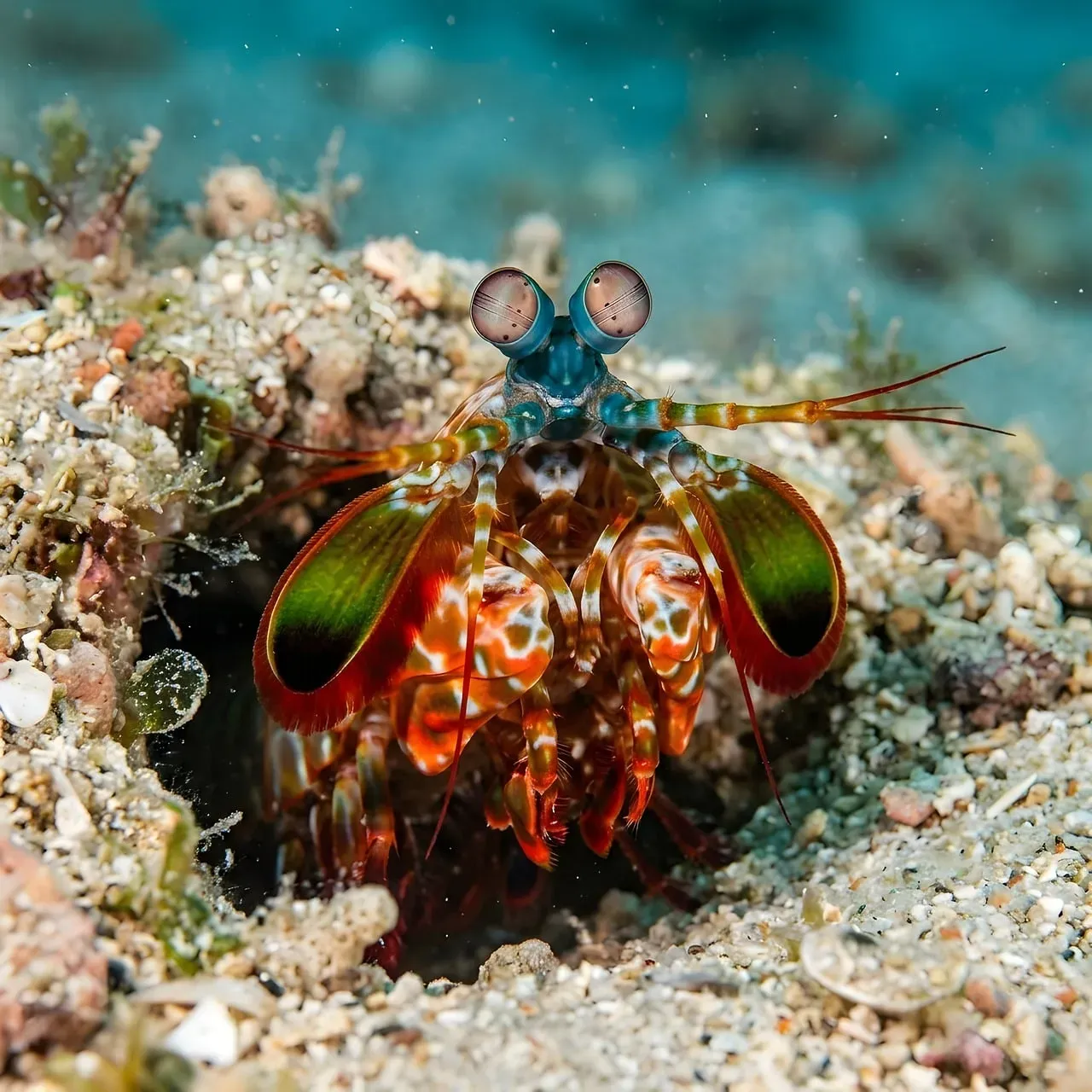
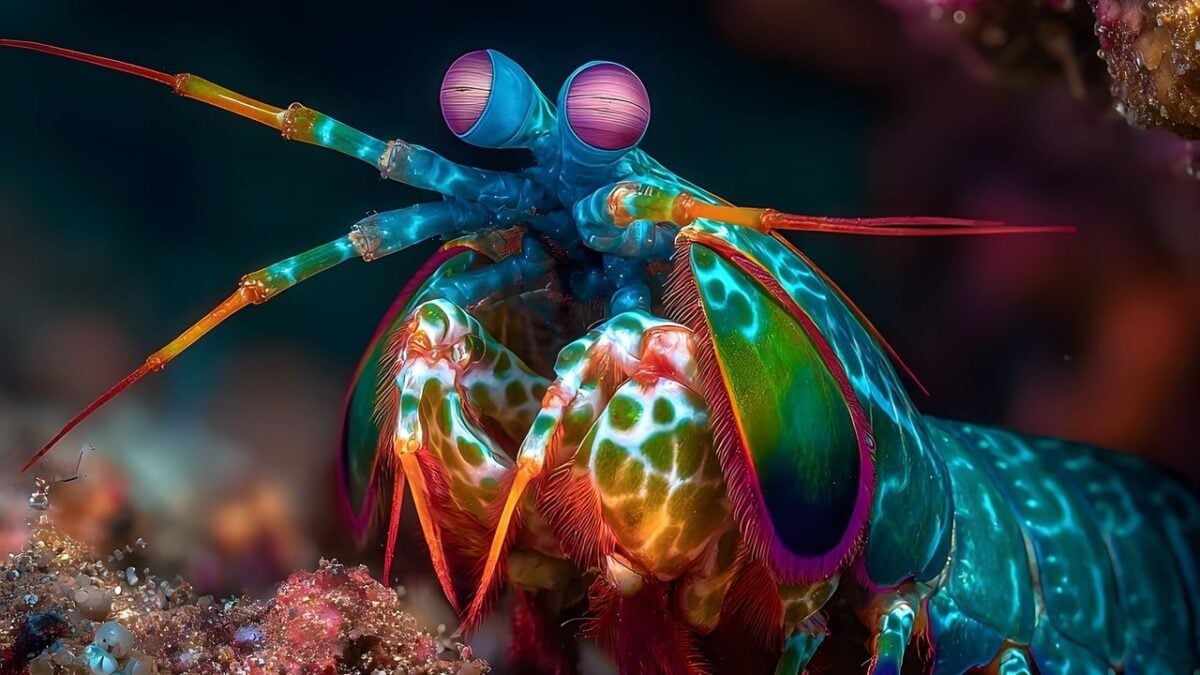
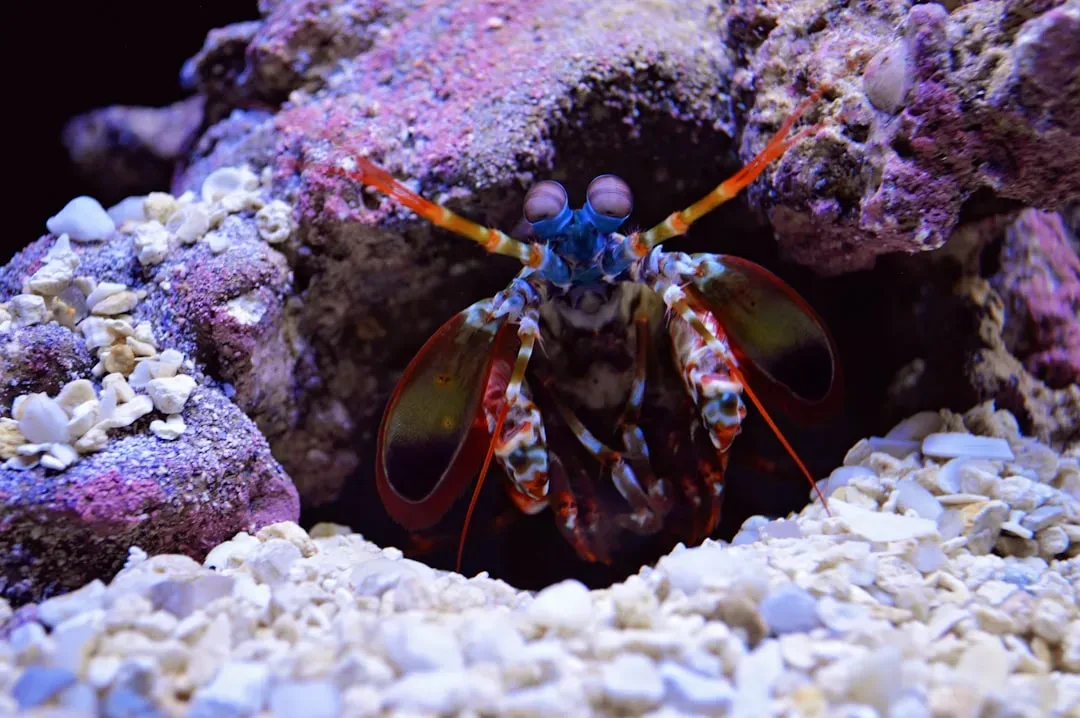
The mantis shrimp’s eye is a compound structure mounted on mobile stalks that allow for independent rotation in all three dimensions, enabling the animal to continuously scan its environment with each eye capable of perceiving depth on its own. This alone would make the eye unusual. Most animals capable of true depth perception need both eyes working together – the mantis shrimp achieves it with just one.
The compound eye is made up of thousands of individual visual units called ommatidia, which send a mosaic image to the brain. A defining feature is the “mid-band,” a set of specialized parallel rows of ommatidia that divides the eye into dorsal and ventral hemispheres, containing four rows dedicated to color processing and two rows specialized for polarization detection. Think of the mid-band as the eye’s analytical engine – a narrow strip doing the heavy lifting while the rest of the eye handles spatial information.
Three parts of each eye look at the same point in space, resulting in about 70 percent of the eye focusing on a narrow strip, while also giving the animal the ability to perceive depth with just one eye. To create an image using this strip, mantis shrimp are constantly moving their eyes and scanning the environment. It’s a continuous, active process – less like a camera shutter and more like a painter’s brush moving across a canvas, sampling and building rather than capturing all at once.
Sixteen Receptor Types and What That Number Actually Means
Human eyes have three types of color receptors, which detect red, blue, and green light respectively, along with three different proteins called opsins involved in light detection, with one opsin at work in each kind of color receptor. Mantis shrimp, by contrast, have 16 receptor types – the most known in any animal species. The gap between three and sixteen is not just a numerical difference. It represents an entirely different relationship with the electromagnetic spectrum.
Species with six ommatidial rows in the midbands of their compound eyes create 16 functional classes of photoreceptors using unusual receptor arrangements, including two or three tiers of rhabdom segments in each ommatidium. This arrangement creates abundant opportunities for spectral filtering and tuning of photoreceptors, amplified by the use of photostable filter pigments paired with specific sets of photoreceptors. The system is layered, almost architectural. Light passes through biological filters before it even reaches the receptors, pre-sorted before the visual process truly begins.
After more than a decade of painstaking experiments, researchers found that instead of the expected 16 opsins, mantis shrimp eyes have at least 33 types of opsins – and the relationships between opsins and color receptors were completely different from what scientists had expected. The deeper scientists look, the more complex the system becomes. Every answer so far has produced a longer list of questions.
The Vision Paradox: More Receptors, Fewer Color Distinctions
Despite the unprecedented number of photoreceptors, the mantis shrimp exhibits surprisingly poor color discrimination when tested behaviorally. While humans with only three color channels can distinguish between millions of different hues, the mantis shrimp struggles to tell the difference between colors separated by fewer than 25 nanometers in wavelength. This inability to finely differentiate colors despite the complex hardware is known as the mantis shrimp vision paradox.
Instead of comparing all 12 to 16 color channels simultaneously, which would require enormous neural processing power, each midband row functions as a separate opponent channel. The system identifies colors quickly by recognizing which specific receptor responds most strongly, rather than computing complex ratios between multiple channels. It’s the difference between a barcode scanner and a painter’s eye. The mantis shrimp identifies, categorizes, and responds – fast. It does not linger over subtle gradations the way human vision does.
Humans use parallel processing, where the signals from the three photoreceptor types are compared and contrasted simultaneously to create fine distinctions in color. The mantis shrimp, however, appears to use a form of sequential scanning or filtering. Two completely different evolutionary solutions to the same problem, shaped by completely different survival pressures, arriving at results that look nothing alike on the inside.
Seeing Light That Doesn’t Exist in Human Experience
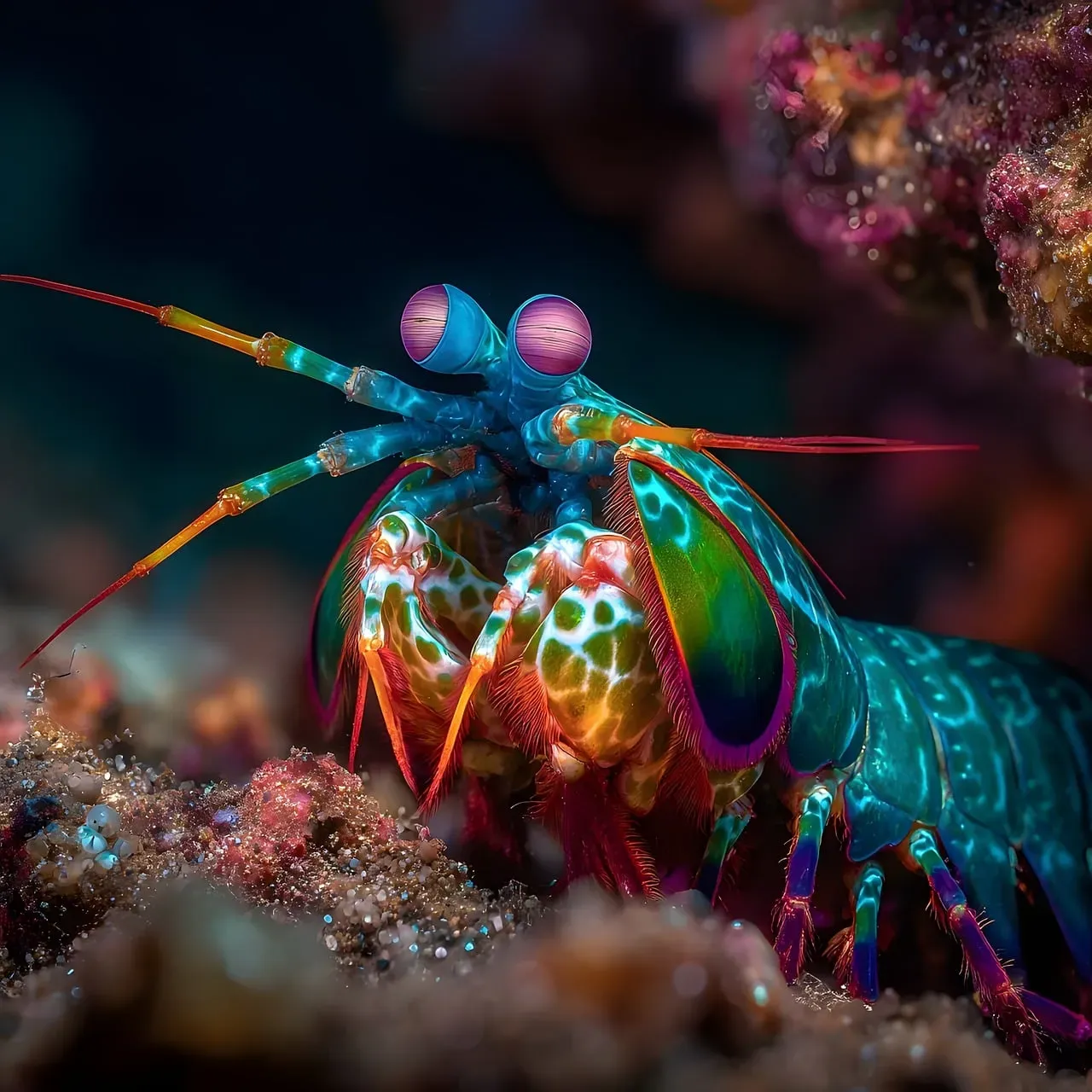
Using highly evolved compound eyes with up to 16 color receptors, mantis shrimp detect UV, visible, and polarized light. With so many receptors, mantis shrimp can see the polarization of light with less glare and distortion. Polarized light is something humans interact with – it’s what polarized sunglasses filter out – but we don’t see it. The mantis shrimp doesn’t just detect it; it reads it as a language.
These crustaceans possess the ability to detect polarized light, including both linear and circular polarization, making them the only known animals capable of perceiving circularly polarized light. Polarized light refers to light waves that vibrate in a specific direction, and detecting it provides a distinct advantage in their aquatic environment, helping them see through the glare and reflections common underwater. That ability to cut through reflective interference in an aquatic world is a meaningful survival advantage, not a biological accident.
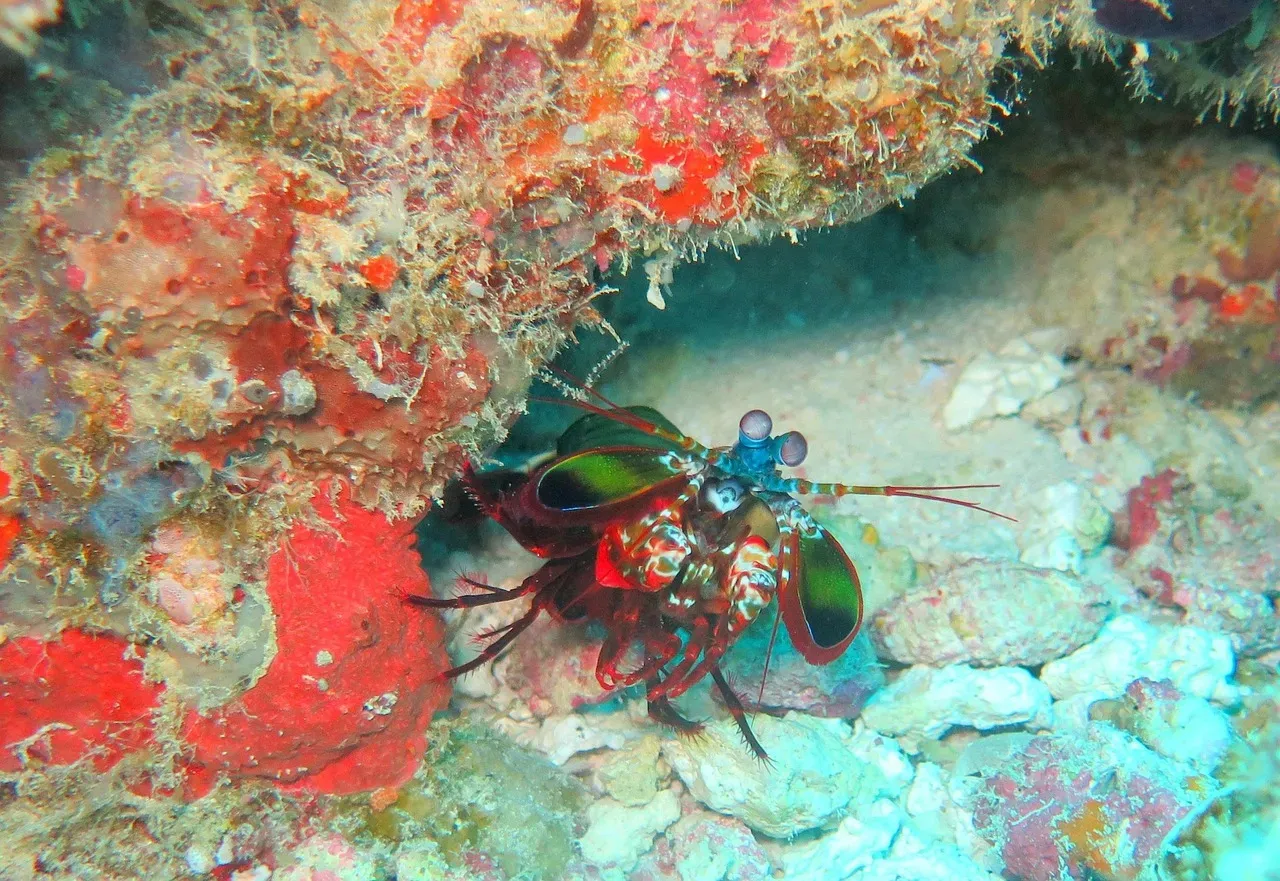
UV vision allows them to see patterns on coral and other marine organisms that reflect ultraviolet light. Mantis shrimp likely use similar UV cues to identify prey species, assess the health of potential meals, or even evaluate the status of rival shrimp during territorial disputes. The reef, to a mantis shrimp, is annotated with information completely invisible to every human who has ever dived it.
How a Small Brain Handles All That Information
Despite having one of nature’s most sophisticated visual systems, mantis shrimp brains are relatively simple. They don’t have massive visual processing centers like primates. This creates an engineering puzzle that has genuinely surprised researchers. The hardware is extraordinary. The central processor, by primate standards, is modest. Something has to bridge that gap.
Parallel processing refers to the way visual inputs like color and polarization travel from the eyes to the brain. Rather than traveling on the same pathway one after the other, there are multiple parallel pathways that allow mantis shrimp to process visual inputs concurrently. They move their eyes to absorb visual information and integrate color along with polarization in their spatial vision, and after the visual information leaves the retina, it gets processed in numerous parallel data streams leading to the central nervous system. This greatly reduces the high-level analytical requirements of their vision and reduces the amount of work necessary to process what they see.
Researchers were intrigued to discover a neural connection between the reniform body and a brain region known to be involved with memory. This connection may allow mantis shrimp to store visual memories, most likely enabling them to remember something that’s good to eat or something else they should run away from. The visual system is not just about perception in the moment. It feeds memory, shapes behavior, and builds a usable map of a dangerous world.
What Vision Is Actually For: Survival, Communication, and Combat
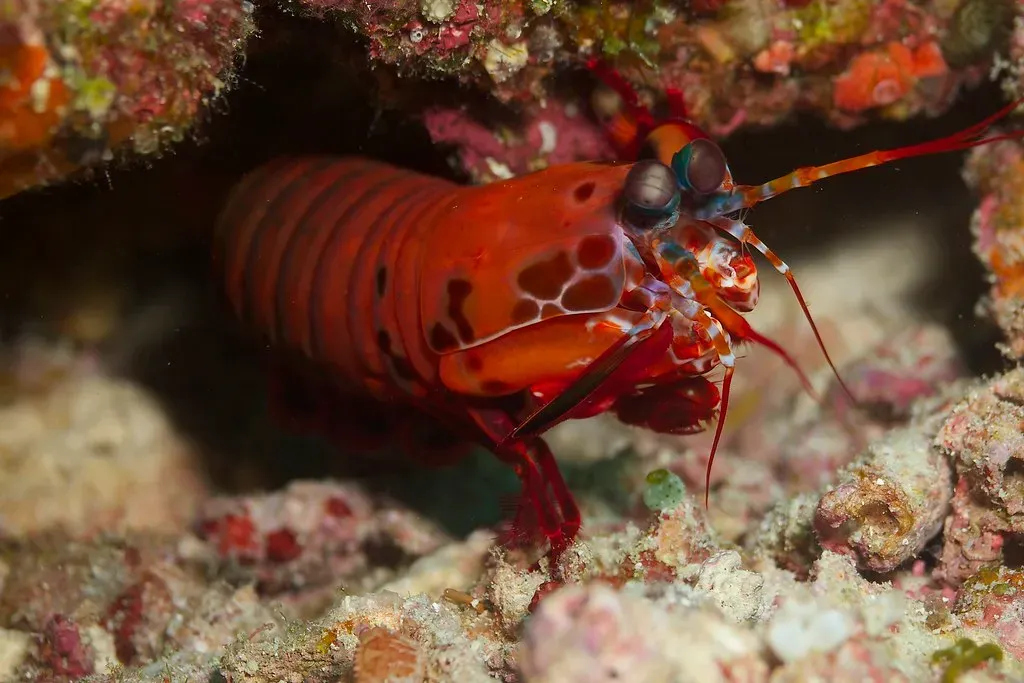
The complex vision of the mantis shrimp has evolved to provide significant ecological benefits. Their ability to perceive a wide spectrum of light, including polarized and UV light, is crucial for hunting prey. They can identify camouflaged organisms and detect transparent creatures that might be invisible to other animals, and the rapid color recognition system allows for quick decisions – an advantage for a predator known for its lightning-fast strikes.
Vision also plays a central role in communication among mantis shrimp. They utilize patterns of polarized light on their bodies as signals for species recognition, mating displays, and territorial defense. These visual cues are essential for navigating social interactions within their habitats, reducing conflict by conveying intentions. The body of a mantis shrimp is essentially a signaling system, broadcasting in frequencies invisible to most other ocean animals.
Their complex visual systems include the ability to see polarized light and use fluorescence to emit light for signaling. Fluorescence occurs when organisms absorb light, transform it, and re-emit it as a different color. Like neon paint that glows under a blacklight, mantis shrimp throughout the western Atlantic have fluorescent yellow markings that appear as patches on their bodies, and studies show these play an important role in visual communication, particularly during threat displays.
The Instrument Problem: Why We Cannot Truly Translate Their World
Despite decades of research, mantis shrimp vision still holds mysteries. Scientists don’t fully understand how the brain integrates all those separate color channels with polarization data and motion detection, and the exact neural circuitry remains largely unmapped. Even less is known about how individuals develop their visual capabilities, whether different species have evolved different processing strategies, or how the system degrades with age or injury. The honest answer to “what does a mantis shrimp see?” remains genuinely incomplete.
As virtual and augmented reality technologies advance, we’re gaining the ability to visualize data outside our natural sensory range. Infrared and ultraviolet cameras can map their signals to visible colors, and polarization data can be rendered as brightness patterns. We’re building technological extensions that let us peek into the mantis shrimp’s rainbow, translating the unimaginable into something our limited trichromatic brains can process. But that translation is exactly the problem. We are always converting, always reducing, always filtering an alien signal through a three-channel receiver.
One fascinating question is whether mantis shrimp visual capabilities can be mapped to a computational model that could guide artificial sensor design. Researchers are working on this, but the hybrid opponent-binning system doesn’t fit neatly into conventional computer vision frameworks, and cracking this code could lead to fundamentally new approaches to image processing. The gap isn’t just biological. It’s also mathematical – the system doesn’t map cleanly onto any model humans have built yet.
What the Mantis Shrimp Is Teaching Medicine and Engineering
Researchers have developed technology inspired by the mantis shrimp’s vision to aid cancer detection. In recent years, hyperspectral imaging has been used to help detect skin cancer, and using visible, ultraviolet, and infrared light wavelengths, doctors receive a three-dimensional image of potential tumors. The very wavelengths that a mantis shrimp uses to assess a meal or a rival are now being used to find tumors in operating rooms.
Over the past decade, researchers have devoted significant time and effort to developing mantis-shrimp-inspired sensor technology for cancer imaging, including during cancer surgery. The technology can capture the three colors of visible light that a doctor would normally see as well as three colors of invisible near-infrared light that the doctor would miss. That is the direct application of a principle the mantis shrimp evolved for entirely different reasons – turned toward one of medicine’s hardest problems.
Cancer cells are easy to see under polarized light because their disorganized and invasive structures scatter light differently than normal body cells. Research on mantis shrimp vision has led to the bioengineering of sensors for polarized imaging devices and analyzers, with applications including biomedical imaging technology that can facilitate early cancer detection. The reef predator and the surgical suite have turned out to share a surprisingly direct line.
Conclusion: A Creature That Humbles the Limits of Perception
Mantis shrimp vision reveals how arbitrary our own perception is. We assume the visible spectrum defines what’s “real,” but that’s just evolutionary happenstance. Our ancestors needed to distinguish ripe fruit and read facial expressions under the savanna sun; they didn’t need to see UV flower patterns or detect polarization. Different selection pressures built different visual worlds.
What makes this genuinely worth sitting with is not just the spectacle of a strange animal with strange eyes. It’s what the mantis shrimp implies about every other creature on this planet – that each one inhabits its own version of reality, shaped by its own evolutionary pressures, tuned to its own slice of the physical world. We are not the benchmark. We are one data point in a very large dataset that science is still, slowly, gathering. The mantis shrimp has been building its visual system for roughly 400 million years. We’ve been studying it seriously for a few decades. The gap in understanding feels appropriate.