

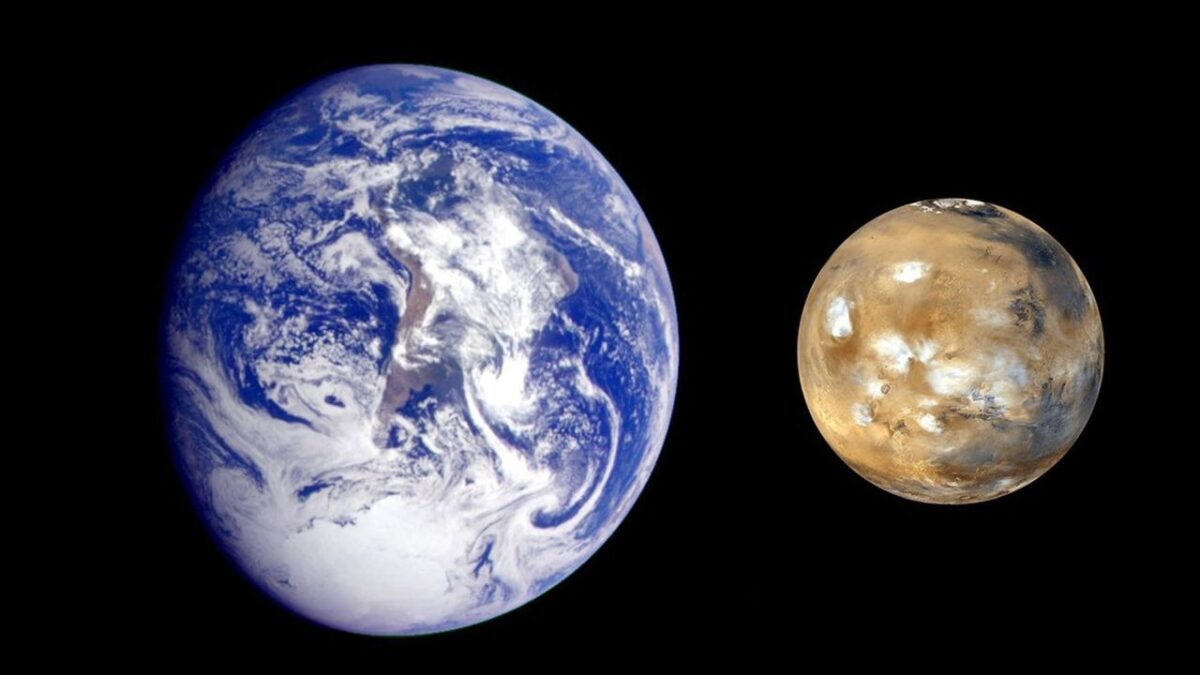
The Overlooked Influence of a Smaller Neighbor (Image Credits: Cdn.mos.cms.futurecdn.net)
Astronomers have uncovered evidence that the distant red planet exerts a subtle yet profound influence on Earth’s long-term climate rhythms, challenging assumptions about planetary interactions in our solar system.
The Overlooked Influence of a Smaller Neighbor
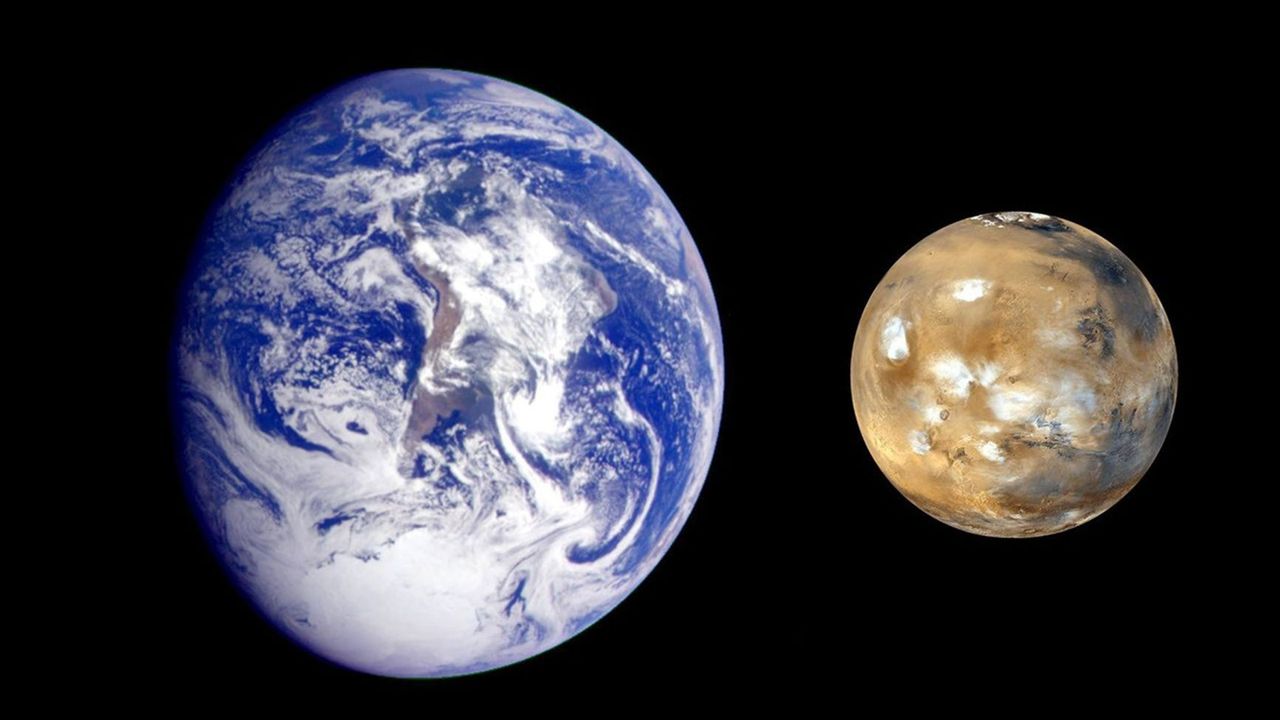
Stephen Kane, a professor of planetary astrophysics at the University of California, Riverside, initially doubted claims linking Mars to Earth’s climate history. He viewed the red planet’s gravitational effects as negligible given its modest size – only half of Earth’s diameter and a tenth of its mass. Yet, detailed computer simulations changed his perspective. These models demonstrated how Mars’ orbit perturbs Earth’s path, amplifying variations in our planet’s tilt and eccentricity over millions of years.
This interaction forms part of broader orbital dynamics involving Jupiter and other planets. Kane’s work, published in early 2026, quantified Mars’ role more precisely than previous studies. Sediment records from ocean floors, which preserve traces of ancient ice ages, align closely with these simulated patterns. The findings suggest that without Mars’ pull, Earth’s climate cycles would differ significantly in timing and intensity.
Decoding Milankovitch Cycles Through New Lenses
Milankovitch cycles describe how gradual shifts in Earth’s orbit and axial tilt modulate the amount of sunlight reaching the planet, triggering periods of glaciation and warming. These cycles operate on timescales from tens of thousands to millions of years, with the longest – a 2.4-million-year rhythm – now tied directly to Mars’ gravitational nudge. Kane’s simulations revealed that Mars enhances the eccentricity cycle, where Earth’s orbit stretches from nearly circular to more elliptical.
Historically, scientists attributed these grand cycles mainly to Jupiter’s dominant mass. However, the research highlights Mars’ disproportionate impact, as its position allows it to resonate with Earth’s orbit in ways that build cumulative effects. Ocean sediment layers from sites worldwide corroborate this, showing climate signals matching the model’s predictions. Such alignments confirm that Mars contributes to the pacing of ice ages, including the current interglacial period that began about 12,000 years ago.
Simulations That Bridge Planets and Paleoclimate
To test his skepticism, Kane developed advanced orbital models incorporating the solar system’s full gravitational interplay. These computations tracked Earth’s position relative to the Sun over 65 million years, factoring in planetary perturbations. The results showed Mars inducing variations in Earth’s orbital precession and obliquity, key drivers of seasonal contrasts.
One striking outcome emerged: Mars amplifies a low-frequency cycle that aligns with deep-sea core data. This cycle influences global ice volume, with peaks corresponding to major glacial advances. Kane noted in interviews that the effect, while small individually, compounds over geological time. The study, detailed in a Phys.org report, underscores how even distant bodies shape habitable worlds.
Broader Implications for Planetary Science
This discovery reframes our understanding of solar system stability and its ties to climate evolution. It suggests that smaller planets like Mars play outsized roles in multi-body dynamics, potentially applicable to exoplanet systems. For Earth, the findings illuminate why ice ages recur with such regularity, aiding predictions of future shifts amid human-induced warming.
Climate modelers now incorporate these orbital forcings more accurately, blending astronomical data with geological records. The research also prompts questions about Mars’ own climate history, where its thin atmosphere and lost water hint at past habitability influenced by similar interactions. As Kane reflected, “I’d thought its gravitational influence would be too small to easily observe within Earth’s geologic history.”
- Mars’ mass: 10% of Earth’s, yet it perturbs orbits significantly.
- Key cycle affected: 2.4-million-year eccentricity variation.
- Evidence source: Ocean sediment layers from 300 global sites.
- Simulation span: 65 million years of solar system behavior.
- Primary driver amplified: Earth’s orbital tilt and shape changes.
Key Takeaways
- Mars enhances Milankovitch cycles, directly influencing ice age timing.
- Gravitational effects accumulate over millions of years for measurable climate impact.
- New models confirm alignments between simulations and paleoclimate data.
While Mars remains a cold, arid world today, its unseen hand continues to guide Earth’s climatic destiny, reminding us of the intricate dance governing our planet’s past and future. What aspects of this cosmic connection intrigue you most? Share your thoughts in the comments below.

As a little kid, I fell in love with nature, wildlife, and animals. Living in the USA, South Africa, Italy, China and Germany gave me the opportunity to discover the world's Wildlife. My favorite animals are Mountain Gorillas, Siberian Tigers, and Great White Sharks.
I'm a certified PADI Open Water Diver, went to Everest Base Camp and Trekked Gorillas in Uganda. I hold a Master of Science in Economics and Finance.
Please send any feedback to feedback@animalsaroundtheglobe.com
- 11 Most Endangered Insects Buzzing in America Today - July 22, 2026
- 10 Most Frequently Googled Animal Birth Facts - July 22, 2026
- 10 Incredible Migration Journeys in the Animal Kingdom - July 22, 2026