

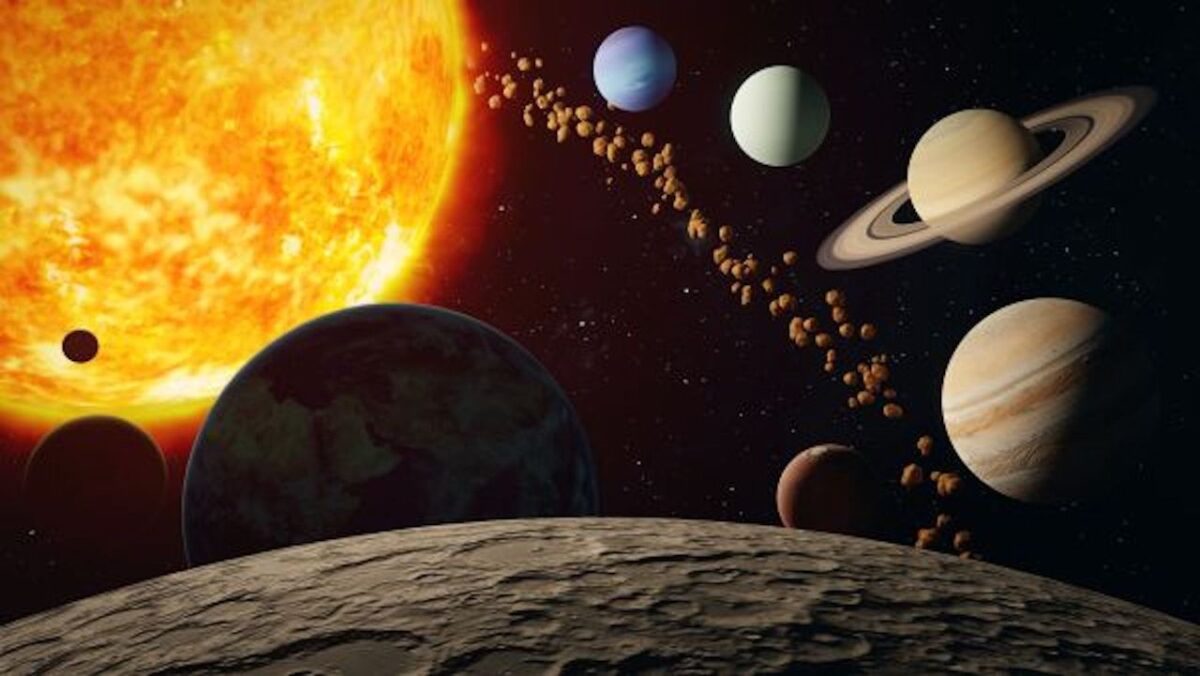
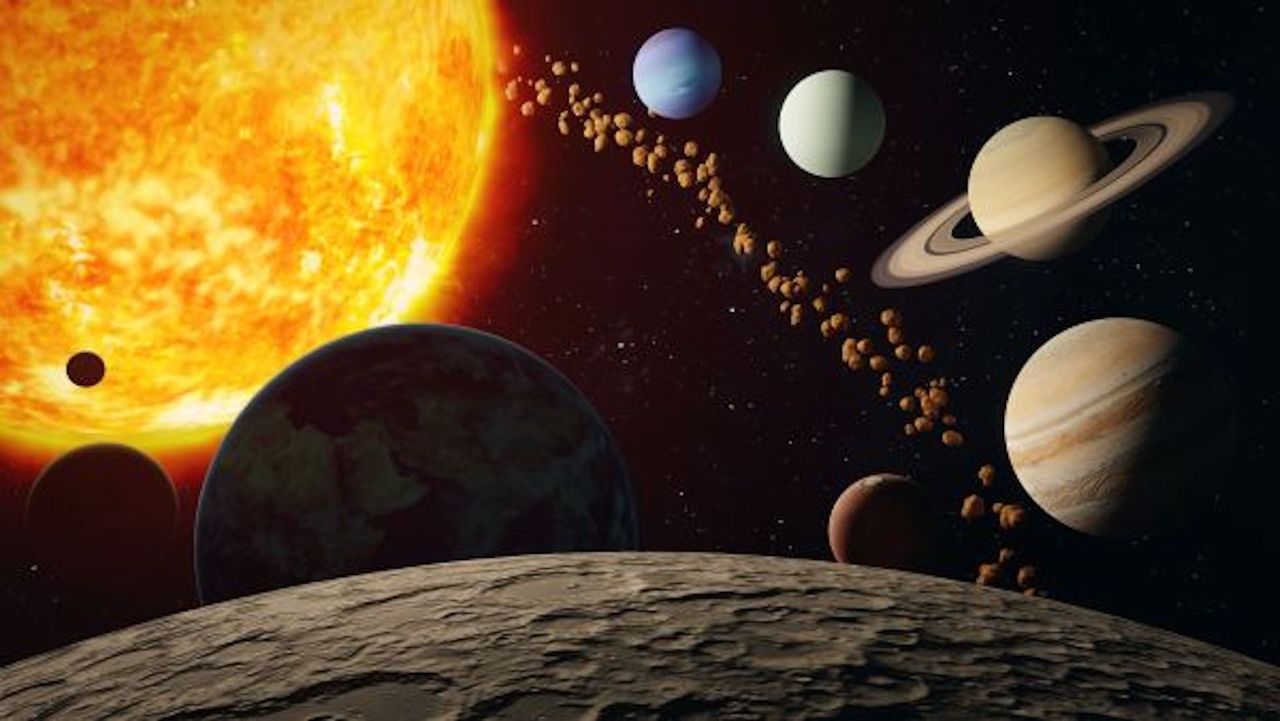
The Pull of Gravity: Earth’s Local Reality (Image Credits: Cdn.mos.cms.futurecdn.net)
In the vast expanse of the universe, the familiar notion of “below” Earth dissolves into a question of perspective, challenging our everyday intuitions about direction.
The Pull of Gravity: Earth’s Local Reality
Gravity anchors our sense of up and down to the planet’s surface. For anyone standing on Earth, “down” points toward the center of the planet, where immense pressure and heat define the interior layers. Scientists have long mapped these depths through seismic waves and drilling projects, revealing a structure that begins with the thin crust, transitions to the viscous mantle, and reaches the molten outer core surrounding a solid inner core of iron and nickel.
This layered composition, forged over billions of years, governs much of what we experience on the surface. Yet, as we lift our gaze beyond the planet, this directional certainty fades. The transition from terrestrial to celestial scales reveals that space operates without such fixed orientations, prompting astronomers to rethink spatial relationships entirely.
The Ecliptic Plane: Orbiting in a Cosmic Disk
Earth’s journey around the Sun follows a specific path known as the ecliptic plane, a flat disk where most solar system bodies align their orbits. This arrangement arose from the gravitational collapse of a rotating cloud of gas and dust about 4.6 billion years ago, flattening the system into a pancake-like structure. From our vantage, the Sun appears to trace this plane across the sky over the course of a year, influencing seasons and ancient calendars alike.
Within this plane, “below” Earth might seem to point toward the southern ecliptic, where planets like Jupiter and Saturn periodically dip. However, this is merely a projection; in three-dimensional space, the solar system extends perpendicularly from the ecliptic by varying degrees. Missions such as Voyager have ventured out of this plane, confirming that the Sun’s influence wanes gradually, giving way to interstellar space without a clear “bottom.”
Galactic Alignment: Earth’s Place in the Milky Way
Zooming out further, the Milky Way galaxy imposes its own flattened structure, with Earth orbiting the galactic center in a disk roughly 100,000 light-years wide. Our solar system resides about 26,000 light-years from the core, bobbing slightly above and below the galactic plane due to the combined gravitational tug of stars and dark matter. This motion, known as the Sun’s vertical oscillation, takes around 70 million years to complete one cycle.
In this broader context, directions like “below” lose meaning as the galaxy spirals through local space. Observations from telescopes such as Hubble have shown that neighboring galaxies, including Andromeda, approach us at angles unrelated to Earth’s local down. The illusion persists only because human perception clings to the planet’s curvature and spin.
Beyond the Local Group: Infinite Perspectives
At the universe’s grandest scales, the concept of below evaporates entirely, replaced by the expansion of space itself. The observable universe stretches 93 billion light-years across, with galaxies receding in all directions due to the Big Bang’s ongoing legacy. Cosmologists describe this as an isotropic realm, where no preferred up or down exists, only relative motions governed by dark energy.
Recent studies, including those from the James Webb Space Telescope, highlight how early universe structures formed without directional bias, reinforcing that Earth’s “below” is a purely local artifact. Theoretical models suggest that even multiverse ideas, if real, would maintain this directionless nature, underscoring humanity’s provincial view of the cosmos.
- The ecliptic plane dictates solar system orbits but offers no absolute “below.”
- Galactic dynamics position Earth in a disk, with oscillations above and below the plane.
- Universal expansion ensures space’s isotropy, eliminating fixed directions.
- Gravity’s role confines “down” to planetary scales.
- Telescopic observations confirm the relativity of spatial orientation.
Key Takeaways
- Earth’s interior layers provide a tangible “below,” but space redefines it as perspective-dependent.
- The solar system’s flat plane creates an apparent structure, yet true navigation requires three dimensions.
- In the infinite universe, directions are illusions shaped by our position, not cosmic absolutes.
Ultimately, what lies “below” Earth reflects not a hidden realm but the limits of our grounded thinking; embracing the cosmos invites a humbler, more fluid understanding of place. What aspects of space’s boundless directions intrigue you most? Share your thoughts in the comments.

- Urban Coyotes Show Remarkable Adaptability, Learning to Thrive in City Environments - July 22, 2026
- Beavers Are Nature’s Engineers, Creating Vital Habitats for Other Wildlife Species - July 21, 2026
- The Recovery of the California Condor Offers Hope for Other Critically Endangered Birds - July 21, 2026