

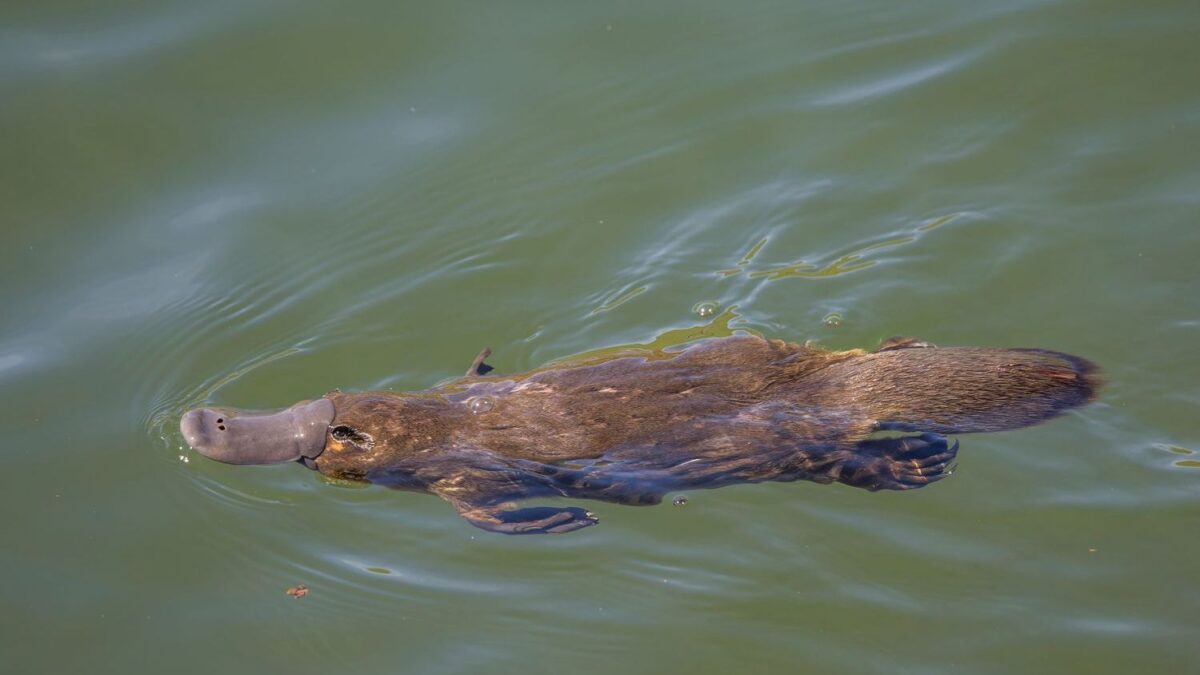
Eastern Australia — In the quiet rivers and streams where platypuses paddle with their distinctive duck-like bills, researchers have uncovered yet another layer of this creature’s profound oddity. A recent study revealed that the structures responsible for the animal’s brown fur resemble those found in birds rather than typical mammals. This finding adds to the platypus’s reputation as one of nature’s most perplexing animals.[1][2]
A Mosaic of Evolutionary Traits
The platypus has long captivated scientists with its patchwork of features borrowed from different animal groups. It sports a bill akin to a duck’s for detecting electric fields from prey, a flat beaver-like tail that stores fat, webbed feet for swimming, and lays leathery eggs much like reptiles. Males even possess venomous spurs on their hind legs, a rarity among mammals.
These traits position the platypus as a monotreme, one of only two types of egg-laying mammals alongside echidnas. Females lack nipples and instead secrete milk through pores in their skin, which the young lap up. The species also fluoresces under ultraviolet light, and its genome boasts an unusual array of 10 sex chromosomes.[1]
Peering Inside the Fur
Biologists at Ghent University in Belgium turned their attention to the platypus’s fur, examining tiny pigment-producing organelles called melanosomes under high-resolution electron microscopes. What they found defied expectations: the melanosomes were both hollow and spherical. Such hollow structures had never before been observed in any mammal, including the platypus’s close relatives, the echidnas.
The team analyzed hairs from multiple platypus specimens and compared them to over 120 other mammal species, as well as birds. Mammalian melanosomes are typically solid, while hollow ones in birds contribute to iridescent colors and brightness in feathers. In the platypus, however, these unusual melanosomes produce only a standard brown hue, leaving researchers puzzled about their purpose.[2][1]
“This was totally unexpected,” study author Jessica Leigh Dobson remarked. “Hollow melanosomes have never been found in mammals before, and the combination of hollow and spherical isn’t seen anywhere else as far as we know.”[2]
Challenging Assumptions About Color and Cells
Melanosomes play a crucial role in determining the color of hair, skin, and feathers by packaging melanin, the pigment that gives rise to browns, blacks, and more vibrant shades. Scientists had long assumed a straightforward correlation between melanosome shape and color output: solid rods for darker tones in mammals, hollow forms for structural colors in birds.
The platypus upends this model. Its hollow, spherical melanosomes do not produce iridescence or unusual brightness, just everyday brown fur. “This doesn’t really conform with what we currently know about how melanosome shape correlates with colour,” Dobson noted. The discovery prompts questions about whether these structures evolved independently in the platypus or represent a retained ancient trait from early mammal ancestors.[2]
Further comparisons revealed no such hollow melanosomes in short-beaked or long-beaked echidnas, the platypus’s fellow monotremes. This specificity suggests the feature ties closely to the platypus’s lifestyle.
- Spherical shape: Common in some pigments but rare in combination with hollowness.
- Hollow interior: Allows light scattering in birds; function unclear in platypus fur.
- Absence in other mammals: Highlights platypus uniqueness among 120+ species studied.
Evolutionary Clues from an Aquatic Life
Researchers hypothesize that the hollow melanosomes may link to the platypus’s semi-aquatic habits. Both platypuses and their ancestors inhabited water, where such structures could have provided better insulation against cold. Echidnas, having shifted to terrestrial life, might have lost this trait over time.
Yet this theory raises new puzzles. Other aquatic mammals like otters, beavers, and seals show no hollow melanosomes. The platypus’s persistence with this bird-like feature underscores its position as a living relic, bridging mammalian and reptilian lineages. The study, published March 18, 2026, in the journal Biology Letters, opens doors to research on melanin genetics and melanosome development.[1]
Preserving platypus populations in Australia becomes ever more vital as climate change and habitat loss threaten these enigmatic swimmers. Their biology continues to offer insights into evolution’s creative paths.
Lessons from Nature’s Oddball
The platypus reminds scientists that evolution often defies neat categories. What began as a specimen dismissed as a hoax in the 18th century now reveals cellular secrets that challenge decades of assumptions. As Dobson and her team continue their work, the humble monotreme promises more surprises.
This discovery not only enriches our understanding of pigmentation but also emphasizes the platypus’s role in unraveling mammalian origins. In a world of specialized creatures, the platypus stands as a testament to nature’s boundless experimentation.
