
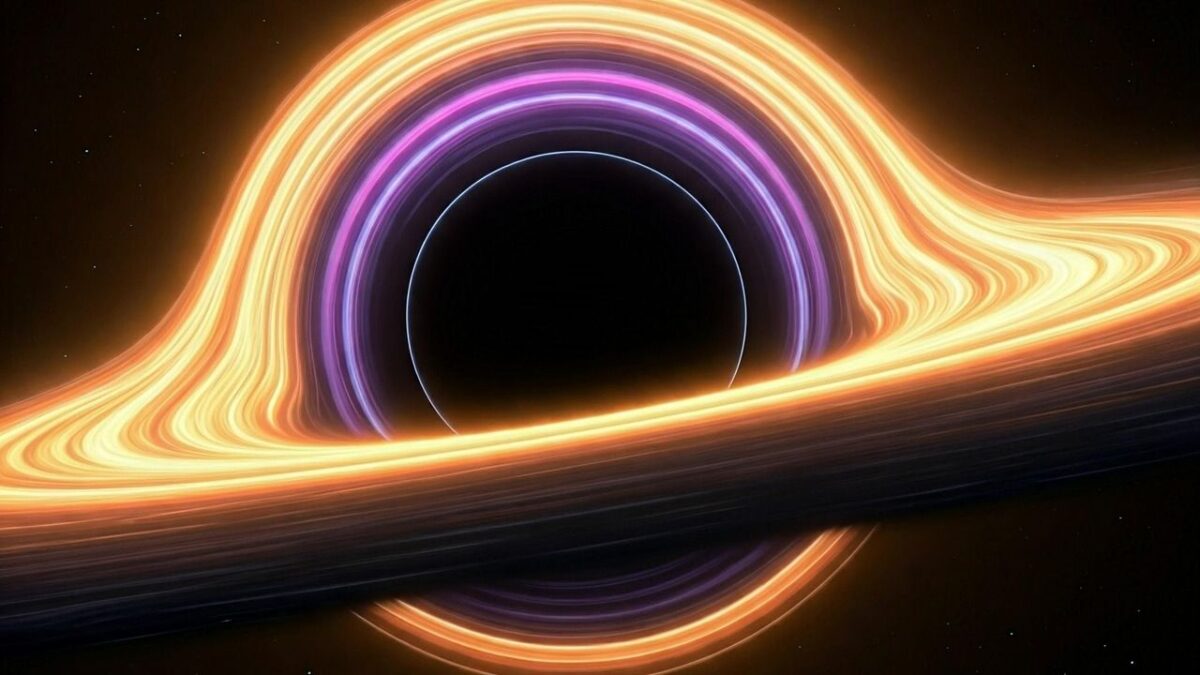
The Long-Standing Rule That Black Holes Were Supposed to Follow
For decades, scientists have relied on a quantity known as the tidal Love number to describe how an object deforms under gravitational forces. While planets, stars, and even neutron stars display measurable responses, black holes have stood apart with a value fixed at zero, suggesting no deformation at all.
Love numbers were first formulated in 1909 by British mathematician Augustus Edward Hough Love, who wanted to understand the tidal deformation experienced by the Earth as it is pulled on gravitationally by the Moon and the Sun. Today, these Love numbers help scientists explore the internal structure of objects as they shift and stretch due to tidal forces.
This interaction is quantified by what is known as a “tidal Love number,” and for decades, scientists have known that the tidal Love number for black holes is precisely zero. This means that a black hole experiences no deformations when it comes into contact with outside gravitational influences. It was one of the tidiest results in all of theoretical astrophysics. Then researchers started looking at the problem from a different angle entirely.
What Fermionic Fields Have to Do With It
This study decided to analyze the Love number of black holes from another perspective: a fermionic one. Typically, Love numbers are derived from bosonic, or force-carrying, sources, which include things like gravitational waves, electromagnetic fields, or scalar fields.
The researchers analyzed Kerr black holes, uncharged black holes with angular momentum described by Einstein’s Theory of Relativity, using fermionic sources, such as the massless neutrino-like Dirac field, a mathematical field in quantum field theory. The distinction matters enormously. Bosons and fermions behave by fundamentally different rules, and that turns out to change everything.
Remarkably, the fermionic response function is real and nonvanishing for both Kerr and Schwarzschild black holes. In plain terms, when you probe a black hole using fermionic fields rather than bosonic ones, the zero result simply doesn’t hold. The black hole responds. It does something it was never supposed to do.
Breaking the Symmetry That Enforced the Zero
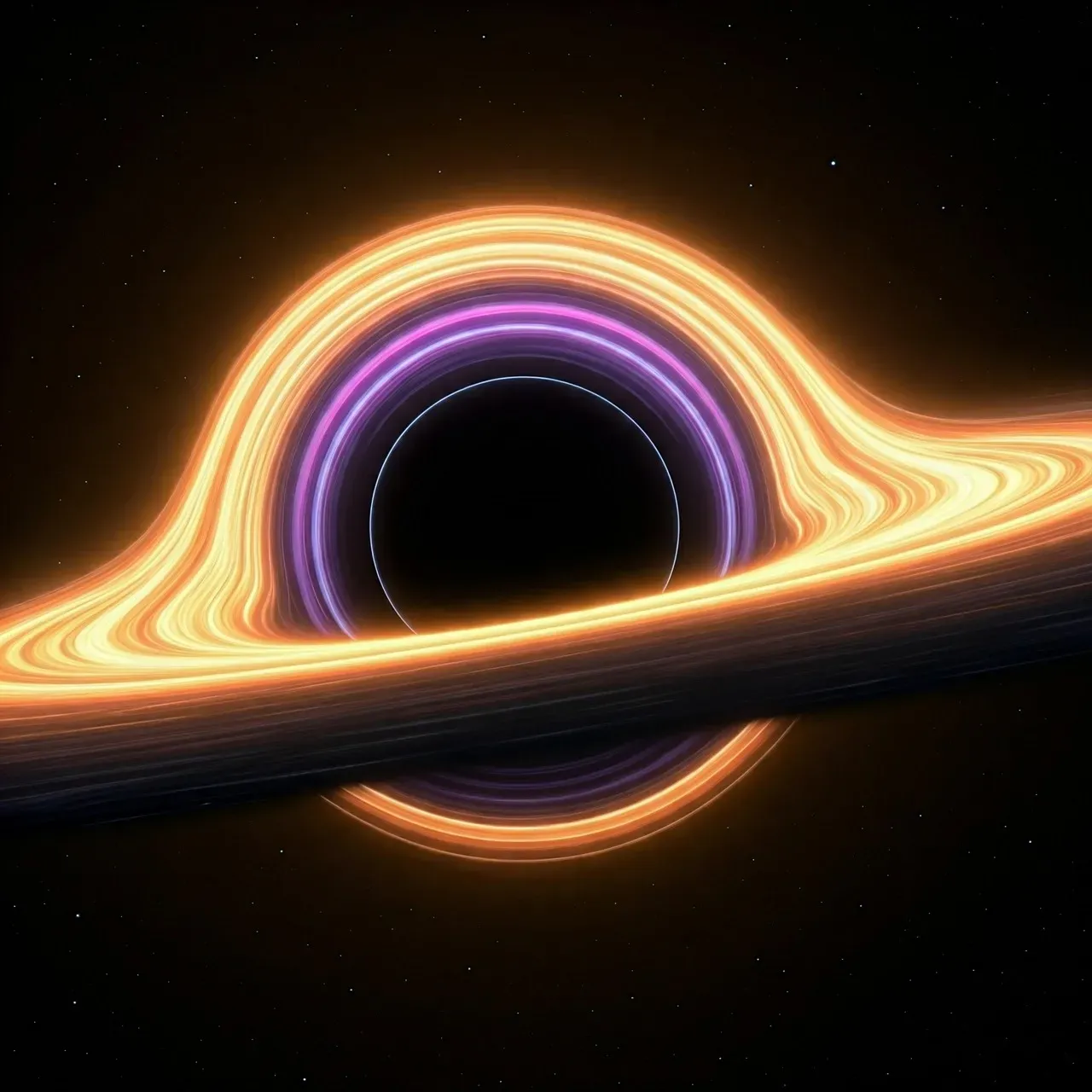
The difference between the two approaches boils down to what are known as “ladder symmetries.” These symmetries essentially force a zero solution for bosonic perturbations, but the fermionic fields evade this constraint because their lowest multipole moment “admits a regular decaying solution,” according to the authors.
These results highlight a fundamental distinction between bosonic and fermionic perturbations, which can be interpreted as a breaking of the hidden symmetries that underlie the vanishing of Love numbers in the bosonic sector. The symmetry, in other words, was real, but it was never universal. It only applied to one category of field.
Black holes in general relativity exhibit a remarkable feature: their response to static scalar, electromagnetic, and gravitational perturbations, as quantified by the so-called tidal Love numbers, vanishes identically. The researchers present the first exception to this rule: the Love numbers of a black hole perturbed by a fermionic field are nonzero. They derive a closed-form expression of these fermionic Love numbers for generic spin in the background of a Kerr black hole with arbitrary angular momentum.
Could Black Holes Have “Hair” After All?
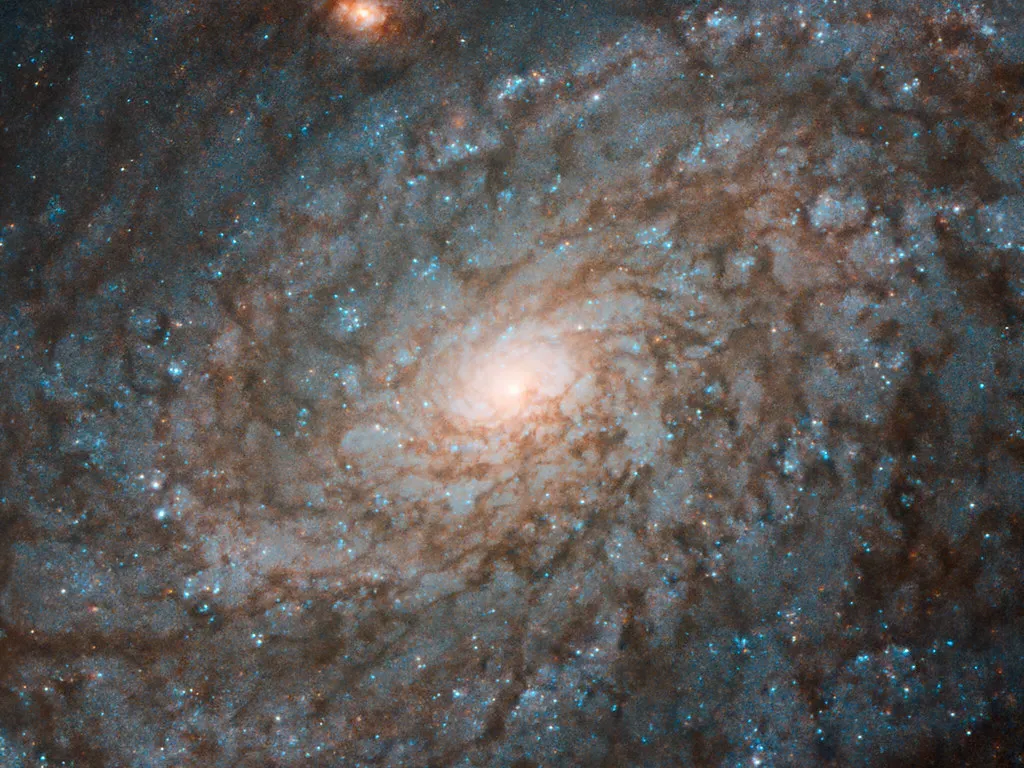
This departure from the zero-value rule raises the possibility that black holes could possess what physicists call “hair,” a term used to describe additional observable properties beyond mass, charge, and angular momentum. The “no-hair theorem” has been a cornerstone of black hole physics for half a century, and this finding quietly nudges it.
This suggests that the black holes might contain fermionic “hair,” similar to a theoretical scenario known as electroweak hair, which describes a cloud of W and Z bosons from which a given black hole can extract energy and angular momentum. Whether this kind of hair is physically observable in any practical sense remains an open question, but the theoretical door is now ajar in a way it wasn’t before.
If confirmed, the finding could open a new way to probe black holes, their interactions with fundamental fields, and possibly their internal structure. That last part, the internal structure, is where things get genuinely provocative. Because black holes, by definition, are not supposed to let us peer inside.
The Singularity Problem Has Not Gone Away

The idea of the singularity has existed since black holes first emerged from the solutions to Albert Einstein’s theory of gravity, general relativity, which was published in 1916. It represents the point at which mass becomes infinitely dense, so concentrated that the curvature of space-time it creates becomes infinite also.
This remains concerning, because it represents a breakdown of the laws of physics. Thanks to their central singularity, black holes don’t obey the laws of physics, even general relativity, the theory that first described them. That is a paradox that just won’t do for many physicists, who are working hard to eliminate it by busting the central singularity.
The center of a black hole is predicted to be a point of infinitely high density, called a singularity, where all the mass of the black hole is concentrated, but fundamental physics teaches us that infinities do not exist, and their appearance in any theory signals its inaccuracy or incompleteness. The fermionic Love number discovery doesn’t resolve the singularity problem, but it does add yet another layer to the sense that our current picture of black holes is incomplete.
Jets That Shouldn’t Be Accelerating, Are
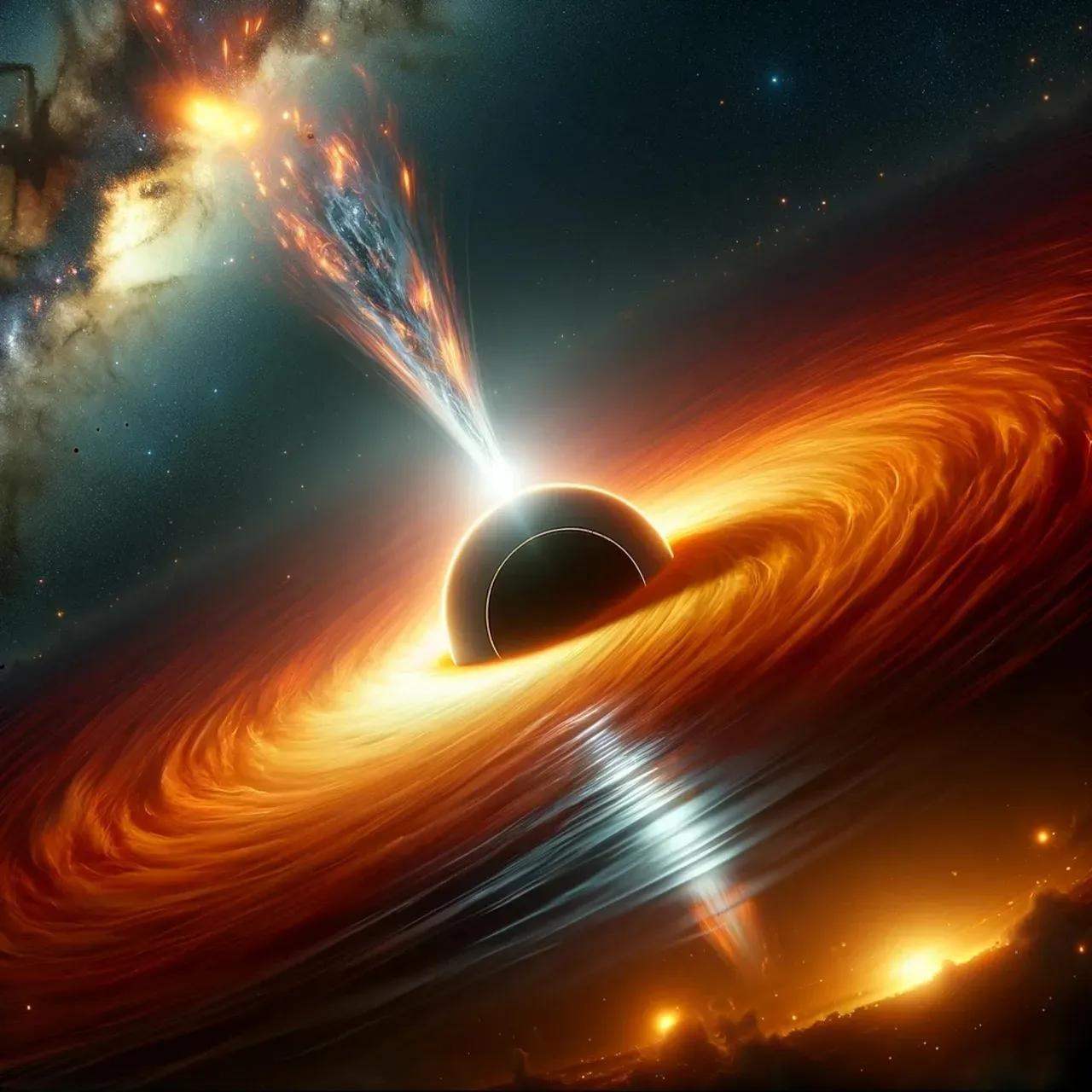
Jets near supermassive black holes are speeding up when they should be cruising. That is what a fresh look at the sharpest radio images suggests. This is a separate but related challenge, coming from observational rather than theoretical physics.
A team working from institutes in Bonn and Granada analyzed the Event Horizon Telescope’s 2017 observations of 16 active galaxies and found jet behavior that conflicts with the standard picture. Standard models of jet physics predict that energy output should stabilize as the jets travel outward. Instead, the jets appear to grow hotter and brighter the farther they travel from the black hole.
If black hole jets brighten outward, energy must move into the particles that make the radio glow. A high Poynting flux, energy carried by electromagnetic fields, can turn into particle motion. Scientists suspect electromagnetic energy is feeding the jets further down the line, but precisely how and why remains unresolved. The rules, once again, are not behaving.
What These Findings Could Mean for Physics Going Forward
These results, if confirmed, would not overturn existing physics outright, but they would complicate a picture once considered settled, adding yet another layer to the enduring mystery of black holes. This is the careful, important qualifier that researchers themselves are quick to note.
Scientists’ findings demonstrate how, using the laws of quantum mechanics, the black hole singularity is replaced by a region of large quantum fluctuations, tiny, temporary changes in the energy of space, where space and time do not end. Instead, space and time transition into a new phase called a white hole, a theoretical region of space thought to function in the opposite way to a black hole. Whether that specific model proves correct or not, it reflects the broader momentum in the field: researchers are no longer content to accept that black holes simply end the conversation.
Another promising direction is to embed the fermionic Love number computation within the worldline effective field theory, by analyzing the scattering of massless fermions. This framework would allow researchers to quantify the imprint of fermionic Love numbers on the dynamics of black-hole binaries. Gravitational wave observatories may one day be sensitive enough to detect these signatures directly, turning an abstract theoretical result into a measurable signal.
Conclusion
Physics has a long history of objects that were supposed to be simple turning out to be anything but. Black holes began as a mathematical curiosity in Einstein’s equations and became, over the following century, one of the most productive sources of genuine scientific upheaval we have ever encountered. The tidal Love number result from March 2026 fits that tradition perfectly. It doesn’t demolish what we know. It reveals that what we knew was narrower than we thought.
The deepest insight may be this: the rules black holes were thought to follow were never truly universal. They were rules that held under specific conditions, with specific types of fields, in a framework that didn’t account for everything nature has available. As researchers push into fermionic territory, into quantum corrections, and into gravitational wave data of increasing precision, the picture will keep sharpening. Black holes aren’t breaking physics. They’re telling us where physics needs to grow.

- The World’s Most Mysterious Ancient Sites: 7 Ancient Wonders Of North America - July 18, 2026
- Can Animals Truly Predict Major Weather Events Before Humans? - July 18, 2026
- 15 Types of Foxes And Where To See Them in The Wild - July 18, 2026