


Worried about unexpected vet bills?
Pet insurance can cover thousands in unexpected vet costs. Get a free quote from Lemonade in under 2 minutes.
Get My Free Quote →Sponsored · Opens Lemonade.com
In the inky darkness of the deep sea, where sunlight fails to penetrate and pressures would crush an unprotected human, evolution has crafted some of Earth’s most extraordinary and nightmarish predators. These remarkable creatures have adapted to one of our planet’s most extreme environments, developing hunting strategies and physical adaptations that seem to defy imagination. From fish with transparent heads to squid that can alter their own genetic makeup, the deep ocean harbors predatory species that continue to astonish marine biologists with each new discovery. This alien realm, which makes up the largest habitat on Earth, remains largely unexplored, with scientists estimating we’ve documented less than 20% of its inhabitants. Let’s dive into the mysterious world of the deep sea’s most bizarre predators, creatures that have evolved incredible specializations to survive in this dark, cold, and unforgiving frontier.
The Barreleye Fish: Nature’s Living Submarine
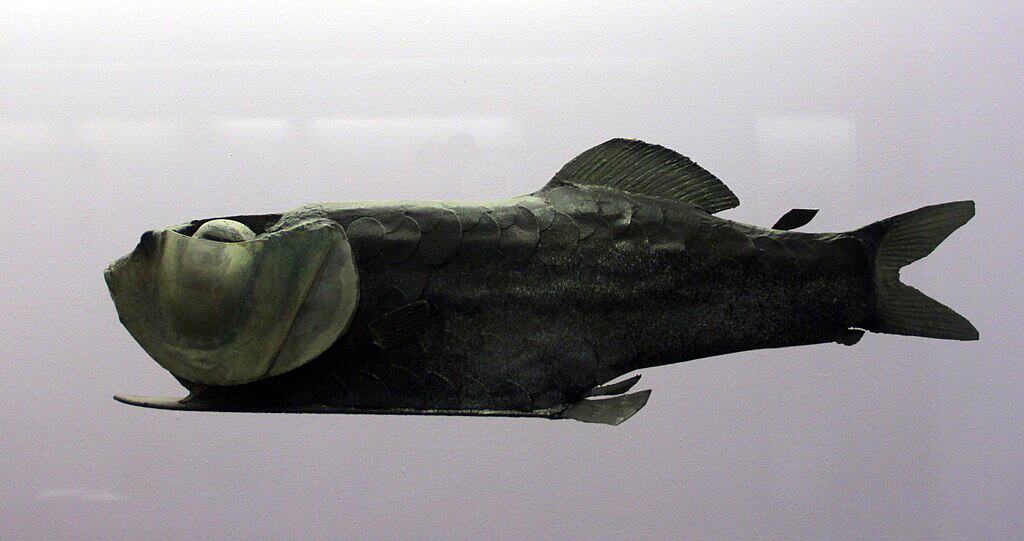
Among the deep sea’s most peculiar hunters is the barreleye fish (Macropinna microstoma), a creature that seems designed by science fiction writers rather than natural selection. The most striking feature of this fish is its transparent, fluid-filled dome that encases its head, through which its tubular, highly sensitive eyes are visible. Unlike most fish, these eyes point upward, allowing the barreleye to detect the silhouettes of potential prey against the faint light filtering down from above. What makes this adaptation even more remarkable is that these eyes can rotate within the transparent shield, enabling the fish to look forward when pursuing prey.
First discovered in 1939, scientists initially misunderstood the barreleye’s anatomy because specimens brought to the surface were damaged by the pressure change. It wasn’t until 2009 that researchers from the Monterey Bay Aquarium Research Institute captured footage of living barreleyes at depths of 2,000 feet, revealing the true nature of their transparent heads. These predators primarily feed on small crustaceans and jellyfish, often stealing prey from the tentacles of siphonophores (colonial jellyfish relatives) without getting stung themselves. The barreleye’s ability to hover motionless in the water column while scanning for prey makes it one of the deep sea’s most patient and peculiar ambush hunters.
The Black Dragonfish: Master of Light and Darkness

The female black dragonfish (Idiacanthus atlanticus) embodies the terrifying efficiency that deep-sea evolution can produce. Growing up to two feet long with a slender, black body that virtually disappears in the darkness, this predator boasts a mouth full of fang-like teeth that are proportionally among the largest of any fish. These teeth angle inward, ensuring that once prey enters its cavernous mouth, escape is impossible. What truly sets the black dragonfish apart, however, is its mastery of light—both visible and invisible to the human eye.
Unlike most bioluminescent creatures that produce blue light, the dragonfish can generate red light from specialized organs called photophores beneath its eyes. This adaptation is revolutionary because most deep-sea animals cannot see red light, having evolved in an environment where red wavelengths are quickly absorbed by water. This gives the dragonfish a form of “night vision”—it can illuminate prey with red light without being detected. Scientists have discovered that the dragonfish also possesses unique visual pigments that allow it to see its own red light, creating a predatory advantage akin to using invisible flashlights in a dark room. Interestingly, the males of this species are tiny, toothless, and non-predatory, highlighting the extreme sexual dimorphism that can evolve under deep-sea conditions.
The Goblin Shark: Living Fossil With a Projectile Jaw

Often called a “living fossil,” the goblin shark (Mitsukurina owstoni) is the only extant representative of a family that dates back 125 million years. Its most distinctive feature—the one that earns it comparisons to movie monsters—is its elongated, flattened snout that resembles a sword blade, beneath which lurks perhaps the most mechanically sophisticated jaw in the animal kingdom. When a goblin shark detects prey with its ampullae of Lorenzini (gel-filled sensory organs that detect electrical fields), it displays a hunting technique that continues to astonish marine biologists.
The goblin shark’s jaw can extend outward at remarkable speed, almost like a bullet firing from a gun. High-speed camera footage reveals that the shark’s jaw can project forward up to 9.4 inches in just 0.3 seconds, one of the fastest known jaw movements of any vertebrate. This adaptation allows it to capture fast-moving prey like fish and squid in the deep sea, where the usual lunging attack methods would be too energy-intensive. After capture, the jaw retracts, bringing the prey back to be processed by rows of needle-like teeth designed for grasping rather than cutting. Adding to its alien appearance, the goblin shark’s semi-transparent skin reveals a network of blood vessels that give it a pinkish hue—a feature that has earned it the nickname “vampire shark” in some parts of the world.
The Vampire Squid: Deceptive Name, Remarkable Adaptations
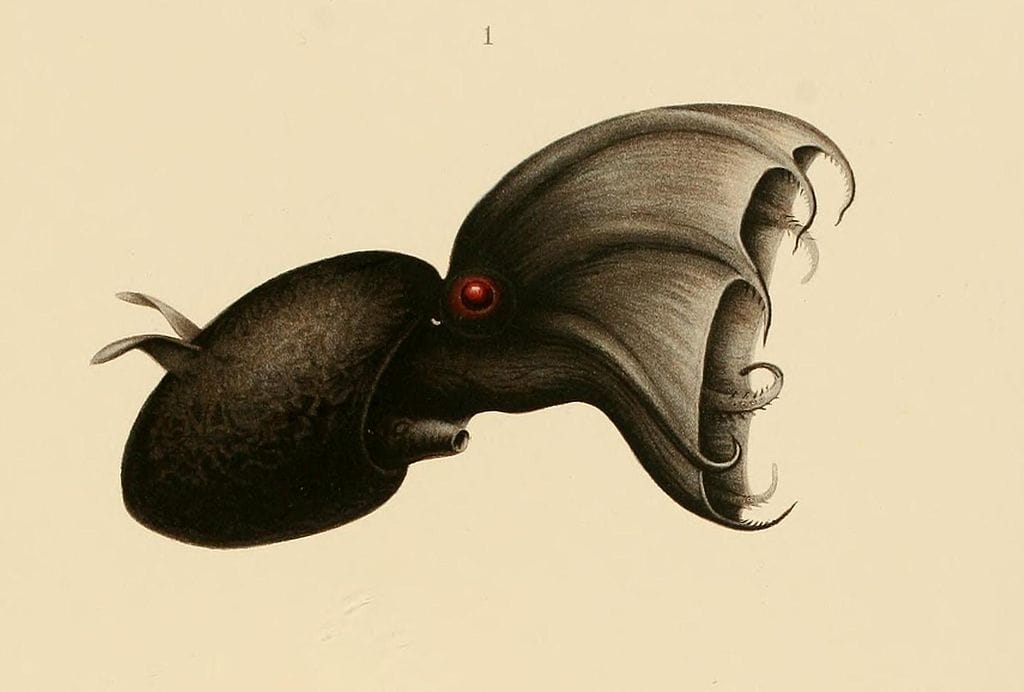
Despite its ominous name, the vampire squid (Vampyroteuthis infernalis, which translates to “vampire squid from hell”) is not the bloodthirsty monster that early taxonomists imagined. In fact, this ancient creature, which is neither a true squid nor an octopus but the sole surviving member of the order Vampyromorphida, has evolved one of the most unique feeding strategies in the deep sea. Living at depths between 2,000 and 3,000 feet in oxygen-minimum zones where few predators venture, the vampire squid has abandoned the active hunting lifestyle of its relatives.
When threatened, the vampire squid can invert its webbed arms over its head, taking on the appearance of a spiky, intimidating ball. Its most spectacular defensive adaptation, however, is its ability to eject bioluminescent mucus from the tips of its arms, creating a cloud of glowing particles that confuses predators while the vampire squid escapes. Recent research has revealed that, unlike true squids, this creature is actually a detritivore that feeds on “marine snow”—the constant shower of organic debris falling from above. It uses two thread-like filaments to capture this material, then transfers it to specialized appendages that wrap the food in mucus before delivering it to the mouth. This fascinating creature represents an evolutionary path that diverged from both octopuses and squids approximately 30 million years ago.
The Fangtooth: Owner of the Ocean’s Most Impressive Teeth
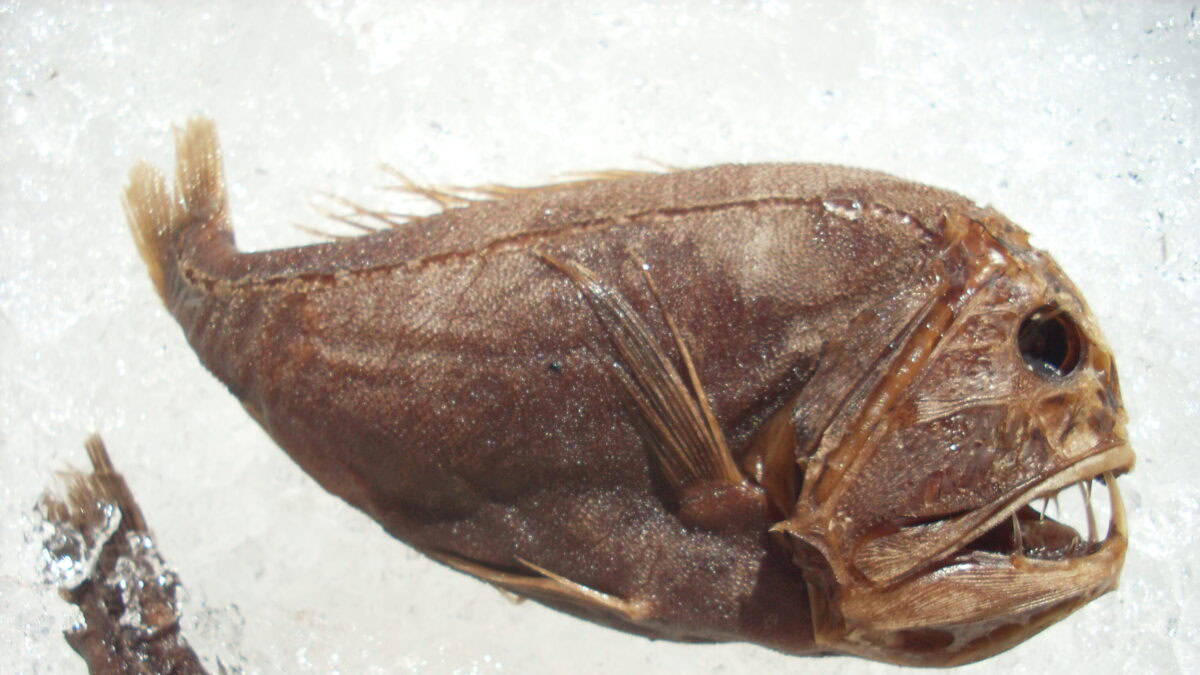
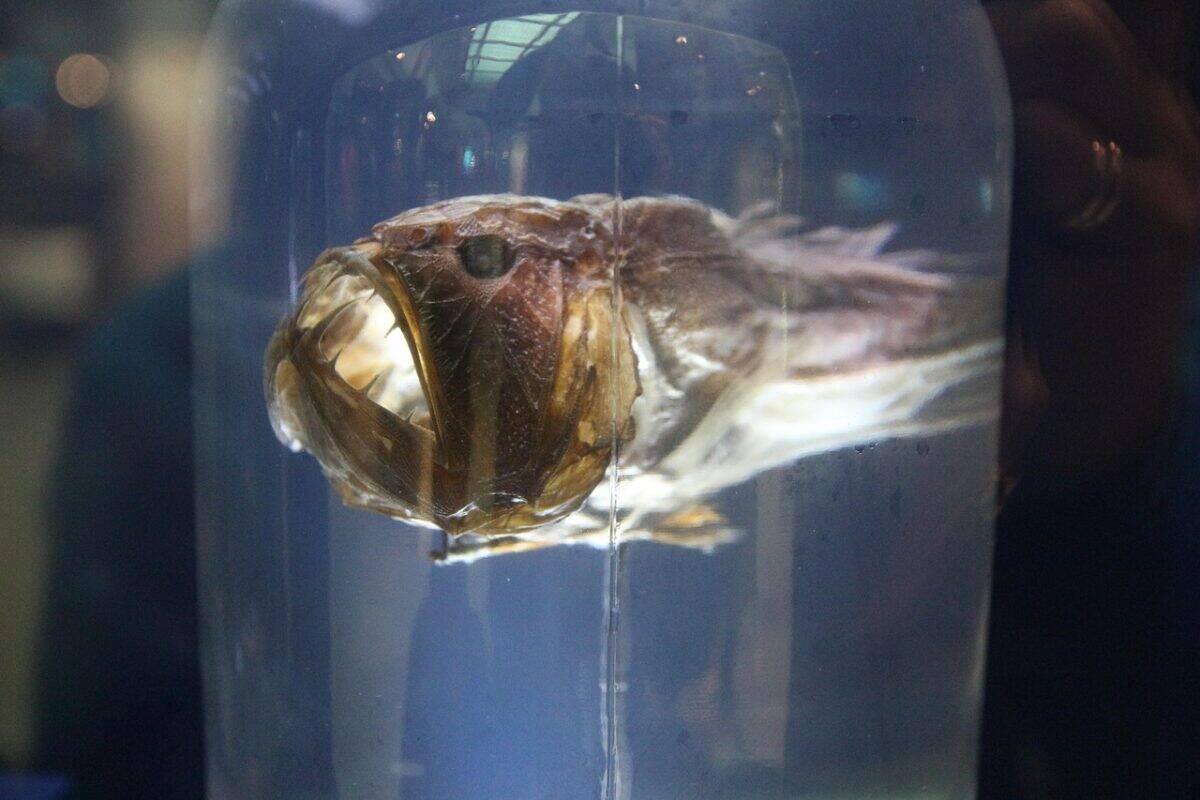
The common fangtooth (Anoplogaster cornuta) might be small—rarely exceeding six inches in length—but it possesses the largest teeth relative to body size of any fish in the ocean. These disproportionate fangs are so long that the fish has evolved special pouches on the roof of its mouth to accommodate them when it closes its jaws. Without these sheaths, the fangtooth would impale its own brain with its teeth. These formidable dental weapons serve a critical purpose in the deep sea, where missing a meal could mean starvation.
Fangtooths typically inhabit depths between 1,600 and 6,500 feet, where their dark brown to black coloration renders them nearly invisible. Their bodies are covered with spiny scales that provide protection against would-be predators. Unlike some deep-sea fish that are ambush predators, fangtooths actively hunt, using a lateral line system (pressure-sensitive organs running along their sides) to detect the movements of prey in the darkness. Juvenile fangtooths undergo a remarkable transformation as they mature, beginning life near the surface as typical-looking fish with large eyes and silver coloration before developing their distinctive teeth and migrating to the depths. Scientists believe this dramatic metamorphosis represents an evolutionary strategy that allows them to exploit different ecological niches throughout their lives.
The Giant Isopod: Deep-Sea Scavenger With Ancient Origins
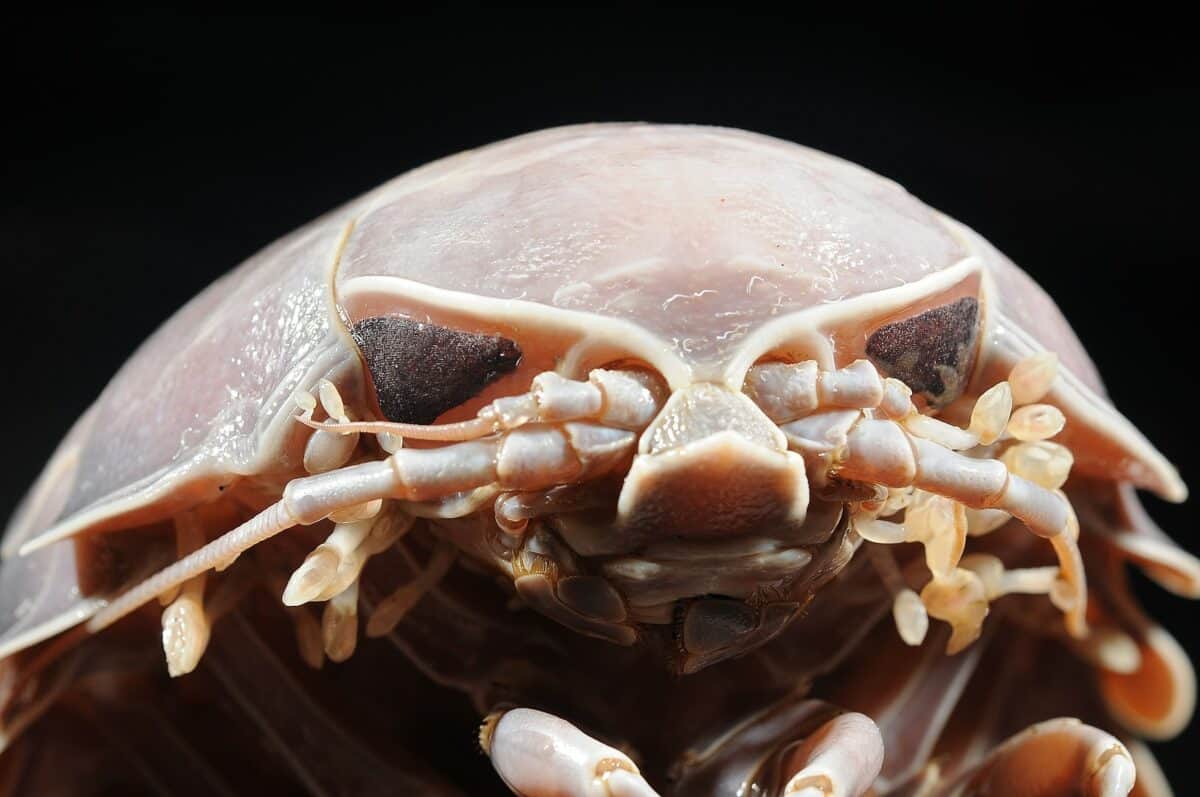
The giant isopod (Bathynomus giganteus) represents one of the most striking examples of deep-sea gigantism—the tendency for some crustaceans and other arthropods to grow to much larger sizes in the deep ocean than their shallow-water relatives. While the pill bugs or roly-polies in your garden rarely exceed half an inch, their deep-sea cousins can reach lengths of over 16 inches and weigh up to 3.7 pounds. With their armored exoskeletons and multiple pairs of legs, giant isopods resemble prehistoric creatures, and indeed, their lineage has remained largely unchanged for over 160 million years.
These formidable scavengers play a crucial role in deep-sea ecosystems as part of nature’s cleanup crew. When large animals die and sink to the seafloor, giant isopods can detect the carcass from considerable distances, drawn by the scent of decaying flesh carried by ocean currents. Using their powerful mandibles, they tear through even tough skin and can consume so much food in one sitting that they double their body weight. This adaptation allows them to survive the feast-or-famine conditions of the deep sea, where meals are unpredictable. Giant isopods can go years without eating—specimens in aquariums have survived more than five years between meals. While primarily scavengers, they are opportunistic predators that will attack slow-moving creatures like sea cucumbers and sponges when carrion is unavailable.
The Anglerfish: The Ocean’s Most Famous Ambush Predator
Perhaps no deep-sea predator has captured the public imagination quite like the anglerfish, thanks to its appearance in films like “Finding Nemo” and countless nature documentaries. There are more than 200 species of anglerfish, but the females of the order Lophiiformes share the distinctive feature that makes them famous: a modified first dorsal spine that extends over the head, tipped with a bioluminescent lure. This natural fishing rod, called an illicium, contains bacteria that produce light through a chemical reaction. In the darkness of the deep ocean, this glowing lure attracts curious prey within striking distance of the anglerfish’s enormous, tooth-filled mouth.
The reproductive strategy of the deep-sea anglerfish ranks among the most extreme in the animal kingdom. The tiny male anglerfish, often less than an inch long, exists solely to find a female. Once he does, he bites into her skin and releases an enzyme that dissolves the point of contact, fusing their tissues. Over time, the male degenerates until nothing remains but his testes, which provide the female with a lifetime supply of sperm. Some female anglerfish have been found with multiple males attached to their bodies, essentially becoming self-contained reproductive collectives. This bizarre arrangement ensures reproductive success in the vast darkness of the deep ocean, where encountering a mate of the same species could otherwise be nearly impossible. The anglerfish’s body is designed for efficiency rather than speed, with loose, scaleless skin and a lax bone structure that conserves energy in an environment where food is scarce.
The Viperfish: Deadly Beauty of the Twilight Zone

The viperfish (Chauliodus sloani) embodies the terrifying elegance that evolution can produce under extreme conditions. Its most prominent features are its needle-like teeth, which are so long that they won’t fit inside the mouth. Instead, they curve back toward the eyes, giving the viperfish its signature fearsome appearance. These fangs, some of the largest proportional to body size in the animal kingdom, are connected to the skull by a hinge mechanism that allows them to fold in when the mouth closes, preventing self-impalement. The first vertebra behind the viperfish’s head is actually modified to act as a shock absorber when it strikes prey, preventing whiplash injuries to its own spine.
The viperfish is a master of bioluminescence, using light in multiple sophisticated ways. Along its sides runs a series of photophores (light-producing organs) that can flash in patterns thought to confuse predators, communicate with potential mates, or possibly even illuminate prey. Like the anglerfish, the viperfish also possesses a modified dorsal fin ray that extends forward over its head, tipped with a light organ that serves as a lure. This deep-sea hunter employs a unique hunting strategy, remaining motionless in the water column until prey approaches, then using its large pelvic muscles to lunge forward with extraordinary speed. The viperfish is also known to perform daily vertical migrations, moving from depths of 5,000 feet during the day to as shallow as 600 feet at night to follow the movement of its preferred prey—smaller fish and crustaceans that themselves follow the daily migration of plankton.
The Gulper Eel: A Living Vacuum Cleaner

The gulper eel (Eurypharynx pelecanoides), also known as the pelican eel, demonstrates how deep-sea evolution can produce body plans that seem to defy physical limitations. Despite reaching lengths of up to six feet, this creature is primarily composed of a massive mouth attached to a relatively tiny body with a whip-like tail. The mouth is perhaps the most disproportionate in the animal kingdom, supported by jaw joints that are exceptionally loose, allowing it to open wide enough to consume prey larger than the eel itself. When not extended, this enormous mouth folds like an accordion along the underside of the body.
Unlike many deep-sea predators that are specialized for particular prey, the gulper eel has evolved a generalist feeding strategy that capitalizes on whatever food becomes available in the nutrient-poor depths. When it encounters a potential meal, it can rapidly expand its mouth by inflating a special sac on its lower jaw, creating a balloon-like net that engulfs a volume of water containing prey. As the mouth closes, the water is forced out through the gill openings while the food remains trapped inside. The gulper eel’s tiny eyes provide limited vision, so it relies primarily on a sensitive lateral line system to detect movement in the water. Perhaps its most unusual feature is its tail, which ends in a complex light-producing organ. Scientists believe this luminous tip may serve as a lure to attract prey, similar to an anglerfish’s illicium, but positioned at the opposite end of the body—a remarkable example of convergent evolution in the deep-sea environment.
The Frilled Shark: Ancient Predator with Serpentine Grace

Often described as a “living fossil,” the frilled shark (Chlamydoselachus anguineus) has changed little in appearance from ancestors that swam the oceans during the time of the dinosaurs over 80 million years ago. With its elongated, eel-like body and unusual arrangement of 300 trident-shaped teeth aligned in 25 rows, this deep-sea predator evokes images of mythical sea serpents. Its name derives from the frilly appearance of its six gill slits, which form a distinctive collar around its neck. Unlike most sharks that have five gill slits positioned on the sides of their heads, the frilled shark’s gills extend almost completely around the circumference of its body.
The hunting strategy of the frilled shark represents a specialized adaptation to deep-sea conditions. Moving through the water with sinuous, snake-like motions, it can strike with surprising speed, bending its body into a tense curve before lunging forward to capture prey. Its unusual dentition functions like rows of backward-facing barbs, making it nearly impossible for captured prey to escape. Research suggests that the frilled shark may be an ambush predator that can hover nearly motionless in the water column until suitable prey approaches. Typically inhabiting depths between 1,600 and 3,300 feet, these sharks occasionally venture into shallower waters, particularly during winter months in some regions. Female frilled sharks have one of the longest gestation periods known among vertebrates, carrying their developing young for up to three and a half years before giving birth to live offspring—an extreme reproductive investment that reflects the challenges of ensuring survival in the deep ocean.
The Giant Squid and Colossal Squid: Titans of the Deep
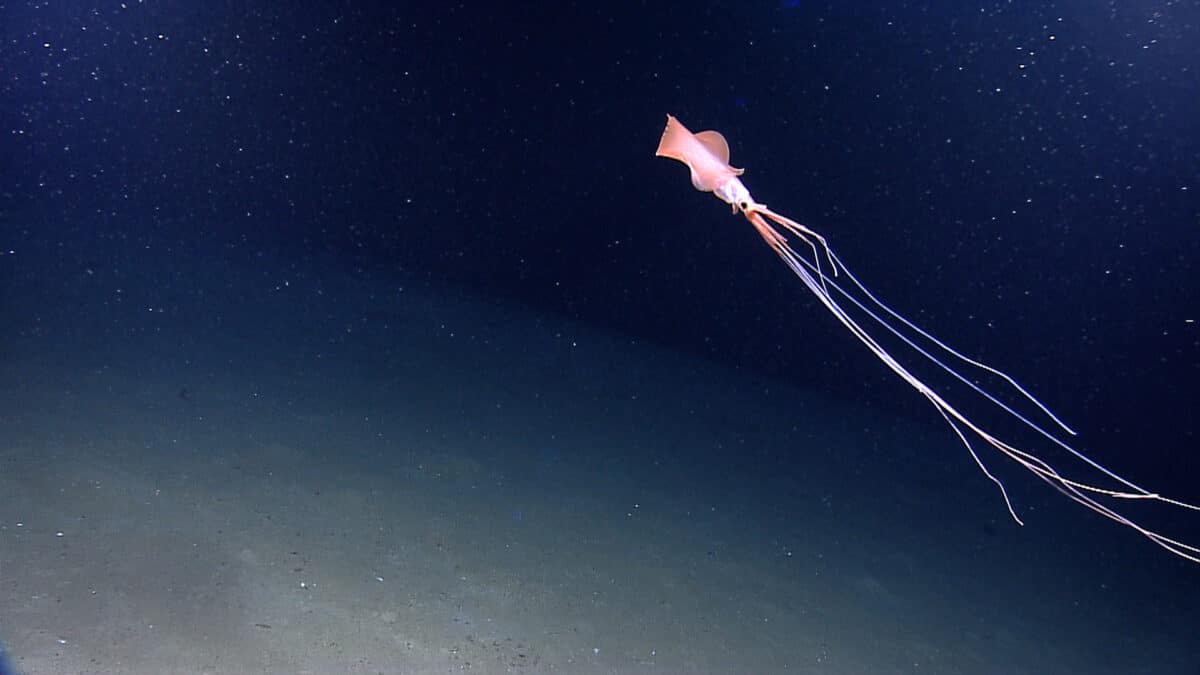
For centuries, these massive cephalopods existed primarily in sailors’ tales and maritime legends, described as kraken capable of dragging ships beneath the waves. Today, we know that while the giant squid (Architeuthis dux) and colossal squid (Mesonychoteuthis hamiltoni) don’t quite match those mythological proportions, they remain among the most awe-inspiring and elusive creatures in the ocean’s depths. The giant squid can grow up to 13 meters (43 feet) long, with eyes the size of dinner plates and tentacles lined with suction cups bearing razor-sharp rings. The colossal squid, while typically shorter, is far bulkier and more heavily armed, equipped with swiveling hooks on its limbs and a beak capable of slicing through prey with terrifying efficiency. Both species are rarely seen alive, living in the twilight and midnight zones of the ocean, where pressure is crushing and sunlight never penetrates.
Despite advances in deep-sea exploration, much about these titans remains a mystery. Most of what scientists know comes from specimens found in sperm whale stomachs or washed up on remote shores. Their physiology challenges our understanding of life in extreme environments, from their ammonia-filled bodies that help with buoyancy to their immense neurological structures. As technology allows us to peer deeper into the ocean than ever before, each new glimpse of these creatures fuels our fascination and reminds us just how little we know about the hidden ecosystems of the abyss.
Conclusion: Mysteries of the Deep Sea
In the cold, lightless expanse of the deep sea, evolution has crafted predators that defy imagination—creatures with transparent heads, extendable jaws, bioluminescent lures, and nightmarish appendages. These bizarre hunters, from the anglerfish and gulper eel to the vampire squid and fangtooth, showcase the astonishing diversity of life that thrives under immense pressure and in total darkness. Their grotesque yet perfectly adapted forms remind us that survival in such an extreme environment demands innovation far beyond what surface-dwelling species require.
As deep-sea exploration technology improves, we’re only just beginning to uncover the secrets of these alien worlds. Each strange predator we discover challenges our understanding of biology and expands the boundaries of what we consider possible. In their eerie beauty and brutal efficiency, these animals offer a glimpse into Earth’s final frontier—a realm where life has taken paths more twisted, fascinating, and unexpected than any science fiction could imagine.
Worried about unexpected vet bills?
Pet insurance can cover thousands in unexpected vet costs. Get a free quote from Lemonade in under 2 minutes.
Get My Free Quote →Sponsored · Opens Lemonade.com

From exploring the marine wonders in the Azores and witnessing the vast savannas of Kenya, to delving deep into the rich biodiversity of South Africa and traversing iconic landscapes in Australia and the US like Yellowstone, Chris's experiences are vast.
With a penchant for diving alongside sharks, the ocean holds a special place in his heart.
Through his academic insights, he champions wildlife conservation, striving with 'Animals Around The Globe' to cultivate a profound connection between humans and animals, enhancing our mutual appreciation.
Connect with him at Feedback@animalsaroundtheglobe.com.
- 10 Animals with the Craziest Defensive Mechanisms in the Wild - June 10, 2026
- The Most Magical Forests to See Orangutans in the Wild - June 10, 2026
- 12 Creatures That Only Live in the American Southwest - June 10, 2026