

In the vast, unforgiving landscapes of Earth’s polar regions, where temperatures plummet to unimaginable lows and blizzards can rage for days, a remarkable partnership emerged that would define the golden age of polar exploration. The bond between polar explorers and their sled dogs represents one of history’s most profound examples of human-animal cooperation, born of necessity but evolving into something far deeper. These canine companions weren’t merely tools of transportation—they became lifelines, emotional anchors, and in many cases, the difference between an expedition’s success and its tragic failure. From Roald Amundsen’s methodical reliance on dog teams to reach the South Pole to Fridtjof Nansen’s emotional attachments to his faithful companions during years trapped in Arctic ice, the stories of these relationships reveal as much about human nature as they do about the remarkable capabilities of dogs in extreme environments.
The Origins of Dogs in Polar Exploration

The use of dogs for polar travel wasn’t an innovation of Western explorers but rather knowledge borrowed from indigenous Arctic peoples who had perfected the practice over thousands of years. Inuit, Yupik, Chukchi, and other northern communities had long relied on dogs for hunting, transportation, and protection—developing specialized breeding practices that produced animals uniquely adapted to Arctic conditions. These dogs possessed thick double coats that insulated against temperatures as low as -60°F, broad paws that distributed weight over snow, and remarkable metabolic efficiency that allowed them to convert seal fat and other high-calorie foods into sustained energy.
When European and North American explorers began serious attempts to reach the poles in the late 19th century, they quickly recognized the superiority of dog teams over other transportation methods. Early expeditions that relied solely on human power, like the ill-fated 1845 Franklin Expedition, often ended in disaster. By contrast, explorers who adopted indigenous knowledge—purchasing dogs from Greenlandic or Siberian communities and learning their handling techniques—gained a critical advantage. Norwegian explorer Fridtjof Nansen’s 1893-1896 Fram expedition marked a turning point, as his successful use of dog sleds demonstrated their effectiveness for long-distance polar travel and inspired a generation of explorers who would follow his methods.
Breeds That Made History

While modern sled dog races like the Iditarod have popularized breeds such as the Alaskan Husky and Siberian Husky, historic polar expeditions relied on working dogs with diverse origins. The Greenland Dog (also known as the Greenland Husky) played a crucial role in many Arctic and Antarctic expeditions. These powerful animals, bred by the Inuit for centuries, possessed incredible stamina and cold resistance. Roald Amundsen specifically chose Greenland Dogs for his successful South Pole expedition, believing their temperament and physical capabilities made them ideal for Antarctic conditions. Canadian Arctic Inuit Dogs (now recognized as Canadian Eskimo Dogs) were similarly valued for their strength and endurance in extreme conditions.
Siberian Huskies gained international recognition after Norwegian-born musher Leonhard Seppala used them in the famous 1925 serum run to Nome, Alaska—delivering diphtheria antitoxin across nearly 700 miles of Alaskan wilderness. Though this wasn’t a polar expedition per se, it demonstrated the breed’s exceptional capabilities. Robert Falcon Scott’s ill-fated Terra Nova Expedition (1910-1913) primarily used Siberian ponies rather than dogs—a decision many historians believe contributed to the expedition’s tragic outcome. By contrast, Ernest Shackleton’s Imperial Trans-Antarctic Expedition utilized a mix of breeds, including Eskimo Dogs and Samoyeds, though famously, these animals met a tragic end when food shortages forced difficult decisions.
The Science of Survival: Canine Adaptations to Polar Environments

The survival of sled dogs in polar environments represents one of nature’s most remarkable adaptations, enhanced through generations of selective breeding. Physiologically, these dogs possess unique traits that allow them to thrive where most mammals would perish. Their double-layered coats combine a dense, woolly undercoat with longer guard hairs, creating insulation so effective that these dogs can sleep comfortably on ice at temperatures of -40°F. Their metabolism shifts dramatically in cold conditions, allowing them to generate tremendous internal heat while burning fat reserves efficiently—a crucial adaptation when food supplies became limited during extended expeditions.
Equally important are these dogs’ cardiovascular adaptations. Research has shown that sled dogs can increase their heart output by up to 40% during exertion without corresponding increases in blood pressure, allowing sustained performance over incredible distances. Their paws contain specialized circulation systems that prevent freezing through countercurrent heat exchange, while specialized fat deposits provide additional insulation. Polar explorers quickly learned to trust these biological advantages, with Roald Amundsen noting in his journals that his dogs could endure conditions that left human expedition members in severe distress, writing: “The dogs seemed indifferent to the cold, even sleeping outside during blizzards that kept us confined to our tents.”
The Practical Role: Transportation and Survival

The primary function of dogs on polar expeditions was transportation, where their capabilities far exceeded other options available to early explorers. A well-conditioned dog team could pull sleds for 20-30 miles daily across challenging terrain while carrying loads of 75-100 pounds per dog. This efficiency transformed what was possible in polar exploration. Amundsen’s successful South Pole expedition in 1911 covered the final 679 miles to the pole in just 49 days using dog teams, averaging nearly 14 miles daily in the harshest conditions imaginable. By comparison, Scott’s competing expedition, which relied more heavily on man-hauling after their motorized sledges failed, managed only about 7-8 miles daily, contributing to their eventual tragedy.
Beyond transportation, dogs served critical survival functions. Their acute senses could detect dangerous thin ice or approaching storms before humans noticed any warning signs. Many explorers documented instances where dogs refused to cross seemingly solid terrain, only for investigation to reveal hidden crevasses that could have swallowed the entire team. Dogs also provided protection from wildlife—particularly polar bears in the Arctic—and served as living emergency food supplies in the most desperate circumstances. Frederick Cook’s controversial 1908 Arctic expedition and Amundsen’s South Pole journey both planned strategically to slaughter weaker dogs as the expedition progressed, feeding their meat to remaining team members—both human and canine—a practice that, while ethically troubling to modern sensibilities, reflected the brutal realities of survival in polar regions.
The Emotional Bond: Beyond Working Animals

What began as purely practical relationships often developed into profound emotional connections that sustained explorers through the psychological challenges of polar isolation. Diaries and accounts from numerous expeditions reveal the deep attachments formed between men and dogs during months or years in the most isolated environments on Earth. Fridtjof Nansen wrote extensively about his favorite dogs during the Fram expedition, particularly noting one named Kvik: “He was my friend and comrade for more than two years, faithful and enduring, demanding no reward save the touch of my hand.” Similarly, members of Douglas Mawson’s Australasian Antarctic Expedition (1911-1914) documented their growing emotional reliance on their sled dogs, with descriptions of sharing tent space during the worst storms and finding comfort in their presence during the perpetual darkness of polar winter.
These bonds became especially evident when dogs were lost. When Ernest Shackleton’s ship Endurance was crushed in Antarctic ice in 1915, the heartbreaking decision to shoot the expedition’s dogs (as they couldn’t be accommodated in the small lifeboats) was recorded as one of the most emotionally devastating moments for the crew. Frank Wild, Shackleton’s second-in-command, was tasked with shooting his own dog team and later wrote that it was “the worst job I had ever been asked to do.” The psychological impact of these animals extended beyond companionship—they provided a sense of normalcy and routine in environments where human psychology was tested to its limits. Daily feeding, harnessing, and caring for dogs gave structure to expedition life and created a sense of purpose beyond mere survival.
Amundsen’s Approach: The Norwegian Method

Roald Amundsen’s relationship with his sled dogs represents perhaps the most successful implementation of dog-powered exploration in polar history. His Norwegian approach, informed by years studying with indigenous Arctic peoples, viewed dogs as the centerpiece of expedition strategy rather than just one component. Before his famous South Pole expedition, Amundsen spent significant time with Netsilik Inuit in the Canadian Arctic, learning not just driving techniques but holistic dog care—from harness design to feeding protocols. He selected 97 Greenland Dogs for his Antarctic journey based on specific criteria: medium-sized animals with proven endurance, calm temperaments, and robust appetites. His journals detail meticulous attention to their diet, including carefully calculated portions of dried fish, seal blubber, and pemmican designed to maintain optimal energy levels.
Amundsen’s success where others failed stemmed partly from his willingness to adopt indigenous knowledge without Western modifications. Unlike Scott, who viewed dogs as somewhat crude transportation compared to motorized options, Amundsen embraced their use fully. He implemented the controversial but effective indigenous practice of using some dogs as food for others as the expedition progressed, starting with nearly 100 dogs and returning with just 11. This strategy, while difficult for many expedition members, enabled fast travel with progressively lighter loads. By the time Amundsen’s team reached the South Pole on December 14, 1911, they had traveled faster and more efficiently than any previous polar expedition, largely due to his comprehensive understanding of dog handling. As he wrote, “Our victory is due solely to our dogs, the faithful, capable animals who made our progress possible under the most difficult conditions imaginable.”
Scott’s Tragedy: The British Approach and Its Consequences

The contrast between Amundsen’s success and Robert Falcon Scott’s fatal 1910-1913 Terra Nova Expedition illustrates the consequences of different approaches to expedition dogs. Scott’s relationship with sled dogs was complicated by British cultural attitudes and his military background, which emphasized human effort and technological solutions over indigenous knowledge. While Scott did include dogs in his expedition plan, he placed greater faith in motorized sledges and Siberian ponies. The 33 dogs he brought to Antarctica were underutilized and often mishandled, with British expedition members having limited experience in dog driving techniques. Scott’s journals reveal frustration with the animals’ performance, not recognizing that poor results stemmed largely from improper care and handling rather than inherent limitations of the dogs themselves.
The consequences proved fatal. When Scott’s motorized sledges failed early in the journey and the ponies couldn’t tolerate Antarctic conditions, his team was forced to man-haul their heavy sledges—physically dragging supplies themselves across hundreds of miles of ice and snow. This exhausting work depleted their energy reserves and extended their journey time, ultimately leaving them caught in deteriorating weather conditions. Scott’s final diary entries, found with his frozen body eight months after his death, reflect a dawning recognition of Amundsen’s superior approach: “No doubt we are weaker, in point of fact. We did not calculate on this. The Norwegians have had it all their own way… We are beaten by their dogs.” This tragic outcome fundamentally changed future polar exploration, with subsequent expeditions almost universally adopting Amundsen’s dog-centered methods until the technological advancements of the mid-20th century.
Shackleton and the Endurance: Loyalty in Crisis

Ernest Shackleton’s relationship with expedition dogs during the Imperial Trans-Antarctic Expedition (1914-1917) reveals how these animals became central to crew morale during crisis situations. When his ship Endurance became trapped in pack ice in the Weddell Sea, ultimately being crushed and sinking, the expedition’s 69 dogs became vital emotional supports during months living on ice floes. Shackleton, recognizing their psychological importance, established regular dog racing events and pulling competitions to maintain morale. Each team member was assigned responsibility for specific dogs, creating personal bonds that helped combat depression and hopelessness as their situation grew increasingly dire.
The expedition photographer Frank Hurley captured numerous images showing expedition members playing with, caring for, and sleeping alongside their dogs—visual evidence of relationships that transcended mere utility. When the ice began breaking up in April 1915, forcing the men to relocate to small lifeboats, Shackleton faced perhaps the most agonizing decision of the expedition. The dogs could not be accommodated in the overcrowded boats, and after careful deliberation, he ordered them humanely shot rather than abandoning them to slow starvation on the ice. In his book “South,” Shackleton described this as “heartbreaking work,” noting that many crew members couldn’t bear to watch. The depth of attachment is perhaps best illustrated by expedition member Thomas Orde-Lees, who wrote in his diary: “It was awful to see them looking at us with such trust and devotion, while we knew in our hearts that they were about to be killed for our benefit. Some of them seemed to know what was coming.”
Byrd’s Antarctic Expeditions: The Transition Era
Richard E. Byrd’s multiple Antarctic expeditions from 1928 through the 1950s represent a transition period in the relationship between polar explorers and their dogs. Byrd combined traditional dog sledding with emerging technologies like aircraft, mechanized vehicles, and radio communications. His first Antarctic expedition (1928-1930) included 94 dogs, primarily Siberian Huskies and Alaskan Malamutes, alongside the first aircraft used in Antarctica. This hybrid approach created a unique dynamic where dogs remained essential for ground transportation and safety, while technology expanded the expedition’s range and capabilities. Byrd’s personal attachment to the dogs is evident throughout his writings, particularly his fondness for a lead dog named Chinook who disappeared during the first expedition—an event Byrd described as “like losing one of the men.”
Byrd’s later expeditions progressively incorporated more technology but continued to rely on dog teams for critical functions. During Operation Highjump (1946-1947), one of the largest Antarctic expeditions ever mounted, dogs were still deployed alongside helicopters, planes, and snowcats. The expedition’s records show that dogs remained irreplaceable for certain tasks, particularly navigating crevasse fields too dangerous for vehicles. Byrd’s expeditions documented this transitional era when the ancient partnership between humans and dogs in polar regions began yielding to technology—though never completely. His dog handlers, many veterans of multiple polar journeys, maintained the traditions of careful breeding, training, and handling developed over centuries while adapting to incorporate new technological capabilities, creating a bridge between traditional methods and modern polar exploration.
The Ethics Debate: Changing Attitudes Toward Expedition Dogs

The treatment of dogs on polar expeditions has become subject to evolving ethical scrutiny as cultural attitudes toward animals have changed. Early expeditions routinely practiced culling weaker dogs to feed stronger team members and humans—a practice inherited from indigenous Arctic cultures where pragmatic survival decisions were necessitated by the harsh environment. Amundsen’s successful South Pole expedition began with 97 dogs and returned with only 11, the others having been slaughtered along the journey. While shocking to modern sensibilities, this approach reflected the life-or-death realities of early polar exploration and the cultural context of the time, when working animals were viewed primarily as tools rather than companions.
Attitudes began shifting noticeably by mid-century. The British Commonwealth Trans-Antarctic Expedition (1955-1958), led by Vivian Fuchs and Edmund Hillary, still used dog teams extensively but incorporated improved care protocols and made efforts to return dogs safely rather than viewing them as expendable resources. By the 1980s and 1990s, environmental concerns led to significant policy changes. The Antarctic Treaty’s Protocol on Environmental Protection, implemented in 1991, included provisions that effectively banned dogs from Antarctica by 1994, citing concerns about disease transmission to native wildlife and changing ethical standards regarding animal treatment. While scientifically justified, this decision marked the end of a centuries-old partnership in Antarctic exploration. Today’s polar researchers, working from established bases with helicopter and snowmobile support, maintain a fundamentally different relationship with the polar environment than their predecessors who relied on the unique capabilities and companionship of sled dogs.
Modern Legacies: From Working Partners to Cultural Icons

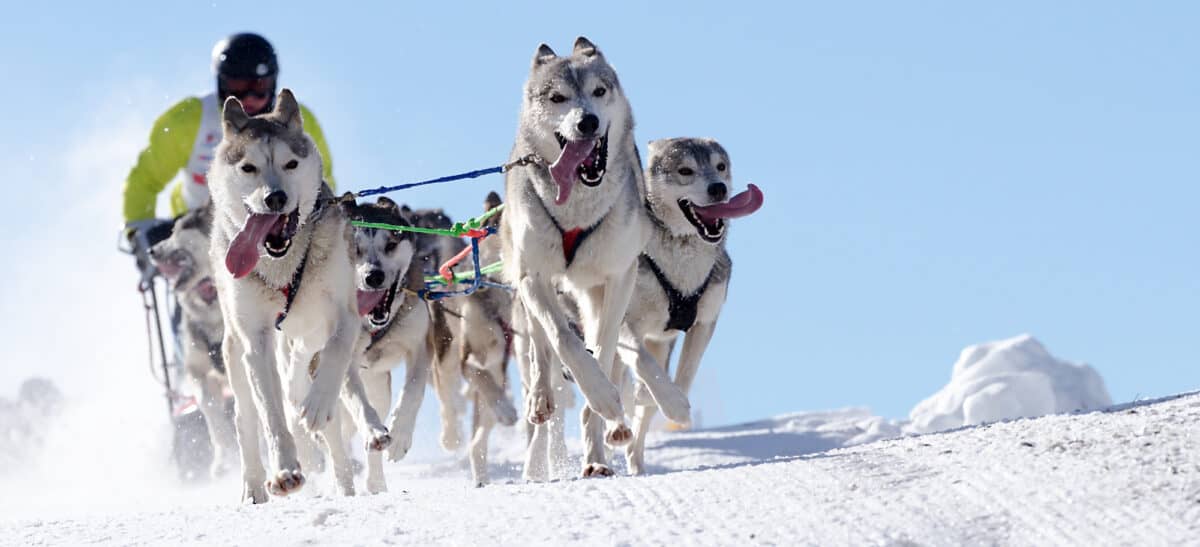
Though no longer central to polar exploration, sled dogs and their historic partnership with explorers have left an enduring cultural legacy. Competitive events like the Iditarod Trail Sled Dog Race honor the resilience, strength, and loyalty of these remarkable animals. The Iditarod, which traces part of the historic mail and supply routes across the Alaskan wilderness, serves not only as a grueling sporting event but also as a tribute to the vital role sled dogs played in survival and transportation in the Arctic. Their ability to endure harsh conditions and work as a cohesive team exemplifies the deep bond between humans and animals forged in some of the planet’s most unforgiving environments.

- 10 Animals That Cheat Death in the Most Unexpected Ways - July 19, 2026
- The Shrimp That Punches Like a Bullet - July 19, 2026
- This Tiny Mammal Can Slow Its Heartbeat to One Beat Per Minute - July 19, 2026