

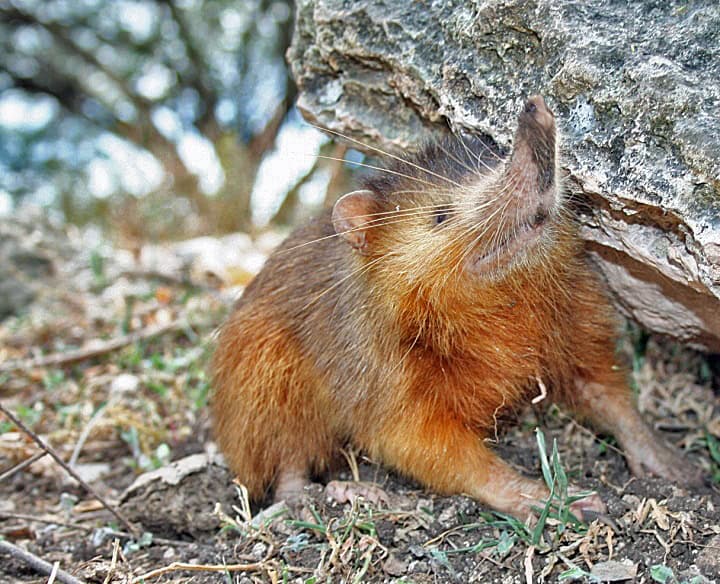
In the depths of Southeast Asian rainforests dwells an extraordinary creature with a record-breaking anatomical feature—fangs that are proportionally the longest of any mammal on Earth. The gaboon viper? The saber-toothed tiger? Neither. Meet the extraordinary gaboon viper? The walrus? Neither. The remarkable solenodons—small, shrew-like mammals that have been roaming our planet since the time of dinosaurs. These ancient creatures possess fangs so long that they can be up to 4.5 inches in length, which, compared to their body size, makes them the proportionally longest in the animal kingdom. Yet, despite this fearsome appearance, these creatures use their impressive dental equipment not to attack or defend, but with surprising dexterity—like a pair of precise tweezers for capturing their insect prey. This fascinating dichotomy between formidable appearance and delicate function makes solenodons one of nature’s most intriguing paradoxes.
Meet the Solenodons: Living Fossils with Extraordinary Dentition

Solenodons (genus Solenodon) are nocturnal, burrowing mammals native to the Caribbean islands, specifically Cuba and Hispaniola (shared by Haiti and the Dominican Republic). With their existence dating back at least 76 million years, these creatures have earned the title of “living fossils.” They survived the mass extinction event that wiped out the dinosaurs and have remained relatively unchanged since the Cretaceous period. There are only two surviving species: the Hispaniolan solenodon (Solenodon paradoxus) and the Cuban solenodon (Solenodon cubanus), both critically endangered due to habitat loss and the introduction of predators like cats, dogs, and mongooses.
What makes solenodons truly extraordinary is their dental architecture. Their second lower incisors feature a deep groove that channels venom from modified salivary glands—a trait extremely rare among mammals. These specialized teeth, which give them their name (from Greek “solen” meaning channel and “odon” meaning tooth), project forward from their elongated snouts and can reach proportional lengths unmatched in the mammalian world. Despite their primitive appearance, with their long, flexible snouts, scaly tails, and tiny eyes, solenodons have evolved one of the most specialized feeding adaptations in the animal kingdom.
The Record-Breaking Dental Phenomenon

Solenodons possess fangs that are proportionally the longest of any mammal, with the Hispaniolan solenodon’s fangs measuring up to 4.5 inches in length. This is particularly impressive considering the animal’s body is only about 12 inches long, not including the tail. If humans had teeth in the same proportion, our incisors would extend well past our chins! These elongated teeth evolved not as weapons of aggression, but as highly specialized tools for feeding. The fangs are narrow, slightly curved, and remarkably strong for their size, allowing the animals to probe into tight spaces where their insect prey might hide.
What makes these teeth even more remarkable is their internal structure. Unlike the solid fangs of snakes or the thick tusks of walruses, solenodon fangs contain a groove that runs along the inner surface—a biological innovation that serves as a delivery system for their venom. This groove effectively turns the tooth into a natural hypodermic needle, enabling the precise injection of venom into prey. This unique dental adaptation represents an evolutionary path distinct from other venomous vertebrates and highlights the diverse ways that natural selection can solve the challenge of subduing prey.
Venomous Saliva: A Rare Trait Among Mammals

Solenodons belong to an exclusive club of venomous mammals that includes just a handful of species worldwide. Their modified submaxillary glands produce a neurotoxic venom delivered through the grooved canals in their lower incisors. When a solenodon bites, the venom flows along these channels and into the wound, similar to how a doctor’s syringe delivers medicine. This venom isn’t lethal to humans but causes painful swelling and can be fatal to the small invertebrates that make up their diet. The chemical composition of solenodon venom includes proteins that disrupt nerve function and can induce paralysis in small animals.
What makes this venomous adaptation particularly fascinating is its evolutionary history. While most venomous animals—such as snakes, spiders, and scorpions—belong to relatively recent evolutionary lineages, solenodons represent one of the oldest venomous mammal lineages still in existence. Their venom delivery system evolved independently from other venomous mammals like the platypus and certain shrews, representing a remarkable case of convergent evolution. Scientists studying solenodon venom are discovering compounds that may have applications in medical research, potentially leading to new treatments for pain management and neurological disorders.
The Tweezers Technique: How Solenodons Hunt

Despite their intimidating fangs and venomous capabilities, solenodons employ their impressive dental equipment with surprising delicacy. Their hunting technique resembles someone using precision tweezers rather than weapons of aggression. Under the cover of darkness, these nocturnal hunters use their elongated, flexible snouts to probe leaf litter, soil, and rotting logs for prey. Their poor eyesight is compensated by an acute sense of smell and touch, with their snouts covered in sensitive whiskers and tactile receptors that help them detect the slightest movements of potential meals.
When a solenodon locates prey—typically insects, worms, small reptiles, or amphibians—it uses its fangs with remarkable precision. Rather than a aggressive striking motion seen in snakes, the solenodon gently grasps its prey between its specialized incisors, holding it firmly but delicately. The venom flows down the grooved canals, quickly subduing the prey without damaging it. This precision “tweezer technique” allows solenodons to capture and consume small, fast-moving prey that might otherwise escape, while minimizing energy expenditure—a crucial adaptation for a creature with a high metabolic rate that must eat constantly to survive.
Evolutionary History: Outliving the Dinosaurs

The evolutionary history of solenodons reads like a survival saga spanning millions of years. These remarkable mammals belong to the order Eulipotyphla (formerly Insectivora), which includes shrews, moles, and hedgehogs. However, solenodons diverged from their closest relatives approximately 76 million years ago during the Late Cretaceous period when dinosaurs still dominated the landscape. This makes them one of the most ancient mammal lineages still in existence today. Their survival through the Cretaceous-Paleogene extinction event that wiped out the dinosaurs 66 million years ago testifies to their remarkable adaptability.
Geographic isolation played a crucial role in their evolution. Scientists believe that solenodons reached the Caribbean islands when these landmasses were still connected to the North American continent, before tectonic movements separated them. This isolation protected them from competition with more advanced mammalian predators that evolved on the mainland, creating an evolutionary sanctuary that allowed these living fossils to persist virtually unchanged for tens of millions of years. The lack of natural predators and competitors in their island habitats allowed solenodons to occupy ecological niches that would be fiercely contested in mainland environments, enabling their unusual adaptations—including their specialized dentition—to develop and persist.
Physical Characteristics Beyond the Famous Fangs

While their extraordinary fangs often steal the spotlight, solenodons possess numerous other fascinating physical characteristics. They typically weigh between 1-2 pounds (0.5-1 kg) and measure about 12 inches (30 cm) in body length, with an additional 8-10 inches (20-25 cm) of tail. Their bodies are covered in coarse, reddish-brown to blackish fur that provides camouflage in their forest habitats. Their long, nearly naked tails serve as sensory organs and help with balance when navigating through the undergrowth. Perhaps most peculiar is the location of their teats—female solenodons have their mammary glands positioned near their buttocks rather than on their abdomen like most mammals.
Solenodons’ limbs reveal their ancient lineage, with five-toed feet ending in strong claws adapted for digging. They possess a unique ball-and-socket joint at their snout base, allowing extraordinary flexibility when probing for food. Their eyes are tiny and nearly functionless, reflecting their primarily nocturnal and subterranean lifestyle where vision offers little advantage. Their ears, though small, provide excellent hearing, which complements their acute sense of smell. Another unusual feature is their specialized hip joints that allow them to move with a side-to-side gait rather than the more typical forward motion seen in most mammals—a characteristic that contributes to their somewhat awkward, ancient-looking movement pattern.
Ecological Role: Nature’s Pest Controllers

Solenodons serve as important ecosystem engineers in their native habitats. As voracious insectivores, they help control populations of potentially harmful insects and other invertebrates that might otherwise reach pest proportions. A single solenodon can consume a significant percentage of its body weight in insects each night, making them natural pest controllers that help maintain ecological balance. Their burrowing activities also contribute to soil aeration and nutrient cycling, benefiting the forest ecosystem as a whole. By creating networks of tunnels, they inadvertently provide microhabitats for other small creatures and help with water infiltration during heavy Caribbean rains.
Their position in the food web is particularly significant given the limited number of native mammalian predators in Caribbean island ecosystems. Before human colonization brought invasive species, solenodons occupied a specialized niche with few competitors. Their nocturnal habits and insectivorous diet meant they rarely competed directly with birds or reptiles that hunted during daylight hours. This ecological specialization allowed them to persist for millions of years, maintaining healthy forest ecosystems through their predation on invertebrates. The decline of solenodon populations has likely contributed to ecological imbalances, including potential increases in certain insect populations that would normally be kept in check by these unique predators.
Conservation Status: On the Brink of Extinction

Both surviving solenodon species face a precarious future. The Hispaniolan solenodon is classified as Endangered on the IUCN Red List, while the Cuban solenodon is listed as Critically Endangered and was even thought extinct until rediscovered in the 1970s. Their population decline is primarily attributed to habitat destruction through deforestation and the introduction of invasive predators like cats, dogs, and mongooses, which the slow-moving solenodons have no natural defenses against. Climate change poses an additional threat, as it alters the Caribbean forest ecosystems these specialized creatures depend on. Their slow reproductive rate—typically producing only one or two litters of 1-3 young per year—further hampers their ability to recover from population declines.
Conservation efforts for solenodons face significant challenges. Their nocturnal, secretive nature makes population assessment difficult, and their specialized habitat requirements complicate captive breeding programs. Nevertheless, organizations like the Durrell Wildlife Conservation Trust and the Solenodon Conservation Project are working to protect remaining solenodon populations through habitat preservation, predator control, and public education campaigns. Research initiatives are also underway to better understand solenodon ecology, behavior, and genetics to inform conservation strategies. These efforts represent our best hope for ensuring that these remarkable living fossils, with their record-breaking fangs and unique evolutionary history, survive for future generations to appreciate.
Behavioral Quirks: Nocturnal Oddities

Solenodons display a range of peculiar behavioral traits that make them as behaviorally unique as they are physically distinctive. They are primarily solitary creatures, coming together only briefly for mating. Their social structure revolves around loosely defined territories marked with scent glands located near their anus. Perhaps their most curious behavior is their awkward movement—despite being mammals that have existed for millions of years, solenodons never quite mastered the art of graceful locomotion. They move with a slow, ungainly waddle and are known to trip over their own feet, making them easy targets for introduced predators.
Their vocalizations add another layer of peculiarity to their behavioral profile. Solenodons communicate through a repertoire of squeaks, clicks, and high-pitched calls that resemble a blend of bird chirps and insect sounds. When frightened, they may emit a strong musky odor from their scent glands as a defensive mechanism. Another unusual behavioral adaptation is their sleep pattern—they don’t follow the typical mammalian sleep cycle but instead take multiple short naps throughout the day in their underground burrows. This irregular sleep pattern allows them to maximize feeding opportunities while minimizing exposure to potential predators, representing yet another unique adaptation that has helped these ancient mammals survive across geological epochs.
Scientific Significance: What Solenodons Teach Us

The scientific value of solenodons extends far beyond their curiosity factor. As living fossils that have changed little over tens of millions of years, they provide a rare window into mammalian evolution during the time of dinosaurs. Their venomous nature offers unique research opportunities—scientists studying solenodon venom have identified novel compounds with potential applications in medicine, particularly for treating cardiovascular diseases and pain management. The grooved dental system that delivers this venom has also inspired biomedical engineers developing new injection systems and drug delivery mechanisms.
Genomic studies of solenodons have revealed insights into mammalian adaptations to island environments and the genetic basis for venom production in mammals. Their long isolation on Caribbean islands makes them excellent subjects for studying evolutionary processes like genetic drift and adaptive radiation. Additionally, solenodons’ responses to environmental changes offer valuable data for conservation biologists developing strategies to protect other endangered species. Perhaps most importantly, the very existence of these ancient mammals—with their primitive features alongside highly specialized adaptations like venomous fangs used with tweezer-like precision—challenges our understanding of evolutionary “success” and reminds us that survival doesn’t always favor the most advanced or aggressive species, but often those that develop highly specialized adaptations to unique ecological niches.
Cultural Significance in Caribbean Communities

Throughout their native Caribbean range, solenodons have woven themselves into local folklore and cultural narratives. Indigenous Taíno people of Hispaniola incorporated solenodons into their mythology long before European contact. In Dominican and Haitian rural communities, solenodons feature in traditional stories, often portrayed as mysterious forest guardians or as symbols of the islands’ unique natural heritage. Local names for solenodons reflect their unusual characteristics—in the Dominican Republic, they’re sometimes called “juron” or “jumao,” while in Cuba, the local name “almiquí” has pre-Columbian origins. These cultural connections highlight the species’ importance beyond their biological significance.
In more recent times, solenodons have become symbols of conservation efforts in the Caribbean. Their images appear on postage stamps, currency, and educational materials throughout Cuba, Haiti, and the Dominican Republic. Conservation organizations have leveraged the cultural significance of these animals to promote environmental awareness and habitat protection. Local ecotourism initiatives, though limited due to the creatures’ rarity and nocturnal habits, have attempted to create economic incentives for protecting solenodon habitats. The potential loss of these culturally significant animals has sparked grassroots conservation movements, demonstrating how a species with unusual anatomical features—like record-breaking fangs used with tweezer-like precision—can become a powerful symbol for broader environmental protection in regions facing significant ecological challenges.
Conclusion: Nature’s Paradoxical Masterpiece

The solenodon stands as one of nature’s most fascinating paradoxes—a creature with the longest proportional fangs in the mammalian world that uses these fearsome tools with the delicacy of tweezers. Their survival from the age of dinosaurs to the present day represents one of evolution’s most remarkable success stories, demonstrating how specialized adaptations can ensure a species’ longevity even as more “advanced” creatures come and go. These living fossils, with their venomous bite, awkward gait, and primitive features, challenge our perceptions of evolutionary success and remind us that nature often favors the specialized over the generalized.
As solenodons face mounting threats to their existence, their potential loss would represent not just the disappearance of a single species, but the erasure of an entire evolutionary lineage that has persisted for tens of millions of years. Protecting the solenodon means preserving a unique chapter of Earth’s natural history—one that offers invaluable insight into mammalian evolution, island ecology, and the delicate balance of life in isolated ecosystems.
In a world where many species are vanishing before they are fully understood, the solenodon’s story calls us to action. Conservation efforts must prioritize habitat protection, invasive species control, and scientific research to ensure that this extraordinary creature continues to scurry through the forests of Hispaniola for generations to come. The solenodon is more than a biological curiosity; it is a symbol of life’s resilience, fragility, and the profound responsibility we bear as stewards of the planet’s ancient and irreplaceable wonders.

From exploring the marine wonders in the Azores and witnessing the vast savannas of Kenya, to delving deep into the rich biodiversity of South Africa and traversing iconic landscapes in Australia and the US like Yellowstone, Chris's experiences are vast.
With a penchant for diving alongside sharks, the ocean holds a special place in his heart.
Through his academic insights, he champions wildlife conservation, striving with 'Animals Around The Globe' to cultivate a profound connection between humans and animals, enhancing our mutual appreciation.
Connect with him at Feedback@animalsaroundtheglobe.com.
- Stunning Horse Breeds That Define Kentucky’s Equestrian Legacy - June 16, 2026
- The Phoenix: Firebird of Rebirth from Many Cultures - June 16, 2026
- The Best National Parks for Seeing Mountain Lions (If You’re Lucky) - June 16, 2026