

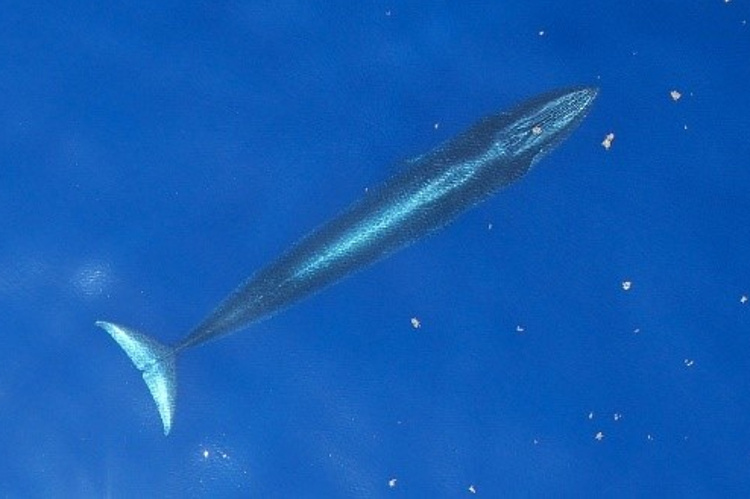
Just 50 Rice’s Whales Remain in a Shrinking World (Image Credits: Upload.wikimedia.org)
Gulf of Mexico – Federal officials recently granted a sweeping exemption to oil and gas activities, eliminating Endangered Species Act protections for the Rice’s whale and other imperiled marine life. The critically endangered cetacean, with a global population hovering around 50, now faces heightened risks from industrial operations in its sole habitat.[1][2] This unprecedented move by a little-known government committee underscores tensions between energy production and biodiversity conservation in one of the world’s busiest offshore drilling zones.
Just 50 Rice’s Whales Remain in a Shrinking World
Scientists identified the Rice’s whale as a distinct species only in 2021, distinguishing it from its Bryde’s whale relatives. Confined entirely to the Gulf of Mexico, these massive mammals – reaching lengths of 42 feet – rely on a narrow oceanic corridor for foraging on fish and krill. Their population plummeted after the 2010 Deepwater Horizon spill, which killed roughly one-fifth of known individuals.[1]
Today, aerial surveys and acoustic data confirm fewer than 50 survive, making them among the rarest whales globally. They cannot simply migrate elsewhere; their deep-water habitat ties them to this precise region, amplifying vulnerability to human activities. Ship strikes, seismic blasting, and entanglement already claim lives annually.
The ‘God Squad’ Delivers a Rare Verdict
The Endangered Species Committee – nicknamed the “God Squad” for its extinction-level authority – convened for the first time in 35 years on March 30, 2026. All seven members, including Trump administration appointees, voted unanimously to exempt Gulf oil and gas leases from Endangered Species Act consultations.[2][3] Defense Secretary Pete Hegseth cited national security imperatives tied to domestic energy output as the rationale.
The panel’s closed-door session lasted under 15 minutes, bypassing typical lengthy reviews triggered by industry or state complaints. NOAA Under Secretary Neil Jacobs clarified that the exemption covers all protective measures previously required for the Rice’s whale. This broad ruling applies not just to whales but to sea turtles, birds, and other listed species affected by decades of drilling.
Specific Safeguards Now Scrapped
Oil companies previously had to implement vessel speed reductions in whale hotspots to minimize collision risks. Operators also deployed protected species observers and passive acoustic monitoring during seismic surveys and drilling. These measures stemmed from biological opinions deeming ongoing activities a jeopardy to the species’ survival.[1]
Without them, unchecked vessel traffic and noise pollution surge threats. The Gulf hosts over 3,000 platforms and thousands of daily ship transits, creating a hazardous gauntlet for the slow-moving whales. Past incidents, like the Deepwater Horizon disaster, illustrate the stakes: that event alone decimated 20% of the population.
- Ship strikes from faster vessels in whale foraging areas
- Underwater noise disrupting foraging and communication
- Oil spills contaminating prey and habitat
- Lack of monitoring during high-risk operations
- Incidental entanglement in fishing gear
Conservationists Launch Immediate Counterattack
Environmental organizations reacted swiftly, filing lawsuits to block the exemption. Groups including Earthjustice, Sierra Club, Oceana, and the Center for Biological Diversity argue the decision violates the Endangered Species Act and ignores scientific consensus on extinction risks.[4][5] Earthjustice’s Steve Mashuda described it as exploiting a “self-made gas crisis” to dismantle wildlife safeguards.
Experts warn this could mark the first whale extinction in North American waters in 300 years. Advocacy intensifies calls for reinstating critical habitat designations and vessel speed rules, previously delayed amid industry pushback. Litigation now tests whether national security claims override statutory protections for species on the brink.
Key Takeaways
- Only about 50 Rice’s whales survive, all in the Gulf of Mexico.
- Exemption covers all oil and gas from Endangered Species Act rules.
- Lawsuits from major environmental groups seek reversal.
The Rice’s whale’s fate now hinges on courtroom battles and potential policy shifts, as Gulf drilling ramps up. This clash reveals deeper divides over America’s energy future versus irreplaceable natural heritage. What do you think about balancing security needs with species survival? Tell us in the comments.

- Beavers Are Nature’s Engineers, Creating Vital Habitats for Other Wildlife Species - July 21, 2026
- The Recovery of the California Condor Offers Hope for Other Critically Endangered Birds - July 21, 2026
- Bats Play a Crucial Role in Controlling Insect Populations Across the United States - July 21, 2026