

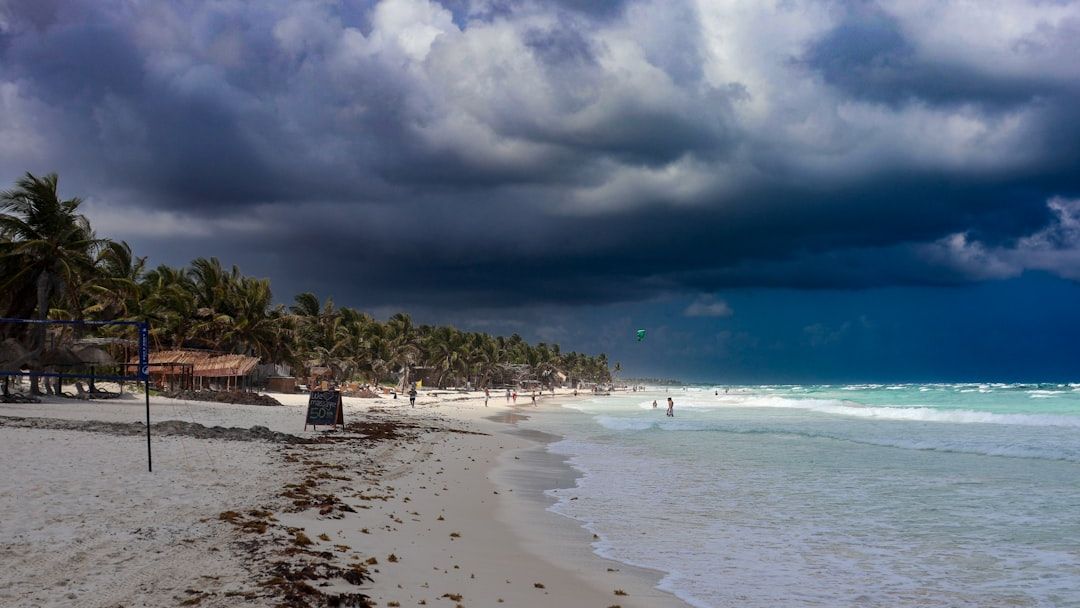
Potential Super El Niño could supercharge start to Eastern Pacific hurricane season – Image for illustrative purposes only (Image credits: Unsplash)
Sea surface temperatures off Mexico’s southern coast already simmer several degrees above average, setting the stage for possible tropical development even before the official Eastern Pacific hurricane season begins on May 15.[1][2] Forecasters point to an emerging El Niño pattern as a key driver that could elevate storm numbers across the basin this year. This combination raises the prospect of an unusually vigorous start to the season, which extends through November 30.
Early Signals from Unusually Hot Pacific Waters
Current conditions in the Eastern Pacific feature sea surface temperatures running 2 to 3 degrees Fahrenheit above normal in key areas, with some spots reaching the upper 80s Fahrenheit – well above the 80-degree threshold needed for tropical cyclone formation.[1] NOAA’s Climate Prediction Center recently highlighted a zone off southern Mexico where a tropical system might spin up between May 13 and 19, just ahead of the season’s kickoff.[1] Such early activity aligns with historical patterns, as the basin’s first named storm often emerges around June 10.
These warm waters provide ample fuel for storms, encouraging rapid organization and growth. The FOX Forecast Center noted that this setup, paired with shifting atmospheric patterns, points to heightened risks right out of the gate.
El Niño Emergence on the Horizon
ENSO-neutral conditions currently prevail across the equatorial Pacific, but NOAA forecasters now assign a 61 percent chance of El Niño developing during May through July, with odds holding steady at 62 percent for June through August.[3][4] Models from NOAA and Columbia University’s International Research Institute suggest this event could qualify as a “super El Niño,” potentially pushing Niño 3.4 index values to +2.0°C or higher – a one-in-four prospect by late 2026.[3] Subsurface ocean heat continues to build, supporting this transition from recent La Niña influences.
El Niño alters global wind patterns and convection, drawing warm air upward in the Eastern Pacific to spawn thunderstorms that feed hurricane development. The FOX Weather team emphasized, “The combination of water temperatures already above average and a developing El Niño suggests that this could be the start of a supercharged hurricane season in the basin.”[1]
Boosted Activity Backed by History and Data
El Niño years consistently deliver above-average results in the Eastern Pacific. Since 1990, moderate events have produced excess storms 85 percent of the time, averaging 17 named storms, 9 hurricanes, and 5 major hurricanes – up from neutral-year norms of 15, 8, and 4, respectively.[2] A supercharged version could push those figures even higher.
Recent examples underscore the stakes. In 2023, under El Niño conditions, Hurricane Otis exploded into a Category 5 just before slamming Acapulco, Mexico, with winds surging 115 mph in 24 hours and causing billions in damage.[2] Tropical Storm Hilary’s remnants that year dumped record rains across the U.S. Southwest, while 1992’s Hurricane Iniki ravaged Hawaii as a Category 4.
Fox Weather Hurricane Specialist Bryan Norcross captured the essence: “It only takes one storm to create major impacts.”[2]
- Average neutral year: 15 named storms, 8 hurricanes, 4 major.
- El Niño average: 17 named storms, 9 hurricanes, 5 major.
- Potential super El Niño: Likely exceeds these benchmarks.
Broader Ramifications and Atlantic Contrast
While the Eastern Pacific gears up for busier times, the same El Niño promises restraint in the Atlantic, where heightened wind shear often disrupts storm formation. Colorado State University anticipates just 13 named storms there this season, including 6 hurricanes and 2 majors – below average.[5] This split influence highlights El Niño’s dual nature across ocean basins.
Communities along Mexico’s Pacific coast, Central America, and even Hawaii must prioritize readiness amid these forecasts. Though exact outcomes hinge on El Niño’s precise strength and timing, the signals demand vigilance from the season’s outset.
As the Pacific warms and patterns shift, coastal residents face a clear message: an active season looms, but proactive measures can blunt its worst effects.

As a little kid, I fell in love with nature, wildlife, and animals. Living in the USA, South Africa, Italy, China and Germany gave me the opportunity to discover the world's Wildlife. My favorite animals are Mountain Gorillas, Siberian Tigers, and Great White Sharks.
I'm a certified PADI Open Water Diver, went to Everest Base Camp and Trekked Gorillas in Uganda. I hold a Master of Science in Economics and Finance.
Please send any feedback to feedback@animalsaroundtheglobe.com
- The Best Ways to Introduce New Fish to an Existing Aquarium - July 30, 2026
- 10 Creatures With the Strongest Jaws on Earth - July 30, 2026
- 14 Animals Endangered in the U.S. And Whats Being Done - July 30, 2026