


Venus today is a hellish world with scorching temperatures reaching 864°F (462°C), crushing atmospheric pressure 92 times that of Earth, and clouds of sulfuric acid. Yet, this inhospitable planet, often called Earth’s “evil twin,” may once have been a potentially habitable world with liquid water oceans and conditions suitable for life.
Recent scientific research has unveiled compelling evidence suggesting that Venus could have maintained habitable conditions for billions of years before transforming into the hostile environment we observe today. This dramatic transformation represents one of the most intriguing planetary evolution stories in our solar system and offers valuable insights into planetary habitability, climate change, and potentially Earth’s own future.
Ancient Venus: A World of Water

According to computer models and geological evidence, Venus likely possessed significant amounts of water during its early history, potentially even hosting vast oceans similar to Earth’s. Climate simulations suggest that between 4 and 2 billion years ago, Venus may have maintained surface temperatures between 20°C and 50°C (68°F to 122°F), warm but within ranges potentially suitable for certain forms of life.
The planet’s slower rotation rate (243 Earth days for one Venusian day) compared to Earth would have created distinctive cloud patterns that could have shielded the surface from excessive solar radiation while still allowing enough light for potential photosynthesis. These ancient Venusian oceans, if they existed, would have played a crucial role in regulating the planet’s climate system and potentially providing environments where simple life forms could have evolved.
Venus in the Habitable Zone

When our solar system formed approximately 4.6 billion years ago, Venus was located within what astronomers call the “habitable zone” – the region around a star where conditions might allow for liquid water on a planet’s surface. Though Venus receives about twice the solar radiation that Earth does today, the young Sun was approximately 30% dimmer billions of years ago. This reduced solar output meant that early Venus likely received a much more moderate amount of heat, potentially creating surface conditions that could support liquid water. Some models suggest Venus may have remained in the habitable zone for as long as 2-3 billion years, providing an extensive window during which life could potentially have emerged and evolved before conditions deteriorated.
The Goldilocks Planet That Wasn’t
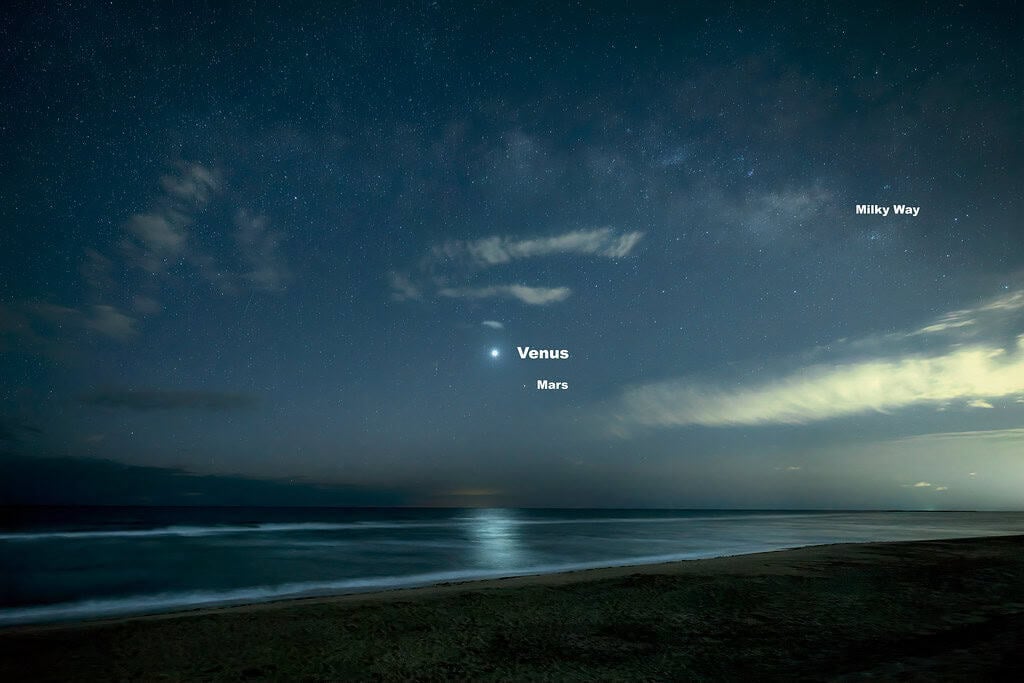
Early in its history, Venus may have been remarkably Earth-like in many respects. Both planets formed from similar materials in the solar nebula, are comparable in size (Venus’s diameter is 95% of Earth’s), have similar gravity (Venus’s surface gravity is 90% of Earth’s), and both possessed significant atmospheres.
Recent research from NASA and other space agencies suggests Venus may have even had plate tectonics similar to Earth, cycling carbon between the atmosphere and interior, which is crucial for maintaining stable climate conditions over geological timescales. The combination of these factors means Venus might once have been a “Goldilocks” planet – with conditions not too hot and not too cold for liquid water and potentially life – before it underwent catastrophic climate change that transformed it into the inhospitable world we see today.
Evidence from Pioneer Venus Mission

Our first significant hints about Venus’s potentially habitable past came from NASA’s Pioneer Venus mission in the late 1970s. This mission discovered that Venus has a deuterium-to-hydrogen ratio approximately 150 times higher than Earth’s. Deuterium, or “heavy hydrogen,” doesn’t escape into space as easily as regular hydrogen. This elevated ratio strongly suggests that Venus once had substantial amounts of water that have since been lost.
As ultraviolet radiation from the Sun broke water molecules into hydrogen and oxygen, the lighter hydrogen atoms escaped into space while the heavier deuterium remained in greater proportions. Calculations based on this deuterium enrichment indicate Venus may have once possessed enough water to cover the entire planet in an ocean between 4 and 25 meters deep, though some models suggest it could have been much deeper in certain regions.
The Role of Venus’s Volcanoes
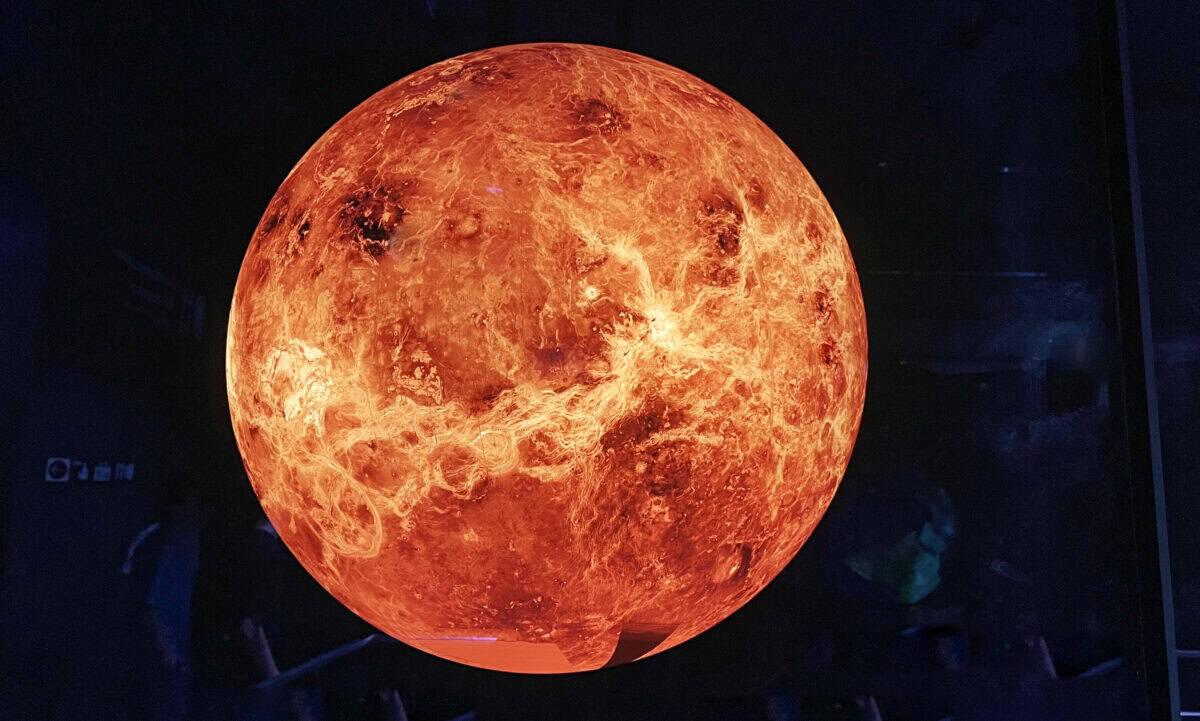
Venus’s surface is dominated by volcanic features, with over 1,600 major volcanoes and hundreds of thousands of smaller ones. Evidence from Venus’s surface, mapped by NASA’s Magellan spacecraft, indicates extensive volcanic activity throughout the planet’s history. During Venus’s potentially habitable period, controlled volcanic activity would have been beneficial, releasing gases that contributed to the atmosphere and helping regulate the carbon cycle. However, later catastrophic volcanic eruptions may have played a critical role in Venus’s transformation.
Massive eruptions could have released enormous amounts of carbon dioxide, initiating or accelerating a runaway greenhouse effect. Some research suggests Venus may have experienced global volcanic resurfacing events around 500-700 million years ago, potentially marking the final transition from a habitable world to the hostile environment we observe today.
The Runaway Greenhouse Effect
The most widely accepted theory for Venus’s transformation involves what scientists call a “runaway greenhouse effect.” As Venus received more solar radiation than Earth and possibly experienced increased volcanic activity, water vapor and carbon dioxide accumulated in its atmosphere. Both gases are powerful greenhouse gases that trap heat. This created a positive feedback loop: as temperatures rose, more water evaporated from oceans into the atmosphere, trapping more heat and raising temperatures further.
Eventually, all surface water evaporated. Without liquid water to facilitate carbon sequestration through weathering of rocks, carbon dioxide continued to build up from volcanic outgassing. Water molecules in the upper atmosphere split apart under intense solar radiation, with hydrogen escaping to space and oxygen likely combining with surface materials. The result was the thick, carbon dioxide-dominated atmosphere we observe today, which maintains Venus’s extreme surface temperatures by trapping heat extraordinarily efficiently.
The Sun’s Brightness and Venus’s Fate

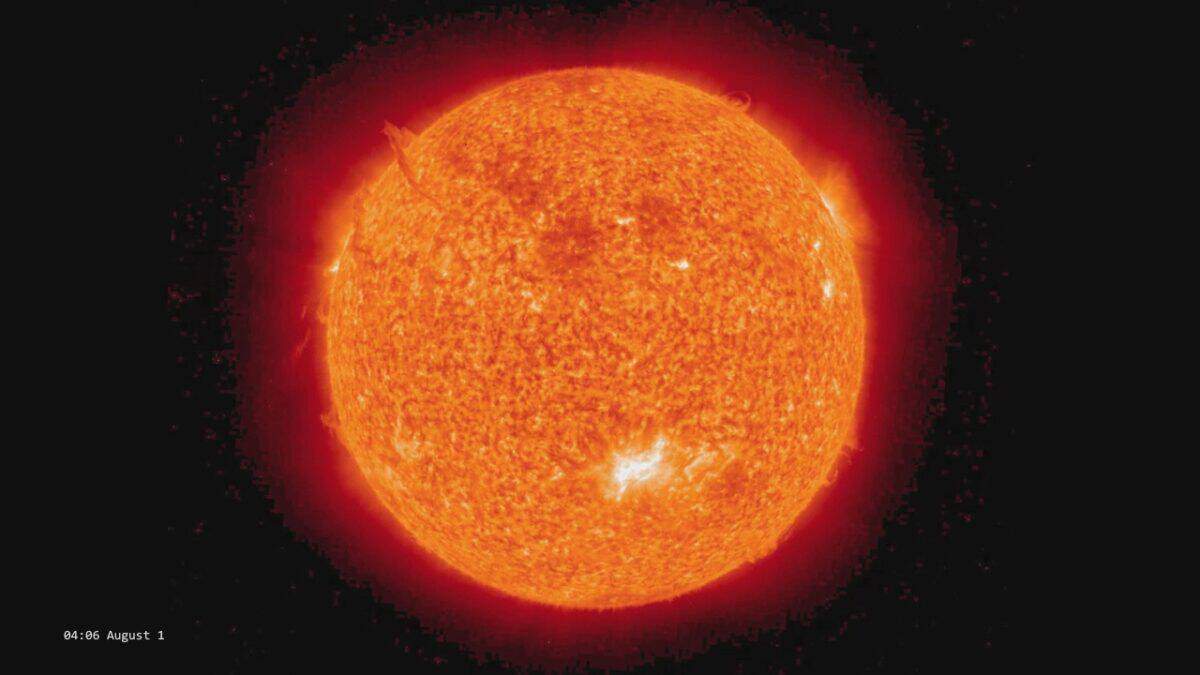
The Sun’s gradually increasing brightness over billions of years likely played a decisive role in Venus’s transformation. Our star has grown approximately 30% brighter since the formation of the solar system. For a planet already receiving more solar radiation than Earth, this increase may have pushed Venus past a critical threshold.
Research published in journals like Nature Geoscience suggests that even if Venus started with Earth-like conditions, the increasing solar output would eventually have triggered the runaway greenhouse effect. This has profound implications for understanding habitable zones around stars, suggesting they aren’t static but rather move outward as stars age. It also raises questions about Earth’s own long-term future, as our planet will eventually face increasing solar radiation that could potentially trigger similar, though hopefully less extreme, climate changes billions of years from now.
Venus’s Lack of a Magnetic Field

Unlike Earth, Venus lacks a strong intrinsic magnetic field, which may have contributed significantly to its loss of habitability. Earth’s magnetic field shields our atmosphere from the solar wind – a stream of charged particles from the Sun that can strip away atmospheric gases. Without similar protection, Venus would have been more vulnerable to atmospheric erosion.
The lack of a magnetic field also means Venus’s surface and any potential early life would have been exposed to higher levels of cosmic radiation. Scientists believe Venus’s magnetic field weakness stems from its extremely slow rotation (243 Earth days for one Venus day) and possibly differences in its internal structure and core composition. Some models suggest Venus might have maintained a magnetic field early in its history when its core was more molten and perhaps when it rotated faster, potentially providing a temporary shield during the planet’s more habitable phase.
Recent Climate Modeling Insights

Advanced climate modeling from research teams at NASA’s Goddard Institute for Space Studies, the University of Chicago, and international institutions has provided increasingly sophisticated views of Venus’s potential habitable period. A groundbreaking 2016 study published in Geophysical Research Letters suggested Venus could have maintained habitable conditions until as recently as 715 million years ago.
These models incorporate complex factors including cloud formation, atmospheric circulation patterns, and the relationship between Venus’s rotation rate and its climate. The slow rotation of Venus would have created distinctive cloud patterns that might have actually helped maintain habitable conditions by reflecting sunlight during the day while trapping some heat during the long Venusian nights. Some models suggest that if Venus had formed with slightly less water, or if other factors like its rotation rate had been different, it might have avoided the runaway greenhouse effect entirely and remained habitable today.
Potential for Ancient Venusian Life
If Venus was indeed habitable for billions of years with liquid water oceans and moderate temperatures, it raises a fascinating possibility: life might have emerged there. Simple microbial life on Earth appeared relatively quickly after the planet cooled enough to support liquid water, suggesting that under the right conditions, life might arise readily. Any potential Venusian life would likely have been microbial, possibly similar to Earth’s extremophiles – organisms adapted to harsh conditions.
If life did develop on Venus, it would almost certainly have gone extinct during the planet’s transition to its current state, though some speculative hypotheses suggest highly adapted microorganisms might potentially survive in Venus’s upper atmosphere, where conditions are less extreme. The 2020 detection of phosphine gas in Venus’s atmosphere (though still debated) sparked renewed interest in this possibility, as phosphine on Earth is primarily produced by biological processes.
Future Missions to Unveil Venus’s Past

Several upcoming missions aim to unlock more secrets about Venus’s potentially habitable past. NASA’s DAVINCI+ (Deep Atmosphere Venus Investigation of Noble gases, Chemistry, and Imaging Plus) mission, scheduled to launch in the late 2020s, will drop a probe through Venus’s atmosphere, analyzing its composition in unprecedented detail and potentially revealing more evidence about ancient water.
The VERITAS (Venus Emissivity, Radio Science, InSAR, Topography, and Spectroscopy) mission will create detailed 3D maps of Venus’s surface, potentially identifying features formed by ancient oceans. The European Space Agency’s EnVision mission will use radar to peer beneath Venus’s surface, possibly revealing geological evidence of the planet’s transformation. These missions, combined with advanced sample return concepts being developed for the hostile Venusian environment, promise to revolutionize our understanding of Venus’s history and potentially provide definitive evidence of its once-habitable conditions.
Earth’s Twin and Cautionary Tale

Venus offers both a window into our solar system’s past and a potential warning about planetary climate systems. Often described as Earth’s “sister planet” or “twin” due to its similar size and composition, Venus demonstrates how dramatically a planet’s conditions can change. The stark contrast between Earth and Venus today – despite their similarities in size, composition, and distance from the Sun – underscores the delicate balance of factors that maintain Earth’s habitability.
Some scientists view Venus as a cautionary tale about irreversible climate change, though Earth’s situation differs significantly from Venus’s runaway greenhouse scenario. Studying Venus’s transformation helps scientists refine models of planetary habitability, better understand the factors that keep Earth hospitable, and improve our ability to identify potentially habitable exoplanets around other stars. Venus reminds us that planetary habitability isn’t guaranteed but depends on a complex interplay of astronomical, geological, and atmospheric factors that can change over time.
Conclusion: The Lost Paradise Next Door

Venus stands as one of the solar system’s most profound mysteries and transformations – a world that potentially shifted from an Earth-like, ocean-covered planet to the scorching, acid-cloud-shrouded inferno we see today. This dramatic evolution underscores the fragility and complexity of planetary climate systems and the delicate balance required for habitability.
As we continue exploring Venus with increasingly sophisticated instruments and missions, we may finally confirm whether it truly was habitable and perhaps even hosted primitive life forms billions of years ago. Beyond scientific curiosity, understanding Venus’s past and its eventual transformation provides valuable insights into planetary evolution, the factors that maintain Earth’s habitability, and the potential futures of Earth-like worlds throughout the universe. Venus reminds us that even seemingly stable planetary environments can change dramatically over geological timescales, making the preservation of Earth’s habitable conditions all the more precious.

From exploring the marine wonders in the Azores and witnessing the vast savannas of Kenya, to delving deep into the rich biodiversity of South Africa and traversing iconic landscapes in Australia and the US like Yellowstone, Chris's experiences are vast.
With a penchant for diving alongside sharks, the ocean holds a special place in his heart.
Through his academic insights, he champions wildlife conservation, striving with 'Animals Around The Globe' to cultivate a profound connection between humans and animals, enhancing our mutual appreciation.
Connect with him at Feedback@animalsaroundtheglobe.com.
- How Axolotls Are Helping Researchers Study Cancer Resistance - July 23, 2026
- Scientists Stunned by Electric Pangolin Found in Congo - July 23, 2026
- The Largest Clam Ever Dredged Up From U.S. Waters - July 22, 2026