


When we think of the “king of the jungle,” the lion immediately comes to mind with its majestic mane and powerful roar. However, many ecosystems around the world have their own apex predators and dominant species that rule their respective territories with equal authority. From the dense rainforests of South America to the snowy peaks of the Himalayas, these magnificent creatures command respect through their strength, intelligence, or sheer presence. This article explores fifteen remarkable animals that, while not lions, reign supreme in their natural habitats as true kings of their own jungles.
1. The Jaguar: America’s Spotted Sovereign

The jaguar (Panthera onca) stands as the largest cat in the Americas and the third-largest big cat globally after tigers and lions. With its muscular build and distinctive rosette-patterned coat, this solitary hunter rules the rainforests, swamps, and grasslands from the southwestern United States through Central America to northern Argentina. What truly sets jaguars apart from other big cats is their extraordinary bite force—the strongest of all felines—allowing them to pierce the skulls and shells of prey that other predators cannot tackle.
Unlike many other big cats, jaguars are excellent swimmers and often hunt caimans, capybaras, and fish in rivers. Their hunting technique typically involves a powerful bite to the skull rather than a throat bite, demonstrating their exceptional strength. With nearly 50% of their original habitat lost to deforestation and human encroachment, these magnificent creatures now face conservation challenges, with an estimated 15,000 wild jaguars remaining, making their continued reign increasingly precarious.
2. The Bengal Tiger: India’s Striped Monarch
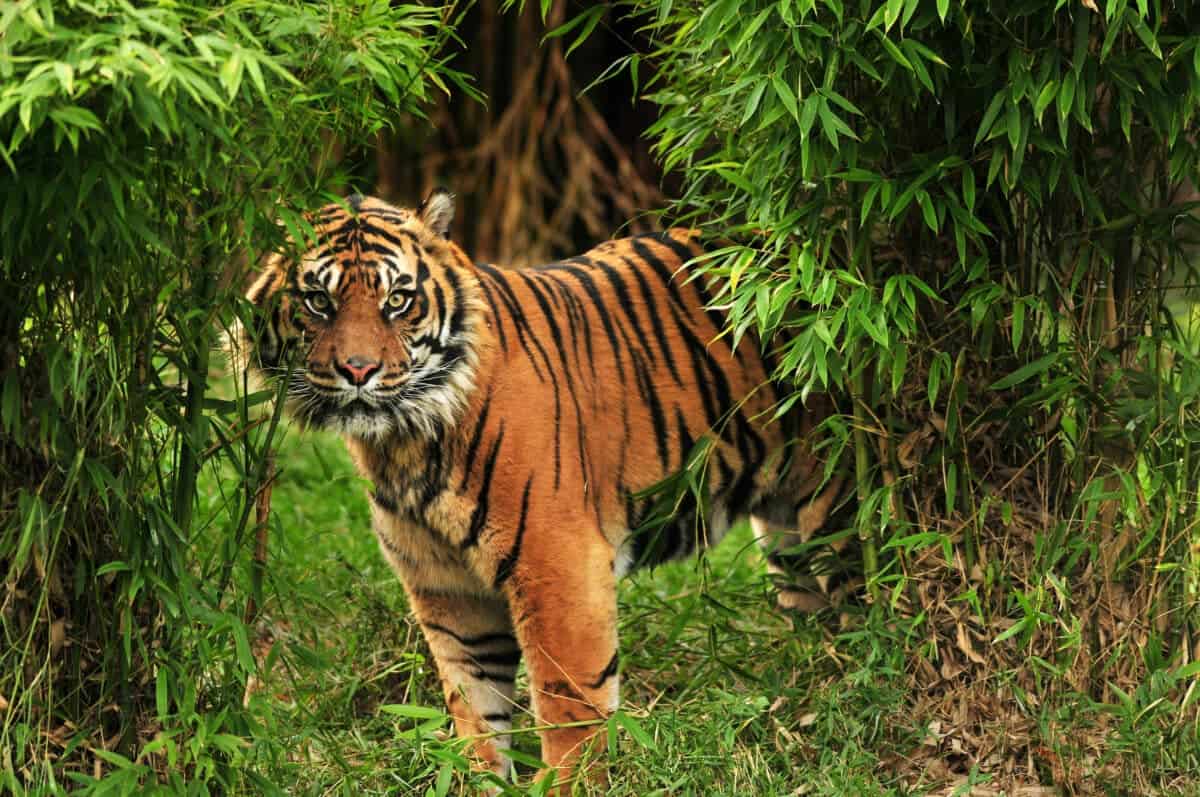
The Bengal tiger (Panthera tigris tigris) is perhaps the most iconic of all tiger subspecies, representing India’s national animal and cultural symbol. These magnificent cats can weigh up to 550 pounds (250 kg) for males, with females somewhat smaller, making them significantly larger than lions. Their distinctive orange coat with black stripes provides perfect camouflage in the dappled light of forests and grasslands across the Indian subcontinent. Unlike lions, Bengal tigers are primarily solitary creatures, establishing and defending large territories that can span up to 60 square miles (155 square kilometers).
What makes Bengal tigers particularly remarkable is their adaptability across various habitats, from the mangrove forests of the Sundarbans to the foothills of the Himalayas. Their swimming abilities far surpass those of lions, allowing them to navigate through flooded forests with ease. Despite being a protected species, Bengal tigers remain endangered with approximately 3,000 individuals left in the wild, threatened by habitat loss, poaching for their body parts used in traditional medicine, and human-wildlife conflict. Conservation efforts, including India’s Project Tiger, have helped stabilize some populations, but these jungle kings continue to face significant challenges.
3. The Gorilla: Gentle Giant of the Congo

The mountain gorilla (Gorilla beringei beringei) and western lowland gorilla (Gorilla gorilla gorilla) represent the largest living primates and true kings of the African rainforests. Adult male silverbacks can reach heights of 5.6 feet (1.7 meters) when standing upright and weigh up to 485 pounds (220 kg), possessing strength estimated to be 10 times that of an adult human. Despite their imposing physical presence, gorillas are predominantly herbivores, feeding on leaves, shoots, fruits, and occasionally insects, demonstrating that dominance doesn’t always require a predatory nature.
Gorilla society revolves around the silverback male, who leads family groups of 5-30 individuals. These patriarchs make all important decisions, mediate conflicts, determine group movements, and protect family members from outside threats, including humans and leopards. Their leadership isn’t maintained through constant aggression but through complex social dynamics and occasional impressive displays when needed. Despite their power, gorillas face severe threats from habitat destruction, poaching, and disease, with mountain gorillas numbering only around 1,000 individuals and western lowland gorillas classified as critically endangered, making conservation efforts crucial for these forest monarchs.
4. The Anaconda: Colossal Constrictor of the Amazon
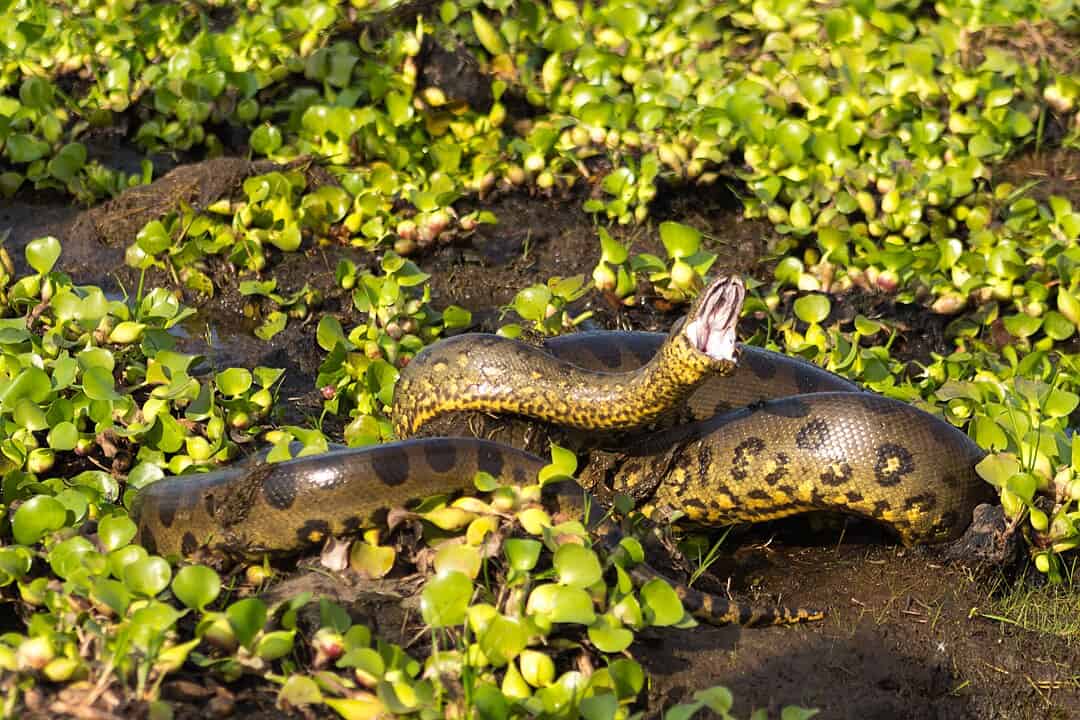
The green anaconda (Eunectes murinus) rules the waterways of South America as the world’s heaviest snake, with females reaching lengths of over 25 feet (7.6 meters) and weights exceeding 550 pounds (250 kg). Unlike many jungle kings that rely on speed or sharp teeth, the anaconda’s dominance comes through sheer mass and constricting power. These aquatic serpents spend most of their lives in or near water, perfectly adapted with eyes and nostrils positioned on top of their heads to allow breathing while remaining almost completely submerged.
Anacondas are ambush predators with incredible patience, sometimes waiting days for the right moment to strike. When they do attack, they grab prey with their teeth before rapidly coiling around it, tightening with each exhale until the victim suffocates. Their diet includes capybaras, caimans, deer, and occasionally jaguars—proving that even apex predators can become prey. Females are significantly larger than males, with mating seasons creating “breeding balls” where multiple males compete for a single female. Though not endangered, anacondas face threats from habitat destruction and hunting for their skins, while climate change affecting Amazon water levels may impact their future reign.
5. The Orangutan: Arboreal King of Borneo and Sumatra
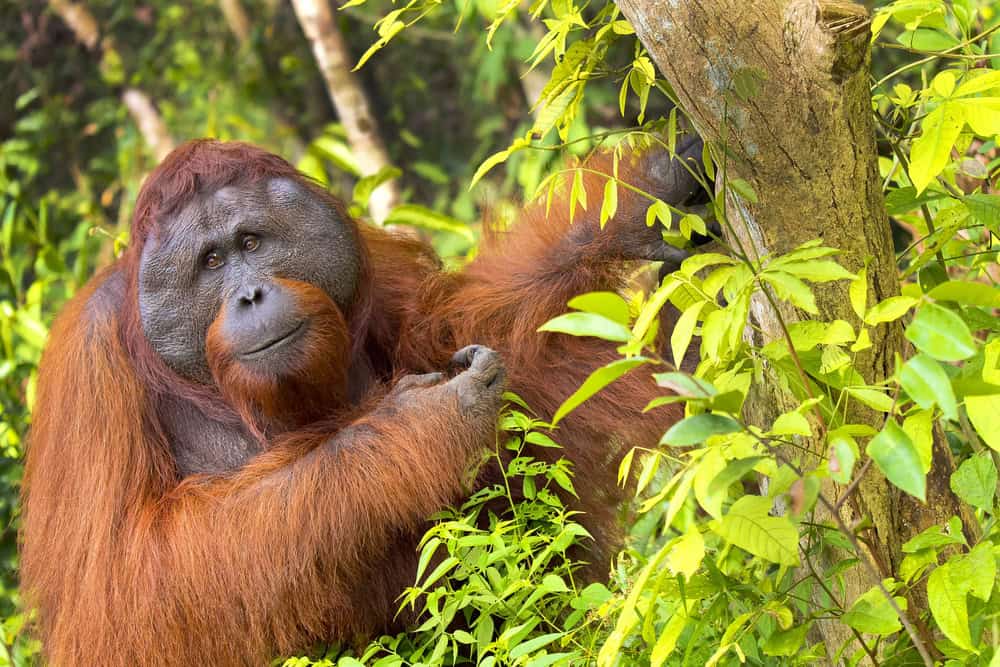
The orangutan, comprising two species—Bornean (Pongo pygmaeus) and Sumatran (Pongo abelii)—rules the rainforest canopies of Southeast Asia as the largest tree-dwelling animals on Earth. Adult males can weigh up to 200 pounds (90 kg) and develop distinctive cheek pads and throat pouches as they mature. Unlike other great apes that spend considerable time on the ground, orangutans are almost exclusively arboreal, with their long, powerful arms spanning up to 8 feet (2.4 meters) allowing them to swing effortlessly between trees. Their incredible strength enables them to hang from branches using just a few fingers while feeding.
What truly distinguishes orangutans is their remarkable intelligence, with problem-solving abilities and tool use comparable to chimpanzees. They craft rain hats from leaves, use sticks as spears to fish, and build elaborate nests each night from branches and foliage. Their extensive mental maps of fruit locations and ripening schedules throughout their territory demonstrate exceptional spatial memory. Sadly, both species face critical endangerment due to palm oil plantation expansion, logging, and illegal pet trade. With fewer than 120,000 Bornean and 14,000 Sumatran orangutans remaining in the wild, these “men of the forest” (the literal translation of their name) may lose their arboreal kingdoms without increased conservation efforts.
6. The Snow Leopard: Phantom Ruler of the Himalayas

The snow leopard (Panthera uncia) reigns over the harsh, rugged mountains of Central and South Asia, earning its nickname “ghost of the mountains” due to its elusive nature and remarkable camouflage. Adapted for life at extreme altitudes of 3,000-4,500 meters (9,800-14,800 feet), these cats possess several unique features: enlarged nasal cavities to warm frigid air, extra-long tails for balance and warmth, and incredibly thick fur—the densest of any big cat—with individual hairs measuring up to 5 inches (12 cm) long. Their wide, fur-covered paws act as natural snowshoes, distributing weight across treacherous terrain.
Unlike lions that rely on group hunting, snow leopards are solitary hunters with exceptional jumping abilities, capable of leaping up to 50 feet (15 meters) horizontally and 20 feet (6 meters) vertically. They primarily prey on mountain sheep and goats, often pursuing them across near-vertical cliff faces that would be impossible for most predators to navigate. Despite their power, snow leopards rarely attack humans and cannot roar like other big cats, instead producing distinctive “chuffing” sounds. With an estimated population of 4,000-6,500 individuals spread across 12 countries, these mountain monarchs face threats from poaching for their fur and bones, retaliatory killing by farmers protecting livestock, and climate change affecting their high-altitude habitats.
7. The Komodo Dragon: Ancient Sovereign of Indonesian Islands

The Komodo dragon (Varanus komodoensis) rules as the world’s largest lizard and a living remnant of prehistoric times. Native to five small Indonesian islands, these fearsome reptiles can grow to 10 feet (3 meters) in length and weigh up to 150 pounds (70 kg). Their hunting strategy differs dramatically from mammalian predators, relying on a powerful bite delivered by serrated teeth and toxic saliva containing over 50 bacterial strains and venom compounds that induce shock, prevent blood clotting, and cause significant blood loss in victims. After biting prey, Komodo dragons often follow wounded animals for miles until they succumb to the toxins, using their powerful sense of smell to track blood trails.
What makes these reptilian kings particularly formidable is their patience and longevity. They can survive on just 12 meals per year, consume up to 80% of their body weight in a single feeding, and live for over 30 years in the wild. Female Komodos can reproduce through parthenogenesis—essentially cloning themselves when males aren’t available—ensuring survival even in isolated populations. With fewer than 4,000 individuals remaining across their limited range, these living dragons face threats from habitat loss, climate change, and human encroachment. Their protected status and tourism value have created conservation incentives, though careful management is needed to balance human interaction with their continued reign.
8. The Harpy Eagle: Aerial Monarch of Neotropical Rainforests

The harpy eagle (Harpia harpyja) commands the skies above the rainforests of Central and South America as one of the world’s largest and most powerful eagles. With females weighing up to 20 pounds (9 kg) and sporting a wingspan of 7.5 feet (2.3 meters), these birds possess talons comparable in size to grizzly bear claws—reaching 5 inches (13 cm) in length. These formidable weapons can exert crushing pressure of 110 pounds per square inch, allowing harpies to snatch prey as large as monkeys and sloths from treetops. Their distinctive appearance includes a double crest of feathers that can be raised to create an intimidating facial disc, along with black and gray plumage that provides perfect camouflage against the forest canopy.
Unlike many birds of prey that rely on soaring to spot prey from a distance, harpy eagles are adapted for the dense forest environment, capable of flying at speeds of 50 mph (80 km/h) between trees and executing sharp turns with remarkable agility. They primarily hunt by perching silently and waiting for prey to move within striking distance before launching lightning-fast attacks. Harpy eagles form monogamous pairs that mate for life, raising only one chick every 2-3 years—one of the slowest reproduction rates among birds. With a wild population estimated at fewer than 50,000 individuals and declining due to deforestation and hunting, these aerial predators have disappeared from much of their historic range, making conservation of intact rainforest crucial for their survival.
9. The Saltwater Crocodile: Prehistoric Tyrant of Tropical Waters
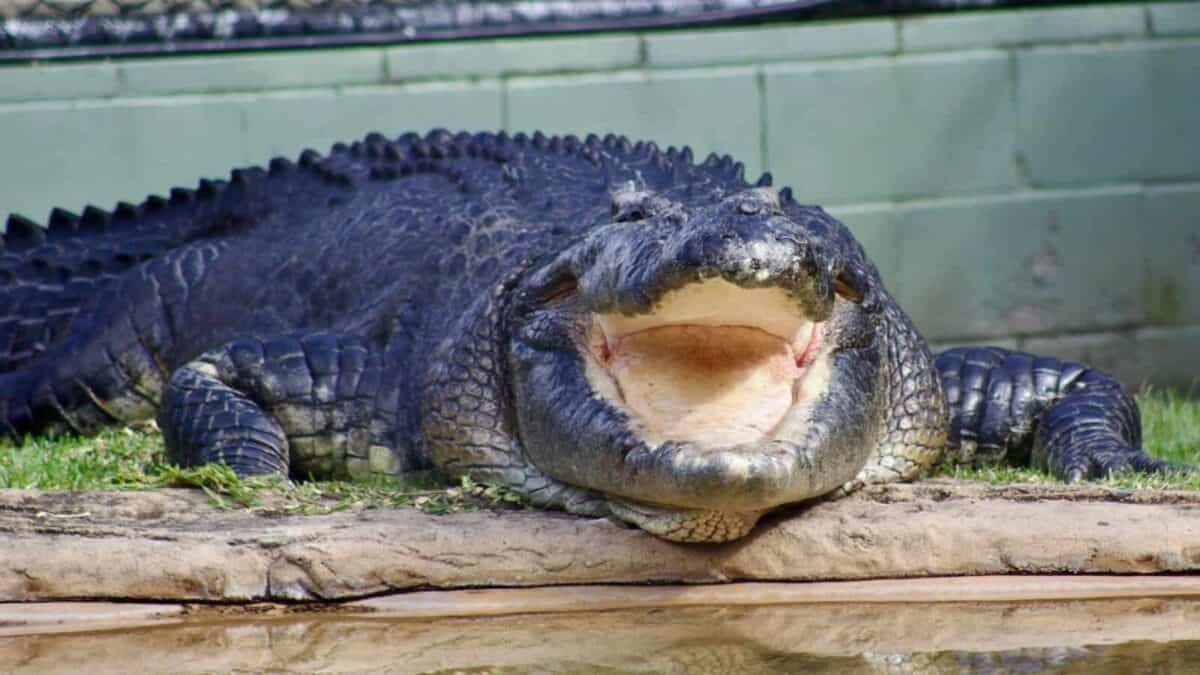
The saltwater crocodile (Crocodylus porosus) reigns as the largest living reptile and the most formidable predator across the waterways of Southeast Asia, Northern Australia, and the Pacific Islands. Males can reach lengths exceeding 20 feet (6 meters) and weights of over 2,200 pounds (1,000 kg), with the largest verified specimen measuring 23 feet (7 meters). These ancient creatures possess the strongest bite force of any animal alive today, with measurements exceeding 3,700 pounds per square inch—more than 7 times that of a lion. Their jaws contain 60-70 conical teeth designed to grip rather than chew, allowing them to drag prey underwater where they perform their signature “death roll” to tear manageable pieces from larger victims.
Unlike many predators that hunt primarily for sustenance, saltwater crocodiles are opportunistic and territorial, attacking virtually any animal that enters their domain—from fish and birds to water buffalo, sharks, and humans. They are exceptional swimmers capable of traveling over 500 miles (800 km) across open ocean currents, explaining their wide distribution across multiple countries. Despite being hunted to near extinction for their valuable skins during the mid-20th century, successful conservation programs have allowed populations to recover in some regions, particularly Australia where numbers have rebounded from 3,000 to over 100,000 since protection began in 1971. Today, human-crocodile conflict represents the greatest challenge in managing these aquatic predators, whose reign has continued virtually unchanged for millions of years.
10. The Wolverine: Pound-for-Pound Champion of Northern Forests
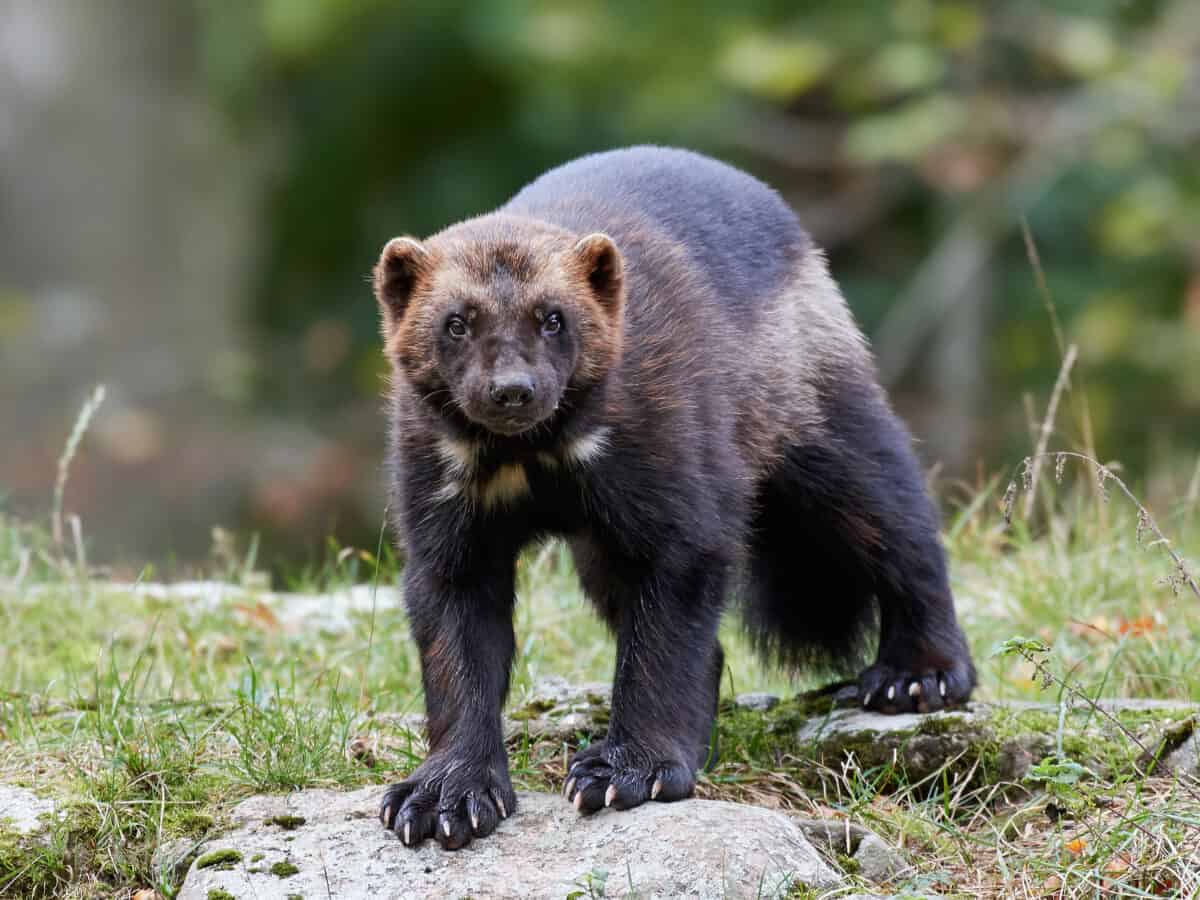
The wolverine (Gulo gulo) might not be the largest predator of the northern forests and tundra, but pound-for-pound, few animals can match its ferocity and determination. Despite weighing just 20-40 pounds (9-18 kg)—similar to a mid-sized dog—these members of the weasel family possess legendary strength and tenacity that allow them to take down prey many times their size, including caribou and moose when conditions favor them. Their powerful jaws and specialized molars can crush frozen meat and bone, enabling them to scavenge carcasses that other predators cannot process, while their broad, snowshoe-like paws support movement across deep snow that would trap many competitors.
What truly distinguishes wolverines as kings of their domain is their incredible endurance and territorial nature. Individual wolverines patrol massive territories spanning up to 500 square miles (1,300 square kilometers), traveling up to 15 miles (24 km) daily across challenging terrain. Their dense, oily fur provides unmatched protection against extreme cold, allowing them to remain active during the harshest winter conditions when most predators struggle. This same fur once made them targets for trappers, contributing to population declines across their range. Today, climate change represents their greatest threat, as diminishing spring snow cover affects denning sites crucial for raising young. With fewer than 300 wolverines remaining in the contiguous United States and approximately 15,000-30,000 worldwide, these fierce forest kings face an uncertain future despite their legendary resilience.
11. The Hippopotamus: Colossal Guardian of African Rivers

The hippopotamus (Hippopotamus amphibius) might not fit the traditional image of a predator, but these semi-aquatic giants rule African waterways through sheer size and aggression. Weighing up to 4,500 pounds (2,000 kg) and capable of running at speeds of 19 mph (30 km/h) despite their bulky appearance, hippos are responsible for more human fatalities in Africa than any other large animal. Their massive jaws can open to 150 degrees, revealing tusks that can reach 20 inches (50 cm) in length and deliver bites with a force exceeding 1,800 pounds per square inch—enough to slice a small boat in half.
Highly territorial, especially in water, male hippos aggressively defend their stretches of river and the groups of 10-30 females and calves that constitute their pods. Though primarily herbivorous, consuming up to 88 pounds (40 kg) of grass nightly during their terrestrial foraging, hippos occasionally engage in cannibalism and predation when resources are scarce. Their skin secretes a natural sunscreen substance that appears red, leading to the myth that they “sweat blood,” while providing protection during the many hours they spend semi-submerged. Despite their current population of 115,000-130,000 individuals across sub-Saharan Africa, hippos face significant threats from habitat loss, poaching for their ivory tusks, and conflicts with expanding human settlements along riverbanks, leading to their classification as vulnerable by conservation authorities.
Conclusion: Royalty Comes in Many Forms

While lions have long held the title of “King of the Jungle,” they’re far from the only animals worthy of the crown. Across the world’s jungles, forests, and grasslands, a variety of species command their realms with strength, intelligence, and influence. From the silent dominance of jaguars in South America to the calculated rule of tigers in Asia, and from the strategic power of alpha chimpanzees to the sheer resilience of giant anacondas, the animal kingdom is full of rulers that earn their status through unique adaptations and undeniable presence.
These wild kings remind us that dominance in nature isn’t just about brute force—it’s about survival skill, leadership, and ecological importance. By celebrating the diversity of these jungle monarchs, we gain a deeper respect for the many ways nature defines power. Lions may wear the cultural crown, but the jungle has many thrones—and each is ruled in its own extraordinary way.

From exploring the marine wonders in the Azores and witnessing the vast savannas of Kenya, to delving deep into the rich biodiversity of South Africa and traversing iconic landscapes in Australia and the US like Yellowstone, Chris's experiences are vast.
With a penchant for diving alongside sharks, the ocean holds a special place in his heart.
Through his academic insights, he champions wildlife conservation, striving with 'Animals Around The Globe' to cultivate a profound connection between humans and animals, enhancing our mutual appreciation.
Connect with him at Feedback@animalsaroundtheglobe.com.
- How Some Animals Survive on Almost No Food for Months - July 20, 2026
- A Bear Journey Through The USA: 18 Best Bear Photos from 18 US States - July 19, 2026
- Elephant Matriarchs Know Every Waterhole for Miles - July 19, 2026