

1. Ruby-throated Hummingbird (Archilochus colubris)
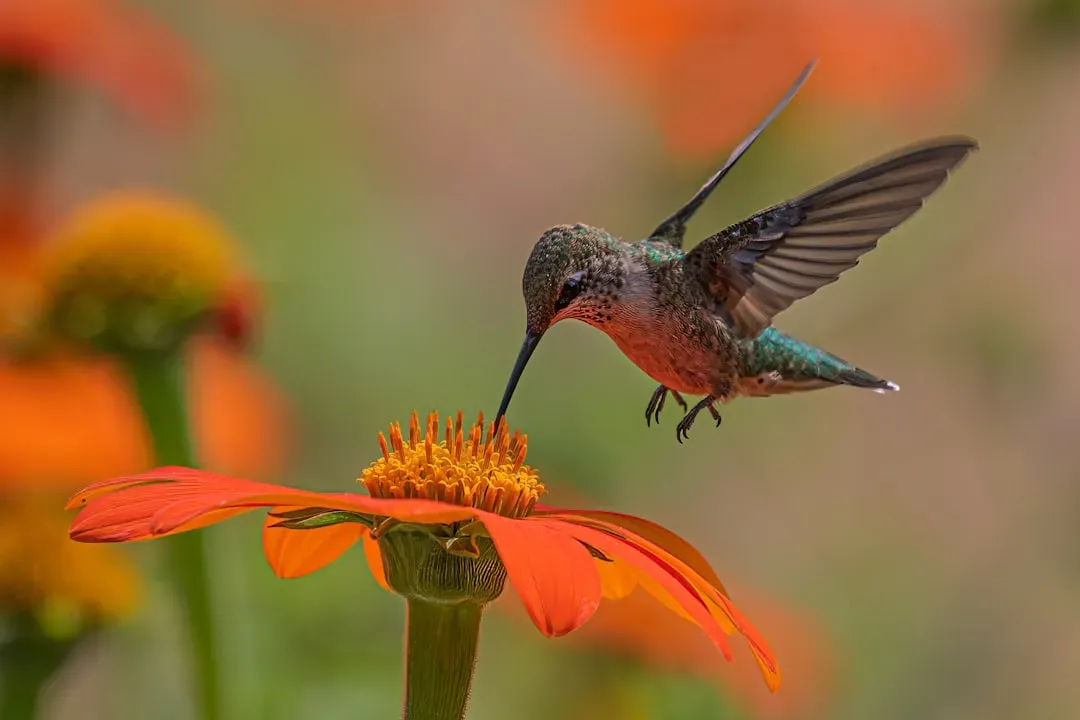
The ruby-throated hummingbird is the only common type of hummingbird in the eastern half of the continent, and the only breeding species throughout most of its range. For millions of people east of the Mississippi, this is simply “the” hummingbird. Its emerald back catches sunlight like polished glass, and the male’s crimson throat has a way of stopping you mid-sentence.
Ruby-throated hummingbirds can fly across the Gulf of Mexico in a single flight. To fuel up, they feast on nectar and insects and double their body mass, going from 3 grams to 6 grams. That’s a remarkable act of preparation for such a tiny creature. This particular species lives in forest edges, meadows, grasslands, open woodlands, and in gardens, parks, and backyards. During the summer months of breeding season these birds can be found across the eastern half of the United States and the southern portion of Canada.
2. Anna’s Hummingbird (Calypte anna)
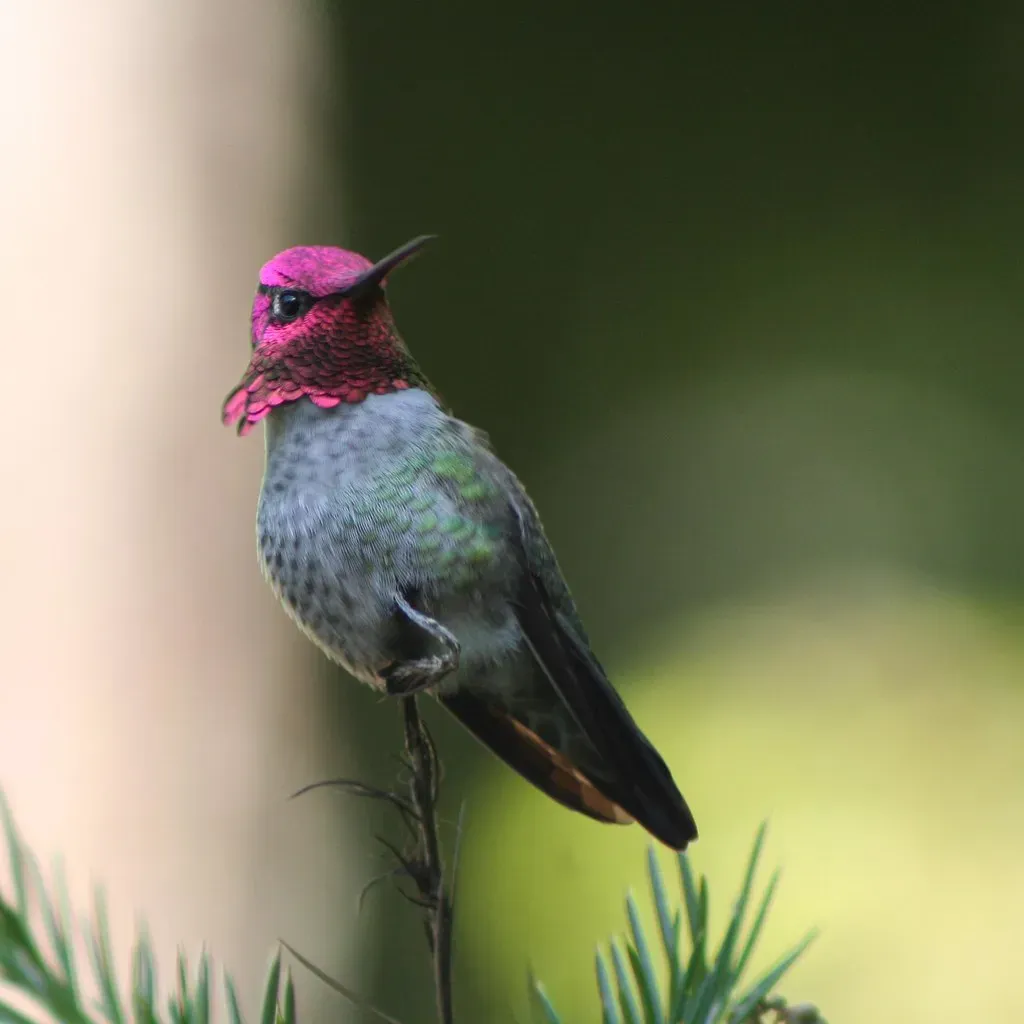
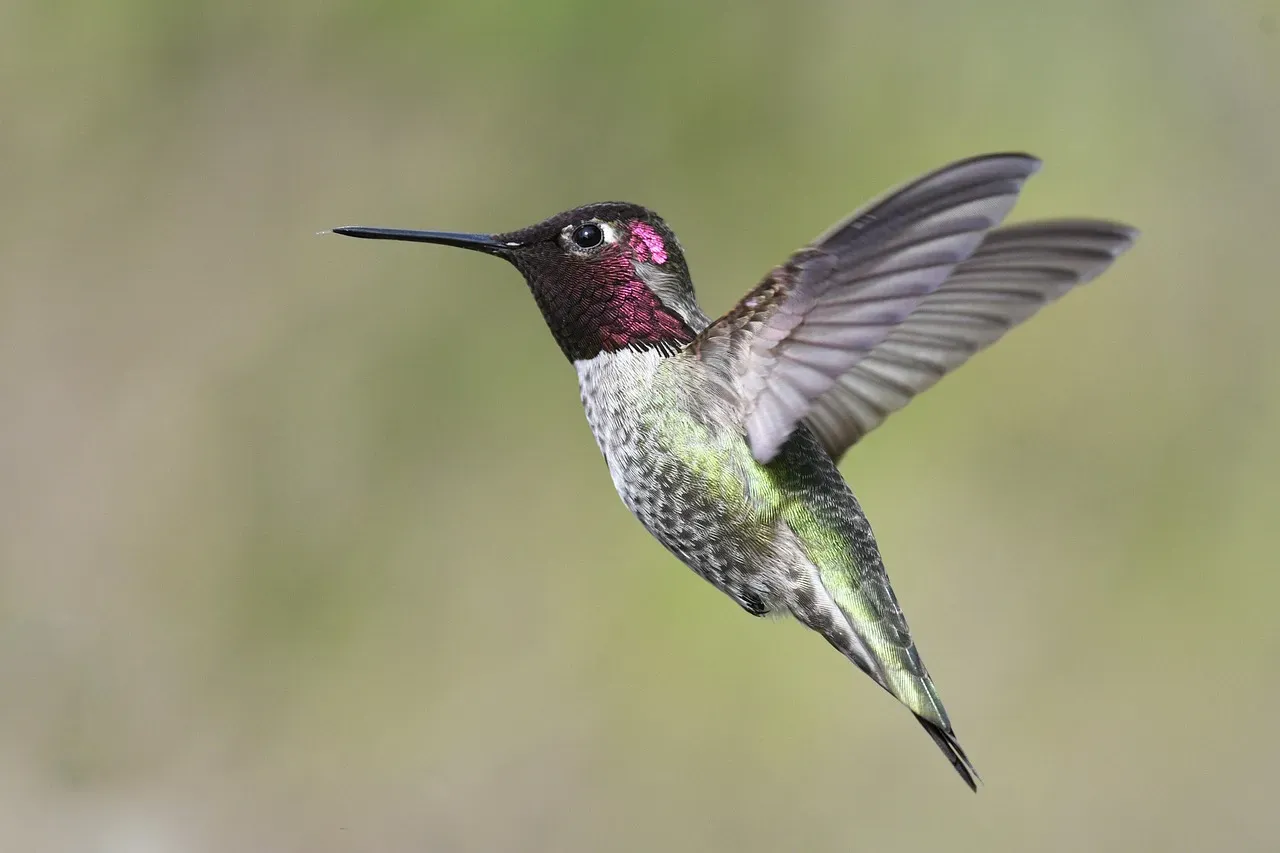
Only in recent decades has the Anna’s hummingbird become the most abundant type of hummingbird of the Pacific states. Moreover, it is the only type of hummingbird that remains year-round in the Northwest. This alone makes it unusual. Most hummingbirds are migrants at heart, but Anna’s has chosen permanence over the road, adapting to winters that would send other species packing.
Males are spectacular, with shiny rose-pink covering both the throat and crown, and a metallic green back. Anna’s Hummingbird has expanded its range northward over recent decades, likely due to more exotic flowering plants and backyard feeders. They’re now common winter residents in areas where they were once absent. Males perform dramatic courtship displays, climbing high into the air before diving at speeds exceeding 60 mph.
3. Rufous Hummingbird (Selasphorus rufus)
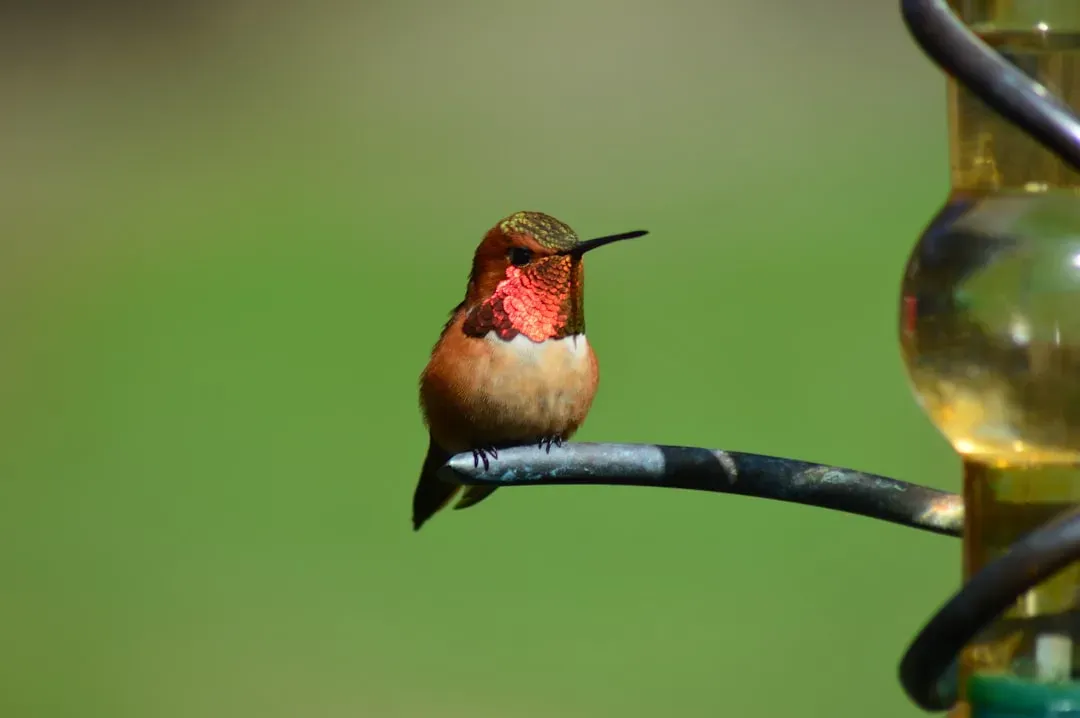
Rufous hummingbirds are small, feisty, and not shy about chasing off larger hummingbirds. They breed the farthest north of any hummingbird, yet their 4,000-mile migration to Mexico is possibly the longest migration relative to body size of any bird. That attitude-to-body-size ratio is genuinely staggering. A bird smaller than your thumb is out here winning territory disputes with species twice its size.
Male rufous hummingbirds are fiery orange in good light with a bright iridescent red throat. Females are green on their backs with rust-colored feathers on their flanks, tail, and often a small patch of orange on the throat. Both male and female rufous hummingbirds are aggressive and can typically be found performing aerial launches to chase off any other hummingbirds that appear, even in areas where they’re spending only a short amount of time passing through for migration.
4. Black-chinned Hummingbird (Archilochus alexandri)
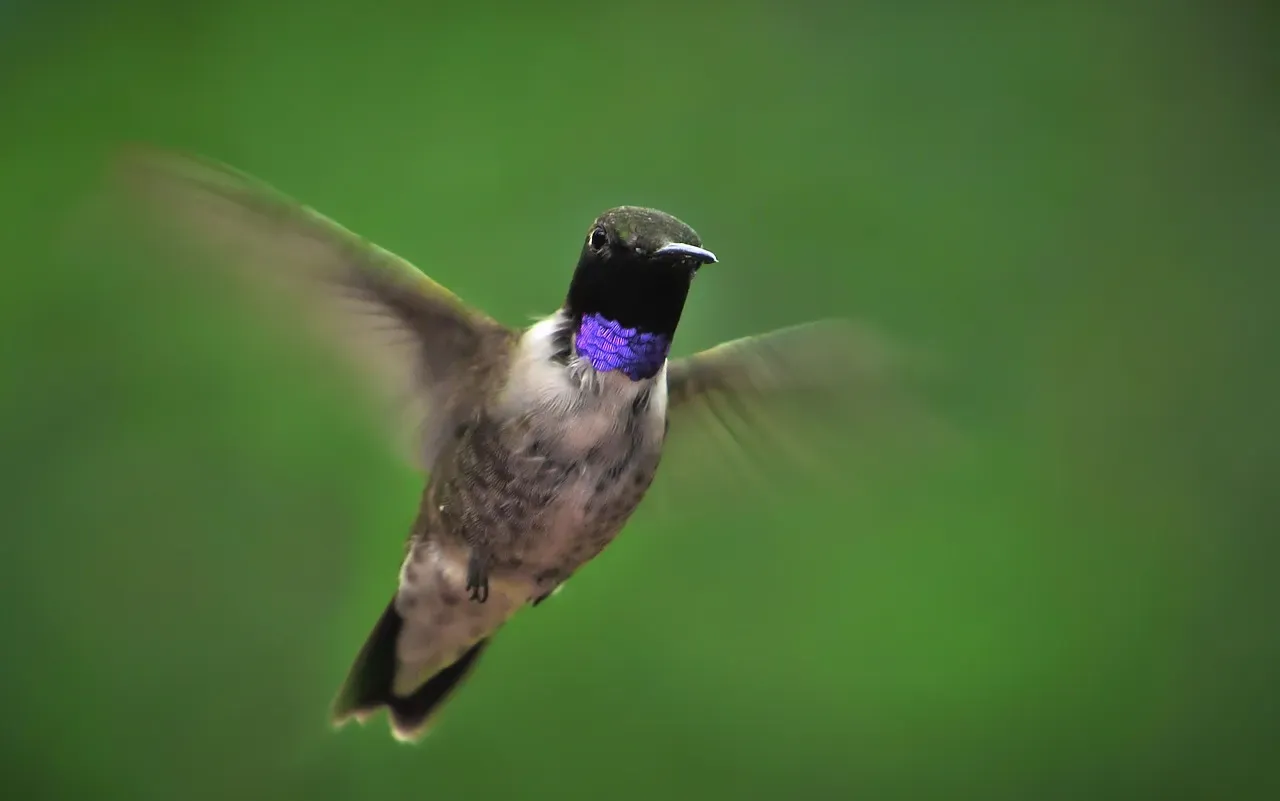
Black-chinned hummingbirds are among the most adaptable of all North American hummingbirds, found in deserts, mountain forests, urban parks, and natural areas. Adaptability is underrated in wildlife, and this species has mastered it. You might see one in a desert wash one morning and a suburban garden the next afternoon.
The male’s mostly black throat gives this species its common name, but just the right turn of the head, in the proper light, startlingly reveals a narrow, rich blue-violet gorget bordering the black. That subtle iridescence is easy to miss if the light is wrong. Black-chinned hummers are tail waggers, their tail is almost always twitching when they hover to feed, a behavior that can help distinguish females from similar species. It’s one of those small behavioral details that experienced birders rely on more than plumage alone.
5. Calliope Hummingbird (Selasphorus calliope)
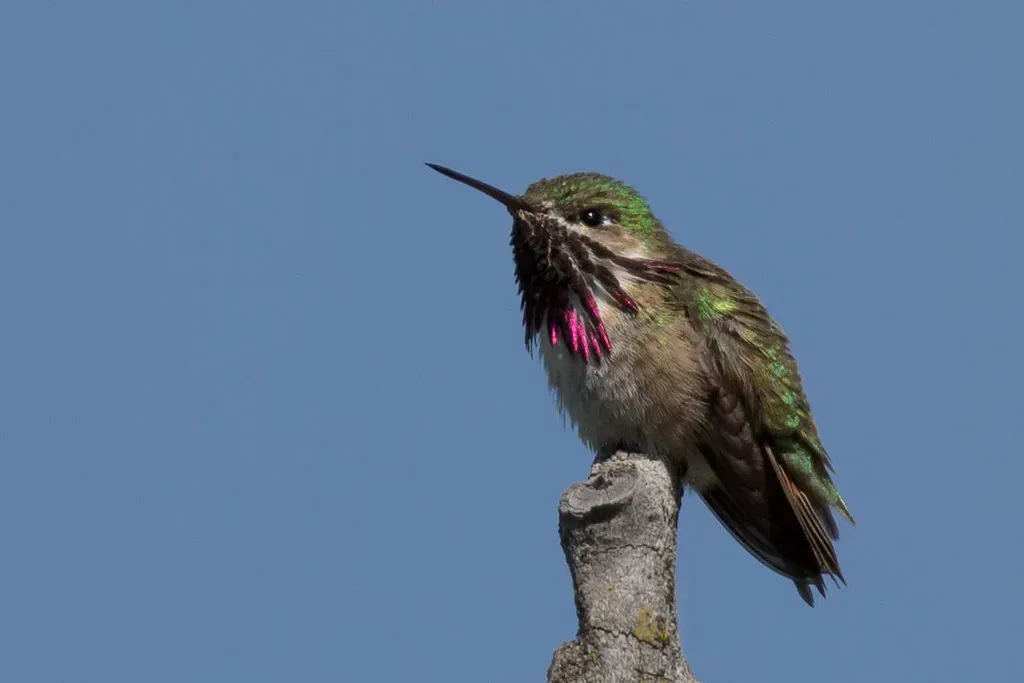
The smallest bird breeding north of Mexico in North America, the dainty calliope hummingbird is a mountain specialist, breeding as high as timberline from the Sierra Nevada and Cascade crest to the Rockies. Despite being the tiniest long-distance migrant bird in the world, it carries itself with an almost improbable confidence. They are among the long-distance migrators, their annual path taking them as far north as the Canadian Rockies of central British Columbia from their wintering grounds on the Pacific side of central and southern Mexico. This circuitous journey, which can reach 5,000 miles for some individuals, makes the calliope hummer the world’s smallest long-distance migratory bird.
The standout feature of a Calliope Hummingbird is the magenta rays on the male’s throat. Both males and females are greenish above, but males wear a greenish vest below while females and immatures have a peachy wash across their underparts. Magenta rays burst from the throats of the male Calliope Hummingbird as it dances and hovers, performing U-shaped display dives for females. During these displays he makes a sputtering buzz with tail feathers and gives a sharp zinging call.
6. Broad-tailed Hummingbird (Selasphorus platycercus)
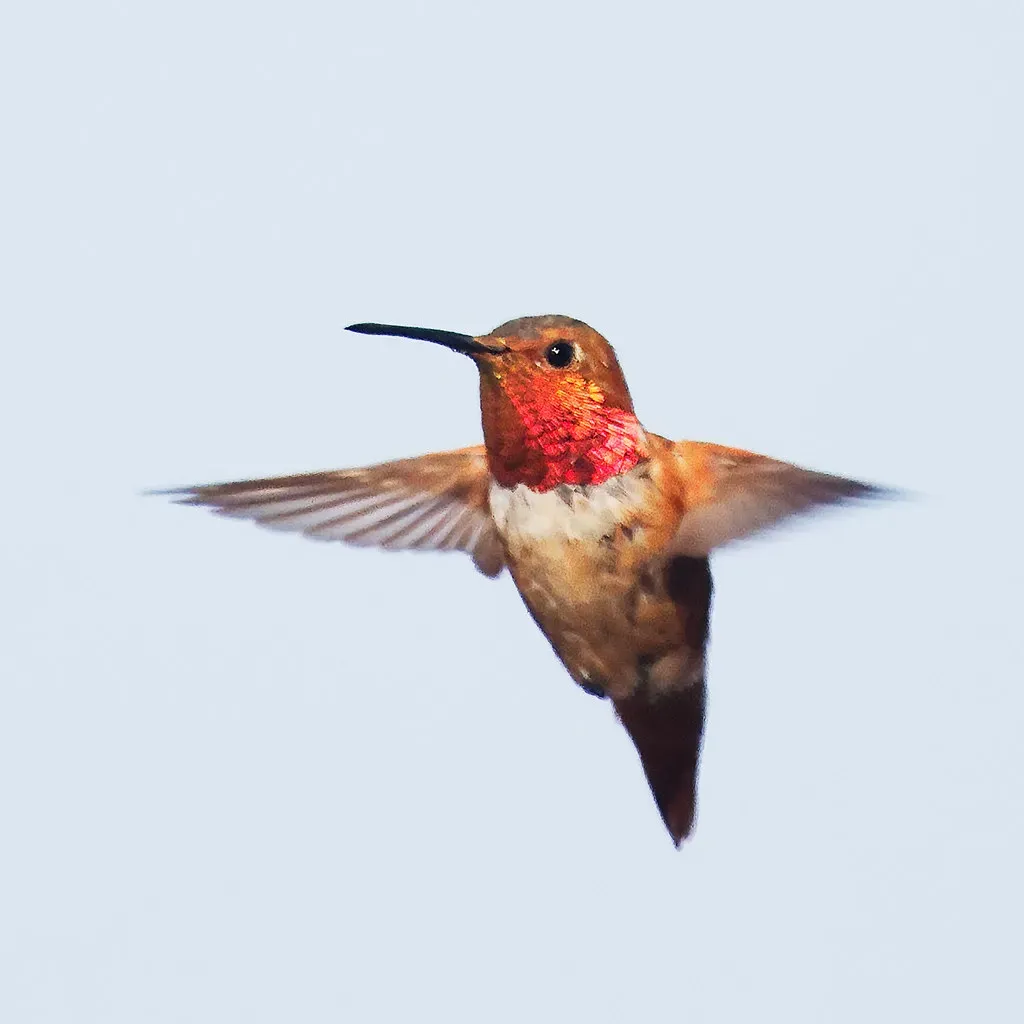
The common hummingbird of the central Rockies, the broad-tailed hummingbird reaches the northern extent of its breeding range in the mountains of southwestern Montana, eastern and central Idaho, and possibly far eastern or southeastern Oregon. Broad-tailed hummers are the most common type of hummingbird in Colorado. During summer, they are easy to find around feeders and areas of good habitat in many of the state’s mountain towns.
They breed and nest at high elevations, even above 10,000 feet. Thanks to the shape of its outer primary flight feathers, the male can produce a rapid, insect-like trill, which it uses during courtship display dives and during chase flights. Male broad-tailed hummingbirds have a light-colored belly, shimmering green back and wings, and a rosy pink gorget. The breast is white, and the species also has a distinctive white eye-ring to set it apart from other hummers. That wing trill is often how birders hear this species before they see it.
7. Costa’s Hummingbird (Calypte costae)
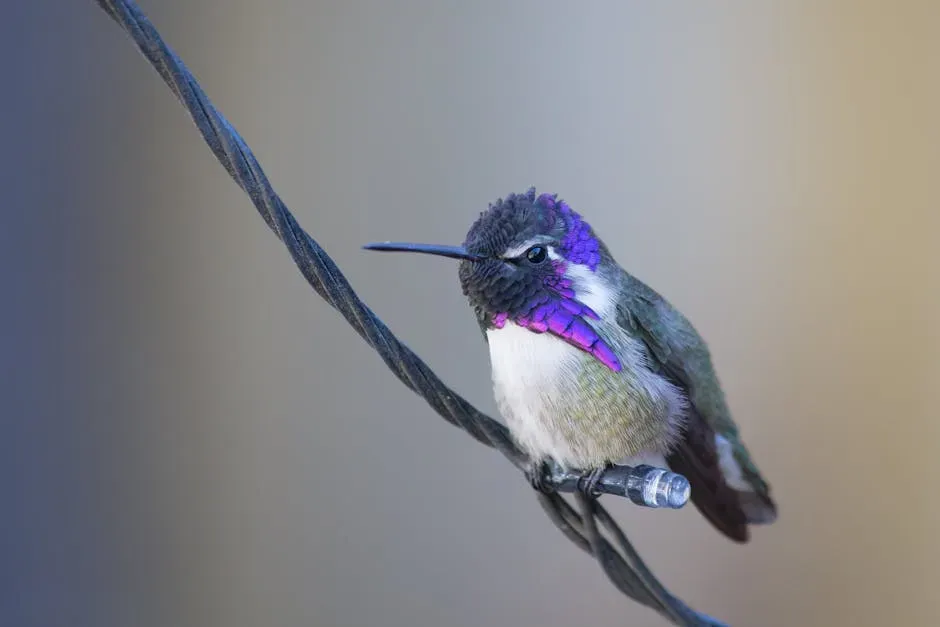
Costa’s hummingbirds zip among saguaro and ocotillo in the parched landscape of the Sonoran and Mojave deserts. Males flash a brilliant royal purple throat patch that juts off the sides of their neck like little wings. There’s something almost theatrical about them, darting through the desert heat with all that purple finery. They look like they belong in a painting rather than a cactus patch.
The adult male sports a brilliant royal purple crown and gorget, which envelops the face and base of the bill, and forms a long, pointed “mustache.” This makes him one of the most photogenic types of hummingbirds in North America. Though Sonoran desert scrub is the Costa’s natural habitat, vagrants appear annually in the San Francisco Bay area and almost annually from northern California to British Columbia. Costa’s hummingbird is currently listed as a Bird of Conservation Concern, making every sighting carry a little extra weight.
8. Allen’s Hummingbird (Selasphorus sasin)
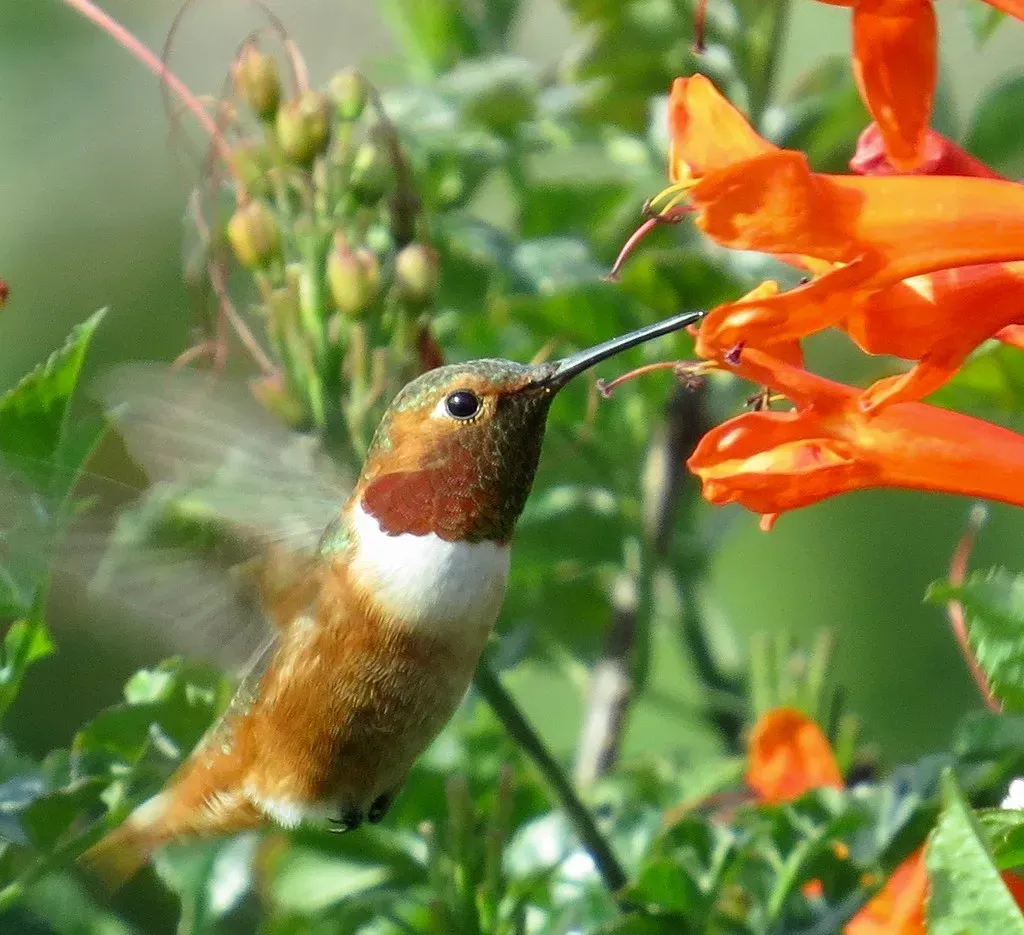
Allen’s hummingbirds are lookalike cousins to the Rufous Hummingbird, with an affinity for the fragrant coastal scrub and chaparral of California and Oregon. If you’re birding the California coast and spot what looks like a rufous hummingbird, there’s a real chance it’s actually an Allen’s. Telling them apart is genuinely difficult. Both Allen’s hummingbirds and rufous hummingbirds share many of the same physical characteristics and can be extremely hard to distinguish in the field, even by experienced birders. The only true way to decipher between these species is by subtle differences in the shape of their tail feathers. In Allen’s hummingbirds, all tail feathers are narrower than their rufous counterpart.
Males fly elaborate courtship displays, though as with most hummingbird species, the males don’t help raise the young. The male’s display is a rapid, steep J-shaped or elliptical dive accompanied by a sharp, metallic squeal. Other than a tiny length of coastline in bordering southwestern Oregon, California comprises the entire breeding range of this energetic, tiny hummingbird. That narrow range makes it a regional specialty worth seeking out.
9. Lucifer Hummingbird (Calothorax lucifer)
The tiny, vividly purple-throated Lucifer Hummingbird is mainly a species of northern Mexico and central Mexico. Where it reaches the United States, in extreme southern Arizona, New Mexico, and west Texas, it’s a highly sought-after species among avid birders. Its name comes not from anything sinister but from the Latin word for “light-bearing,” a nod to its dazzling gorget. Even so, it’s a bird that feels delightfully dramatic.
The Lucifer Hummingbird’s most distinctive features are its curved bill and narrow, forked tail. The large head and heavy, downcurved bill seemingly overbalance this bird’s small, tapered body. Unlike other hummingbirds, which perform courtship displays near feeding areas, perches, or special sites for group displays, the male Lucifer Hummingbird performs its displays at the nest of a female. That behavior alone sets it apart. It is one of six species currently listed as a Bird of Conservation Concern, which gives the birding community genuine reason to pay attention when one appears.
10. Broad-billed Hummingbird (Cynanthus latirostris)
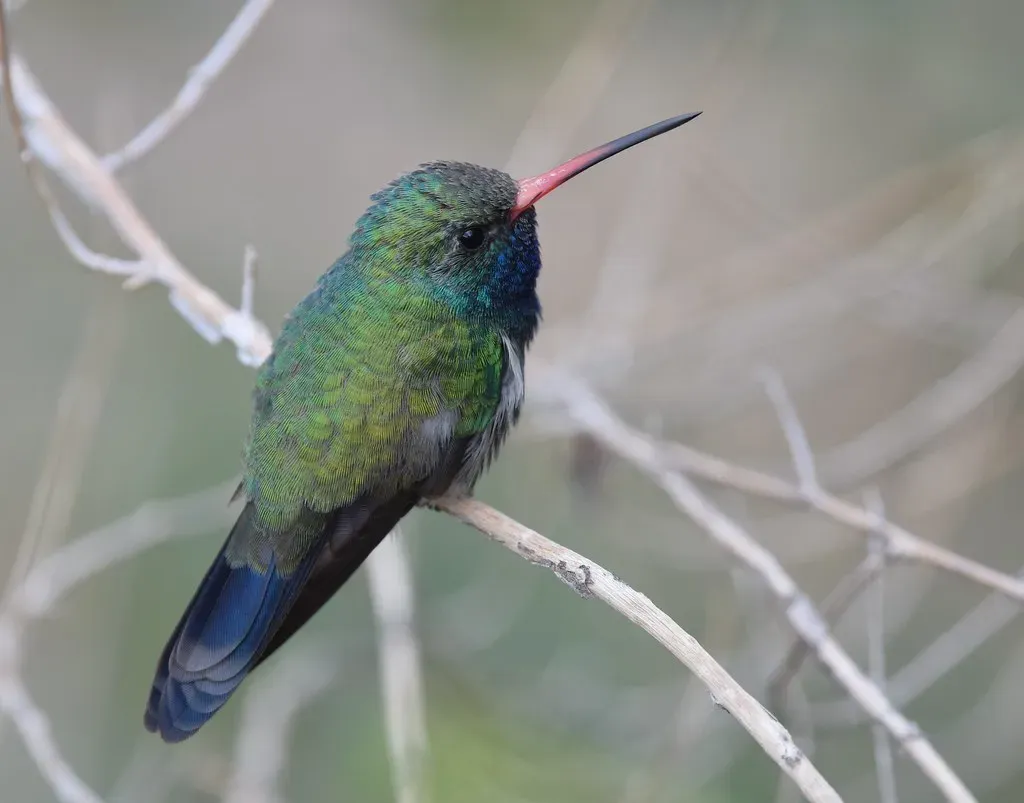
The Broad-billed Hummingbird is a beauty in a beautiful family. The male’s vivid red bill, emerald body, and glittering sapphire throat sets it apart from other U.S. hummingbirds. When the light hits a male broad-billed just right, the combination of those three colors is genuinely arresting. It’s the kind of bird that makes newcomers question whether they’re actually looking at something from a tropical rainforest.
Broad-billed hummingbirds have emerald bodies, vivid red bills with black tips, and wingspans of about 5 inches. Adult males also have vibrant blue throats, white undertail coverts, and black forked tails, while adult females have grayish throats and undersides, and pale outer tips on their tails. A distinguishing feature of females is the thin white spot behind their eyes. Broad-billed Hummingbirds reach their northern range limit in southern Arizona and southwestern New Mexico, and they’re mostly summer visitors.
11. Blue-throated Mountain-Gem (Lampornis clemenciae)
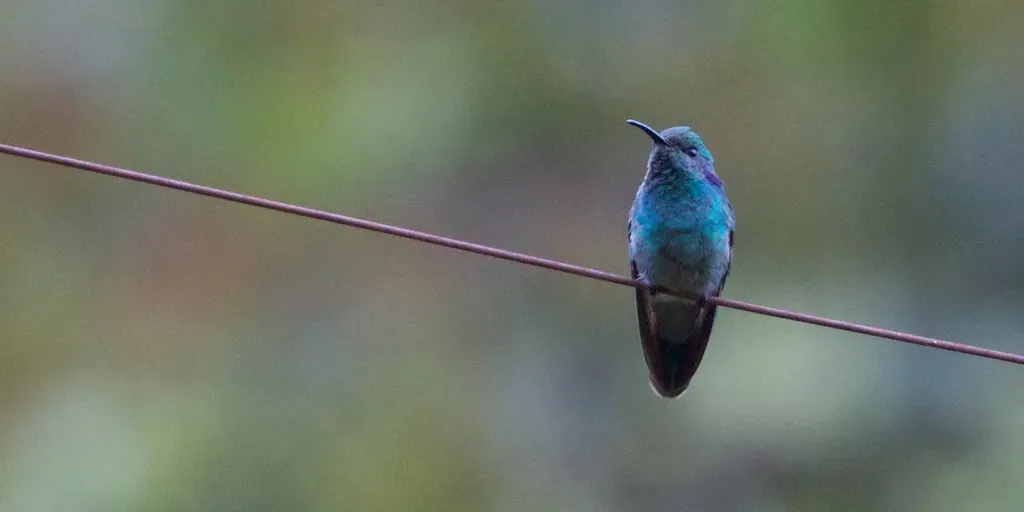
Blue-throated hummingbirds are the largest hummingbird species that nests in the United States, about 3 times heavier than the ruby-throated hummingbird. They can be bold and aggressive in dominating other hummingbirds, capable of beating their wings about half as fast as smaller hummingbird species. Size, in this case, comes with a slower and more audible hum. Blue-throated Mountain-gems have relatively slow wing beats for hummingbirds, beating about 20 times per second compared to 50 to 80 for smaller species. Their flight produces a noticeably deeper hum.
Both male and female blue-throated hummingbirds look similar and have complex songs sometimes sung in a duet, and they perform a series of short flights during courtship. The male has a striking cobalt blue gorget that’s not easily seen, usually only visible at certain angles. These birds favor shaded mountain streams and canyons with sycamores and maples, quite different from the open habitats that many desert species prefer. Finding one in a shaded canyon in the Chiricahua Mountains is one of the more memorable experiences birding in the American Southwest can offer.
12. Rivoli’s Hummingbird (Eugenes fulgens)
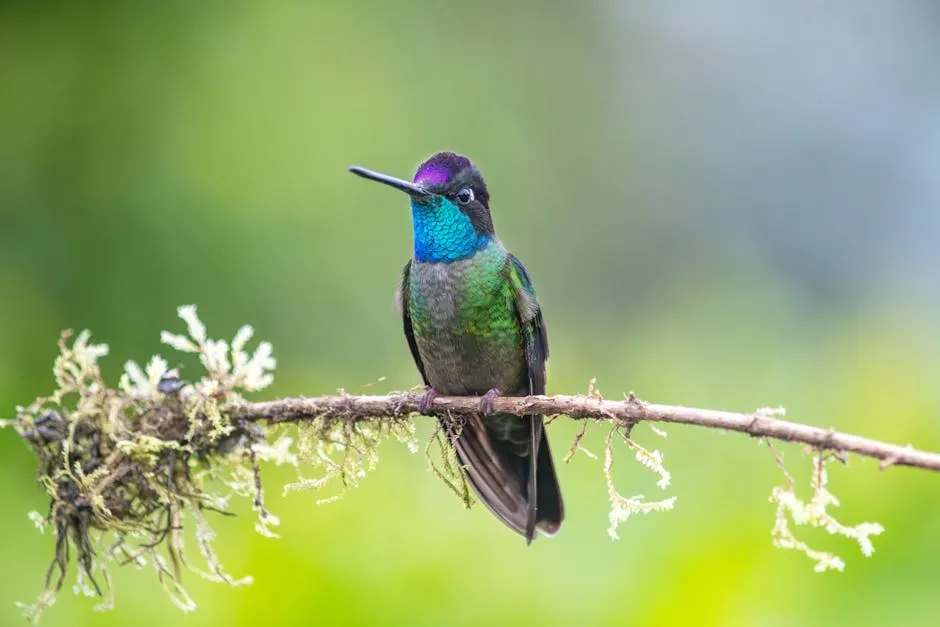
The former common name for this species, magnificent hummingbird, seemed perfectly appropriate for a large, striking hummingbird that reaches the northernmost extent of its range in the American Southwest. In 2017, the American Ornithological Society split the magnificent hummingbird into the talamanca hummingbird of Costa Rica and western Panama, and the Rivoli’s hummingbird, which ranges from northern Nicaragua to the southwesternmost United States. The name change is recent enough that many birders still reach for the old name by instinct.
The male has a black breast and emerald-green gorget that separates it from all other U.S. hummers. Also look for a brilliant purplish crown. It is the second-largest North American hummingbird. The Rivoli’s Hummingbird favors the interior of pine-oak forests, humid montane or cloud forest, and forest edges at elevations ranging from 1,500 to at least 2,740 meters. A Rivoli’s Hummingbird lifespan of 11 years and 2 months has been documented based on a bird banded and recaptured in Arizona. For a bird this size and this striking, it remains surprisingly under-celebrated outside serious birding circles.
A Few Final Thoughts for Any Birder
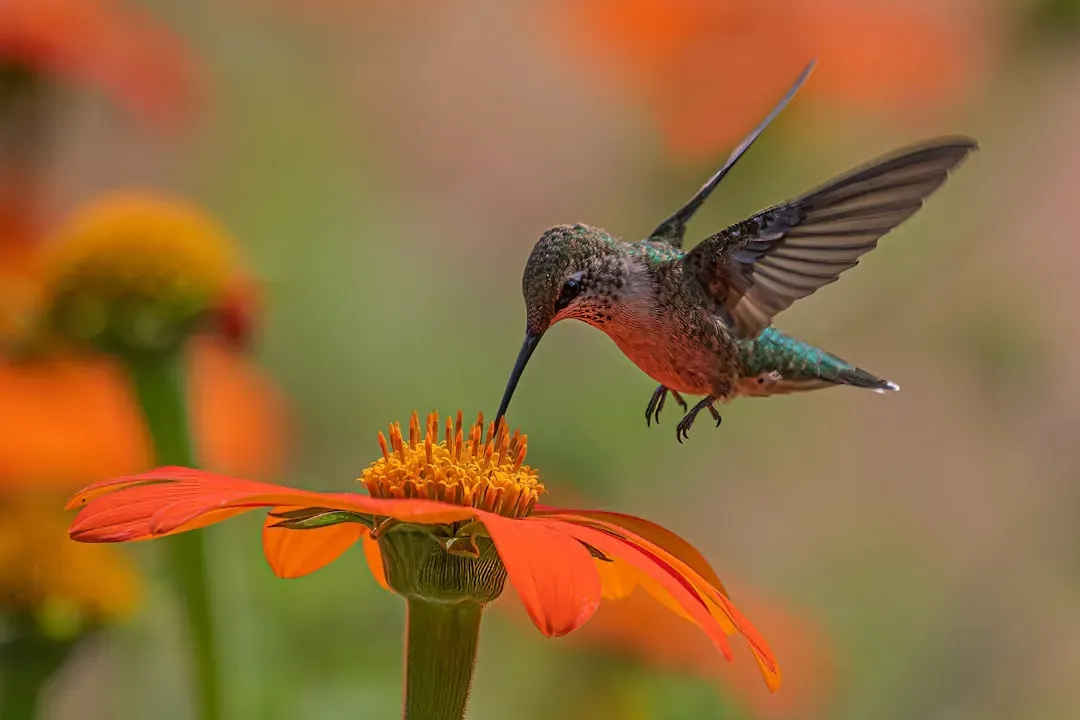
Getting serious about hummingbirds means learning to slow down. Identifying them can be a challenge. They are tiny and restless. Their color pattern can be difficult to discern on a tiny body and may look different when seen from different angles. Location matters enormously too. Most North American hummingbirds are migratory and spend only a few months in specific regions of the country. Several species including the Lucifer, Violet-crowned, Buff-bellied, Broad-billed, and Rivoli’s Hummingbirds are found regularly in only a few locations near the U.S. Mexico border.
To conserve energy, hummingbirds can enter a state of torpor, slowing their metabolism and lowering their body temperature when environmental conditions are challenging. Hummingbirds have co-evolved with numerous plants to pollinate them as they drink from their nectar. While nectar is their primary food source, they also consume spiders, insects, and tree sap, especially during the breeding season when protein is essential for their young. These aren’t just decorative birds for backyard feeders. They’re ecological anchors, pollinators, and long-haul athletes wrapped in iridescent feathers.
There’s a reason birders pursue hummingbirds with such dedication. Sadly, more than 28 species, roughly 10 percent of all hummingbirds, are now threatened by extinction. That gives identification more than recreational value. Knowing which species you’re looking at, where it should be, and whether its numbers feel right, is the foundation of meaningful observation. The 12 species described here are a starting point, not a ceiling. Spend enough time in the right places, and you’ll find that even the most familiar species still has something new to show you.
