


The majestic bald eagle, America’s national bird, is not only known for its impressive appearance and hunting prowess but also for its sophisticated communication systems. These powerful birds utilize a diverse repertoire of signals to convey messages to mates, offspring, rivals, and even other species. From their iconic vocalizations echoing through forests to subtle body language that might go unnoticed by casual observers, bald eagles have developed numerous ways to express themselves in their natural habitats. This article explores 17 distinct communication methods used by bald eagles in the wild, offering insight into how these remarkable birds navigate their social interactions and maintain their place at the top of the avian hierarchy.
16. The Distinctive Bald Eagle Call

Perhaps the most misrepresented aspect of bald eagle communication is their vocalization. Despite what Hollywood might have you believe, bald eagles don’t produce the powerful, high-pitched screech often attributed to them in films (which is actually the call of a red-tailed hawk). Instead, bald eagles typically emit a series of high-pitched whistling or piping notes that sound surprisingly weak for such a powerful bird. These calls, consisting of a rapid series of 4-7 notes that can sound like “kee-kee-kee-kee-ker,” serve multiple purposes from greeting mates to warning rivals. Adult eagles can produce around 10 different vocal sounds, each with specific contextual meanings, primarily used during breeding season or when defending territory.
15. Aerial Displays and Courtship Flights

Bald eagles are renowned for their spectacular aerial courtship displays, which serve as a crucial communication method during mating season. The most dramatic of these is the “cartwheel display,” where two eagles fly to great heights, lock talons, and spin downward in a breathtaking free-fall, separating just before reaching the ground. This death-defying performance demonstrates fitness, coordination, and commitment to a potential mate. Other courtship flights include chase displays and undulating flights where eagles repeatedly dive and rise, showcasing their aerial prowess. These complex flight patterns not only communicate romantic interest but also serve to strengthen the bond between mated pairs, who often stay together for life.
14. Talon Presentations and Prey Transfers

During courtship and pair bonding, bald eagles engage in symbolic talon presentations. A male might approach a female with his talons extended forward, essentially “offering” them to his potential mate. More impressively, established pairs perform mid-air prey transfers, where one eagle passes food to another during flight. This behavior serves multiple communication functions: it reinforces pair bonds, demonstrates hunting ability, and functions as parental training for younger eagles. The precision required for these aerial handoffs is remarkable, with the receiving eagle briefly turning upside-down to catch the prey item with its talons. These food transfers communicate trust and cooperation between eagles and are essential demonstrations of compatibility for breeding pairs.
13. Defensive Posturing and Intimidation Displays

When feeling threatened or defending territory, bald eagles employ distinct physical postures to communicate their dominance or aggressive intent. A defensive eagle will raise its head feathers to appear larger, partially spread and droop its wings in a mantling position, and open its beak while fixing an intense gaze on the perceived threat. This unmistakable posture serves as a warning signal to potential competitors or predators. Eagles may intensify this display by raising their bodies to full height and flexing their impressive talons. These intimidation displays are particularly common around nest sites or when defending a food source, communicating clearly to intruders that they risk physical confrontation if they don’t retreat.
12. Bill Duets and Billing Displays

Mated bald eagle pairs engage in “billing” behaviors as an intimate form of communication that strengthens their bond. During this interaction, eagles will touch or rub their bills together, often accompanied by soft vocalizations. This behavior typically occurs at the nest site and signals affection and pair reinforcement. More elaborate forms of billing include “bill duets,” where eagles will rhythmically open and close their bills while facing each other, sometimes interlocking them briefly. This synchronized behavior serves as confirmation of mate recognition and pair status. Research has shown that pairs who engage in more frequent billing displays tend to have higher breeding success, suggesting this communication method plays a vital role in maintaining the long-term partnerships that characterize bald eagle relationships.
11. Nest Building Communication

The process of building and maintaining nests involves distinct forms of communication between mated eagles. Pairs coordinate their efforts through specific vocalizations and body language as they construct some of the largest nests in the avian world (sometimes reaching 10 feet across and weighing up to a ton). Eagles communicate about nest construction through “placement calls”—short, repeated notes that increase in frequency when a branch or nesting material is positioned correctly. They also use visual cues, with one eagle demonstrating where materials should go by manipulating existing nest components. These building communications are crucial for creating the massive, sturdy structures that will safely house their offspring and serve as the center of family life for potentially decades, as bald eagles add to the same nest year after year.
10. Parental Feeding Signals

Adult bald eagles use specific communication methods when feeding their eaglets. Parents will produce distinct “feeding chitters”—soft, rapid vocalizations that signal to chicks that food is available. When approaching the nest with prey, adults typically emit a unique arrival call that prepares the nestlings for feeding. As eaglets develop, parents use increasingly subtle communication to teach proper feeding behavior, including head movements that demonstrate how to tear food and position signals that establish feeding hierarchy among siblings. Interestingly, research has documented that parent eagles adjust their feeding communications based on food availability, using more urgent signals during times of scarcity to reduce sibling competition. These feeding communications play a critical role in eaglet development and ultimately in teaching young eagles how to feed themselves once independent.
9. Juvenile Begging Behaviors

Young bald eagles have developed specialized communication methods to solicit food and care from their parents. Eaglets produce persistent “hunger chirps”—high-pitched, rapid calls that increase in intensity when they’re hungry. These vocalizations are accompanied by distinctive physical behaviors, including wing-quivering displays where the juvenile rapidly vibrates its partially extended wings while maintaining an upright posture. Older nestlings will perform “food solicitation dances,” hopping toward parents with wings slightly raised. These multimodal begging communications continue even after young eagles have fledged, with juveniles following parents and continuing to signal dependency for up to 8-14 weeks after leaving the nest. The persistence and intensity of these begging communications help ensure the young eagles receive adequate nutrition during their crucial development period.
8. Territorial Boundary Marking

Bald eagles communicate territorial boundaries through both physical and behavioral signals. Established pairs will perform conspicuous perching at the edges of their territory, often selecting the highest available trees or structures that maximize visibility. These “sentinel perches” serve as visual announcements of occupation. Eagles reinforce these boundaries through regular patrol flights, following relatively consistent routes that outline their territory. During these flights, they may emit territorial calls—harsh, staccato notes distinct from other vocalizations. Physical marking also occurs through strategic droppings and the placement of molted feathers along boundary lines. Research using GPS tracking has revealed that these territorial communications are remarkably effective, with neighboring eagle pairs rarely violating established boundaries except during severe food shortages.
7. Interspecies Communication
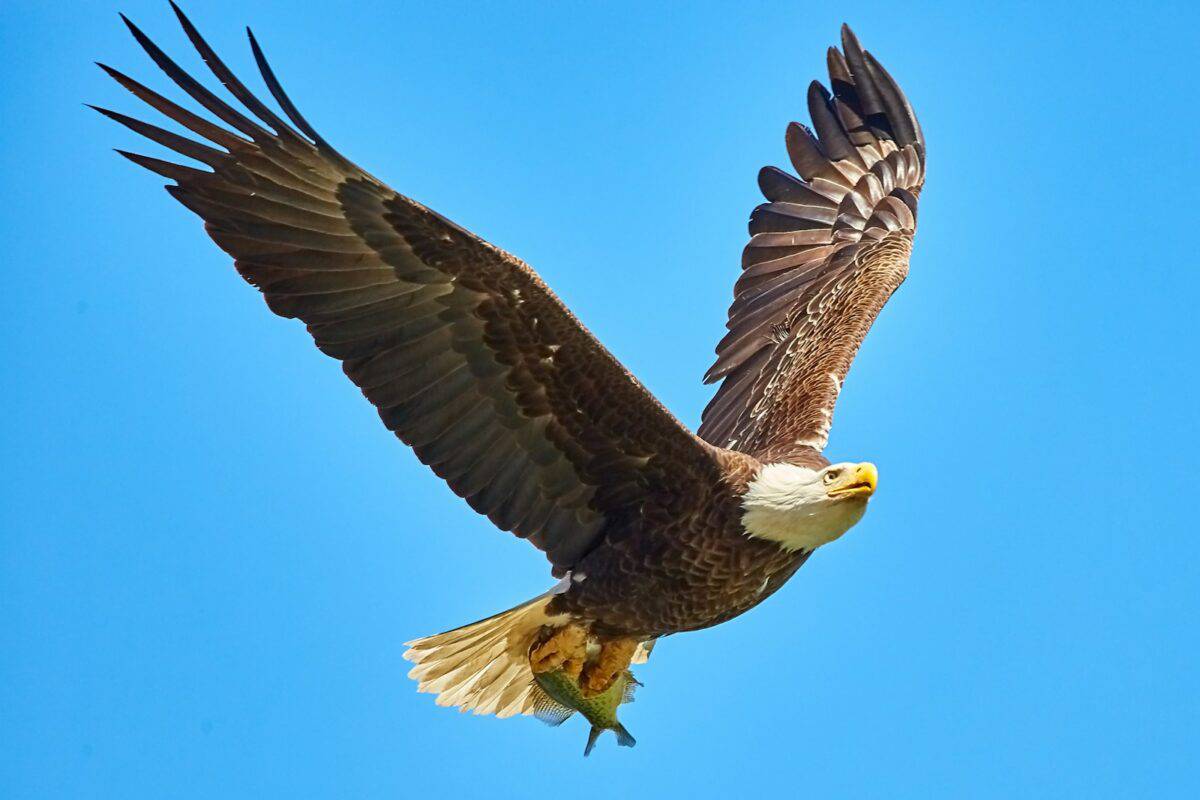
Bald eagles communicate not only with their own kind but also send and receive signals across species boundaries. When competing with osprey, ravens, or other birds for food sources, eagles use specific interspecies threat displays that differ slightly from those used against other eagles. These modified displays include exaggerated wing spreads and distinctive vocalizations that have evolved to be recognizable as warnings to multiple bird species. Eagles also respond to alarm calls from other birds, demonstrating an understanding of heterospecific communication. Perhaps most interestingly, bald eagles engage in information sharing with ravens in some regions, forming a complex relationship where ravens lead eagles to food sources and eagles provide access to carcasses the ravens couldn’t open themselves. This sophisticated cross-species communication showcases the adaptive intelligence that characterizes these impressive predators.
6. Visual Signals Through Plumage

The distinctive appearance of bald eagles, particularly their white heads and tails contrasted against dark brown bodies, serves as a visual communication system in itself. This high-contrast plumage, which develops when eagles reach sexual maturity around 4-5 years of age, signals breeding status to potential mates and competitors. Juvenile eagles, with their mottled brown appearance, communicate their immature status, which often grants them certain social privileges like reduced aggression from adults and greater tolerance at feeding sites. Eagles can also communicate momentary emotional states through subtle manipulation of their head feathers—sleeking them when alert or aggressive and raising them slightly when relaxed or receptive to interaction. Research using high-speed photography has revealed that these plumage adjustments can occur in fractions of a second, providing real-time visual communication during social interactions.
5. Communal Roosting Signals

In areas with abundant food sources like salmon runs or waterfowl concentrations, bald eagles sometimes gather in large communal roosts, requiring specialized communication to maintain social order. Eagles use a combination of postures and vocalizations to establish temporary hierarchies within these groups. Dominant birds perform “displacement flights,” where they approach perched eagles with a distinct gliding pattern that signals their intention to take over a preferred perch. Submissive eagles respond with “yielding postures,” turning their heads away and compressing their body feathers to signal non-confrontational intent. Remarkably, researchers have documented that these communal roost communications include “information exchange” behaviors, where eagles observe each other’s departure directions in the morning and return flight paths in the evening, effectively communicating the location of food sources without direct interaction.
4. Weather-Related Communication

Bald eagles have developed specialized communications related to changing weather conditions, particularly important for protecting vulnerable nestlings. During approaching storms, nesting eagles will emit distinct “weather warning” calls that differ from regular vocalizations. These alert calls prompt specific behaviors from their mates and offspring, including tighter nestling grouping and more protective parental positioning. Eagles also communicate about weather opportunities, with pairs exchanging specific flight invitation calls during the formation of thermal updrafts that facilitate energy-efficient soaring. GPS tracking studies have revealed that eagles communicate about wind patterns through demonstration flights, with experienced birds showcasing efficient flight paths that younger eagles then mimic. This weather-related communication helps eagles maximize their energy efficiency and ensure nest safety during changing environmental conditions.
3. Bathing and Preening Invitations
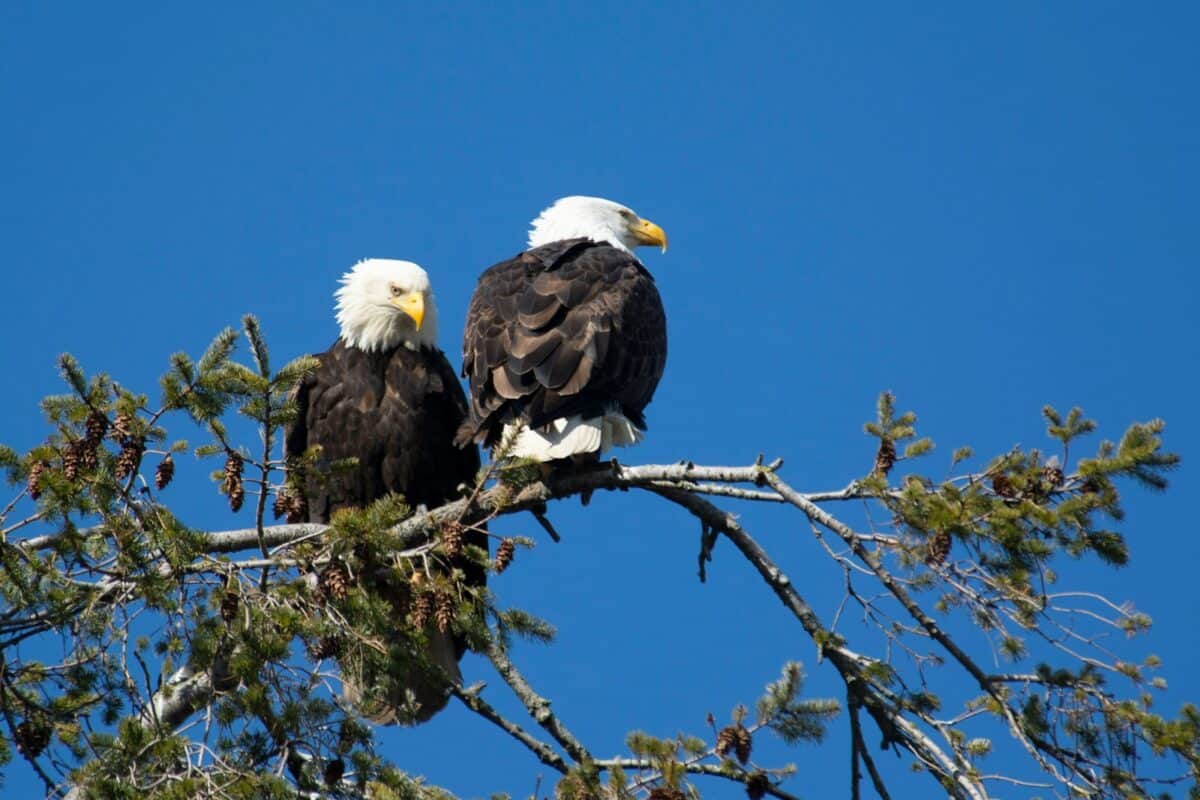
Bald eagles engage in social bathing and preening behaviors that involve distinct communication methods. When inviting another eagle (usually a mate or offspring) to join in bathing, an eagle will perform a characteristic “water dance,” dipping its wings repeatedly in water while making soft, chattering calls. These invitations serve to strengthen pair bonds and teach young eagles proper hygiene behaviors. Following bathing, eagles often engage in mutual preening sessions, using specific head positioning and gentle vocalizations to request preening from partners, particularly for hard-to-reach areas like the head and neck. These grooming communications serve multiple purposes beyond cleanliness, including parasite control, feather maintenance, and social bonding. Research has shown that eagle pairs who engage in more frequent mutual preening communications typically maintain longer-lasting bonds.
2. Migration and Navigation Signals

While not all bald eagle populations migrate, those in northern regions that do undertake seasonal movements employ specific communications to coordinate their journeys. Unlike species that migrate in tight formations, eagles often travel in loose aggregations, using distinct “gathering calls” that help maintain group cohesion without requiring close proximity. Experienced adults communicate flight paths through demonstration soaring, with juveniles following their lead to learn traditional migration routes. Perhaps most fascinating is the documentation of “landmark communication,” where eagles use vocalizations and flight patterns to alert others to geographic features that aid navigation or indicate productive feeding areas along migration routes. Tracking studies have revealed that these migration communications are crucial for juvenile eagles, who show significantly higher survival rates when they migrate within communication range of experienced adults.
1. Distress and Alarm Signals

When faced with immediate threats or dangerous situations, bald eagles employ urgent communication methods that differ from their standard vocalizations. The eagle distress call is a distinctive, rapid series of high-pitched notes that increase in intensity and speed as the perceived threat level rises. This alarm vocalization serves both to warn other eagles and potentially to startle predators. Eagles also use visual distress signals, including a characteristic “fear posture” where they crouch low with feathers sleeked and head retracted, communicating vulnerability. Parent eagles have developed specific “nestling danger calls” that prompt immediate defensive responses from young, including dropping flat in the nest to avoid detection. Research using playback experiments has shown that these distress communications are recognized not only by other eagles but also by some mammalian predators that have learned to associate these signals with aggressive eagle defense behaviors.
Conclusion: The Complex Communication World of Bald Eagles

The 17 communication methods explored in this article reveal the remarkable complexity of bald eagle social interactions. From their distinctive vocalizations and dramatic aerial displays to subtle body language and interspecies signaling, these magnificent birds employ a sophisticated language that ensures their survival and reproductive success. Understanding these communication patterns not only provides valuable insight into eagle behavior but also highlights the importance of protecting the environments where these communications occur. As scientists continue to study eagle communication using advanced technologies like high-definition recording and tracking devices, we can expect to discover even more nuances in how these iconic birds share information and maintain their intricate social structures. The rich communication repertoire of bald eagles stands as a testament to their intelligence and adaptability, qualities that have helped them recover from near extinction to once again soar above North America’s landscapes.

As a little kid, I fell in love with nature, wildlife, and animals. Living in the USA, South Africa, Italy, China and Germany gave me the opportunity to discover the world's Wildlife. My favorite animals are Mountain Gorillas, Siberian Tigers, and Great White Sharks.
I'm a certified PADI Open Water Diver, went to Everest Base Camp and Trekked Gorillas in Uganda. I hold a Master of Science in Economics and Finance.
Please send any feedback to feedback@animalsaroundtheglobe.com
- 13 Cat Breeds That Get Along with Dogs - July 20, 2026
- The 12 Largest Dog Breeds That Still Love to Cuddle - July 20, 2026
- 12 Pet Habits That Secretly Mean They Love You - July 20, 2026