
The United States sits on some of the most geologically dramatic ground on Earth. Volcanic belts, ancient fault lines, and deep-mantle eruptions have conspired, over tens of millions of years, to create pockets of mineral beauty found absolutely nowhere else. While most people associate gemstones with places like Myanmar, Sri Lanka, or South Africa, a handful of the world’s rarest and most captivating stones can only be traced back to American soil.
What makes this especially remarkable is that most of these gems were stumbled upon by accident, by ranchers looking for gold, prospectors chasing copper, or miners hunting for industrial minerals. What they found instead were stones that would baffle geologists, excite jewelers, and spark rivalries in the auction world. Here are six gemstones that belong exclusively to the American landscape, each with its own strange and compelling story.
#1. Red Beryl (Utah / New Mexico): The Rarest Beryl on Earth
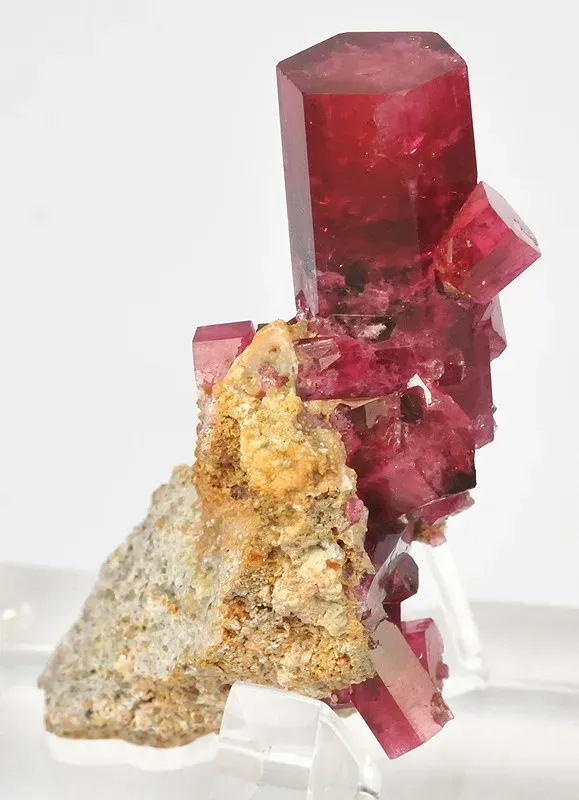
There are gemstones that are rare, and then there is red beryl. It is estimated to be worth 1,000 times more than gold, and so rare that one red beryl crystal is found for every 150,000 diamonds. That number is almost difficult to hold in your mind. It means that for every small, faceted red beryl you might ever encounter, there are tens of thousands of gem-quality diamonds that exist in the world by comparison.
Red beryl is presently found at only three locations in the world: the Thomas Range and the Wah Wah Mountains in west-central Utah, and the Black Range in New Mexico. In the entire world, crystals suitable for cutting gems have been found in only one location: the Ruby-Violet claims in the Wah Wah Mountains of Beaver County, Utah.
In 1904, Maynard Bixby discovered red beryl in the Thomas Range in Juab County, Utah. He thought it might be a new variety of beryl, but the raspberry-red color did not correlate with any beryl known to exist at the time. Laboratory analysis later showed that manganese, along with small amounts of iron, chromium, and calcium, creates the raspberry-red color.
Red beryl is a rare mineral because its formation requires a unique geochemical environment. First, beryllium must be present in large enough amounts to form minerals. Second, manganese must be present at the same time and location. Beryllium rarely occurs in large enough quantities to produce minerals, and the conditions needed to produce a red color rarely occur. This coincidence of two rare events is why red beryl is found in just a few places on Earth.
Red beryl rough is rarely larger than one carat in weight, and most faceted red beryls are only a quarter carat or less. The largest known gem-quality red beryl weighs 8 carats. Moreover, a 2-carat red beryl is considered as rare as a 40-carat diamond.
#2. Benitoite (California): The Blue That Shouldn’t Exist
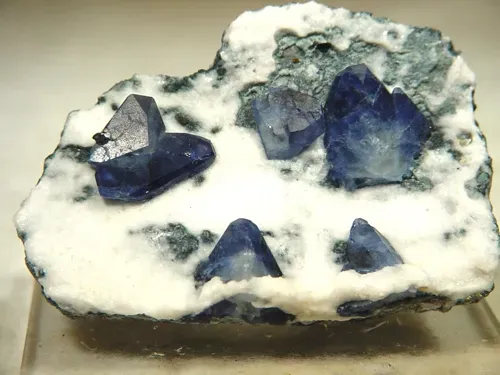
If red beryl is the rarest red gemstone in America, benitoite is its blue counterpart. Gemstone-quality material has only been found in California at the Benito Gem Mine, where it was first discovered. On October 1, 1985, benitoite was designated the official state gem by the California legislature. It is a barium titanium silicate that can occur in rich blue crystals as striking and flawless as the finest sapphires.
It was discovered in 1907 by prospector James M. Couch in the San Benito Mountains, located in central California, southeast of San Jose. Due to its similar color, Couch originally believed it to be sapphire. In 1909, a sample was sent to the University of California, Berkeley, where mineralogist Dr. George D. Louderback realized it was a previously unknown mineral.
One of the most startling things about benitoite is how little science understands its color. Scientists have been unable to identify exactly what gives benitoite its amazing color, and have been unable to duplicate or replicate benitoite’s crystal growth or fluorescent nature. Benitoite fluoresces a bright, deep sky blue under short-wave ultraviolet light, a phenomenon that makes it one of the most visually dramatic minerals ever discovered.
Benitoite outranks every precious gemstone, including diamond, in dispersion, the fiery color flashes bouncing off the stone’s surface. A clean, rare 1-carat cut benitoite sells between $6,500 and $8,000, depending on color, cut, and clarity. The Smithsonian Institution holds the largest stone on record, at 7.8 carats.
The San Benito Mine in California is the only known benitoite mine for gem-quality stones, and it produces only around 300 carats of gem-quality benitoite annually. That is a breathtakingly small supply for a gemstone that collectors worldwide actively pursue.
#3. Yogo Sapphires (Montana): America’s Crown Jewel Contender
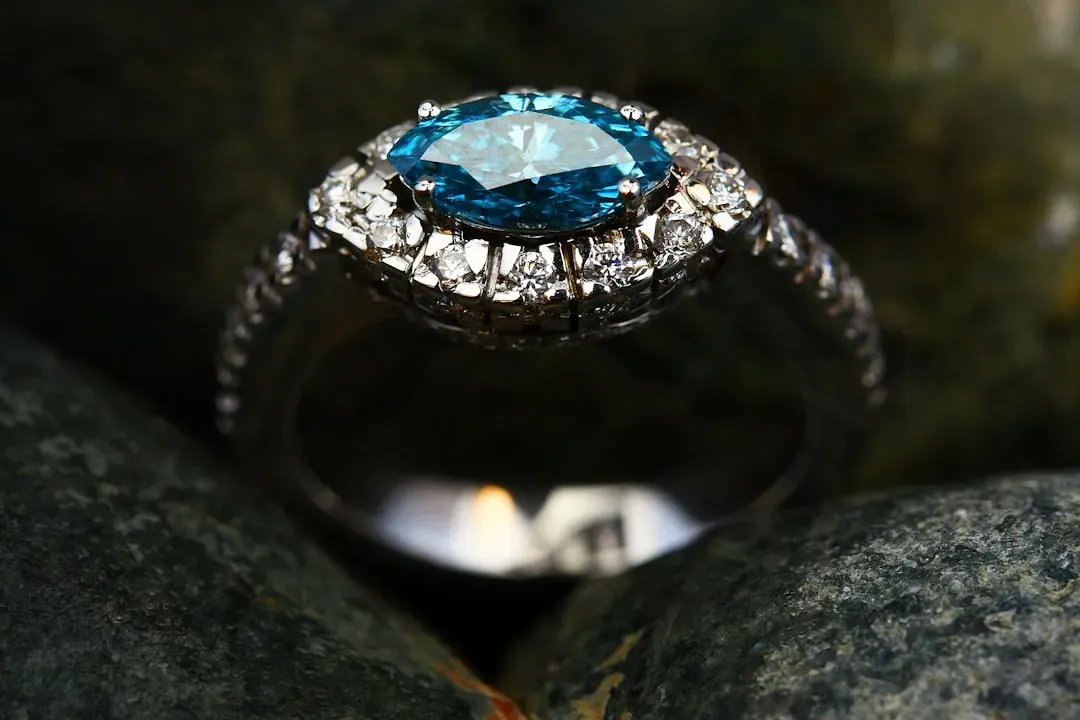
Montana earned its nickname, the Treasure State, fair and square. Yogo sapphires are blue sapphires found in the US state of Montana, primarily in Yogo Gulch in the Little Belt Mountains. They are typically cornflower blue, a result of trace amounts of iron and titanium, with high uniform clarity that maintains its brilliance even under artificial light.
It wasn’t until the 1890s that sapphires were discovered in the Yogo Gulch area. The discovery was accidental, and it wasn’t until 1895 that they were recognized as a unique type of sapphire. A rancher named Jake Hoover stumbled upon a small sapphire deposit while watering his horses. After one year of mining, he and his partners had found just 40 ounces of gold and a few pretty blue pebbles. While other miners discarded the tiny blue rocks, Hoover began to collect them until he had a cigar box full.
Montana Yogo Sapphires, sourced exclusively from a single deposit in central Montana, are celebrated for their naturally intense blue and violet hues and exceptional clarity, requiring no heat treatment to achieve their brilliance. This is a critical distinction in the gemstone world. Yogo sapphires lack the color zoning so prevalent in other sapphires, their uniform cornflower blue color is entirely natural, and their clarity is uniformly high. These features rank them among the world’s finest sapphires.
Yogo sapphires are found within a five-mile-long geological strike in the Little Belt Mountains, embedded in lamprophyre dikes. Early miners extracted Yogo-bearing rock from veins as wide as 20 feet, but today mining is limited to much narrower veins, only 8 to 10 inches wide, located 400 feet underground.
The rough Yogo crystals tend to be small and flat, so cut gems heavier than 2 carats are rare. Only about ten percent of cut pieces are over 1 carat. The largest recorded Yogo rough, found in 1910, weighed 19 carats and was cut into an 8-carat gem. For all their limitations in size, their quality is essentially without peer in North America.
#4. Oregon Sunstone (Oregon): America’s Color-Shifting Treasure
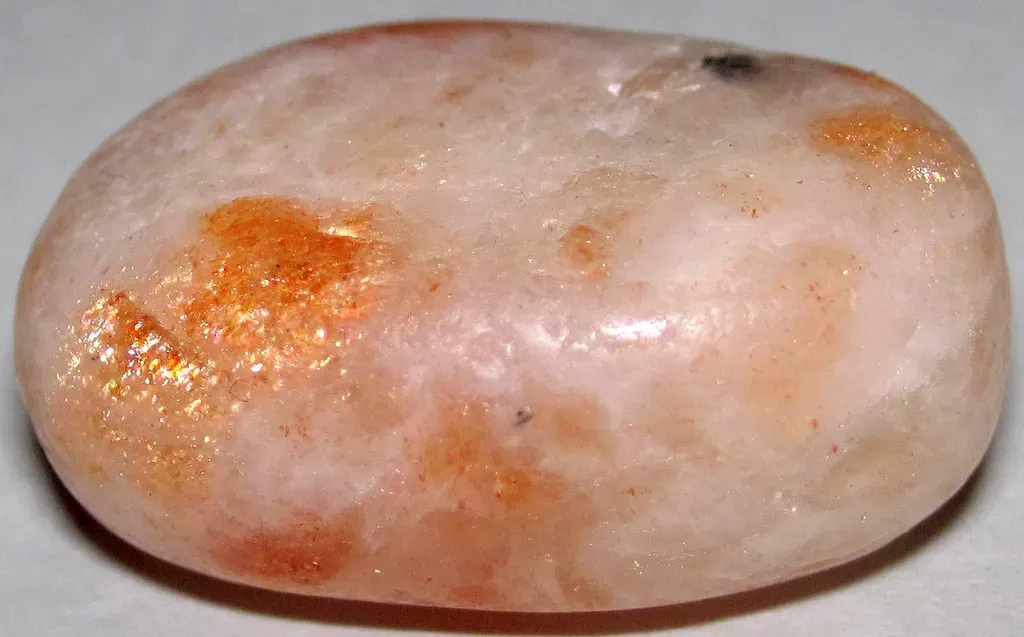
Most people have never heard of Oregon sunstone, and that is genuinely one of gemology’s stranger oversights. While plagioclase feldspar is found in other locations in the world and can occasionally have a schiller effect, only the sunstone from Oregon contains copper, making it a unique and rare gemstone. That copper content is everything. It is what gives this stone its color, its fire, and its identity.
Sunstones are feldspar crystals that formed in lava. Thirteen to fourteen million years ago, a volcano in Steens Mountain erupted, pouring out massive amounts of lava. The lava flow was subsequently covered by a vast lake and remained underwater for thousands of years. As the lake gradually dried up, exposure to weather caused the lava to decompose and reveal loose sunstones.
Oregon sunstone occurs in a variety of colors, beginning with colorless and ranging through yellow, orange, brown, pink, red, green, blue-green, and multicolor. The color is determined by the abundance and size of copper trace elements and platelets within the gemstone. Essentially, the more copper, the deeper and richer the color, which is why each stone tells a slightly different geological story.
To date, Oregon sunstone has only been found in two small areas of Oregon, one near Plush in Lake County and the other in nearby Harney County. Considering its uniqueness, it’s not surprising that it was designated the state gem of Oregon in 1987. Sunstone was not well-known until the early 1900s when reports were found in the Warner Valley area, though Native Americans had been using the stone for centuries before that. Legend has it that the blood of a great warrior dropped onto these gems and colored them red.
Large stones over three carats with an intense red color may retail for as much as $1,700 per carat. The best greens are very rare and may cost even more than the best reds. For a stone that most casual jewelry buyers have never encountered, those numbers speak clearly to its status among serious collectors.
#5. Tiffany Stone (Utah): The Gemstone That Almost Never Survived
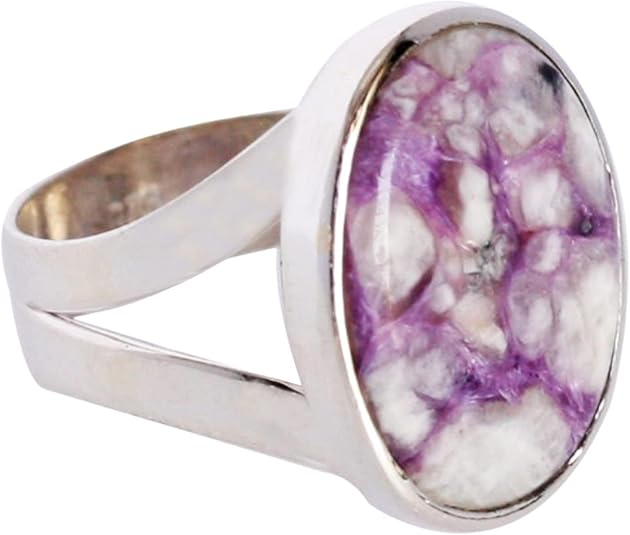
Tiffany Stone has one of the most improbable stories in American gemology. It was never mined for its beauty. It was mined because the ground beneath it held beryllium, a metal critical to military and aerospace industries. The gemstone was essentially a byproduct, and most of it was simply crushed. Tiffany stone is a rare material, mined at one location worldwide: the Brush Wellman beryllium mine at Spor Mountain in western Utah.
Scarce and attractive, Utah Tiffany Stone is renowned among collectors and rock hounds for its unique appearance. Its brecciated look is primarily comprised of rich purples, blending with delicate lavender, creamy whites, and inky blacks. This matrix of colors comes together, forming interesting and surprising patterns within the stone. No two specimens are ever the same, which is part of what makes it so compelling to collectors.
This material is primarily composed of purple fluorite, and the stone’s matrix typically includes bertrandite, chalcedony, and opal. The mix of materials varies from specimen to specimen, so no two samples can ever be expected to be the same. This area was formerly the site of significant volcanic activity, and Tiffany Stone was formed from some of this volcanic material. As water circulated underground, it penetrated these layers of minerals, causing the fluorite content of the rock to opalize over time, lending to its shimmery appearance.
Unfortunately, most of the Tiffany Stone is crushed in the mining process. The material is not commercially collected, and any semi-precious stone cabochon material found is usually old stock brought out by the miners. Tiffany Stone is now rare and highly sought-after. Unless it is from western Utah, it is simply not Tiffany Stone. The fact that much of it was destroyed before anyone recognized its value makes surviving specimens even more precious.
Opalized fluorite from Turkey and China is often missold as Tiffany Stone. Although these can have a similar appearance, they are not the same material. Buyers need to be vigilant about provenance when pursuing this one.
#6. Arizona Peridot (Arizona): The World’s Green Giant
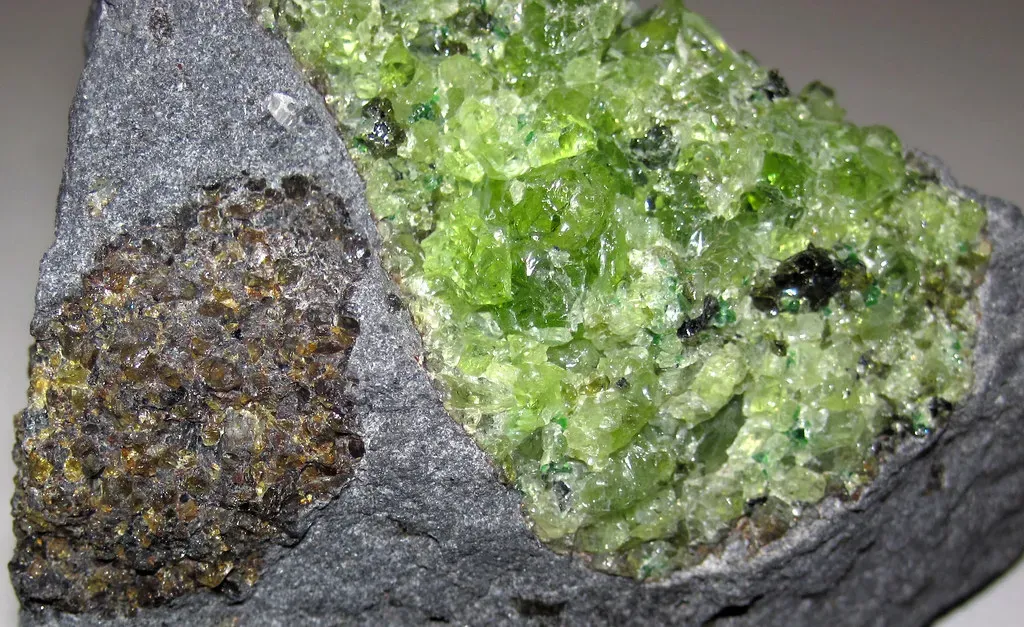
Peridot is one of the oldest known gemstones on Earth, cherished across ancient civilizations for its warm, vivid green color. This bright yellow-green to green gemstone has caught the fancy of humans for thousands of years. Some historians even suspect that at least some of the “emeralds” worn by Cleopatra were actually peridot. What most people don’t realize is that the single most productive source of peridot on the entire planet is tucked into a reservation in Arizona.
The aptly named Peridot Mesa, located on the San Carlos Apache Indian Reservation in Gila County, is the most productive area for peridot in the world. It’s estimated that between 80 and 95 percent of the world’s production of peridot comes from the San Carlos Reservation in Arizona. That is a staggering dominance for a single site in a single U.S. state.
When the mineral olivine is of gemstone quality, it is known as “peridot.” It is a bright yellow-green to dark green gem material that can be cut into beautiful faceted stones. The peridot occurs as xenoliths within basalt flows and is exposed by hard rock mining. It is also found in the soils above the basalt flows and in the sediments of nearby washes.
Peridot Mesa resulted from a single volcanic eruption and basalt flow over an already existing conglomerate base, and is thought to be of late Tertiary or Quaternary age. On the Reservation, peridot can be mined only by individual Native Americans or by individual families of Native Americans from the San Carlos Reservation. This means every gem that leaves the mesa carries both a geological and cultural heritage behind it.
Peridot is one of the only gemstones that only occurs in one color: green. The faceted stones produced from this material are generally about 1 carat in size, with 2 to 3 carat stones not uncommon. Stones as large as 15 and 22 carats have been cut from San Carlos peridot. For collectors seeking a stone rooted in ancient history and produced on sacred land, Arizona peridot is a genuinely compelling choice.
A Final Thought on American Gemstone Heritage
What unites all six of these gemstones is something more than geography. Each one emerged from a specific collision of geological forces so precise and so local that it simply didn’t happen anywhere else on the planet in the same way. A lava flow in Oregon, a volcanic dike in Montana, a beryllium mine in Utah: these are not glamorous settings, yet they produced some of the most extraordinary natural objects on Earth.
There is also something worth noting about how these gems were found. Almost none of them were discovered by expert geologists on a formal expedition. They were found by ranchers, prospectors, and miners who were looking for something else entirely. That accidental quality is part of what makes them feel so alive as stories.
In an era when synthetic stones are increasingly indistinguishable from natural ones, and when gemstone sourcing is frequently murky and ethically fraught, these six American gems offer something genuinely rare: a clear origin, a known landscape, and in many cases, a connection to the communities and cultures of the land where they were born. That, more than any price per carat, may be their most enduring value.
