


In the animal kingdom, birds have long been underestimated in terms of their cognitive abilities. However, recent scientific research has shattered these misconceptions, particularly when it comes to the New Caledonian crow (Corvus moneduloides). This extraordinary bird, native to the Pacific island of New Caledonia, has demonstrated problem-solving abilities that not only rival those of primates but can even surpass those of human toddlers in certain tasks. These crows can analyze complex situations, create tools, and solve multi-step puzzles in timeframes that would impress even the most devoted human parents. Their remarkable intelligence challenges our understanding of animal cognition and raises fascinating questions about the evolution of intelligence across different species.
The Scientific Evidence: Crows vs. Toddlers

In a groundbreaking study published in Scientific Reports, researchers compared the problem-solving abilities of New Caledonian crows with those of children aged 2-4 years. The results were astonishing: when faced with a complex puzzle involving cause-and-effect relationships, the crows consistently solved it faster than the toddlers. In one particular test, crows understood that dropping stones into a water-filled tube would raise the water level and bring a floating reward within reach. Most crows grasped this concept within minutes, while many toddlers struggled to understand the causal relationship even after several attempts. The crows’ median solving time was 107 seconds, compared to the toddlers’ 224 seconds. This doesn’t mean crows are generally more intelligent than children, but it does demonstrate their exceptional abilities in specific cognitive domains.
Anatomy of Avian Intelligence: The Crow’s Brain

The cognitive prowess of the New Caledonian crow is particularly fascinating given the anatomy of its brain. Unlike mammals, birds don’t have a neocortex—the brain region associated with higher cognitive functions in humans. Instead, crows possess a highly developed nidopallium caudolaterale, which serves similar functions. Despite having brains that weigh just 7-10 grams (compared to a human brain at about 1,300 grams), crows pack an astounding neural density. They have approximately 1.5 billion neurons, many concentrated in areas related to problem-solving and tool use. This neural architecture has evolved differently from mammals but converged on similar cognitive capabilities—a phenomenon known as convergent evolution. The efficiency of the crow’s brain allows for remarkable computational power in a compact package, demonstrating that raw brain size isn’t the only determinant of intelligence.
Tool Creation and Modification: The Hallmark of Advanced Cognition

Perhaps the most impressive aspect of New Caledonian crow intelligence is their sophisticated tool use. Unlike most animals that might use found objects as tools, these crows actively manufacture custom tools for specific purposes. They craft hooks from twigs by carefully removing leaves and carving notches in precise locations. More remarkably, they create stepped-cut tools from pandanus leaves, which require a complex series of cuts and tears to fashion a serrated edge. This level of tool manufacturing was once thought unique to humans and occasionally great apes. Research has shown that these crows can even modify tools based on the requirements of a task—making longer tools for deeper crevices or stronger hooks for heavier prey. This capacity for tool innovation demonstrates a level of causal reasoning and planning that exceeds what we observe in human children until around age four.
The Aesop’s Fable Test: Understanding Physical Principles
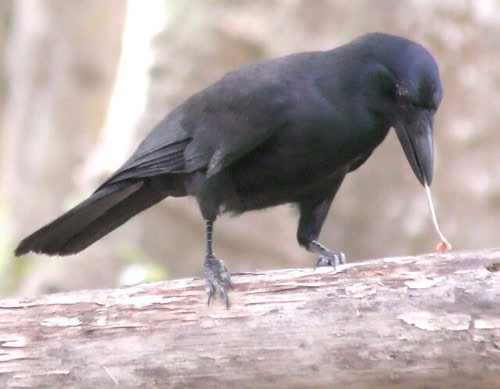
One of the most compelling demonstrations of crow intelligence involves the “Aesop’s Fable” test, named after the ancient tale where a thirsty crow drops pebbles into a pitcher to raise the water level. In scientific versions of this test, New Caledonian crows were presented with tubes containing water with floating food rewards that were out of reach. Without training, many crows quickly realized they could drop heavy objects into the water to raise the level and retrieve the food. More impressively, they showed discrimination in their choices—preferring to drop sinking objects rather than floating ones, and selecting larger stones over smaller ones to raise the water level more efficiently. Some crows even discerned that it was more effective to drop objects into tubes with higher water levels first. These experiments demonstrate an intuitive understanding of displacement and causal physics that human children don’t typically grasp until ages 5-7.
Social Learning and Cultural Transmission Among Crows
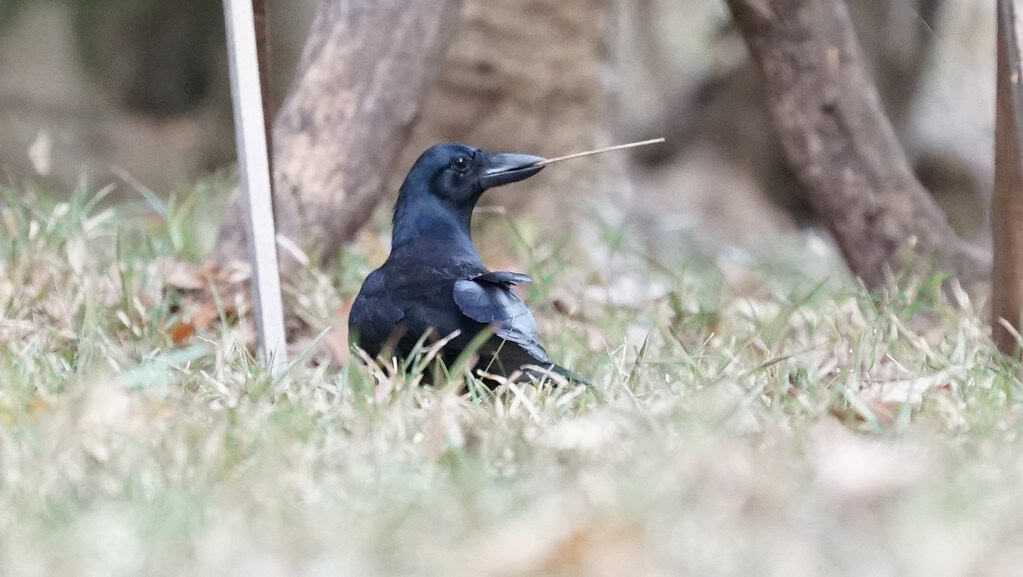
Beyond individual problem-solving abilities, New Caledonian crows exhibit sophisticated social learning mechanisms that parallel human cultural transmission. Juvenile crows spend an extended period—up to two years—observing and learning from their parents. This prolonged learning period is crucial for the development of their tool-making skills. Researchers have documented distinct “tool cultures” in different crow populations, with specific tool designs and techniques passed down through generations. This cultural transmission of knowledge creates regional variations in tool design—effectively, different crow “traditions.” Some crow populations use predominantly hooked tools, while others specialize in pandanus leaf tools with precise cutting patterns. This social dimension of learning reinforces the parallels between crow cognitive development and that of human children, although the crows often master their specialized skills more quickly.
The Multi-Step Problem Solving Experiment

In a particularly impressive demonstration of crow cognition, researchers designed a multi-step puzzle that required planning and sequential actions. The apparatus contained food that could only be retrieved after completing three distinct steps in the correct order. The crows had to remove a short stick, use that stick to retrieve a longer stick from another compartment, and then use the longer stick to finally reach the food reward. This test requires understanding cause-and-effect relationships across time and maintaining a mental representation of the goal while executing intermediate steps. Most tested crows solved this puzzle within minutes of their first exposure, while human children typically struggle with such multi-step planning tasks until around age four. The crows’ performance indicates capabilities in working memory and sequential planning that rival those of great apes and young children.
Self-Control and Delayed Gratification in Corvids

Another dimension of intelligence where crows excel is self-control—the ability to forego immediate rewards for greater future benefits. In one study, crows were offered a choice between an immediate small food reward and a delayed but larger reward. Many crows demonstrated the ability to wait for the larger payoff, showing impressive impulse control. This capacity for delayed gratification emerges in human children around ages 3-4 years, with significant individual variation. In some experimental contexts, crows showed better self-control than many preschoolers. The ability to delay gratification correlates with better outcomes in later life for humans, and in crows, it appears to be an adaptive trait that allows for more sophisticated foraging strategies and tool use. This shared cognitive feature between crows and humans points to similar selective pressures favoring planning and self-regulation despite vastly different evolutionary histories.
Meta-Tool Use: Tools to Get Tools

Perhaps the most complex cognitive task mastered by New Caledonian crows is meta-tool use—the use of one tool to obtain another tool, which is then used to solve the final problem. In laboratory settings, crows have demonstrated the ability to use short sticks to retrieve longer sticks from cages, which they then use to extract food from deep containers. This nested tool requires keeping the final goal in mind while executing a sequence of instrumental actions. Such hierarchical planning was previously thought to be exclusive to great apes and humans over the age of five. In one remarkable experiment, a crow named “Betty” spontaneously bent a straight piece of wire into a hook when presented with a task requiring such a tool—showing invention and causal understanding beyond what most young children could accomplish. This level of abstract problem-solving suggests that certain aspects of crow cognition may actually exceed, rather than merely match, the abilities of preschool-aged children.
The Cognitive Development Timeline: Birds vs. Humans

The developmental timeline of cognitive abilities in crows compared to human children offers fascinating insights. While human children have a much broader range of cognitive abilities that develop over approximately 25 years, crows reach their cognitive peak much faster. By one year of age, New Caledonian crows have usually mastered the complex tool-making skills that define their species. By comparison, human children typically don’t develop comparable causal reasoning about physical objects until ages 3-5, and some aspects of planning and tool modification may not fully develop until ages 7-8. This accelerated cognitive development in crows is likely an evolutionary adaptation to their shorter lifespan (10-15 years in the wild compared to humans’ 70+ years) and the need to become self-sufficient foragers quickly. The efficiency with which crows develop their specialized cognitive toolkit serves as a reminder that intelligence evolves to meet specific ecological challenges rather than following a universal trajectory toward “higher” cognition.
Neuroplasticity and Problem-Solving Flexibility

One of the most impressive aspects of crow cognition is their neuroplasticity—the ability to adapt their thinking to novel challenges. When presented with entirely new problems that they couldn’t have encountered in their natural environment, New Caledonian crows demonstrate remarkable flexibility in applying their cognitive skills. In one study, crows that had never seen a puzzle box with a particular locking mechanism were able to analyze its workings and open it within minutes. This adaptability extends to their ability to generalize concepts—if they learn that a particular type of object can be used as a tool, they can transfer that knowledge to novel but functionally similar objects. This kind of abstract, flexible thinking emerges in human children around ages 4-5 but appears to develop more rapidly in crows relative to their lifespan. The neurological basis for this flexibility lies in the crow’s highly developed nidopallium, which continues to form new neural connections throughout their lives in response to environmental challenges.
Evolutionary Significance: Why Are These Birds So Smart?

The extraordinary intelligence of New Caledonian crows raises fundamental questions about the evolution of cognition. Why would these birds develop such sophisticated problem-solving abilities? The answer appears to lie in their ecological niche and evolutionary history. New Caledonia lacks woodpeckers and other specialized insect-extracting birds, creating an opportunity for crows to exploit hidden food resources through tool use. Over generations, natural selection favored individuals with better tool-making and problem-solving abilities, leading to a cognitive arms race. Additionally, New Caledonia has relatively few predators, allowing crows to devote time to exploration and learning without constant vigilance. The island’s isolation also meant that once tool use emerged, it could be refined through cultural transmission without competition from other species. This perfect storm of evolutionary factors produced a bird with cognitive abilities far beyond what its brain size might suggest. The convergent evolution of these abilities with primates demonstrates that complex cognition can evolve independently in distantly related lineages when similar selective pressures are present.
Conclusions: Redefining Intelligence Across Species

The remarkable cognitive abilities of the New Caledonian crow force us to reconsider our understanding of intelligence across species. These birds demonstrate that advanced problem-solving, tool use, causal reasoning, and even cultural learning can evolve in brains structured very differently from our own. The fact that crows can solve certain puzzles faster than human toddlers reminds us that intelligence is not a single, linear scale with humans at the pinnacle, but rather a diverse array of specialized adaptations to particular ecological challenges. These findings have profound implications for our understanding of the evolution of intelligence and suggest that complex cognition has emerged multiple times through different pathways in the animal kingdom. As we continue to explore the cognitive capabilities of animals like the New Caledonian crow, we gain not only a deeper appreciation for the diversity of minds on our planet but also new insights into the fundamental principles that govern the development of intelligence itself.

From exploring the marine wonders in the Azores and witnessing the vast savannas of Kenya, to delving deep into the rich biodiversity of South Africa and traversing iconic landscapes in Australia and the US like Yellowstone, Chris's experiences are vast.
With a penchant for diving alongside sharks, the ocean holds a special place in his heart.
Through his academic insights, he champions wildlife conservation, striving with 'Animals Around The Globe' to cultivate a profound connection between humans and animals, enhancing our mutual appreciation.
Connect with him at Feedback@animalsaroundtheglobe.com.
- Why Spiders Don’t Get Stuck in Their Own Webs - July 20, 2026
- What Scientists Found in a 10,000-Year-Old Beehive - July 20, 2026
- This Spider Builds Fake Decoys of Itself - July 20, 2026