


When most people hear the word “shark,” images of fearsome predators with rows of razor-sharp teeth often come to mind, fueled by sensationalized media portrayals like the iconic film “Jaws.” However, these misunderstood creatures are far more complex and diverse than their reputation suggests. Out of more than 500 shark species swimming in our oceans, only a handful pose any significant threat to humans. The vast majority are non-aggressive, shy, and even docile animals that play crucial roles in maintaining healthy marine ecosystems. Despite causing fewer than 10 human fatalities worldwide each year—compared to the 100 million sharks killed annually by humans—sharks continue to be vilified and feared. This article highlights 16 shark species that deserve appreciation rather than fear, showcasing their unique characteristics, ecological importance, and the undeserved nature of their fearsome reputation.
15. Whale Shark (Rhincodon typus)

As the largest fish in the ocean, reaching lengths of up to 40 feet, the whale shark might seem intimidating at first glance. However, these gentle giants are filter feeders that primarily consume plankton and small fish. Despite their enormous size, whale sharks pose absolutely no threat to humans. In fact, they’re known for their docile nature, often allowing divers to swim alongside them. With their distinctive pattern of white spots and stripes on a dark blue-gray background, whale sharks have become popular attractions for ecotourism in places like Mexico, the Philippines, and Australia. Unfortunately, these magnificent creatures are classified as endangered due to fishing pressure, accidental capture in fishing gear, and vessel strikes. Their slow reproductive rate—reaching sexual maturity at around 30 years—makes population recovery particularly challenging.
14. Basking Shark (Cetorhinus Maximus)

The basking shark holds the title of the second-largest fish in the sea, growing up to 26 feet in length. Despite their imposing size and somewhat menacing appearance with a large, wide-open mouth, these giants are completely harmless to humans. Like whale sharks, they are filter feeders that swim with their mouths agape, filtering zooplankton from the water. A single basking shark can filter over 2,000 gallons of water per hour through its highly developed gill rakers. These sharks are often spotted “basking” near the surface in cooler waters of the Atlantic and Pacific Oceans, which is how they earned their common name. Listed as endangered by the IUCN, basking sharks face threats from commercial fishing for their fins, meat, and liver oil, as well as vessel collisions. Their slow growth rate and late maturity (around 12-16 years) make them particularly vulnerable to population decline.
13. Nurse Shark (Ginglymostoma cirratum)
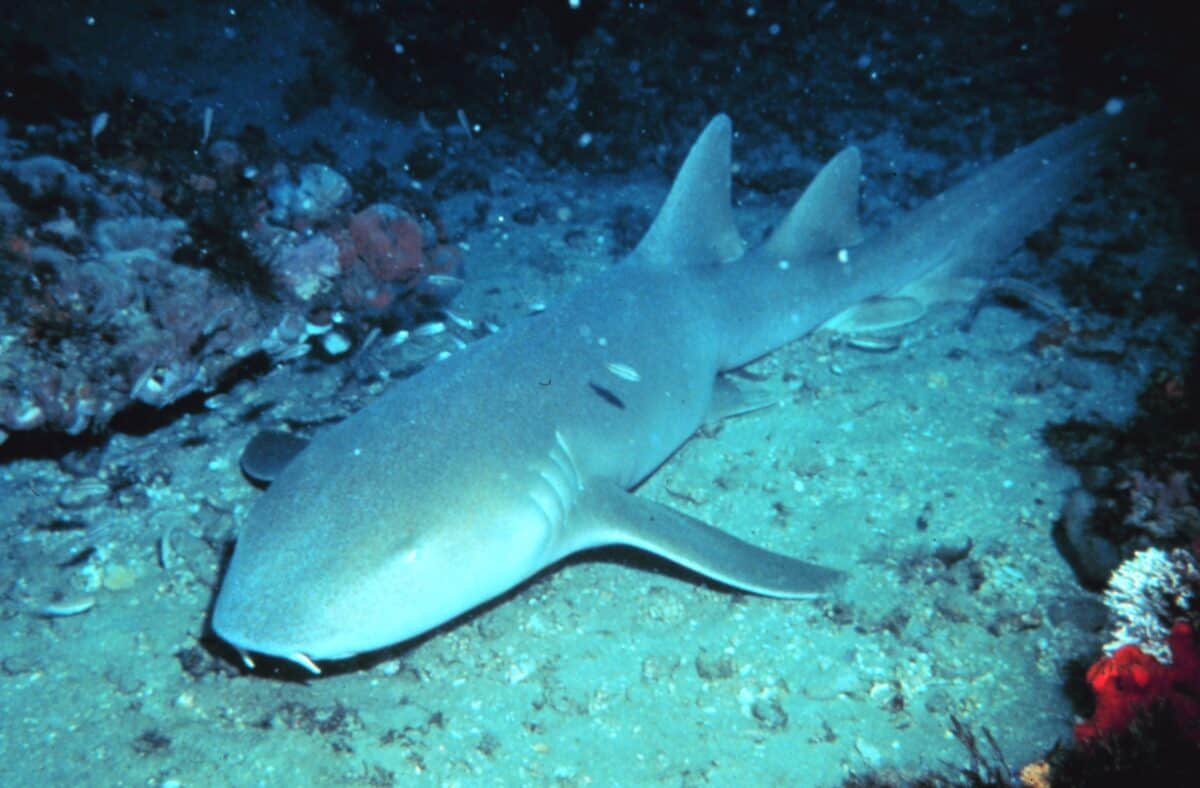
With their yellowish-brown coloration and distinctive barbels (whisker-like sensory organs) near their nostrils, nurse sharks are among the most frequently encountered sharks by divers in tropical and subtropical waters. Growing up to 14 feet long, these bottom-dwellers are known for their sedentary lifestyle, often found resting on the ocean floor during daylight hours. Nurse sharks are generally docile and pose little threat to humans unless provoked. They feed primarily on small fish, shrimp, and squid, using their strong suction power to pull prey from crevices in reefs. Their name likely comes from the sucking sound they make when hunting for prey, which was once thought to resemble a nursing baby. Though they typically avoid human interaction, nurse sharks can become defensive if touched or cornered, highlighting the importance of responsible diving behavior around all marine life.
12. Leopard Shark (Triakis semifasciata)
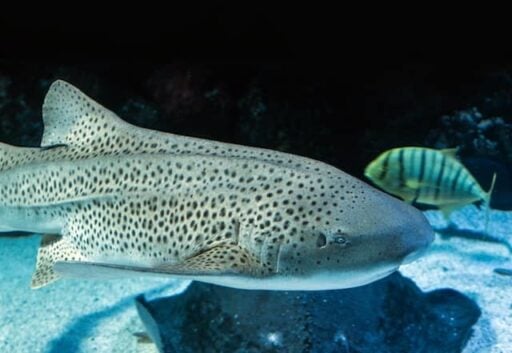
Known for their striking pattern of black saddle-like markings and spots over a silvery-bronze body, leopard sharks are among the most beautiful and recognizable shark species. These slender sharks, typically growing to about 4-7 feet in length, inhabit the shallow waters along the Pacific coast of North America. Leopard sharks are completely harmless to humans, with no confirmed unprovoked attacks on record. They spend much of their time foraging along the bottom for crabs, clams, fish eggs, and small fish. During summer months, large groups of leopard sharks can be observed in shallow bays and estuaries, providing spectacular viewing opportunities for snorkelers and coastal visitors. These sharks are particularly important for maintaining healthy coastal ecosystems by controlling populations of various invertebrates. While their conservation status is listed as “Least Concern,” localized populations face threats from habitat degradation and pollution in coastal environments.
11. Bamboo Sharks (Family Hemiscylliidae)

Bamboo sharks comprise several species within the family Hemiscylliidae, including the brownbanded bamboo shark and the whitespotted bamboo shark. These small, slender sharks typically grow to only 2-4 feet in length and are characterized by their long, flexible bodies and distinctive barbels. Native to the shallow coral reefs of the Indo-Pacific region, bamboo sharks have the remarkable ability to “walk” along the ocean floor using their pectoral and pelvic fins. This unique locomotion helps them maneuver into tight spaces in search of crustaceans and small fish. Their docile nature and relatively small size make them popular in the aquarium trade, though wild collection poses conservation concerns. Bamboo sharks pose absolutely no threat to humans and will typically retreat if encountered. Conservation efforts are increasingly important as these fascinating sharks face habitat loss from coral reef degradation and overfishing in parts of their range.
10. Zebra Shark (Stegostoma fasciatum)
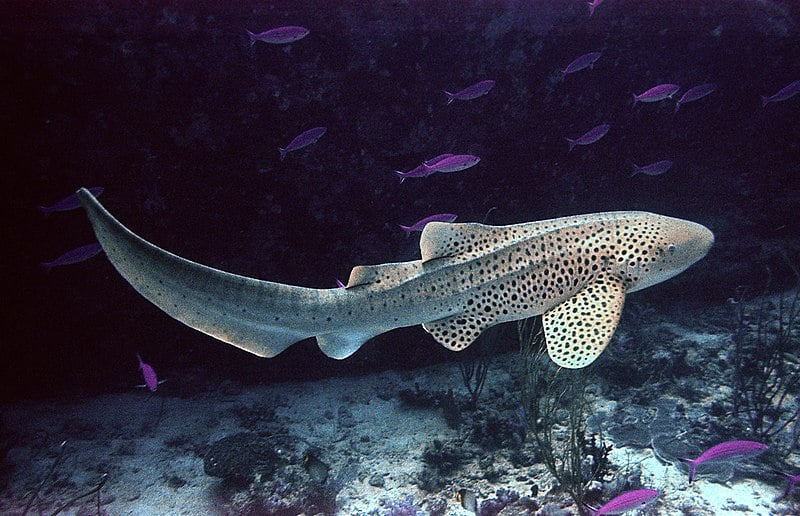
The zebra shark undergoes one of the most dramatic appearance changes of any shark species. Juveniles display bold black and white stripes (hence the name “zebra”), while adults develop a spotted pattern on a yellowish background, causing some to call them leopard sharks in certain regions. Growing up to 8 feet long, these nocturnal hunters have a slender, flexible body that allows them to wriggle into reef crevices in search of shellfish, small fish, and crustaceans. Zebra sharks are known for their docile disposition, often allowing divers to approach closely. They’re frequently encountered resting on the sandy bottom during daylight hours. Unfortunately, the IUCN lists zebra sharks as endangered due to fishing pressure for their meat, fins, and liver oil, along with habitat degradation. Their slow reproductive rate and site fidelity to specific reef areas make them particularly vulnerable to localized depletion.
9. Angel Sharks (Genus Squatina)
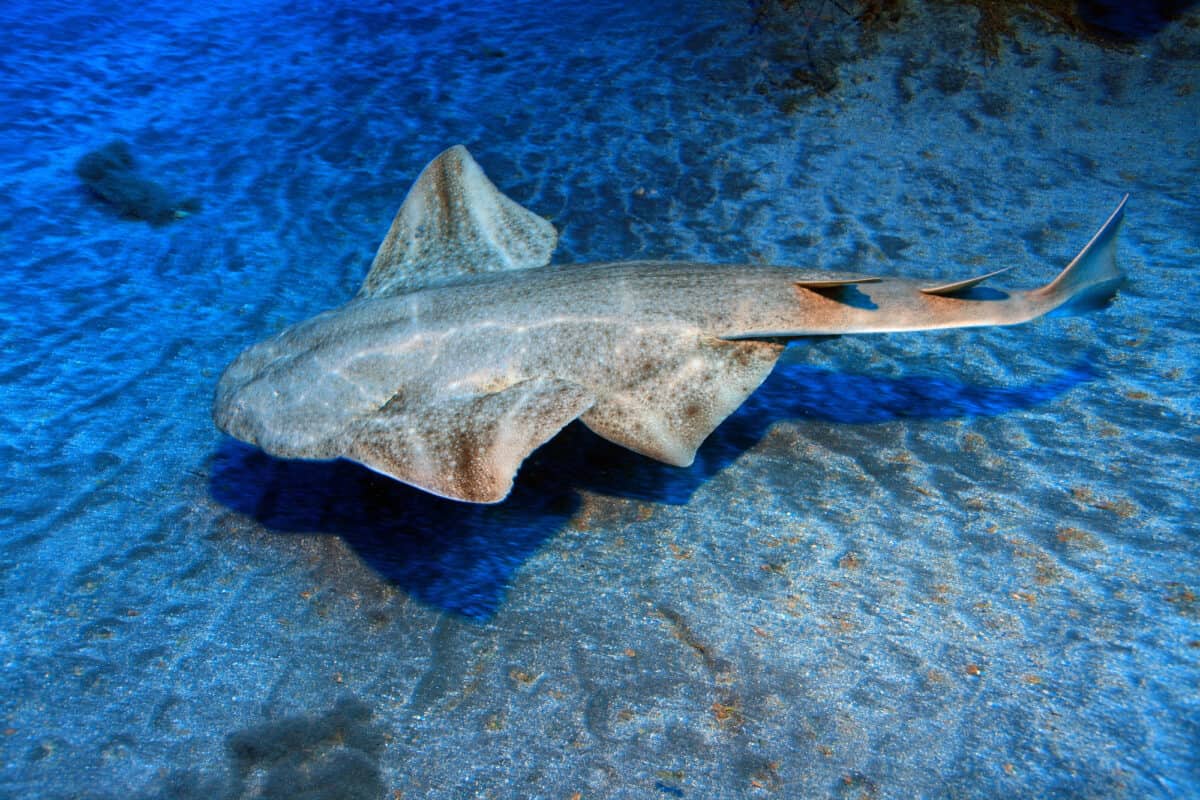
Angel sharks have undergone a remarkable evolutionary adaptation that gives them a flattened, ray-like appearance—a perfect example of convergent evolution. With their broad pectoral fins and cryptic coloration, these ambush predators can bury themselves in sand or mud, waiting for unsuspecting prey to swim overhead. Once common throughout the Northeast Atlantic, Mediterranean, and parts of the Pacific, many angel shark species have experienced severe population declines, with the common angel shark (Squatina squatina) now critically endangered. Despite their somewhat intimidating hunting strategy, angel sharks pose virtually no danger to humans unless directly provoked. They typically grow to 5-6 feet in length and feed primarily on small bottom-dwelling fish, shellfish, and cephalopods. Conservation efforts for these unique sharks have increased in recent years, with protected areas being established in their remaining strongholds, particularly in the Canary Islands where significant populations still exist.
8. Greenland Shark (Somniosus microcephalus)

The Greenland shark holds the distinction of being the longest-lived vertebrate known to science, with some individuals estimated to be over 400 years old. These slow-moving giants prefer the frigid waters of the North Atlantic and Arctic Oceans, swimming at depths of up to 7,200 feet. Growing up to 24 feet long, Greenland sharks move at an average pace of less than 1 mile per hour, earning them the nickname “sleeper sharks.” Despite their size, they pose little threat to humans due to their deep-water habitat and extremely slow metabolism, which is an adaptation to cold environments. Their flesh contains high levels of trimethylamine N-oxide, making it toxic to most mammals unless properly processed through traditional fermentation methods, as with the Icelandic delicacy hákarl. Interestingly, most Greenland sharks have parasitic copepods attached to their eyes, which may eventually cause blindness, though they rely more on smell than vision for hunting. These mysterious sharks face threats from accidental bycatch in commercial fisheries and potentially from climate change affecting their cold-water habitat.
7. Wobbegong Sharks (Family Orectolobidae)

Wobbegong sharks, comprising several species found primarily in the western Pacific Ocean, are master camouflage artists. Their name comes from an Australian Aboriginal language, meaning “shaggy beard,” referring to the distinctive dermal lobes around their mouths that resemble a beard. These bottom-dwelling sharks have flattened bodies with intricate patterns that perfectly mimic the seafloor, coral, or seaweed where they rest. Wobbegongs are ambush predators, remaining motionless on the ocean floor until prey comes within striking distance. Growing to about 4-10 feet depending on the species, these sharks are not aggressive toward humans unless provoked. However, their excellent camouflage means divers might accidentally come too close, prompting a defensive bite. Fortunately, most wobbegong species are currently listed as species of least concern by the IUCN, though localized threats exist from habitat degradation and incidental capture in fishing gear.
6. Horn Shark (Heterodontus francisci)
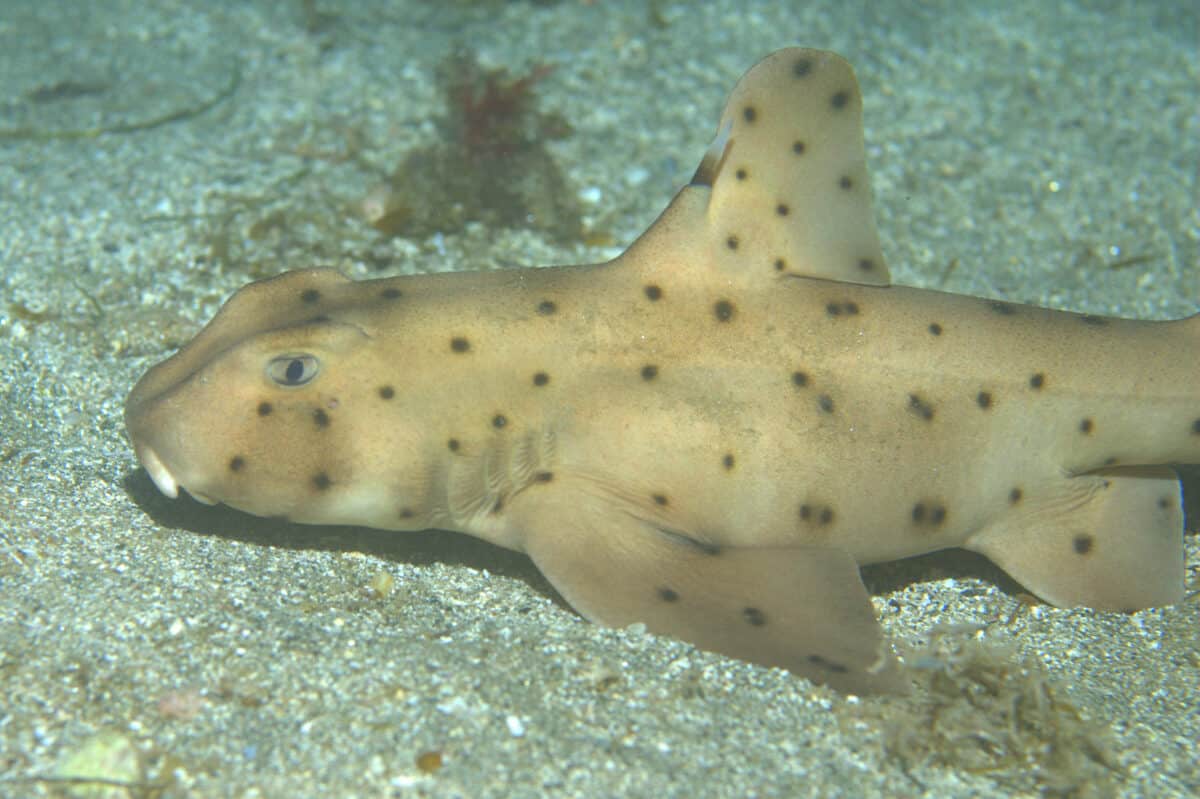
The horn shark gets its name from the short, blunt spine in front of each dorsal fin, which serves as a defensive mechanism against potential predators. These small, sluggish sharks, typically growing to just 3-4 feet in length, are easily recognized by their pig-like snouts and mottled brown coloration. Native to the coastal waters of California and Mexico, horn sharks are nocturnal hunters that use their strong jaws and molar-like rear teeth to crush sea urchins, crabs, and other hard-shelled invertebrates. During daylight hours, they often hide in rocky crevices or under ledges, sometimes wedging themselves in so tightly that they’re difficult to remove. Horn sharks pose no threat to humans and are generally shy around divers. They produce distinctive spiral-shaped egg cases that they wedge into crevices for protection, a unique reproductive strategy among sharks. While not currently threatened globally, local populations face pressure from habitat degradation and collection for the aquarium trade.
5. Epaulette Shark (Hemiscyllium ocellatum)

Perhaps one of the most remarkable sharks in terms of adaptations, the epaulette shark has evolved the ability to “walk” on its fins across the seafloor and even between tide pools. Native to the shallow coral reefs of Australia and New Guinea, these small sharks (typically 2-3 feet long) have developed an extraordinary tolerance for low oxygen conditions. When tide pools become oxygen-depleted, epaulette sharks can survive for hours by lowering their metabolic rate and selectively shutting down non-essential neural functions—a type of self-induced trance. Their most distinctive feature is the large black spot behind each pectoral fin, resembling military epaulettes, which may function to confuse predators. These harmless sharks feed primarily on small invertebrates and fish that they find while foraging in reef crevices. Scientists are particularly interested in studying epaulette sharks’ unique physiological adaptations for potential medical applications, especially in understanding how tissues might be protected during oxygen deprivation events like strokes.
4. Porbeagle Shark (Lamna nasus)

Often mistaken for its notorious relative, the great white shark, the porbeagle is actually much smaller (typically 8 feet long) and poses virtually no threat to humans. These streamlined, powerful sharks inhabit the cold, temperate waters of the North Atlantic and Southern Hemisphere. With their spindle-shaped bodies and conical snouts, porbeagles are built for efficient swimming in open water. Unlike many sharks, porbeagles can maintain a body temperature higher than the surrounding water, an adaptation that allows them to hunt in cold environments and make rapid, powerful movements. They primarily feed on small to medium-sized fish like mackerel and herring. Perhaps most surprisingly, porbeagles have been observed engaging in playful behavior, including rolling at the surface with seaweed and chasing each other. Unfortunately, these sharks are classified as vulnerable globally and critically endangered in the Northeast Atlantic due to overfishing for their meat and fins. Their slow growth rate and late maturity (around 13 years for females) make them particularly susceptible to population decline.
3. Thresher Sharks (Family Alopiidae)

Thresher sharks are immediately recognizable by their extraordinarily long upper caudal (tail) fin lobe, which can be as long as the rest of their body. These elegant sharks use their specialized tails as weapons, whipping them through schools of fish to stun or kill their prey—a hunting technique unique among sharks. There are three species of thresher sharks, with the common thresher (Alopias vulpinus) growing up to 20 feet in length, though half of that is tail. Despite their impressive size and distinctive hunting method, thresher sharks are shy around humans and have no confirmed unprovoked attacks on record. They prefer the open ocean and are rarely encountered by swimmers or divers near shore. Threshers possess another unusual adaptation: large eyes that help them hunt in low light conditions, as they often feed at dawn or dusk. All three thresher species are listed as vulnerable by the IUCN due to fishing pressure, particularly from longline fisheries where they’re caught intentionally for their meat and fins, or as bycatch.
2. Blue Shark (Prionace glauca)

With its slender body and brilliant indigo-blue coloration, the blue shark is one of the most beautiful and widespread shark species, found in temperate and tropical oceans worldwide. These open-ocean predators can grow up to 12 feet long and are known for their extensive migrations, with some individuals traveling over 5,700 miles in a single journey. Blue sharks have proportionally long pectoral fins that help them maintain stability during slow swimming while searching for prey like squid and small fish. Despite being among the most frequently encountered pelagic sharks, blue sharks rarely pose a threat to humans, with only 13 unprovoked attacks attributed to them since record-keeping began, none of which were fatal. Unfortunately, blue sharks are among the most heavily fished sharks in the world, with estimates suggesting between 10-20 million individuals are caught annually for their fins and meat or as bycatch. Though still abundant compared to many shark species, their population is decreasing, and they’re classified as “Near Threatened” by the IUCN.
1. Megamouth Shark (Megachasma pelagios)

One of the most elusive and mysterious sharks in the ocean, the megamouth wasn’t discovered by science until 1976, making it a relative newcomer to our knowledge of marine life. As its name suggests, this deep-sea dweller has an enormous mouth with a rounded snout and luminous lips that may attract plankton in dark waters. Growing up to 18 feet long, megamouth sharks are filter feeders that consume krill, jellyfish, and other planktonic creatures. Despite their imposing size, they pose absolutely no danger to humans. Megamouths are extremely rare encounters; fewer than 100 specimens have been officially recorded worldwide. They’re believed to spend most of their time in the deep ocean (up to 15,000 feet deep) but make vertical migrations to shallow waters at night to feed. Scientists still have much to learn about these enigmatic creatures, including their conservation status, though they likely face threats from deep-water fishing operations and plastic pollution that can be mistaken for food by filter-feeding species.
Conclusion:

Far from being the mindless predators popularized by movies and media, sharks are an incredibly diverse group of species with vital roles in maintaining ocean health. As this article has shown, many sharks are gentle, elusive, and even vulnerable creatures, often more at risk from humans than we are from them. From the plankton-feeding whale and basking sharks to the walking epaulette and the ancient Greenland shark, these fascinating animals deserve admiration rather than fear. By shifting the narrative from menace to marvel, we can foster a deeper respect for sharks and inspire stronger conservation efforts to protect these essential stewards of the sea. Understanding and appreciating their unique traits is not only a step toward preserving marine biodiversity but also toward correcting long-held misconceptions that do sharks—and our oceans—great harm.

As a little kid, I fell in love with nature, wildlife, and animals. Living in the USA, South Africa, Italy, China and Germany gave me the opportunity to discover the world's Wildlife. My favorite animals are Mountain Gorillas, Siberian Tigers, and Great White Sharks.
I'm a certified PADI Open Water Diver, went to Everest Base Camp and Trekked Gorillas in Uganda. I hold a Master of Science in Economics and Finance.
Please send any feedback to feedback@animalsaroundtheglobe.com
- 10 Deadliest Spiders in the World And Where They Live - July 21, 2026
- 15 Sharks That Do Not Deserve Their Bad Reputation - July 21, 2026
- 11 Creatures That Can Survive a Nuclear Blast - July 21, 2026
Leave a comment
You must be logged in to post a comment.