


Killer whales, or orcas (Orcinus orca), stand as the ocean’s apex predators, showcasing remarkable hunting prowess across the world’s seas. These intelligent marine mammals have developed sophisticated strategies and tools that allow them to outmaneuver, outsmart, and capture prey in various environments. From coordinated hunting techniques to advanced communication systems, orcas demonstrate problem-solving abilities that rival those of many land predators. This article explores the fascinating arsenal of 14 tools and techniques orcas employ to outsmart their prey, highlighting their exceptional cognitive abilities and social sophistication in the pursuit of survival.
14. Echolocation: Nature’s Sonar System

Orcas possess one of the most sophisticated biological sonar systems in the animal kingdom. By emitting high-frequency clicks that bounce off objects in their environment, they create detailed mental maps of their surroundings. This echolocation allows them to detect prey up to 500 feet away, even in murky waters or complete darkness. The precision of their echolocation is remarkable—orcas can determine not just the location of prey, but also its size, shape, and even internal structure. Research has shown that orcas can differentiate between similar fish species based solely on echolocation data, allowing them to target preferred prey efficiently. This natural sonar system gives orcas a significant advantage when hunting, especially when pursuing fish or mammals hiding beneath the surface or in complex underwater environments.
13. Coordinated Wave Washing

One of the most dramatic hunting techniques employed by orcas is coordinated wave washing, a behavior primarily observed among transient pods targeting seals or sea lions resting on ice floes. During this sophisticated maneuver, pod members swim in formation to create deliberate waves that wash prey off floating ice. The orcas synchronize their movements with remarkable precision, swimming parallel to one another and then diving simultaneously to generate a powerful wave. This coordinated effort requires significant planning and communication between pod members. The technique demonstrates not only the orcas’ understanding of physics—using water displacement to create waves—but also their ability to strategize collectively. In the Antarctic, researchers have documented pods perfecting this technique over generations, with younger orcas learning by observing experienced hunters before participating in these coordinated hunts.
12. Spy-Hopping for Strategic Surveillance

Spy-hopping represents a vital reconnaissance tool in the orca’s hunting arsenal. During this behavior, an orca rises vertically out of the water, exposing its head up to the eyes, allowing it to survey its surroundings above the surface. This technique is particularly valuable when hunting in coastal areas or near ice fields where seals, sea lions, or penguins might be present. By spy-hopping, orcas can detect potential prey on ice floes or shorelines without alerting them to their presence. The behavior also helps them coordinate with other pod members during complex hunts. Scientists studying orcas in the Salish Sea have observed individuals spy-hopping specifically to locate harbor seal haul-out sites during low tide. This strategic surveillance allows them to plan hunting approaches based on coastal geography and prey distribution, demonstrating their ability to gather intelligence before launching an attack.
11. Pod-Specific Vocal Dialects

Orcas have developed sophisticated communication systems that include pod-specific dialects—unique vocal patterns shared only among family members. These dialects function as both a bonding mechanism and a strategic hunting tool. During coordinated hunts, orcas use their distinctive calls to synchronize movements with precision, allowing them to execute complex maneuvers without visual contact. Each pod’s unique vocal signature also prevents prey from becoming universally habituated to orca calls. Research conducted by the Center for Whale Research has documented at least 25 distinct dialects among the Southern Resident orcas alone. These vocalizations vary in pitch, duration, and pattern, creating what amounts to family-specific “languages.” The complexity of these communication systems highlights the orcas’ advanced cognitive abilities and underscores how social learning contributes to their hunting success across generations.
10. Carousel Feeding Technique
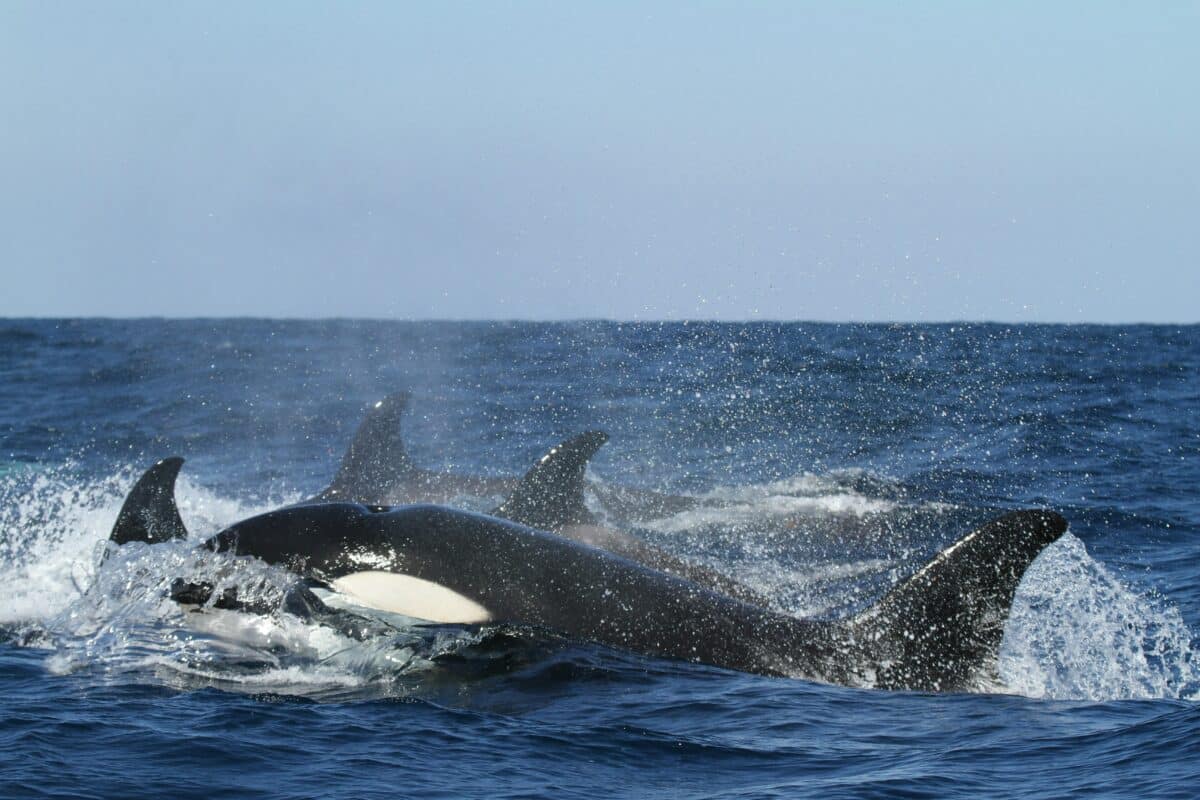
Norwegian orcas have perfected a remarkable hunting strategy known as carousel feeding when targeting herring. This sophisticated technique begins with the pod circling a school of fish, gradually tightening the circle to concentrate their prey into a dense ball. Once the fish are compacted, orcas take turns swimming through the ball, stunning fish with powerful tail slaps before consuming them individually. The entire pod works in coordinated shifts—some maintaining the carousel while others feed, then switching roles. Marine biologists studying this behavior in Norwegian fjords have observed pods maintaining fish balls for over an hour, processing thousands of herring in a single feeding event. The technique demonstrates remarkable cooperation, with each orca playing a specific role in the hunt. Carousel feeding represents a culturally transmitted hunting technique, with younger pod members spending years observing and gradually participating before mastering the complex coordination required.
9. Strategic Beaching

Perhaps one of the most daring hunting techniques in the orca repertoire is intentional beaching, or “beach hunting.” This high-risk strategy, observed primarily among pods in Patagonia, Antarctica, and the Crozet Islands, involves orcas deliberately propelling themselves onto beaches or shallow shoals to capture pinnipeds (seals and sea lions). The orcas calculate wave patterns and beach gradients with remarkable precision, timing their approach to ride incoming waves that help propel them onto shore. After capturing prey, they use the next wave to slide back into deeper water. This technique requires extensive knowledge of local geography, tide patterns, and wave dynamics. The risk of stranding makes this one of the most dangerous hunting methods orcas employ. Research indicates that this behavior is culturally transmitted, with mothers teaching offspring through years of observation and guided practice, demonstrating both the intelligence of orcas and the importance of intergenerational knowledge transfer.
8. Tail Slapping and Stunning

Orcas have weaponized their powerful tails as stunning mechanisms when hunting various prey. With a forceful slap of their caudal fin, they can generate enough pressure to stun or even kill smaller fish and squid. Against larger prey, strategic tail slaps can disorient or injure, creating vulnerability for a more direct attack. This technique proves particularly effective when hunting schooling fish, with a single powerful tail slap potentially stunning dozens of individuals simultaneously. Underwater footage captured by researchers in New Zealand has shown orcas using precisely aimed tail slaps to incapacitate rays and small sharks. The force generated by an adult orca’s tail can exceed several hundred pounds of pressure, creating shockwaves that damage the internal organs of prey animals. This technique demonstrates the orcas’ ability to use their physical attributes as extensions of their hunting strategy, turning a locomotory feature into a sophisticated weapon.
7. Prey Debilitation Techniques

Orcas employ sophisticated methods to debilitate larger or dangerous prey before consumption. When hunting sharks, some pods have developed the technique of flipping the shark upside down, inducing a state of immobility called tonic immobility. This neurological response effectively paralyzes the shark, allowing the orca to feed safely. When targeting whales, orcas work cooperatively to exhaust their prey through prolonged chases, sometimes lasting hours. They strategically prevent the whale from surfacing to breathe by taking turns positioning themselves above the prey. With stingrays, orcas have been documented using their snouts to flip the rays over, neutralizing their venomous spines before consumption. These debilitation techniques demonstrate profound knowledge of prey anatomy and behavior. A particularly striking example was documented off South Africa’s coast, where orcas have learned to precisely extract the nutritionally rich livers of great white sharks while leaving the rest of the carcass—showing not just predatory skill but remarkable anatomical knowledge.
6. Hydroplaning in Shallow Waters

Orcas have developed a remarkable technique for accessing prey in extremely shallow water—a behavior known as hydroplaning. This innovative hunting method involves orcas riding incoming waves to slide onto shallow shelves or sandbanks where seals may be resting. Using the momentum of the wave and their powerful tail thrusts, orcas can temporarily glide across just inches of water to capture prey that would otherwise be inaccessible. This technique is most famously observed among the orcas of Peninsula Valdés in Argentina, who target sea lion pups in the shallows. The orcas must precisely calculate the wave dynamics, beach gradient, and their own body weight to successfully execute this maneuver without becoming stranded. Research from marine biologists at Argentina’s National Patagonian Center indicates that only about 50% of attempts are successful, highlighting the technique’s difficulty. Hydroplaning represents one of the clearest examples of orcas adapting their hunting strategies to overcome the physical limitations of their environment.
5. Bubble Net Trapping

While more commonly associated with humpback whales, certain orca populations have adapted their own version of bubble net feeding to trap elusive prey. In this sophisticated technique, orcas exhale underwater to create curtains or clouds of bubbles that disorient and contain fish schools. The bubbles serve dual purposes: they create a visual and acoustic barrier that confuses prey and prevents escape, while also concentrating fish into denser formations that are easier to consume. Orcas in southeastern Alaska have been observed using cooperative bubble netting when hunting salmon, with different pod members playing specified roles—some creating the bubble barriers while others herd fish into the trap. The bubbles effectively exploit the prey’s natural avoidance behaviors, as many fish species perceive the wall of bubbles as a solid barrier. This technique demonstrates not only the orcas’ problem-solving abilities but also their capacity to adapt hunting strategies based on prey behavior and environmental conditions.
4. Cultural Transmission of Hunting Techniques

One of the most powerful tools in the orca’s arsenal isn’t physical but social—the cultural transmission of hunting knowledge across generations. Unlike many predators whose hunting instincts are primarily genetic, orcas rely heavily on learned behaviors acquired through observation and guided practice. Young orcas spend years observing adults before attempting complex hunting techniques themselves. Different orca populations around the world have developed distinct hunting specializations based on local prey and conditions—forming what researchers call “cultural traditions.” For example, the mammal-hunting transient orcas of the Pacific Northwest employ completely different techniques than the salmon-specialists of the same region. Research by marine biologist Dr. Hal Whitehead indicates that these distinct hunting cultures can persist for generations even when prey availability changes, demonstrating the strength of cultural identity in orca society. This ability to preserve and transmit complex knowledge allows orcas to maintain a diverse toolkit of hunting strategies that can be deployed across changing environments.
3. Cooperative Hunting Formations

Orcas employ military-like precision in their hunting formations, using coordinated positioning to maximize efficiency when targeting prey. When hunting larger marine mammals like baleen whales, orcas arrange themselves in strategic patterns—some individuals harassing the prey from the front while others attack from below or the sides. This 360-degree assault prevents escape and quickly exhausts even much larger animals. Studies of orca pods in the Strait of Gibraltar have documented distinctive formations when hunting bluefin tuna, with certain pod members designated as “drivers” while others position themselves as “blockers” to cut off escape routes. The complexity of these formations increases with prey size and mobility. Research published in the journal Marine Mammal Science documented a pod splitting into two coordinated sub-groups to execute a pincer movement when hunting minke whales—a tactic reminiscent of human military strategy. These sophisticated formations require not only social coordination but also an understanding of prey behavior and real-time adaptation to changing circumstances.
2. Prey-Specific Hunting Specializations
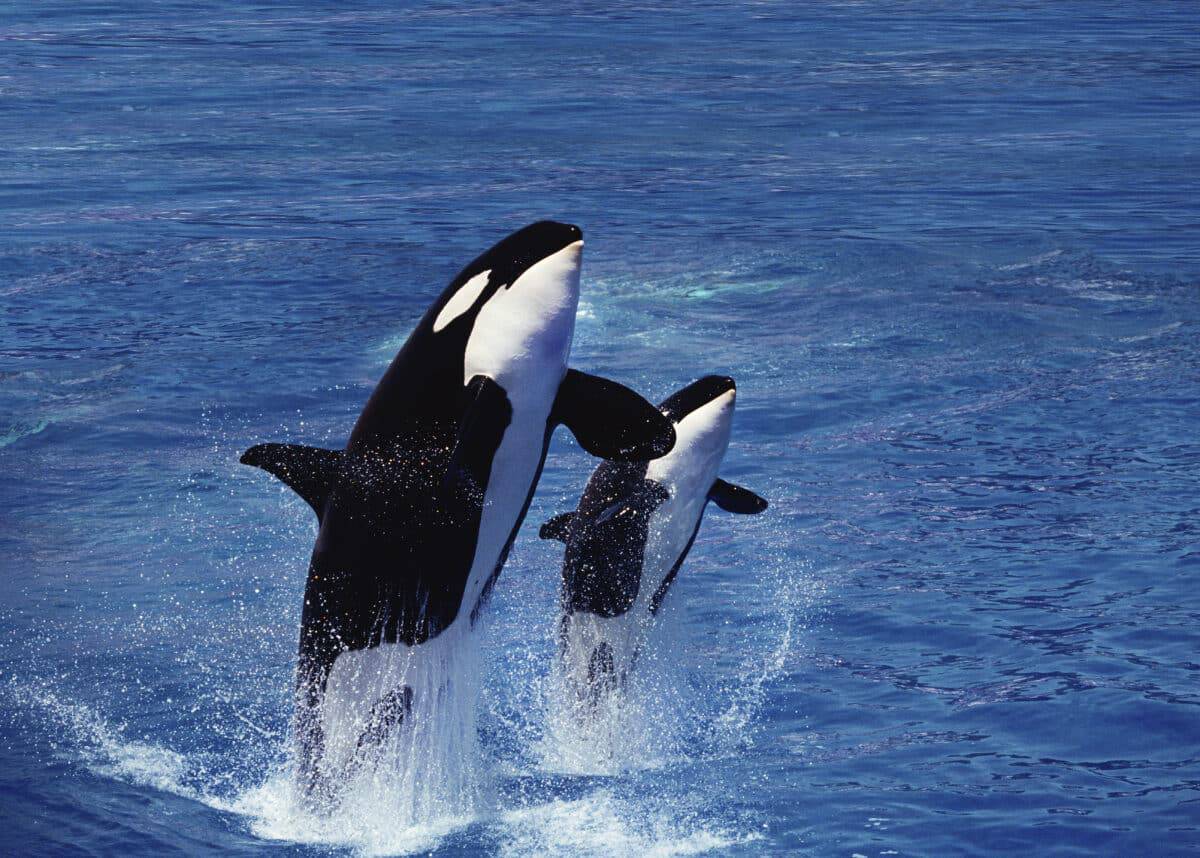
Different orca populations around the world have developed highly specialized hunting techniques tailored to specific prey, reflecting remarkable adaptability. In Antarctica, Type B orcas have mastered the art of creating waves to wash seals off ice floes, while in New Zealand, certain pods specialize in hunting rays by flipping them and avoiding their venomous spines. The Southern Resident killer whales of the Pacific Northwest have evolved techniques specifically for intercepting Chinook salmon at river mouths during seasonal runs. Perhaps most remarkable are the orcas of Península Valdés, Argentina, who have developed a unique strategy for capturing sea lion pups directly from beaches. These prey-specific specializations often involve completely different skill sets and approaches. Research by Dr. Robert Pitman has shown that these specializations can become so entrenched that different orca populations may ignore abundant prey if it doesn’t match their cultural hunting preference—even when facing food shortages. This extreme specialization demonstrates both the advantages of cultural learning and the remarkable cognitive flexibility that allows different orca groups to develop such diverse hunting technologies.
1. Deceptive Hunting Behaviors
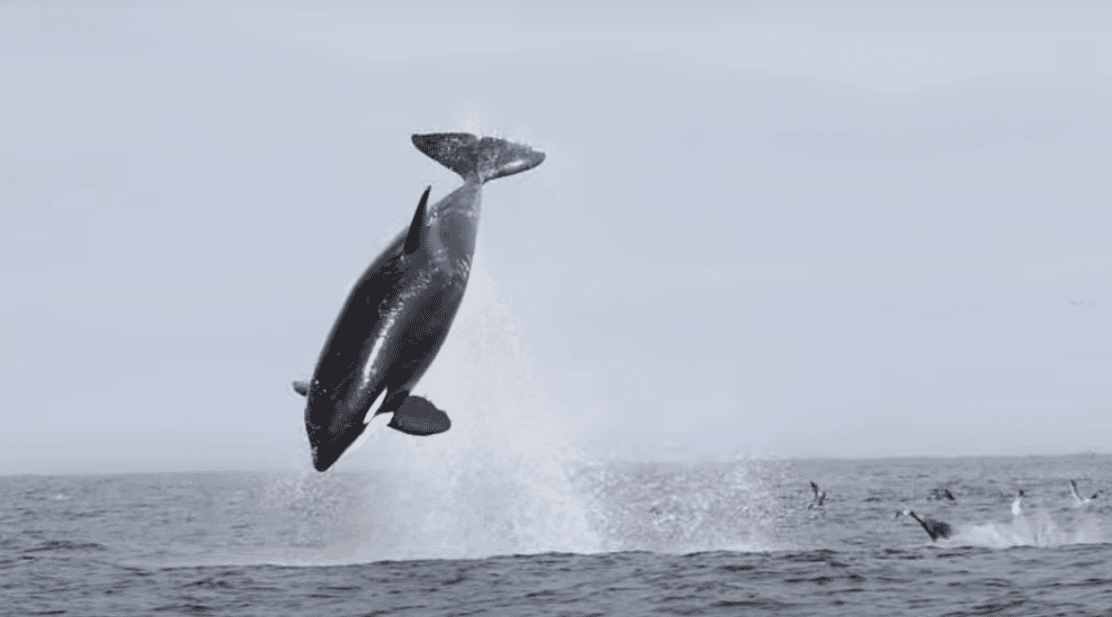
Orcas employ various forms of deception to outwit particularly vigilant prey. One remarkable technique involves “playing dead”—remaining motionless at the surface to pique the curiosity of seals or sea lions. Once the inquisitive prey approaches to investigate, the orca launches a sudden attack. Another deceptive strategy involves strategic silence during the final approach to prey. While orcas typically communicate constantly, hunting pods will go completely silent when closing in on marine mammals with sensitive hearing. In the waters of New Zealand, researchers have documented orcas using their white underside to blend with surface reflections when approaching from below—effectively camouflaging themselves against the bright surface when viewed from below. Some pods targeting seals will intentionally remain out of sight near seal colonies, sending a single member to patrol visibly offshore. When seals relax after seeing only one distant orca, the hidden members surge in for a coordinated ambush. These deceptive tactics demonstrate not just intelligence but a sophisticated understanding of prey psychology—the ability to predict and manipulate the behavior of other species.
Conclusion: Nature’s Ultimate Intelligent Predator
The remarkable arsenal of hunting tools and techniques employed by orcas showcases their position as perhaps the most sophisticated predators in the natural world. Their ability to combine physical adaptations with social coordination, cultural learning, and problem-solving places them in a category of intelligence that rivals many land-based predators. What makes orcas particularly exceptional is their capacity to adapt these techniques across different environments and prey types, maintaining specialized knowledge within pods that can persist for generations. As researchers continue to study these magnificent marine mammals, we undoubtedly will discover even more sophisticated strategies in their hunting repertoire. Understanding these advanced predatory techniques not only provides insight into orca cognition but also highlights the importance of protecting these apex predators and the marine ecosystems they help maintain through their sophisticated hunting behaviors.

As a little kid, I fell in love with nature, wildlife, and animals. Living in the USA, South Africa, Italy, China and Germany gave me the opportunity to discover the world's Wildlife. My favorite animals are Mountain Gorillas, Siberian Tigers, and Great White Sharks.
I'm a certified PADI Open Water Diver, went to Everest Base Camp and Trekked Gorillas in Uganda. I hold a Master of Science in Economics and Finance.
Please send any feedback to feedback@animalsaroundtheglobe.com
- The 10 Rarest Dog Breeds Making a Comeback in America - July 19, 2026
- 13 Creatures That Survived Mass Extinctions - July 19, 2026
- 12 Pets That Are Perfect for Seniors - July 19, 2026