


In the vast kingdom of animals, intelligence manifests in fascinating and diverse ways. While dolphins, chimpanzees, and border collies often dominate conversations about animal intelligence, there exists a remarkable creature that remains largely unknown to the general public despite its exceptional cognitive abilities. The New Caledonian crow (Corvus moneduloides), native to the Pacific island of New Caledonia, demonstrates problem-solving skills and tool usage that rival those of great apes, yet receives far less attention. These remarkable birds have evolved sophisticated behaviors that challenge our understanding of animal cognition and blur the lines between human and animal intelligence. Let’s explore why the New Caledonian crow might just be the smartest animal you’ve never heard of, and what their extraordinary abilities reveal about the evolution of intelligence.
The Island Masterminds of New Caledonia

New Caledonian crows are medium-sized, all-black corvids endemic to the remote South Pacific islands of New Caledonia. Their unremarkable appearance belies their extraordinary mental capabilities. Living in the dense forests of these islands, these birds have evolved in relative isolation, developing unique cognitive adaptations. The geographic isolation has created what scientists call an “evolutionary laboratory,” allowing these crows to develop specialized skills not seen in mainland relatives. Their environment, rich in resources but requiring specific techniques to access them, has shaped their evolution into one of the animal kingdom’s most sophisticated tool makers and users.
Master Toolmakers and Craftsmen
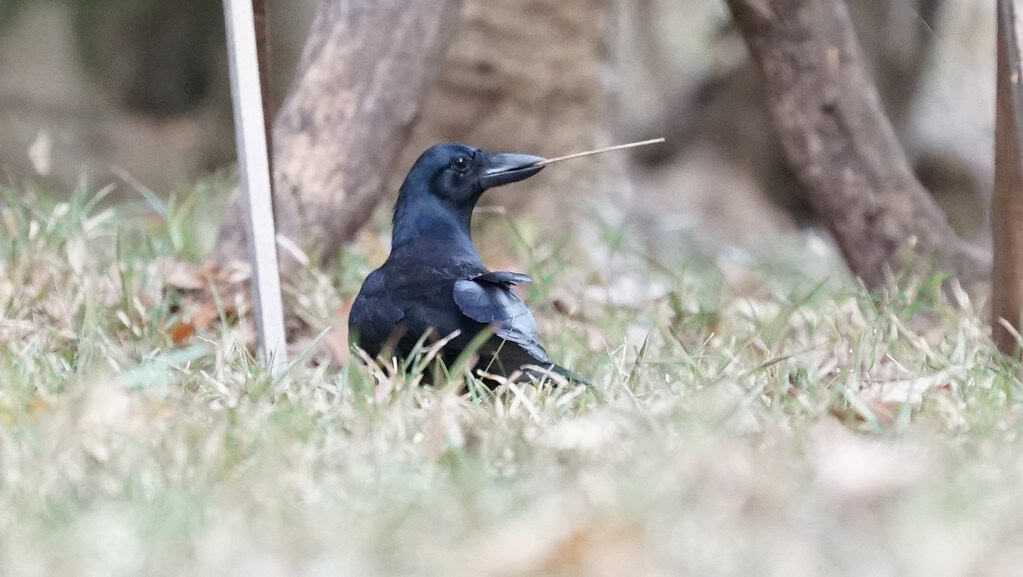
What truly sets New Caledonian crows apart is their sophisticated tool manufacturing abilities. These birds carefully craft tools from materials in their environment with a precision that rivals primitive human toolmaking. They create hooks from twigs by precisely trimming branches and carving small barbs that they use to extract grubs from holes in trees. Even more impressively, they fashion stepped-cut tools from the leaves of pandanus plants, creating serrated edges that serve as efficient food-extracting implements. Research has shown that individual crows have preferences for particular tool designs and can modify their tools if they prove ineffective, demonstrating an understanding of cause and effect that was once thought to be uniquely human.
Problem-Solving That Rivals Primates

The problem-solving abilities of New Caledonian crows have astonished researchers in laboratory settings. In one famous experiment called the “aesop’s fable” test, crows were presented with a narrow tube containing water with a floating food reward that was out of reach. The crows quickly learned to drop stones into the tube to raise the water level and bring the food within reach – a task requiring an understanding of water displacement that many children struggle to grasp before age seven. In another remarkable demonstration, a crow named “Betty” spontaneously bent a straight piece of wire into a hook to retrieve food from a container when no hooked tools were available, showing an understanding of tool properties and creative problem-solving previously documented only in great apes.
Meta-Tool Use: Tools to Make Tools

Perhaps the most impressive cognitive feat demonstrated by New Caledonian crows is their ability to use tools to make other tools – a behavior known as meta-tool use. In studies conducted by researchers at the University of Oxford, these crows used one stick as a tool to obtain another, longer stick, which they then used to retrieve food that was otherwise inaccessible. This sequential tool use demonstrates planning abilities and an understanding of means-end relationships that were previously thought to exist only in humans and, to a limited extent, in great apes. Such abilities suggest a level of abstract thinking and foresight that challenges conventional views of avian intelligence.
Social Learning and Cultural Transmission

New Caledonian crows don’t just individually develop these remarkable skills – they also exhibit sophisticated social learning mechanisms. Young crows learn tool-making techniques by observing their parents, a process that researchers have described as a primitive form of cultural transmission. Studies have shown that juvenile crows spend extensive periods watching adults manufacture and use tools before attempting to do so themselves. This social learning creates distinct “traditions” of tool design and use that vary between different populations of crows on the island, constituting what some researchers consider to be primitive cultural variation – a phenomenon once thought to be exclusive to humans and some primates.
Brain Structure and Specialized Cognition

How can a creature with a brain the size of a walnut perform cognitive feats that rival those of apes with much larger brains? The answer lies in neural efficiency and specialization. New Caledonian crows possess a remarkably developed nidopallium caudolaterale – a brain region analogous to the prefrontal cortex in mammals, which is associated with higher cognitive functions. Despite having much smaller brains than primates, the neural architecture of these crows is highly specialized for the types of problem-solving they regularly encounter. Their brain-to-body-size ratio is also among the highest in birds, comparable to that of chimpanzees relative to their body size, challenging the notion that absolute brain size determines intelligence.
Causal Reasoning and Physical Understanding

New Caledonian crows demonstrate a sophisticated understanding of physical causality that extends beyond simple trial-and-error learning. In experiments testing their comprehension of physical relationships, these crows showed an ability to reason about hidden causal agents. When confronted with a stick that appeared to move on its own (actually manipulated by a hidden human), the crows quickly deduced that an unseen force must be responsible, searching for the hidden cause rather than responding to the stick itself as if it were animate. This suggests an understanding of physical laws and causal relationships that approaches the level of abstract reasoning – cognitive territory once thought to be the exclusive domain of humans and some great apes.
Numerical Cognition and Memory

Beyond their tool-making prowess, New Caledonian crows demonstrate impressive numerical abilities and exceptional memory. Studies have shown that these birds can distinguish between different quantities and appear to understand basic numerical concepts. In memory tests, they have demonstrated the ability to remember the location of food caches over extended periods and can recall specific features of tools they’ve previously used. Some research suggests they can remember human faces that posed a threat to them years after a single encounter, indicating sophisticated recognition abilities and long-term memory that rivals many mammals with substantially larger brains.
Self-Awareness and Mirror Recognition?

While the jury is still out on whether New Caledonian crows possess full self-awareness, some preliminary research suggests they may have at least rudimentary self-recognition abilities. In modified mirror tests, some crows have shown behaviors that hint at an understanding that their reflection represents themselves rather than another bird. While these results remain controversial and require further investigation, they raise intriguing questions about the possibility of self-awareness in these birds. Even if they don’t possess the full mirror self-recognition demonstrated by great apes and dolphins, their behavior suggests at minimum a sophisticated understanding of their physical selves in relation to their environment.
Comparing Intelligence Across Species

Comparing intelligence across vastly different species presents significant challenges for researchers. Traditional measures of intelligence were often developed with humans or primates in mind and may fail to capture the unique cognitive adaptations of species with very different evolutionary histories. New Caledonian crows excel in domains relevant to their ecological niche – tool use, causal reasoning, and problem-solving – while potentially lacking in areas that aren’t relevant to their survival. This pattern of specialized intelligence emphasizes the importance of considering the ecological context in which cognition evolves. Rather than thinking of intelligence as a single scale with humans at the top, modern comparative cognition research suggests we should recognize multiple types of intelligence that have evolved to solve different adaptive challenges.
Conservation Status and Threats

Despite their remarkable cognitive abilities, New Caledonian crows face significant conservation challenges. Their island habitat is under pressure from mining operations, deforestation, and introduced predators. Currently classified as “least concern” on the IUCN Red List, localized populations nevertheless face threats that could impact their long-term survival. Conservation efforts are complicated by the limited range of these birds – they exist only on New Caledonia and the Loyalty Islands – making them vulnerable to habitat changes. Protecting these avian geniuses is not just important for biodiversity conservation but also for continued scientific research into the evolution of intelligence and complex cognition in non-human animals.
What We Can Learn From Crow Intelligence

The extraordinary cognitive abilities of New Caledonian crows have profound implications for our understanding of intelligence evolution. Their example demonstrates that complex problem-solving and tool use can evolve independently in distantly related lineages through convergent evolution, rather than being the exclusive domain of primates. This challenges anthropocentric views of intelligence and suggests that the capacity for sophisticated cognition may be more widespread in the animal kingdom than previously thought. Additionally, studying these birds provides insights into the ecological conditions that drive the evolution of intelligence. Their example suggests that environments requiring extractive foraging and presenting novel challenges may select for higher cognitive abilities, regardless of taxonomic group.
The New Caledonian crow represents one of the most compelling examples of advanced cognition in the animal kingdom, yet remains relatively unknown to the general public. Their sophisticated tool manufacturing, problem-solving abilities, causal reasoning, and potential cultural transmission challenge our preconceptions about avian intelligence and the cognitive divide between humans and other animals. By excelling in domains once thought to be exclusively human, these remarkable birds force us to reconsider what it means to be intelligent and suggest that complex cognition has evolved multiple times through different evolutionary pathways. As research continues to unveil the depths of their mental capabilities, New Caledonian crows stand as a powerful reminder that extraordinary intelligence can emerge in unexpected places, shaped by the unique challenges of specific ecological niches.

- What’s Hiding in the Forests of the Pacific Northwest - July 21, 2026
- Tarsiers: The Tiny Primates with Giant Eyes - July 21, 2026
- Are Zoos Still Ethical in 2025? - July 21, 2026