


High in the rugged mountains of Central Asia, where the air grows thin and temperatures plummet below freezing, roams one of Earth’s most mysterious and captivating big cats. The snow leopard, often called the “ghost of the mountains,” has mastered the art of invisibility among the towering peaks of the Himalayas, including the slopes of Mount Everest. With its smoky-gray fur patterned with dark rosettes and spots, this magnificent predator blends seamlessly into its harsh alpine environment. Despite decades of research, the snow leopard remains one of the most elusive and least understood big cats, adding to its mystique and allure. As climate change and human encroachment increasingly threaten its fragile habitat, understanding this remarkable creature becomes not just a scientific pursuit but a conservation imperative.
The Ghost of the Mountains: Physical Characteristics

Snow leopards (Panthera uncia) possess a distinctive set of physical adaptations that make them perfectly suited for life in the extreme high-altitude environments they call home. Weighing between 60-120 pounds (27-55 kg), they are medium-sized among big cats, with males typically larger than females. Their most striking feature is their thick, luxurious fur coat, which can grow up to 5 inches (12 cm) long during winter months. This dense pelage appears pale gray to yellowish-tan, adorned with large black rosettes and spots that provide perfect camouflage among the rocky, snow-patched terrain.
Beyond their beautiful coat, snow leopards have several specialized adaptations for mountain living. Their unusually large paws function like natural snowshoes, distributing weight evenly across snow and providing traction on treacherous terrain. Their extraordinarily long tail, which can measure up to 3 feet (90 cm), serves multiple purposes: it provides crucial balance when navigating steep slopes, stores fat for energy reserves, and can wrap around the leopard’s body like a blanket during bitter cold nights. Perhaps most remarkable are their enlarged nasal cavities and chest capacity, evolutionary adaptations that allow them to thrive in oxygen-depleted environments above 9,800 feet (3,000 meters), where most other large predators cannot survive.
Masters of the Vertical Realm: Habitat and Range

Snow leopards inhabit one of the most extreme environments on Earth, making their home in the high mountain ranges of Central Asia. Their range spans across 12 countries, including Nepal, India, Pakistan, Afghanistan, China, Mongolia, and Russia, covering approximately 772,204 square miles (2 million square kilometers) of rugged terrain. Within this vast region, they typically prefer elevations between 9,800 and 14,800 feet (3,000-4,500 meters), though they have been documented at altitudes as high as 19,700 feet (6,000 meters) in the Himalayas – higher than many permanent human settlements.
The snow leopard’s habitat consists primarily of steep, rocky slopes, alpine meadows, and high-altitude forests. These regions are characterized by extreme temperature fluctuations, with winter temperatures often plunging below -40°F (-40°C) and summer highs rarely exceeding 77°F (25°C). Despite these harsh conditions, snow leopards have carved out their niche as the apex predator of this vertical realm. On the slopes of Mount Everest and throughout the Sagarmatha National Park in Nepal, they inhabit the subalpine and alpine zones, navigating landscapes that remain largely inaccessible to humans. This inaccessibility has both protected them and made scientific study extraordinarily challenging, contributing to their enigmatic reputation.
The Solitary Hunter: Behavior and Social Structure

Snow leopards are primarily solitary creatures, coming together only during the brief mating season. They maintain large territories, with males patrolling areas as expansive as 80 square miles (207 square kilometers) that may overlap with the smaller territories of several females. Unlike many other big cats, snow leopards are not territorial in the traditional sense – they don’t actively defend their ranges against other snow leopards, instead avoiding conflict through temporal spacing and scent marking.
These cats are crepuscular hunters, most active during dawn and dusk when their prey is also on the move. Patient and methodical, they employ a stalk-and-ambush hunting strategy, sometimes watching potential prey for hours before making their move. When they strike, they can leap as far as 50 feet (15 meters) in a single bound – a remarkable feat that showcases their extraordinary physical capabilities. Unlike other big cats in the Panthera genus, snow leopards cannot roar due to differences in their throat anatomy. Instead, they communicate through vocalizations that include purrs, mews, growls, and a distinctive “chuffing” sound – a non-threatening vocalization that resembles a puffing exhale. They also rely heavily on visual and olfactory communication, using scrapes, scent marking, and feces deposits to exchange information with other snow leopards across their vast, rugged territories.
Diet and Hunting Strategies in the Alpine Zone
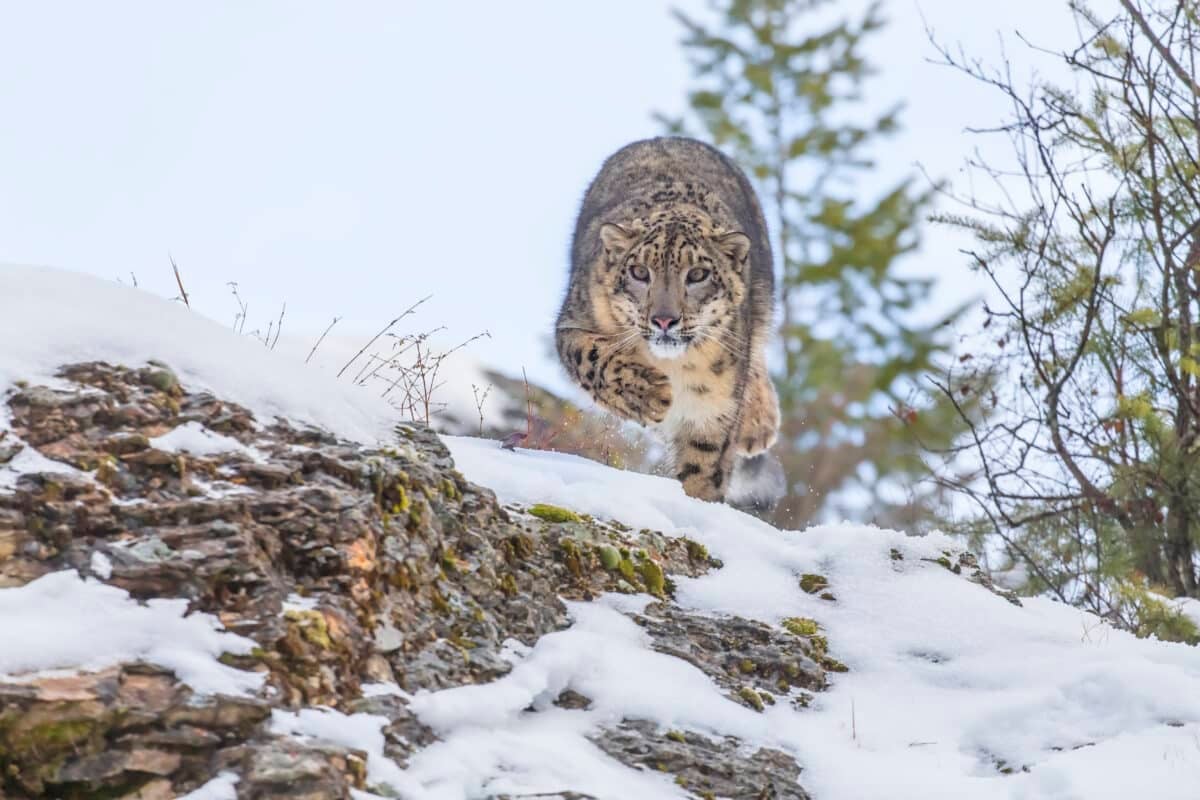
Snow leopards are carnivores with a diet primarily consisting of wild mountain ungulates that share their harsh habitat. Their preferred prey includes blue sheep (bharal), Himalayan tahr, ibex, markhor, and argali sheep – all agile mountain dwellers that can weigh up to three times the leopard’s own body weight. This impressive predator has evolved exceptional hunting capabilities to capture such formidable prey on nearly vertical terrain. With powerful hind legs that enable them to leap up to six times their body length and a low center of gravity for stability, they can pursue prey across landscapes that would be impassable to most other predators.
When larger prey is scarce, snow leopards demonstrate remarkable adaptability by shifting to smaller animals such as marmots, pikas, hares, and game birds. A successful hunt doesn’t happen frequently – research suggests they make a significant kill only once every 8-10 days – and when they do, they maximize the caloric return by remaining with the carcass for 3-4 days, consuming nearly every part of the animal. One unique hunting behavior that distinguishes snow leopards is their willingness to pursue prey downhill – a risky strategy most predators avoid due to the danger of gaining too much momentum. This specialized hunting technique, combined with their cryptic coloration and silent movement, makes them formidable predators in an environment where energy conservation is crucial for survival.
Reproduction and Family Life in Extreme Conditions

The snow leopard breeding season is remarkably brief, typically occurring between January and mid-March when females enter estrus for just 5-8 days. During this short window, normally solitary adults will seek each other out through scent marking and vocalizations. Males may travel long distances across treacherous terrain to find receptive females, and multiple males sometimes compete for a single female, though violent confrontations are rare compared to other big cats.
After a gestation period of 90-100 days, female snow leopards give birth to 1-5 cubs (typically 2-3) in sheltered rocky dens, often located in remote caves or crevices that offer protection from predators and the harsh elements. Cubs are born blind and helpless, weighing just 320-567 grams (11-20 ounces). The mother provides everything for her young, hunting alone and returning to the den to nurse and care for the cubs, which represents an extraordinary energy expenditure in such an unforgiving environment. The cubs’ eyes open at about 7 days, and by 2 months, they begin exploring outside the den. They remain with their mother for 18-22 months – one of the longest dependency periods among big cats – learning essential survival skills for life in the mountains. This extended learning period is crucial, as young snow leopards must master extremely specialized hunting techniques and environmental navigation before striking out on their own. Sexual maturity is reached at around 2-3 years, though females typically don’t reproduce until they establish their own territory.
Adaptations for Survival at the Roof of the World
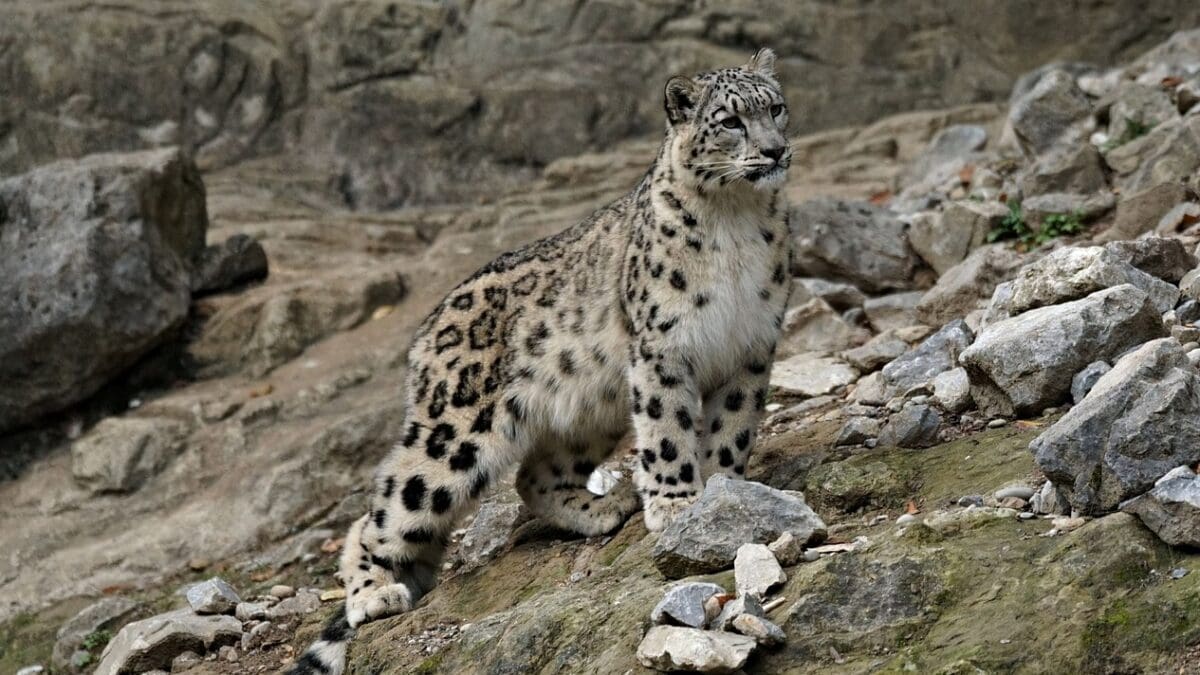
Snow leopards possess a remarkable suite of physiological and anatomical adaptations that allow them to thrive where few large mammals can survive. Their respiratory system has evolved to extract maximum oxygen from the thin mountain air, featuring enlarged nasal cavities that warm and moisten incoming air and larger lungs and heart relative to body size compared to lowland cats. These adaptations enable efficient oxygen processing at altitudes where the air contains approximately 60% of the oxygen available at sea level.
Beyond their respiratory specializations, snow leopards have developed numerous cold-weather adaptations. Their nasal passages are shorter than those of other big cats, which helps reduce heat loss during respiration in sub-zero temperatures. The distinctive thick tail serves as both a balance organ and a built-in muffler, as the leopard can wrap it around its face while resting to conserve warmth. Their fur provides unparalleled insulation, with each hair surrounded by air pockets that trap body heat, while the fur on their undersides grows up to twice as long as that on their backs. Even their compact body design represents an adaptation, with shorter limbs and more rounded ears than other large felines – modifications that minimize heat loss by reducing surface area exposure to the cold. Perhaps most impressive is their metabolic efficiency; snow leopards can slow their metabolism during periods of prey scarcity, allowing them to survive in an ecosystem where food resources are naturally limited and unpredictable.
The Challenge of Studying Everest’s Phantom Cat
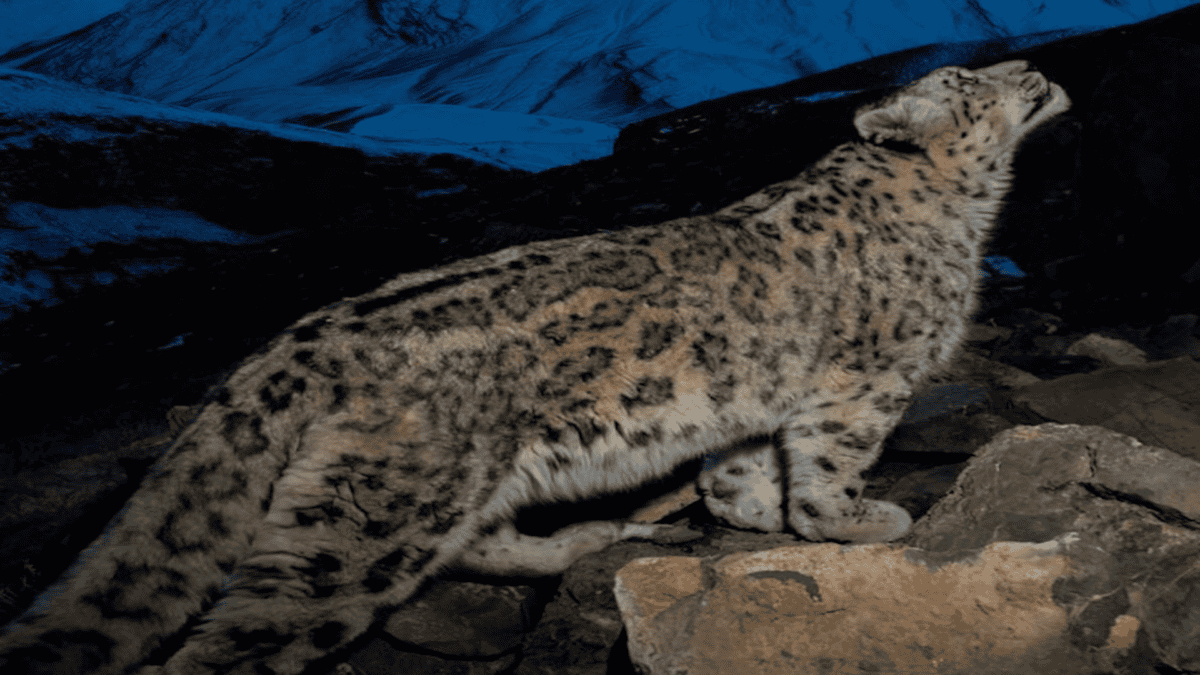
Researching snow leopards presents extraordinary challenges that have earned them the reputation as one of the most difficult large mammals to study in the wild. Their remote habitat at extreme altitudes creates logistical nightmares for researchers, who must contend with oxygen deprivation, unpredictable weather, treacherous terrain, and limited accessibility. Field studies often require weeks of trekking through mountains with heavy equipment, camping in sub-zero temperatures, and navigating landscapes few humans ever traverse.
The elusive nature of snow leopards compounds these difficulties. Their exceptional camouflage, crepuscular activity patterns, and natural avoidance of humans make direct observation exceedingly rare – many dedicated researchers have spent years in the field without ever spotting one. Modern technology has revolutionized snow leopard research, with camera traps, GPS collars, and environmental DNA analysis now providing insights previously impossible to obtain. The Sagarmatha (Everest) region presents particular study challenges, as its sacred status, high tourism traffic, and extreme elevations create additional complications for sustained research efforts. Despite these obstacles, our understanding of snow leopards has advanced significantly in recent decades. The Snow Leopard Trust estimates the global population at 3,500-7,000 individuals in the wild, though this figure remains an educated approximation given the inherent difficulties in conducting comprehensive population surveys across their vast, rugged range.
Conservation Status and Threats

Snow leopards are classified as “Vulnerable” on the IUCN Red List, having been downlisted from “Endangered” in 2017 – a controversial decision that some conservation groups believe was premature given ongoing threats and population uncertainties. Current estimates suggest 3,500-7,000 individuals remain in the wild, with populations fragmented across their 12-country range. Despite their protected status in every country they inhabit, snow leopards face numerous interconnected threats that continue to jeopardize their future.
Human-wildlife conflict represents one of the most immediate challenges. As traditional grazing lands shrink and wild prey becomes scarcer, snow leopards occasionally prey on domestic livestock, leading to retaliatory killings by herders who can ill afford to lose their animals. Habitat degradation through overgrazing, mining, and infrastructure development further compounds these pressures by reducing available space for both leopards and their natural prey. The illegal wildlife trade continues to target snow leopards for their bones, skin, and organs, which command high prices in black markets for traditional medicine and luxury products. Climate change poses perhaps the most pervasive long-term threat, as warming temperatures push the snow line higher, shrinking the specialized alpine habitat that snow leopards depend upon. Research suggests that up to 30% of snow leopard habitat in the Himalayas could become unsuitable due to upward treeline shift and changing precipitation patterns in the coming decades, potentially creating extinction vortices in already isolated populations.
The Cultural Significance of Snow Leopards

Throughout their range, snow leopards hold profound cultural significance for the indigenous peoples who share their mountain home. In Nepal’s Sherpa communities near Mount Everest, the snow leopard (locally called “sadak” or “sat”) is often regarded as a manifestation of mountain deities who guard sacred peaks. Many traditional Buddhist beliefs incorporate the snow leopard as a symbol of spiritual power and harmony with nature, featuring prominently in religious artwork, stories, and ceremonies. In Tibetan Buddhism, the snow leopard is sometimes associated with Padmasambhava (Guru Rinpoche), who is said to have transformed into the great cat during his spiritual journeys through the Himalayas.
Beyond religious contexts, snow leopards feature prominently in the folklore and oral traditions of mountain communities. Tales often emphasize the cat’s ghostly nature, uncanny intelligence, and supernatural abilities to appear and disappear at will. These cultural associations have contributed to traditional protection practices in some areas, where killing a snow leopard is considered spiritually dangerous or taboo. However, as traditional beliefs encounter modern pressures and economic hardships, these cultural protections have sometimes eroded. Conservation efforts increasingly recognize the importance of engaging with and reinforcing these cultural connections, understanding that successful protection of snow leopards requires honoring and working within the cultural frameworks of the communities who have lived alongside these cats for centuries. In the Sagarmatha (Everest) region specifically, the snow leopard serves as both a cultural icon and an increasingly important symbol of ecological health and resilience in the face of climate change and tourism development.
Conservation Success Stories from the Roof of the World

Despite the numerous challenges facing snow leopards, targeted conservation efforts have achieved notable successes that provide hope for the species’ future. In Nepal’s Sagarmatha National Park and buffer zones around Mount Everest, community-based conservation has emerged as a particularly effective approach. Local initiatives like the Sacred Himalayan Landscape project have trained former hunters as wildlife guardians, establishing community-managed protected areas that benefit both people and wildlife. These programs have helped reduce retaliatory killings by implementing livestock insurance schemes, predator-proof corrals, and alternative livelihood options for herding communities.
Technological innovation has revolutionized snow leopard monitoring and protection efforts. The deployment of camera trap networks throughout the Everest region has not only provided crucial population data but has also engaged local communities in citizen science, creating stakeholders in conservation success. Advanced GPS collaring studies have revealed previously unknown aspects of snow leopard movement patterns, helping identify critical habitat corridors that require protection. Perhaps most encouraging is the incorporation of snow leopard conservation into broader landscape-level planning. The recent establishment of the Kanchenjunga Landscape Conservation Area, which spans Nepal, India, and Bhutan, represents a groundbreaking transboundary approach that acknowledges the need for international cooperation to protect wide-ranging species like the snow leopard. These success stories demonstrate that with thoughtful, culturally sensitive approaches that address both ecological and human needs, snow leopard conservation can succeed even in the challenging context of the world’s highest mountains.
For wildlife enthusiasts, glimpsing a snow leopard in its natural habitat represents one of nature’s most coveted and challenging experiences. As interest in snow leopard tourism grows, particularly in the popular Everest region, the industry presents both opportunities and concerns for conservation. When properly managed, snow leopard tourism can generate substantial revenue for local communities and create economic incentives for protection. In Nepal’s Sagarmatha National Park and surrounding areas, specialized snow leopard treks have emerged as high-value tourism products that employ local guides and support conservation initiatives through park fees and community programs.
Ethical snow leopard tourism requires stringent practices to minimize impact on these sensitive cats. Responsible operators maintain appropriate viewing distances (typically using spotting scopes from at least 500 meters away), strictly limit group sizes, ensure proper waste management, and prioritize the animal’s needs over visitor photo opportunities. The best programs incorporate robust educational components that help visitors understand snow leopard ecology and conservation challenges. For travelers hoping to maximize their chances of encountering these elusive predators, winter months (November to March) typically offer the best opportunities, as leopards descend to lower elevations following their prey. The Everest region’s Gokyo Valley and Thame areas have emerged as relative hotspots for s

- Meet the Snow Leopard: Everest’s Elusive Predator - August 7, 2026
- Conservation Success: How Otters Are Making a Comeback - August 7, 2026
- Surprising Foods Wild Animals Have Learned to Eat - August 7, 2026
Leave a comment
You must be logged in to post a comment.