
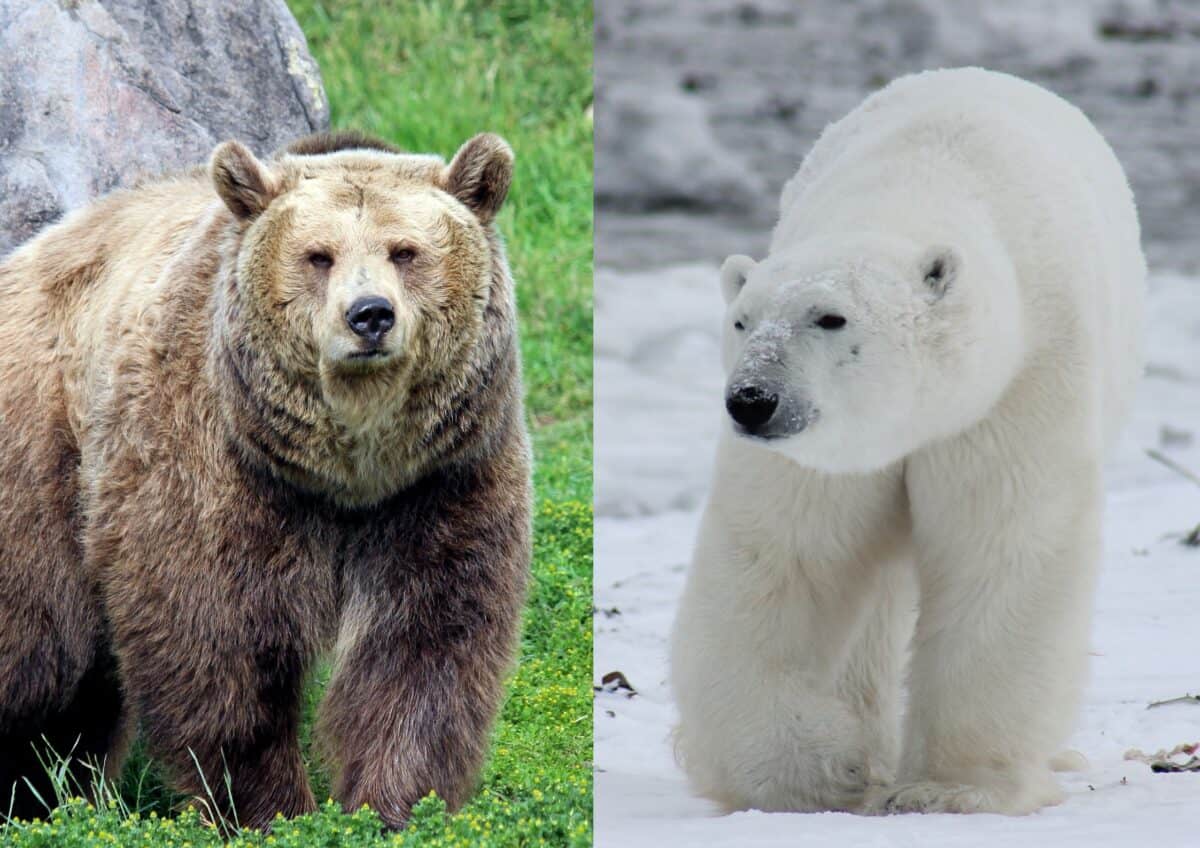
In the vast wilderness of North America, two apex predators reign supreme in their respective domains: the polar bear of the Arctic ice and the grizzly bear of mountain forests and tundra. As climate change pushes these magnificent creatures’ territories closer together, encounters between them are becoming increasingly possible. These rare but significant meetings between polar bears and grizzlies have fascinated scientists and wildlife enthusiasts alike, raising questions about what happens when these powerful bears come face to face. This article explores the dynamics, outcomes, and implications of these extraordinary ursine encounters.
The Natural Habitats and Separation

Historically, polar bears and grizzly bears have occupied distinctly different ecosystems with minimal overlap. Polar bears (Ursus maritimus) are marine mammals that spend most of their lives on Arctic sea ice, hunting seals and traveling across frozen expanses. Their entire physiology is adapted for cold, icy environments and a diet rich in marine fat. Grizzly bears (Ursus arctos horribilis), a subspecies of brown bear, typically inhabit mountain forests, meadows, and inland tundra across North America, with diets varying from berries and roots to fish and mammals. This geographical separation has traditionally kept these species from interacting regularly in the wild.
Climate Change: The Great Connector

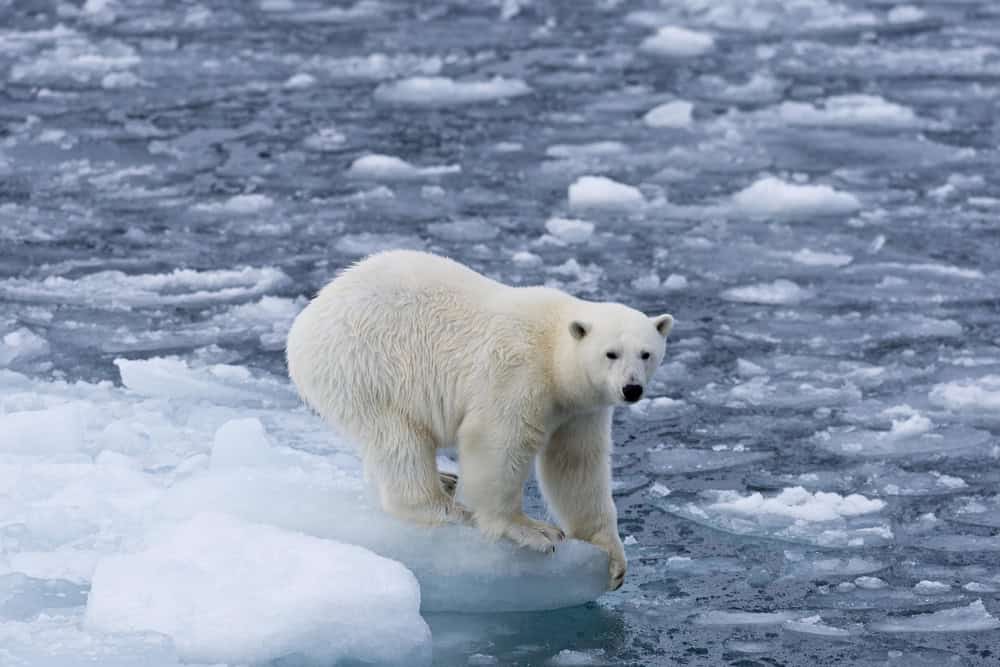
As global temperatures rise, polar bears face shrinking sea ice habitats, forcing them to spend more time on land and venture further south than their traditional territories. Concurrently, warming temperatures allow grizzlies to expand their range northward into previously inhospitable Arctic regions. This climate-driven territorial shift has created a growing zone of overlap in places like northern Canada and Alaska. Scientists have documented increasing instances of both species utilizing the same coastal areas, particularly during summer months when food sources like whale carcasses attract both bears to shorelines. This unprecedented ecological change sets the stage for more frequent encounters between these formidable predators.
Physical Comparison: Size and Strength

When considering a potential confrontation between these bears, physical attributes matter significantly. Polar bears are generally larger, with adult males weighing between 900-1,600 pounds and standing up to 10 feet tall when on hind legs. Their bodies are more elongated with longer necks and heads adapted for hunting in water. Grizzlies are slightly smaller but more compact and muscular, with males typically weighing 400-800 pounds, though exceptional individuals can reach 1,200 pounds. Grizzlies possess a pronounced shoulder hump formed by powerful muscles used for digging and a distinctive dish-shaped face. Both species have enormous strength, with polar bears specialized for swimming and pulling prey from water, while grizzlies excel at digging and turning heavy objects. These physical differences would influence any potential confrontation between the species.
Behavioral Differences and Temperament

The behavioral tendencies of these bears could significantly impact an encounter. Polar bears are often considered more predatory by nature, having evolved as specialized hunters that actively stalk and ambush seals. They rarely face competition in their native environment and generally have less experience with same-sized competitors. Grizzlies, conversely, have evolved in environments with more competition and territorial disputes. They’re known for their aggressive defense of food sources, cubs, and territory against potential threats, including other bears. Grizzlies have more experience with intraspecies confrontation and often use intimidation displays—standing tall, roaring, and false charges—to resolve conflicts without physical combat. These behavioral differences might mean grizzlies are better prepared psychologically for confrontational encounters.
Documented Encounters in the Wild

While still relatively rare, documented encounters between polar bears and grizzlies have increased in recent decades. Wildlife biologists studying the western Hudson Bay and Alaska’s North Slope have observed several interactions with varying outcomes. In some cases, the bears have demonstrated mutual avoidance, maintaining distance when detecting each other. In others, brief territorial displays have occurred with one bear typically retreating—often the younger or smaller individual regardless of species. More direct confrontations have generally occurred around food sources like whale carcasses, with outcomes dependent on individual size, age, and motivation rather than species alone. Notably, when female bears with cubs encounter the other species, they typically demonstrate extreme caution and will go to great lengths to avoid potential conflict.
The Emergence of Pizzly/Grolar Bears

Perhaps the most fascinating outcome of polar bear and grizzly encounters is the documented hybridization between these species. First confirmed through DNA testing in 2006, these hybrids—dubbed “pizzly” or “grolar” bears depending on the parental combination—demonstrate that the species are genetically compatible despite evolutionary separation of hundreds of thousands of years. These hybrids typically display a blend of physical characteristics: creamy white fur with a brownish tint, the shoulder hump of a grizzly but the longer neck of a polar bear, and partially hollow hairs. Most documented hybrids have resulted from male grizzlies venturing into polar bear territory and mating with female polar bears, though the reverse combination has also been confirmed. These hybrids are fertile and capable of reproducing with either parent species or other hybrids, creating complex genetic situations that scientists are still studying.
Competition for Food Resources

When polar bears and grizzlies encounter one another, competition for food resources often drives their interactions. Whale carcasses washing ashore represent significant nutritional opportunities for both species, particularly as climate change affects traditional food sources. Observational studies suggest that when competing for such resources, the outcome often depends on numbers and individual size rather than species. A large male polar bear may dominate a smaller grizzly, while a group of grizzlies might displace a lone polar bear. Interestingly, polar bears’ specialized hunting techniques for seals offer no advantage in these terrestrial food competitions, while grizzlies’ more diverse feeding experience and adaptability to various food sources might provide an edge in some scenarios. As polar bears spend more time on land due to sea ice loss, these competitive interactions over terrestrial food sources may increase.
Territorial Disputes and Dominance

When territories overlap, bears must establish dominance hierarchies. Research suggests that these encounters typically follow patterns similar to intraspecies bear conflicts rather than developing new interspecies dynamics. The larger, more aggressive individual generally establishes dominance regardless of species. Both bear species utilize similar body language and vocalizations in territorial disputes—huffing, jaw-popping, swatting the ground, and false charges. These displays often resolve conflicts without physical combat, which could prove costly to both individuals. In the emerging overlap zones along Arctic coastlines, observations indicate that neither species appears to have an inherent dominance over the other, with individual size, age, sex, and level of hunger or desperation playing more decisive roles than species-specific traits.
Fighting Capabilities and Techniques

While direct combat between polar bears and grizzlies remains rarely documented, we can analyze their potential fighting capabilities based on known attributes. Polar bears possess slightly longer claws designed primarily for traction on ice and gripping prey, while grizzlies have shorter, more curved claws better suited for digging and combat. Polar bears have stronger bites, with specialized canine teeth for dispatching marine mammals, whereas grizzlies have more versatile dentition reflecting their omnivorous diet. In terms of fighting technique, grizzlies may have an advantage due to more frequent territorial disputes with other large predators and bears in their traditional ranges. Their lower center of gravity and powerful forelimbs enable effective grappling. Polar bears, with their longer reach and slightly larger size, might maintain distance advantage in some confrontations. However, these physical adaptations have evolved for different ecological purposes rather than for combat with each other.
Cubs and Maternal Protection
One of the most intense scenarios would involve an encounter between either species and the other’s cubs. Both polar and grizzly bears are known for their fierce maternal protectiveness. Female bears with cubs will go to extraordinary lengths to protect their offspring, including confronting much larger males of their own species. In potential cross-species encounters involving cubs, maternal bears would likely display extreme aggression toward any perceived threat. Male bears of both species have been documented killing cubs in certain circumstances, particularly their own species’ cubs to bring females back into breeding condition. This creates a complex dynamic where female bears must be hypervigilant against all large bears regardless of species. Wildlife observers have noted that female bears with cubs are especially likely to flee areas where they detect the other species, suggesting an evolved caution that transcends species boundaries.
Scientific Monitoring and Research
The increasing overlap between polar bear and grizzly ranges has prompted expanded scientific research into their interactions. Wildlife agencies in Canada, Alaska, and other circumpolar nations have established monitoring programs using satellite tracking, DNA sampling, and camera traps to document encounters. These studies aim to understand how climate-driven range shifts affect both species’ behavior and survival. Researchers are particularly interested in documenting feeding strategies in shared territories, hybridization rates, and whether competitive exclusion might eventually occur in certain areas. This research has practical applications for conservation management, helping wildlife authorities develop strategies to mitigate potential conflicts and protect vulnerable populations of both species as their habitats continue to change. Citizen science has also contributed valuable data, with northern communities reporting bear observations through established networks.
Ecological and Evolutionary Implications

The increasing contact between polar bears and grizzlies represents a living experiment in evolution and adaptation. Hybridization between these species raises profound questions about species boundaries and adaptation to rapidly changing environments. Some scientists suggest hybrid bears might potentially combine advantageous traits from both parent species—the polar bear’s cold tolerance and swimming ability with the grizzly’s more versatile feeding strategies—potentially creating individuals better adapted to changing Arctic conditions. Others worry that hybridization might dilute the specialized adaptations that make polar bears successful marine predators. From an ecological perspective, competition between these apex predators could reshape Arctic and sub-Arctic food webs, potentially creating cascading effects through multiple trophic levels. These encounters thus serve as a powerful case study in how climate change can drive novel ecological interactions with unpredictable consequences.
Conclusion
When polar bears and grizzlies meet, the outcome depends far more on individual circumstances than species identity, with size, age, hunger level, and reproductive status typically determining the interaction’s nature. Climate change has transformed these once-rare encounters into increasingly common occurrences, creating natural laboratories for studying adaptation, competition, and hybridization in real time. As Arctic ecosystems continue transforming, these magnificent bears face uncertain futures where their historical separation dissolves and new relationships emerge. For scientists, conservationists, and bear enthusiasts alike, the ongoing story of polar bear and grizzly encounters represents one of nature’s most compelling dramas—a powerful reminder of how environmental change can rewrite ecological relationships that have existed for millennia.

- What Would Happen If a Polar Bear Meets a Grizzly? - August 15, 2026
- Hyenas in African Lore: Villains or Shamans? - August 15, 2026
- The Deepest-Diving Whale Can Hold Its Breath for Over 2 Hours - August 14, 2026
Leave a comment
You must be logged in to post a comment.