


In the aftermath of nuclear disasters like Chernobyl and Hiroshima, most life forms perished due to lethal radiation exposure. Yet among the devastation, certain organisms have demonstrated remarkable resilience to conditions that would kill humans hundreds of times over. Radiation tolerance varies dramatically across species, with some animals capable of withstanding doses that would be instantaneously fatal to humans. While humans typically succumb to radiation sickness at around 5-10 grays (Gy), certain microorganisms and invertebrates display astonishing resistance to radiation levels thousands of times higher.
Understanding these radiation-resistant organisms has profound implications for multiple fields, from radiation protection technology to cancer treatment and even space exploration. Scientists study these remarkable creatures to uncover the biological mechanisms that allow them to survive in environments that would be lethal to most other life forms. The undisputed champion of radiation resistance in the animal kingdom is a microscopic creature that has fascinated researchers worldwide for its nearly indestructible nature.
Meet the Tardigrade: The Radiation Resistance Champion

While tardigrades display impressive radiation resistance, they aren’t actually the most radiation-resistant animals on Earth. That title belongs to the microscopic organism Deinococcus radiodurans, a bacterium so resilient it earned the nickname “Conan the Bacterium.” However, among multicellular animals, tardigrades (also known as water bears or moss piglets) are the undisputed champions of radiation tolerance. These microscopic invertebrates, typically measuring between 0.1 to 1.5 millimeters, belong to the phylum Tardigrada and have existed for over 500 million years, surviving all five mass extinction events on Earth.
Tardigrades can be found in virtually every environment on Earth—from the deepest ocean trenches to the highest mountains, from tropical rainforests to Antarctic ice. They thrive in both extremely wet and extremely dry environments. Their ubiquitous presence across such diverse habitats hints at their extraordinary survival capabilities. What makes them truly remarkable is their ability to enter a state of cryptobiosis, essentially suspending their metabolism when environmental conditions become unfavorable, including during radiation exposure.
The Science Behind Tardigrade Radiation Resistance
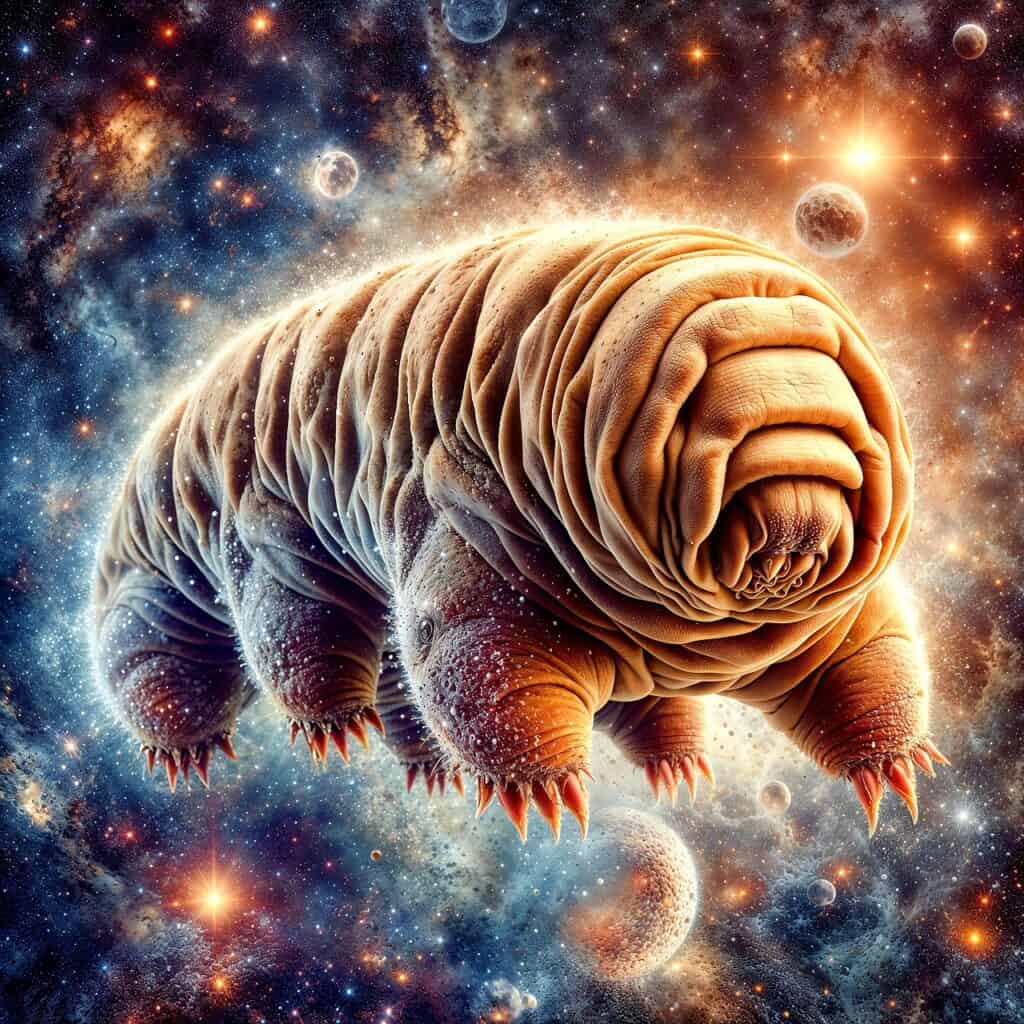
Tardigrades can withstand radiation doses of up to 5,000-6,000 Gy, which is about 1,000 times the lethal dose for humans. Research has revealed several mechanisms behind this extraordinary capability. One key factor is a unique protein called Dsup (Damage Suppressor), which physically shields their DNA from the harmful effects of radiation. This protein binds to nuclear DNA and creates a protective barrier that prevents the formation of reactive oxygen species, which typically damage cellular structures during radiation exposure.
Additionally, tardigrades possess highly efficient DNA repair mechanisms that can quickly mend breaks in DNA strands caused by radiation. They also produce abundant antioxidants that neutralize free radicals generated by radiation. When tardigrades enter their cryptobiotic state, they replace most of the water in their bodies with a sugar called trehalose, which forms a glass-like substance that further protects their cellular components from radiation damage. This combination of protective measures makes tardigrades extraordinarily resistant to radiation levels that would destroy most other organisms.
Deinococcus radiodurans: The True Radiation King

While tardigrades are impressive, the bacterium Deinococcus radiodurans surpasses them in radiation resistance. This extremophile can withstand radiation doses exceeding 15,000 Gy without losing viability—about three times the tolerance of tardigrades. Discovered in 1956 in a can of ground meat that had been radiation-sterilized, D. radiodurans has since been found in various environments from elephant dung to granite in Antarctic dry valleys and has been listed in the Guinness Book of World Records as “the world’s toughest bacterium.”
D. radiodurans achieves its extraordinary radiation resistance through several mechanisms. It possesses multiple copies of its genome, allowing it to reconstruct damaged DNA using intact copies as templates. The bacterium’s DNA is also arranged in a tightly packed toroidal (donut-shaped) structure that minimizes radiation damage. Additionally, it produces enzymes that efficiently repair DNA damage and contains high levels of manganese complexes that protect proteins from oxidative damage. These mechanisms collectively enable D. radiodurans to survive radiation levels that would destroy any other known organism.
Other Radiation-Resistant Organisms

Beyond tardigrades and D. radiodurans, several other organisms display notable radiation resistance. The bdelloid rotifer, another microscopic aquatic invertebrate, can withstand radiation doses up to 2,200 Gy. Like tardigrades, rotifers can enter a state of anhydrobiosis (life without water) when conditions become unfavorable. Certain fungi have also demonstrated impressive radiation tolerance. Cryptococcus neoformans and various species of black fungi (melanized fungi) can withstand high levels of radiation due to the presence of melanin, which absorbs and dissipates radiation energy.
Cockroaches, often mistakenly cited as the most radiation-resistant animals, can indeed withstand radiation levels 5-10 times higher than humans (about 50-100 Gy). This is primarily because their cells divide more slowly than human cells, making them less vulnerable to radiation damage. However, their radiation resistance pales in comparison to tardigrades or D. radiodurans. Some extremophilic archaea found in hot springs and deep-sea hydrothermal vents also display significant radiation resistance, having evolved to handle multiple environmental stressors simultaneously.
Mechanisms of Radiation Damage

To understand what makes these organisms special, it’s important to grasp how radiation damages living cells. Ionizing radiation, such as gamma rays or X-rays, carries enough energy to remove electrons from atoms, creating highly reactive ions. These ions can directly damage DNA by breaking the molecular bonds in the genetic material. However, most radiation damage occurs indirectly when radiation interacts with water molecules in cells, producing reactive oxygen species (ROS) like hydroxyl radicals and hydrogen peroxide that attack DNA, proteins, and cell membranes.
DNA damage typically manifests as single-strand breaks, double-strand breaks, or base modifications. While single-strand breaks are relatively easy for cells to repair, double-strand breaks are more problematic and often lead to mutations or cell death if not correctly repaired. Most organisms, including humans, possess some DNA repair mechanisms, but radiation-resistant species have evolved extraordinarily efficient repair systems that can handle massive DNA damage. Additionally, these organisms often have mechanisms to protect their proteins and other cellular components from oxidative damage, which is crucial for maintaining cellular function after radiation exposure.
Cryptobiosis: The Secret to Surviving Extreme Conditions

Cryptobiosis, meaning “hidden life,” refers to a state in which metabolic activities are reduced to an undetectable level without the organism dying. Tardigrades are masters of this survival strategy, capable of entering several forms of cryptobiosis depending on the environmental stressor. During anhydrobiosis (drying out), tardigrades can lose up to 97% of their body water, shrinking into a barrel-shaped form called a “tun.” In this state, they replace water with trehalose and other protective molecules that preserve the integrity of cell membranes and proteins.
During cryobiosis (freezing), tardigrades produce cryoprotectant molecules that prevent ice crystal formation within their cells. Osmobiosis occurs in response to high salt concentrations, while anoxybiosis happens when oxygen levels are too low. In each case, tardigrades drastically reduce their metabolic rate, sometimes to less than 0.01% of normal, and can remain in this suspended animation for decades. When favorable conditions return, they rehydrate and resume normal activity within hours. This ability to enter cryptobiosis plays a crucial role in their radiation resistance, as cells with reduced metabolic activity and water content suffer less damage from radiation.
Applications in Radiation Protection Technology

The extraordinary radiation resistance mechanisms of tardigrades and D. radiodurans have inspired numerous scientific innovations. Researchers have extracted the Dsup protein from tardigrades and introduced it into human cells, finding that it reduced X-ray damage to human DNA by approximately 40%. This discovery opens possibilities for developing new radiation protection technologies for humans, particularly for cancer patients undergoing radiotherapy, astronauts exposed to cosmic radiation, or workers in nuclear facilities.
Scientists are also studying D. radiodurans for applications in environmental cleanup. The bacterium has been genetically engineered to consume and detoxify mercury and toluene in highly radioactive environments, making it potentially valuable for bioremediation of nuclear waste sites. Additionally, researchers are investigating how the DNA repair mechanisms of radiation-resistant organisms might be adapted to treat cancer or prevent radiation-induced genetic damage. The antioxidant systems of these organisms are being studied for potential applications in preventing oxidative stress-related diseases in humans, from cancer to neurodegenerative disorders.
Implications for Space Travel and Colonization

Space exploration presents numerous challenges, with cosmic radiation being among the most significant. Outside Earth’s protective magnetosphere, astronauts are exposed to high-energy cosmic rays that can damage DNA and increase cancer risk. The radiation resistance mechanisms of tardigrades and other extremophiles could provide solutions for protecting humans during long-duration space missions or establishing colonies on other planets. In fact, tardigrades have already been sent to space in various experiments and have survived direct exposure to the vacuum and radiation of space.
Beyond protecting humans, these radiation-resistant organisms might be valuable in terraforming efforts. D. radiodurans, for instance, could potentially survive on Mars’ surface, which receives significantly more radiation than Earth due to its thin atmosphere and lack of a magnetic field. Some scientists have proposed using radiation-resistant microorganisms as the first colonizers in terraforming projects, as they could potentially survive and begin transforming harsh environments before more sensitive organisms are introduced. Additionally, understanding how these organisms repair radiation damage could lead to the development of radiation-hardened electronics for space exploration.
Evolutionary Origins of Radiation Resistance

The evolutionary history of radiation resistance presents an intriguing puzzle. Earth’s background radiation levels are generally too low to drive the evolution of extreme radiation resistance, suggesting these adaptations evolved in response to other environmental stressors. For D. radiodurans, scientists believe its radiation resistance is a byproduct of adaptations to extreme dehydration. The mechanisms that protect cellular components during desiccation—preventing protein denaturation and DNA fragmentation when water is scarce—happen to provide excellent protection against radiation damage as well.
Similarly, tardigrades likely evolved their radiation resistance primarily as an adaptation to survive desiccation and extreme temperature fluctuations in their microhabitats. The cellular mechanisms that protect against these common environmental stressors—particularly those involved in DNA repair and protein protection—confer radiation resistance as a coincidental benefit. This evolutionary history explains why radiation-resistant organisms are often resistant to multiple extreme conditions: the underlying protective mechanisms address fundamental types of cellular damage that can arise from various environmental challenges. This perspective helps explain why organisms with no evolutionary exposure to high radiation levels can nonetheless survive radiation doses far exceeding anything in Earth’s natural history.
Could Humans Ever Achieve Similar Radiation Resistance?

The prospect of enhancing human radiation resistance using insights from tardigrades and other radiation-resistant organisms is an active area of research. While humans will never naturally achieve the radiation resistance of tardigrades or D. radiodurans, certain protective mechanisms might be adaptable for human use. The successful transfer of tardigrade Dsup protein to human cells demonstrates that at least some radiation protection mechanisms can work across species. Researchers are exploring whether similar proteins or compounds from radiation-resistant organisms could be developed into radiation protection drugs for humans.
Another approach involves understanding the DNA repair mechanisms of radiation-resistant organisms and potentially enhancing similar pathways in human cells. Scientists are also investigating whether certain antioxidant compounds produced by these organisms could be synthesized and used to protect humans from radiation damage. However, significant challenges remain, including potential side effects and the difficulty of delivering protective molecules to all cells in the human body. While complete radiation resistance remains in the realm of science fiction for humans, targeted enhancements of our natural radiation protection mechanisms may become possible in the future, with potential applications in cancer treatment, radiation accidents, and space exploration.
Conclusion: Life’s Remarkable Adaptability

The extraordinary radiation resistance of tardigrades, Deinococcus radiodurans, and other resilient organisms highlights the remarkable adaptability of life on Earth. These organisms demonstrate that even the most extreme environmental challenges can be overcome through evolutionary innovation. Their ability to withstand radiation levels thousands of times higher than what would kill a human showcases nature’s ingenuity in developing protective mechanisms at the molecular and cellular levels. From unique proteins that shield DNA to efficient repair systems that mend radiation damage, these adaptations represent biological solutions to seemingly insurmountable challenges.
As we continue to study these radiation-resistant organisms, we gain not only scientific knowledge but also practical applications that could benefit humanity in numerous ways. From new approaches to cancer treatment to solutions for cleaning up nuclear waste and protecting astronauts in space, the lessons learned from these resilient creatures have far-reaching implications. Perhaps most importantly, they remind us that life, in its endless quest for survival, has already solved many of the problems we face today. The ultimate legacy of these radiation-resistant organisms may be the inspiration they provide for human innovation as we face our own survival challenges in an ever-changing world.

From exploring the marine wonders in the Azores and witnessing the vast savannas of Kenya, to delving deep into the rich biodiversity of South Africa and traversing iconic landscapes in Australia and the US like Yellowstone, Chris's experiences are vast.
With a penchant for diving alongside sharks, the ocean holds a special place in his heart.
Through his academic insights, he champions wildlife conservation, striving with 'Animals Around The Globe' to cultivate a profound connection between humans and animals, enhancing our mutual appreciation.
Connect with him at Feedback@animalsaroundtheglobe.com.
- This Monkey Has a Mustache - July 21, 2026
- How Steve Irwin Changed the World’s View of Wildlife - July 21, 2026
- The Catfish That Caused Earthquakes in Japanese Folklore - July 21, 2026