
When we think of prehistoric creatures, our minds often conjure images of dinosaurs, massive saber-toothed cats, or giant ground sloths—animals known only through fossils and museum exhibits. However, scattered across our planet are remarkable living creatures that appear to have stepped right out of the prehistoric era. These “living fossils” have remained largely unchanged for millions of years, preserving ancient body plans and characteristics that have proven remarkably successful for survival. From the ocean depths to remote forests, these animals offer us a glimpse into Earth’s distant past while continuing to thrive in the present. Here are 12 fascinating creatures that look prehistoric but still walk (or swim or crawl) among us today.
1. Tuatara: The Living Fossil of New Zealand

The tuatara may resemble a typical lizard to the untrained eye, but this remarkable reptile represents the last surviving member of an order that flourished during the age of dinosaurs over 200 million years ago. Native exclusively to New Zealand, the tuatara (Sphenodon punctatus) belongs to the order Rhynchocephalia, which diverged from other reptiles before even the earliest snakes and lizards evolved.
What makes the tuatara truly extraordinary is its biological uniqueness. It possesses a primitive “third eye” on the top of its head—a light-sensitive organ covered by scales in adults. With a lifespan potentially exceeding 100 years, tuataras grow throughout their lives at an exceptionally slow rate. Their slow metabolism allows them to thrive in cool temperatures that would immobilize most reptiles, and they can go months between meals. Currently protected by the New Zealand government, these living time capsules offer scientists invaluable insights into reptilian evolution.
2. Horseshoe Crab: 450 Million Years of Survival
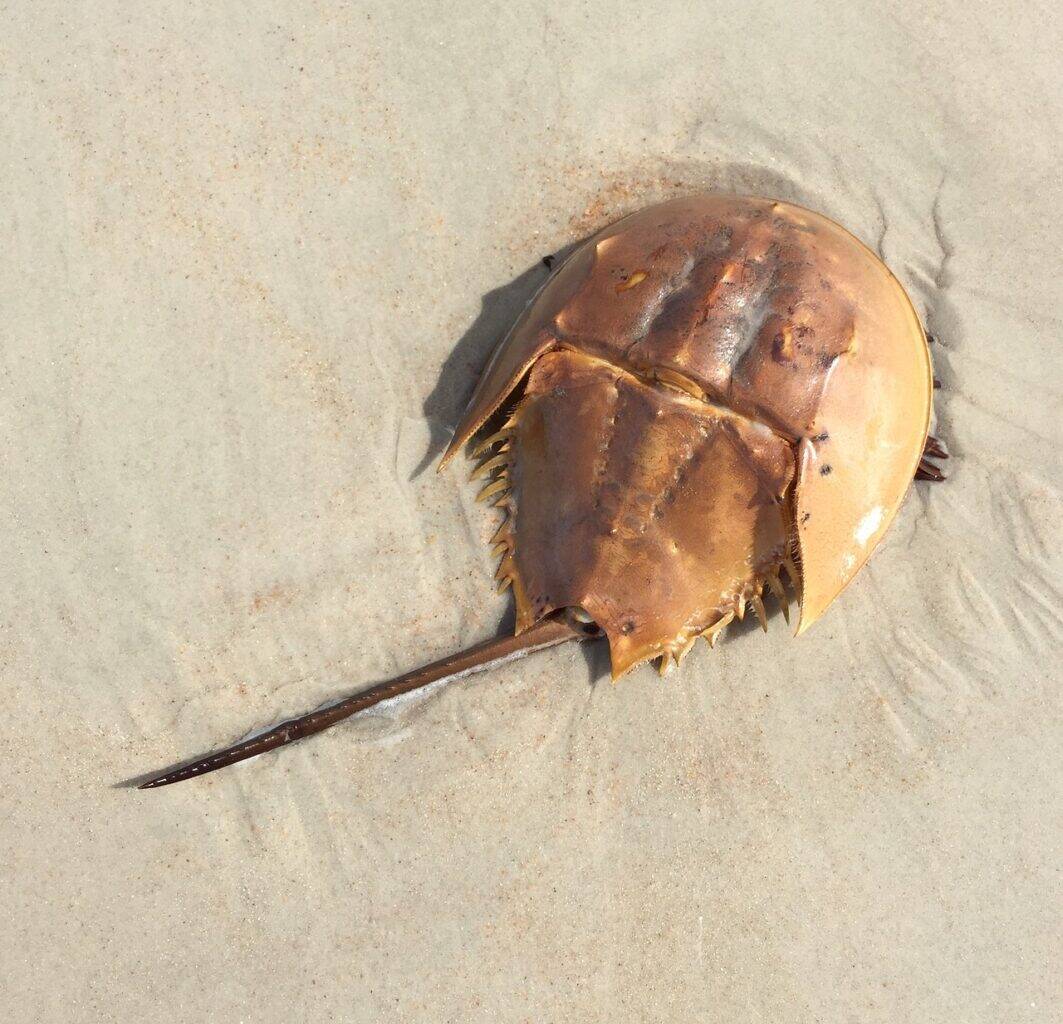
The horseshoe crab stands as one of Earth’s most enduring evolutionary success stories, having remained virtually unchanged for more than 450 million years—predating even the dinosaurs by over 200 million years. Despite their name, horseshoe crabs aren’t true crabs at all. They belong to the subphylum Chelicerata, making them more closely related to spiders and scorpions than to crustaceans. With their distinctive horseshoe-shaped carapace, spiny tail (telson), and primitive blue blood, these creatures epitomize living prehistory.
The remarkable blue blood of horseshoe crabs contains a substance called Limulus Amebocyte Lysate (LAL), which is critically important to medical science. LAL clots in the presence of bacterial endotoxins, making it essential for testing the sterility of vaccines, drugs, and medical devices. Unfortunately, horseshoe crab populations are declining due to habitat loss and harvesting for the biomedical industry. Conservation efforts have increased as scientists recognize not only their ecological importance but also their irreplaceable evolutionary significance as living witnesses to Earth’s ancient past.
3. Gharial: The Fish-Eating Crocodilian

With its extraordinarily long, narrow snout filled with interlocking needle-like teeth, the gharial (Gavialis gangeticus) looks like it swam straight out of the Mesozoic era. This highly specialized crocodilian evolved to become a fish-catching specialist in the rivers of the Indian subcontinent. Unlike other crocodilians, gharials cannot walk with their bodies raised off the ground and are poorly equipped to capture terrestrial prey, having evolved specifically for an aquatic lifestyle where their distinctive snout slices efficiently through water to snare fish.
Male gharials develop a distinctive bulbous growth on the tip of their snout called a “ghara” (the Hindi word for “pot”), which resembles a clay pot and gives the species its name. This structure is used to amplify vocalization and display dominance during breeding season. Once abundant throughout the northern Indian subcontinent, gharials have suffered catastrophic population declines, with fewer than 1,000 adults remaining in the wild. These living relics of the age of reptiles now rank among the most endangered crocodilians on Earth, clinging to existence in isolated pockets of their former range.
4. Coelacanth: The Fish That Came Back From Extinction

Perhaps no rediscovery in zoological history was more stunning than that of the coelacanth. Until 1938, this lobe-finned fish was believed to have gone extinct alongside the dinosaurs approximately 65 million years ago and was known only through fossils. The scientific world was astonished when a living specimen was hauled up by a fishing trawler off the coast of South Africa. The discovery was comparable to finding a living dinosaur and was hailed as one of the most significant zoological events of the 20th century.
Coelacanths possess several primitive features that make them remarkable evolutionary specimens. Their fleshy, lobe-like fins move in an alternating pattern reminiscent of a tetrapod’s walking gait. They have a hinged joint in their skull that allows them to open their mouths extremely wide, and they possess a rostral organ in their snouts that can detect electric fields. Living primarily in deep, volcanic caves at depths of 150-700 meters, these “living fossils” grow up to 2 meters long, can live for nearly a century, and give birth to live young after a gestation period that may last three years—one of the longest among vertebrates. Two species survive today: the West Indian Ocean coelacanth and the Indonesian coelacanth.
5. Giant Salamander: Amphibian Giants

Giant salamanders of the family Cryptobranchidae represent some of the most primitive amphibians alive today, with a lineage dating back over 170 million years. Three living species exist: the Chinese giant salamander, the Japanese giant salamander, and the North American hellbender. Of these, the Chinese giant salamander (Andrias davidianus) is the largest amphibian on Earth, capable of growing over 5.9 feet (1.8 meters) in length and weighing up to 140 pounds (64 kg). These remarkable creatures can live for 60 years or more in the wild.
What makes giant salamanders particularly prehistoric in appearance is their wrinkled skin, flat heads, tiny eyes, and primitive skeletal structure. Unlike most amphibians, they are fully aquatic throughout their lives and never develop lungs, instead absorbing oxygen through their highly vascularized skin—a primitive characteristic. They are ambush predators that lie motionless on stream beds waiting for prey to pass within striking distance. Unfortunately, all three species face severe threats from habitat degradation, pollution, and over-collection for food and traditional medicine, with the Chinese giant salamander now critically endangered throughout most of its range.
6. Nautilus: The Living Fossil of the Deep

With its distinctive spiral shell divided into chambers and its array of up to 90 tentacles, the nautilus represents one of the oldest surviving cephalopod lineages, having remained largely unchanged for over 500 million years. Unlike their more recently evolved relatives—octopuses, squids, and cuttlefish—nautiluses retain an external shell and lack the advanced eye structure and sophisticated camouflage abilities of other cephalopods. Their pinhole camera-type eyes lack lenses, representing a more primitive visual system than their cephalopod cousins.
Nautiluses regulate their buoyancy through a remarkable system involving their chambered shell. They pump gas and fluid in and out of the chambers to control their position in the water column, allowing them to move up and down with minimal energy expenditure. These prehistoric mariners typically inhabit depths of 300-600 meters along deep reef slopes in the Indo-Pacific region, emerging at night to feed on small crustaceans and fish. With lifespans potentially reaching 20 years—extraordinarily long for a cephalopod—nautiluses grow slowly and reproduce late in life, making their populations particularly vulnerable to overfishing. Their beautiful shells have made them targets for the souvenir trade, leading to population declines that have prompted international protection measures.
7. Shoebill Stork: The Bird That Resembles a Dinosaur
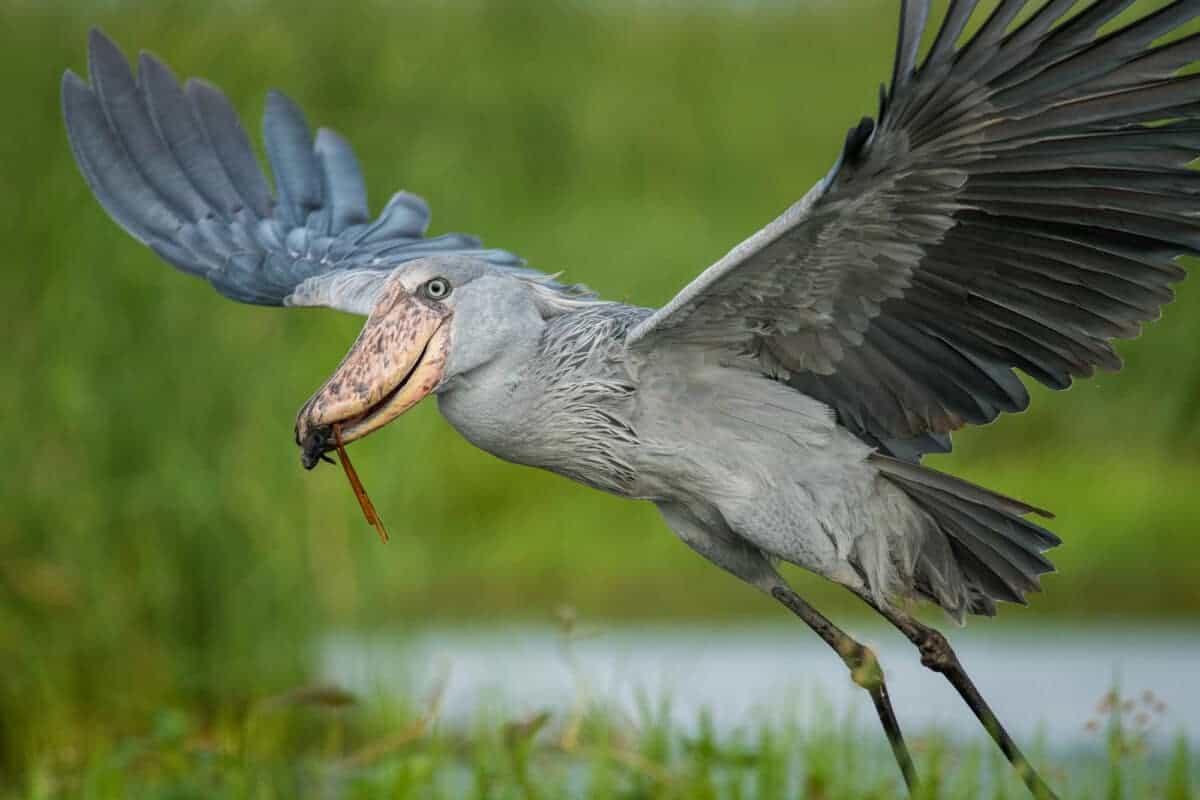
Standing up to 5 feet tall with its massive shoe-shaped bill, the shoebill stork (Balaeniceps rex) has an unmistakably prehistoric appearance that has earned it the nickname “whale-head.” Native to the swamps of East Africa, this imposing bird seems to have stepped directly out of the Mesozoic era. Its enormous bill—which can grow to over 8 inches long and 4 inches wide—ends in a sharp hook and is perfectly adapted for capturing its prey, which includes lungfish, catfish, water snakes, and even baby crocodiles and small turtles.
The shoebill’s dinosaur-like qualities extend beyond its appearance to its behavior. These birds can stand motionless for hours, exhibiting extraordinary patience while hunting. When they do move, they do so with a slow, deliberate gait that adds to their prehistoric impression. Shoebills are known for their peculiar habit of defecating on their legs to cool themselves through evaporation—a behavior called urohydrosis that is shared with storks and some other large birds. With an estimated global population of fewer than 8,000 individuals, the shoebill faces threats from habitat loss, hunting, and capture for the illegal bird trade, making conservation efforts critical for this living link to Earth’s ancient past.
8. Komodo Dragon: Modern Day Dinosaur

The Komodo dragon (Varanus komodoensis) is the world’s largest living lizard, with adult males regularly exceeding 8 feet in length and weighing over 150 pounds. Endemic to a handful of Indonesian islands, these massive reptiles have a particularly prehistoric appearance with their muscular bodies, powerful limbs, and forked tongues. Komodo dragons are the last representatives of a once widespread group of giant lizards that roamed across Indonesia and Australia during the Pleistocene epoch, making them living relics of a time when megafauna dominated Earth’s landscapes.
What makes Komodo dragons especially formidable is their hunting strategy. Recent research has confirmed they possess venom glands that secrete toxins which prevent blood clotting and induce shock in their victims. This, combined with bacteria in their saliva and their serrated teeth, creates wounds that are exceptionally deadly. Komodos can detect carrion from up to 2.5 miles away, and they’re capable of consuming up to 80% of their body weight in a single meal. Despite their fearsome reputation, these prehistoric-looking predators face significant threats from habitat loss, poaching, and climate change, with fewer than 3,000 individuals remaining in the wild. Their presence today offers a glimpse into an age when giant reptiles were Earth’s dominant predators.
9. Giant Isopod: The Deep-Sea Time Capsule
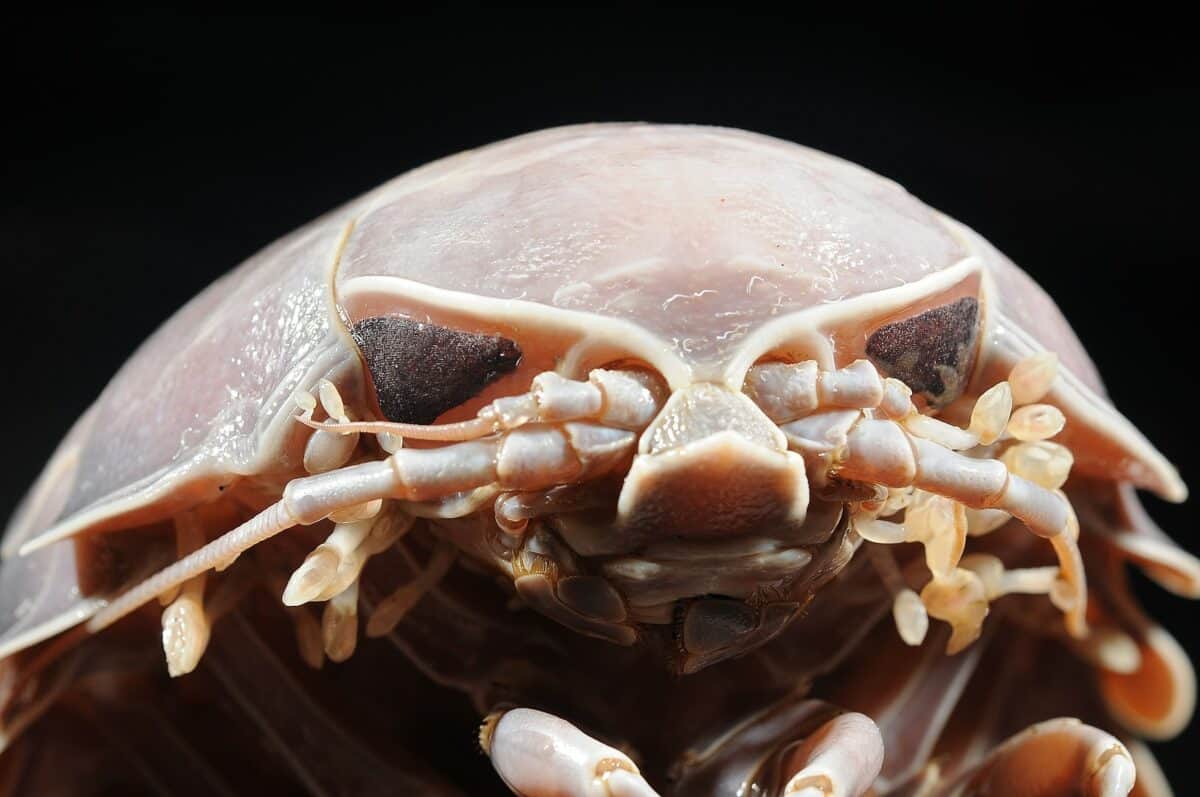
Resembling a massively oversized pillbug or woodlouse, the giant isopod (Bathynomus giganteus) represents one of the most visually striking examples of deep-sea gigantism. These remarkable crustaceans can grow up to 16 inches (40 cm) in length—hundreds of times larger than their terrestrial relatives. With their segmented exoskeletons, multiple pairs of legs, and compound eyes, giant isopods have remained virtually unchanged for over 160 million years, making them living fossils that offer insights into ancient crustacean evolution.
Adapted for life in the crushing pressures and near-freezing temperatures of the deep ocean, giant isopods inhabit the benthic zone at depths ranging from 550 to 7,020 feet (170 to 2,140 meters). Their slow metabolism allows them to survive for extraordinary periods without food—one specimen in a Japanese aquarium survived for over five years without eating. As opportunistic scavengers, they play a crucial ecological role in the deep sea by consuming fallen carcasses that reach the ocean floor. Their prehistoric appearance, coupled with their adaptation to one of Earth’s most extreme environments, makes giant isopods fascinating windows into both evolutionary history and the enduring nature of successful biological designs.
10. Goblin Shark: The Living Fossil of the Deep Sea
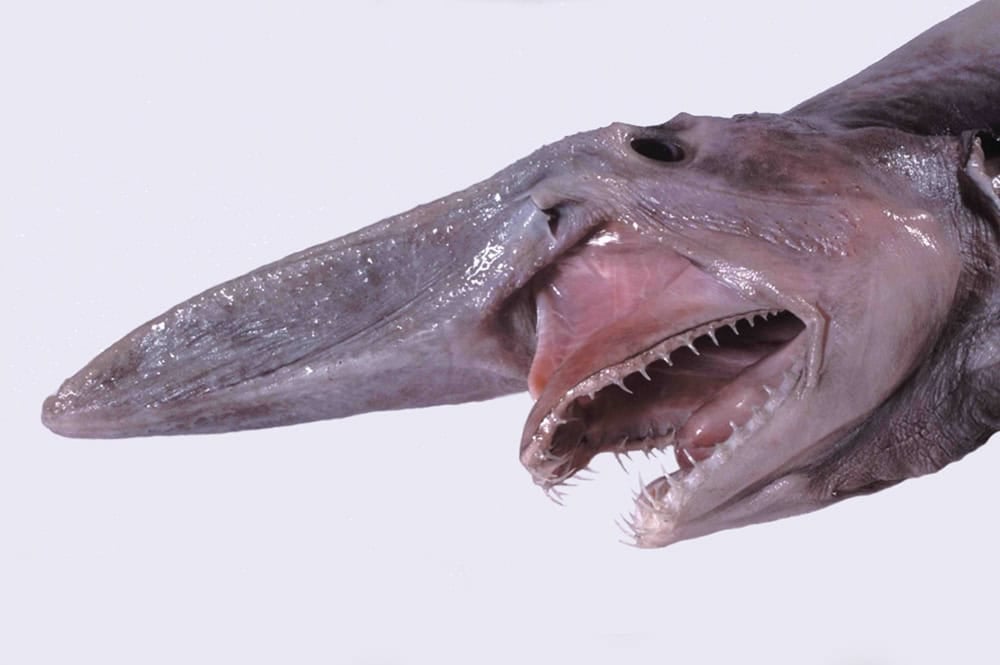
With its elongated, flattened snout and protrusible jaws filled with needle-like teeth, the goblin shark (Mitsukurina owstoni) is perhaps the most alien-looking of all living sharks. This rare deep-sea predator belongs to a lineage that has remained largely unchanged for about 125 million years, earning it the status of a living fossil. The most distinctive feature of the goblin shark is its protruding snout, called a rostrum, which is covered with specialized sensory organs called ampullae of Lorenzini that detect the electrical fields produced by other organisms—essentially giving the shark a sixth sense to locate prey in the darkness of the deep ocean.
The goblin shark’s feeding mechanism is equally prehistoric and specialized. When prey is detected, the shark can project its jaw forward at remarkable speed—one of the fastest known jaw movements of any fish. This slingshot-like projection allows it to capture prey that might otherwise escape its relatively slow swimming speed. Living at depths between 890 and 3,150 feet (270 to 960 meters), goblin sharks rarely encounter humans, and much about their biology and behavior remains mysterious. Their soft, flabby bodies and pinkish coloration (due to blood vessels visible through their semi-transparent skin) add to their otherworldly appearance, making them seem like creatures from Earth’s distant past that continue to haunt the modern deep sea.
11. Platypus: The Mammal That Defies Classification
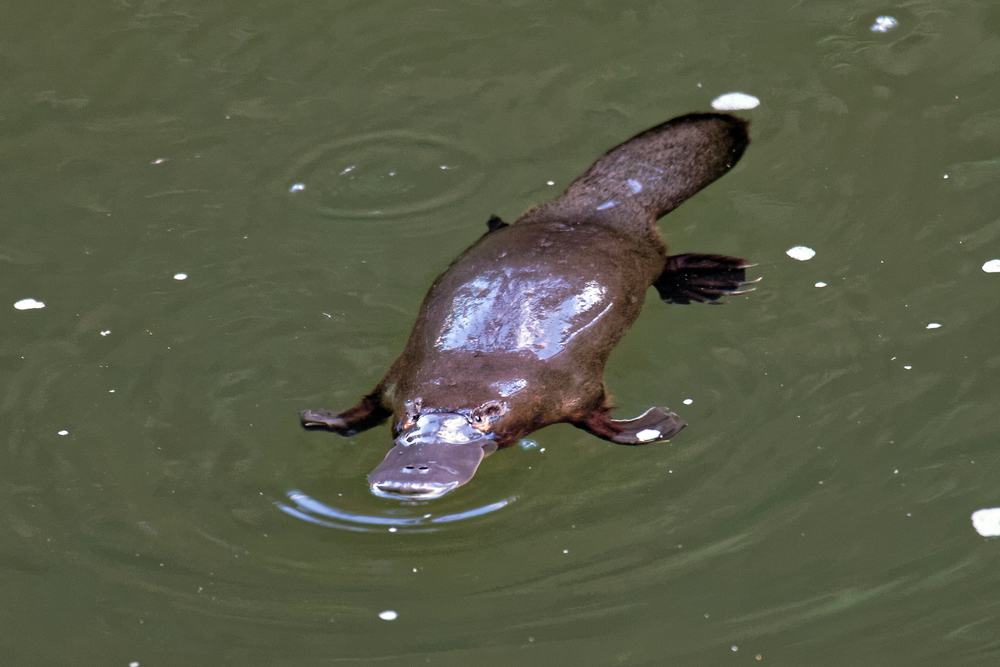
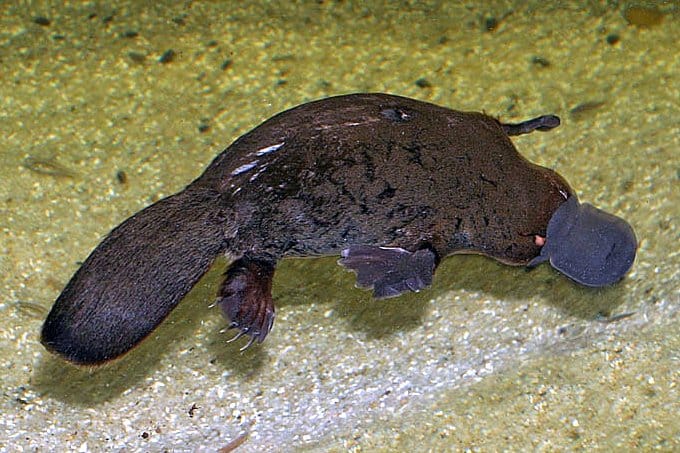
Few creatures challenge our understanding of evolution as thoroughly as the platypus (Ornithorhynchus anatinus). With its duck-like bill, beaver-like tail, otter-like feet, and venomous spurs on the males’ hind legs, this egg-laying mammal seems assembled from parts of various animals. The platypus belongs to the order Monotremata, the most primitive group of mammals that diverged from other mammals approximately 166 million years ago. As one of only five living monotreme species (alongside four species of echidna), the platypus represents a fascinating evolutionary bridge between reptiles and more modern mammals.
Beyond its bizarre appearance, the platypus possesses truly prehistoric biological features. It lays leathery eggs like reptiles but produces milk (without nipples) to feed its young. The platypus bill is not a rigid structure like a bird’s beak but a soft, flexible organ packed with thousands of electroreceptors that detect the electrical impulses generated by the muscle movements of prey. This electroreception, combined with mechanoreceptors that detect pressure changes in water, allows platypuses to hunt effectively with their eyes, ears, and nostrils closed underwater. The males’ venomous ankle spurs—unusual among mammals—produce venom strong enough to kill small animals and cause excruciating pain in humans. Endemic to eastern Australia, these living fossils offer a unique glimpse into mammalian evolution and the diverse paths that early mammals took.
12. Frilled Shark: The Serpent of the Deep

With its elongated, eel-like body and primitive features, the frilled shark (Chlamydoselachus anguineus) appears to have swum straight out of the Cretaceous period. This deep-sea dwelling shark belongs to one of the most ancient extant shark lineages, having remained largely unchanged for approximately 80 million years. Its most distinctive characteristic is its arrangement of 300 trident-shaped teeth aligned in 25 rows—a primitive dentition pattern that allows it to trap and consume prey whole with snake-like strikes.
The frilled shark gets its name from its six pairs of gill slits that create a frilled appearance around its throat. Unlike most modern sharks that have five gill slits positioned on the sides of their heads, the frilled shark’s gill arrangement resembles that of ancient shark species known only from fossils. These living fossils typically inhabit depths between 390 and 4,200 feet (120-1,280 meters), though they occasionally venture into shallower waters. Their biology remains poorly understood due to their deep-sea habitat, but we know they can grow up to 6.6 feet (2 meters) in length and may live for 25 years or more.

- The Bird That Can Recognize More Faces Than a Human - July 29, 2026
- How Army Ants Coordinate Massive Raids Without a Leader - July 29, 2026
- 13 Largest Horses in the World - July 29, 2026