

Paleontologists in Argentina have made a jaw-dropping discovery: a new species of dinosaur apparently fossilized mid-meal, with the leg bone of an ancient crocodile lodged between its jaws. The dinosaur, named Joaquinraptor casali, belongs to the mysterious megaraptoran lineage and may well reshuffle our understanding of predator–prey dynamics in the late Cretaceous of South America. (Note: some details are interpretations of reported science.)
A Predator Frozen in Time
In the fossil deposits of the Lago Colhué Huapi formation in Patagonia, scientists unearthed skeletal remains that include parts of the skull, limbs, vertebrae, ribs — and most strikingly, a crocodyliform humerus pressed against the dinosaur’s lower jaws.
The bone isn’t just adjacent — it contacts several tooth crowns and even bears possible tooth marks, suggesting the dinosaur may indeed have died while biting into its crocodilian prey.
The preserved specimen, cataloged as UNPSJB-PV 1112, was recovered in part between 2019 and 2023, and is currently housed at the National University of Patagonia San Juan Bosco.
Its partial skeleton is among the most complete megaraptor fossils yet recovered in South America — a rare and valuable window on a group often known only from fragmentary remains.
Anatomy, Size & Identity
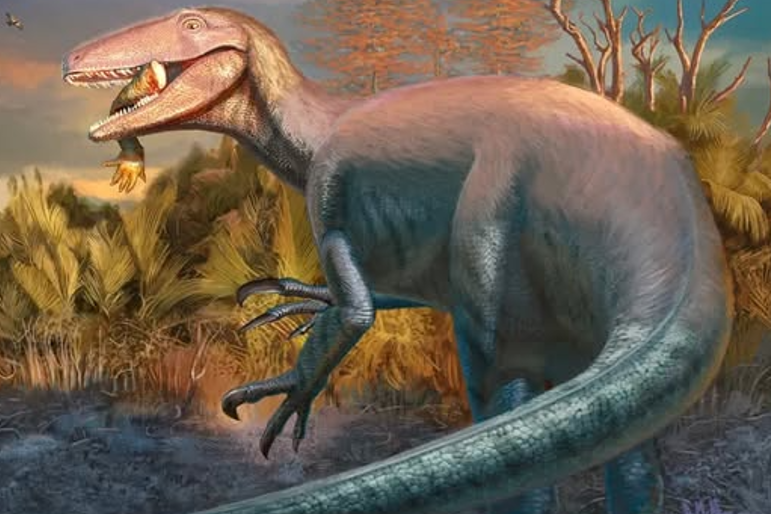
Joaquinraptor casali is estimated to have measured about 7 meters (≈ 23 feet) long and weighed over a ton, placing it squarely in the league of apex predators in its ecosystem.
The genus name “Joaquinraptor” honors the son of lead paleontologist Lucio Ibiricu, who passed away young and was said to have loved dinosaurs; the species name “casali” acknowledges Gabriel Casal, whose work helped characterize the Lago Colhué Huapi formation.
Structurally, it displays hallmarks of megaraptorans: elongated skulls, robust forelimbs, and hypertrophied claws.
Phylogenetic analyses place Joaquinraptor deep within Megaraptoridae, as a sister taxon to genera like Megaraptor, Maip, and Tratayenia.
Its addition helps refine the megaraptor family tree and the evolution of their forelimb specializations.
Feeding Behavior & Ecological Role
The direct evidence of the crocodyliform bone in its jaws raises compelling possibilities about diet: Joaquinraptor likely preyed not only on more typical dinosaur fauna but also competed with, or hunted, crocodilian relatives.
That said, scientists caution alternative explanations: perhaps the bone was washed into position postmortem, though the articulation and tooth-mark evidence suggest a more active predation scenario.
If the predation hypothesis is correct, it highlights the fierce competition and ecological complexity of Cretaceous ecosystems in Gondwana. In a landscape of floodplains and waterways, crocodilians and theropods may have been locked in a constant struggle. Joaquinraptor might well have sat at the top — a dinosaur that could challenge even armored or semi-aquatic predators.
Implications & Gaps in Understanding
This discovery addresses critical gaps in megaraptoran paleontology, given how few well-preserved specimens exist.
It strengthens the hypothesis that megaraptorans in the southern continents were apex carnivores late in the Cretaceous, filling niches left by absent or limited tyrannosauroids in Gondwana.
Nevertheless, many questions remain. The precise hunting strategy, growth rate, and life history of Joaquinraptor aren’t yet clear.
The relationship between megaraptorans and other theropod clades remains debated, as does their biogeographic distribution and diversity patterns.
Further fieldwork, especially in underexplored Patagonian horizons, and comparative studies with contemporaneous faunas will be essential.
Conclusion
The fossil of Joaquinraptor casali — potentially preserved in the act of consuming a crocodilian relative — is more than a spectacular paleontological trophy. It is a wake-up call: even after more than a century of dinosaur excavation, Earth’s deep past continues to harbor surprises that challenge our assumptions. This discovery serves not only to enrich the fossil record but to sharpen our imagination about ancient ecosystems, predator hierarchies, and the raw drama of survival.
In my view, Joaquinraptor isn’t just a new species — it’s a narrative pivot. It pushes us to see dinosaurs and crocodilians not as separate worlds but participants in the same brutal arena. As more discoveries emerge, I expect the boundary between “dinosaur predator” and “croc competitor” will blur, revealing a more intertwined prehistoric web of life than we have ever appreciated.
