

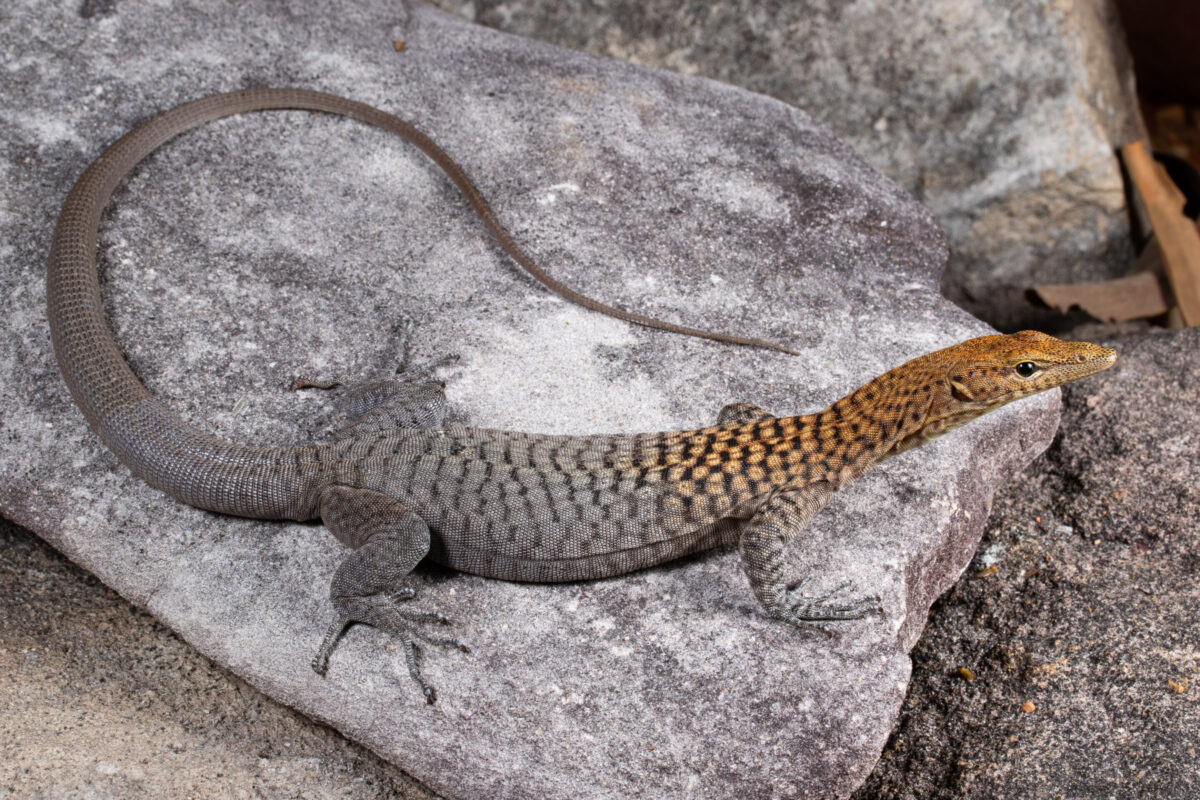
The First Rock Monitors of Eastern Australia (Image Credits: Stephen Zozaya)
In the rugged savannas of northern Queensland, scientists have uncovered a remarkable surprise hiding among ancient rock outcrops. Researchers have formally identified three previously unknown species of rock-dwelling monitor lizards, revealing a hidden branch of reptile diversity that had gone unnoticed in one of Australia’s most biologically rich landscapes.
The discovery highlights how even well-studied regions of the world can still harbor undiscovered wildlife. Through detailed genetic and anatomical analysis, scientists found that these striking lizards—each with distinctive coloration and evolutionary history—represent entirely new species within the same lineage as the legendary Komodo dragon.
A Stunning Trio of New Monitor Lizards
The research team identified three unique species of rock-dwelling monitor lizards from northeastern Queensland’s savannas. The species were named the rainbow rock monitor (Varanus iridis), the orange-headed rock monitor (Varanus umbra), and the yellow-headed rock monitor (Varanus phosphoros).
Each species displays distinctive coloration patterns that inspired their names. Their bright hues and patterns are not only visually striking but may also play roles in camouflage among rocky landscapes or communication between individuals. The naming theme also reflects the researchers’ fascination with the vivid tones displayed by these reptiles in the wild.
These discoveries expand the diversity of monitor lizards in Australia, one of the world’s most reptile-rich regions.
The First Rock Monitors of Eastern Australian Savannas
While Australia already hosts several rock-dwelling monitor species, they were previously known mainly from western parts of the continent. The newly described lizards represent the first rock-adapted monitors discovered in the eastern Australian savanna ecosystems.
Their habitats consist of scattered rocky outcrops embedded within tropical savanna landscapes. These rocky environments provide shelter from predators, temperature extremes, and fires that frequently sweep through the surrounding grasslands.
The discovery reveals that eastern Australia’s rocky savannas harbor a unique evolutionary lineage of monitor lizards that had remained hidden until now.
Genetic Analysis Reveals an Unexpected Evolutionary Branch
When researchers first encountered these lizards, they initially assumed they belonged to a single species with slight variations in appearance. But genetic testing told a very different story.
DNA analysis showed that the three populations were far more genetically distinct than expected, indicating they had evolved separately for millions of years.
In fact, the genetic differences between them are greater than those seen between some monitor lizard species that have been recognized for decades. This revelation transformed what seemed like minor variation into a major discovery in reptile evolution.
Ancient Landscapes Shaping New Species
The isolated rocky outcrops scattered across Queensland’s savannas likely played a key role in driving the evolution of these species. These rocky “islands” create fragmented habitats that can isolate animal populations over long periods.
Over thousands or millions of years, such isolation can lead to populations adapting to their specific environments and eventually diverging into new species.
For these rock monitors, each outcrop may have acted as a natural evolutionary laboratory, allowing distinct populations to evolve independently.
Many Mysteries Still Surround These Lizards
Despite the excitement surrounding their discovery, scientists know surprisingly little about the ecology of these newly identified species. Their population sizes, geographic ranges, and behaviors remain largely unknown.
Researchers suspect the lizards rely heavily on rocky habitats for shelter and hunting, possibly feeding on insects, small vertebrates, and other prey typical of monitor lizards.
Future field studies will be essential to understand how these reptiles survive in their harsh savanna environments and how vulnerable they might be to environmental changes.
Australia’s Reptile Diversity Still Holds Secrets
Australia is widely recognized as one of the world’s hotspots for reptile diversity. Yet discoveries like this demonstrate that many species remain undocumented, even in regions scientists have studied for decades.
Rocky habitats, remote savannas, and isolated mountain ranges often act as refuges for species that escape detection. With advances in genetic analysis and field surveys, scientists are increasingly uncovering these hidden branches of biodiversity.
Each discovery helps fill in gaps in the evolutionary story of reptiles and reveals how landscapes shape life over time.
Conclusion A Powerful Reminder That Nature Still Hides Wonders
The discovery of three new monitor lizard species in northern Queensland is both thrilling and humbling. It reminds us that even in an era of satellites, genetic sequencing, and global research networks, Earth still holds biological secrets waiting to be revealed.
More importantly, it underscores the urgency of protecting wild landscapes. These lizards evolved quietly for millions of years among scattered rock outcrops—ecosystems that could easily be overlooked or disturbed by human activity.
If such spectacular species can remain hidden until now, one must wonder how many more are waiting to be discovered—and whether humanity will protect them long enough for science to find them.

- Urban Coyotes Show Remarkable Adaptability, Learning to Thrive in City Environments - July 22, 2026
- Beavers Are Nature’s Engineers, Creating Vital Habitats for Other Wildlife Species - July 21, 2026
- The Recovery of the California Condor Offers Hope for Other Critically Endangered Birds - July 21, 2026