

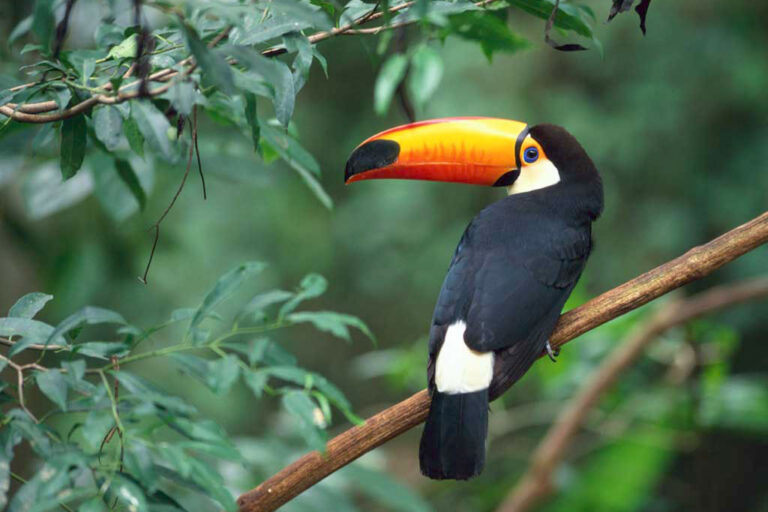
Elders’ Observations Spark Global Study (Image Credits: Imgs.mongabay.com)
Communities deeply connected to their landscapes have documented a profound shift in avian populations, where giants of the sky yield to smaller successors.[1][2]
Elders’ Observations Spark Global Study
Researchers first heard the accounts during fieldwork among the Tsimané people in Bolivia’s Amazon. Elders described large birds, once abundant in their youth, as increasingly scarce. Álvaro Fernández-Llamazares, lead author and ethnobotanist at Spain’s Autonomous University of Barcelona, recalled those conversations vividly. “Many elders told me that the large birds they had grown up seeing in the forest had become much rarer. Species that were once common in their childhood were now difficult to encounter,” he shared.[1]
Similar stories emerged from distant ecosystems. A Daasanach elder in Kenya captured the sentiment: “All the big birds are now gone.”[1] These narratives prompted a coordinated effort under the Local Indicators of Climate Change Impacts project. Teams surveyed 1,434 adults across 10 sites in 10 countries. Participants recalled the three most common birds from their childhood – around age 10 – and compared them to today. The effort yielded 6,914 reports covering 283 species over roughly 80 years.[2]
A Consistent Pattern Emerges Worldwide
The data painted a uniform picture. Average bird body mass plunged from about 1,580 grams in the 1940s to 535 grams in the 2020s – a 72% reduction across all sites. In the past, six of the 10 most reported species exceeded 1,000 grams; today, only two do. Statistically significant drops appeared in Bolivia’s Tsimané territory, Mexico’s Timucuy, Madagascar’s Vavatenina, and China’s Ordos Desert.[2]
Sites spanned three continents:
- Americas: Bolivia (Tsimané), Mexico (Timucuy), Brazil, Chile (Lonquimay).
- Africa: Senegal, Ghana, Kenya (Daasanach), Madagascar (Vavatenina).
- Asia: China (Ordos Desert), Mongolia (Bulgan soum).
Even where changes lacked statistical significance, the trend toward smaller birds persisted. This alignment bridged traditional ecological knowledge with quantitative analysis from databases like AVONET.[3]
Reasons Behind the Vanishing Giants
Large birds face heightened risks. They reproduce slowly, recover poorly from losses, and demand vast habitats. Hunters target them for greater yields, while deforestation and infrastructure fragment their ranges. Participants cited power lines in Mongolia and agricultural expansion in Madagascar as culprits.[2]
Fernández-Llamazares noted multiple drivers. “This shift may reflect both the local extinction of large-bodied species – more vulnerable to hunting, habitat loss and infrastructure development – and profound social transformations,” he explained. Smaller, adaptable species now dominate, often thriving near human activity.[4]
Ecosystem and Cultural Losses Mount
The changes extend beyond size. Large birds disperse seeds, control pests, and regenerate forests – roles smaller ones cannot fully replace. For communities, birds weave into identity. Tsimané stories feature macaws and guans; their absence erodes rituals and lore. Mayan traditions in Mexico once mimicked thick-knee calls in dances, now at risk.[5]
Pam McElwee of Rutgers University, unaffiliated with the study, praised the approach. “This study is a great example of how Indigenous science and knowledge and Western science can be woven together to provide clearer answers.”[1] The findings urge equitable partnerships for conservation.
Key Takeaways
- Indigenous reports show a 72% drop in average bird body mass since the 1940s across three continents.
- 1,434 participants from 10 sites provided consistent evidence of large species loss.
- Integrating local knowledge strengthens global conservation efforts.
Such collaborations highlight an urgent truth: avian declines are not distant statistics but lived realities. Protecting large birds demands addressing root causes while honoring those who know the land best. What wildlife shifts have you observed in your area? Tell us in the comments.

- Urban Coyotes Show Remarkable Adaptability, Learning to Thrive in City Environments - July 22, 2026
- Beavers Are Nature’s Engineers, Creating Vital Habitats for Other Wildlife Species - July 21, 2026
- The Recovery of the California Condor Offers Hope for Other Critically Endangered Birds - July 21, 2026