
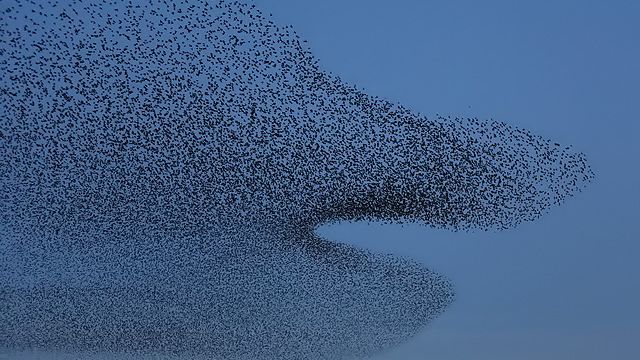
Picture thousands of birds moving across a winter sky as a single, breathing entity. Twisting. Folding. Erupting into shapes that look almost deliberate, almost artistic. It’s the kind of thing that stops you in your tracks, phone already out, mouth slightly open.
These aerial performances are not random accidents. They are not some quirky bird hobby. There is deep biology, survival instinct, and jaw-dropping physics all tangled together in those swirling forms above your head. If you’ve ever watched one and felt a strange sense of awe you couldn’t quite explain, you’re in good company – scientists feel it too. Let’s dive in.
What Exactly Is a Murmuration – and Why Does It Look So Alive?
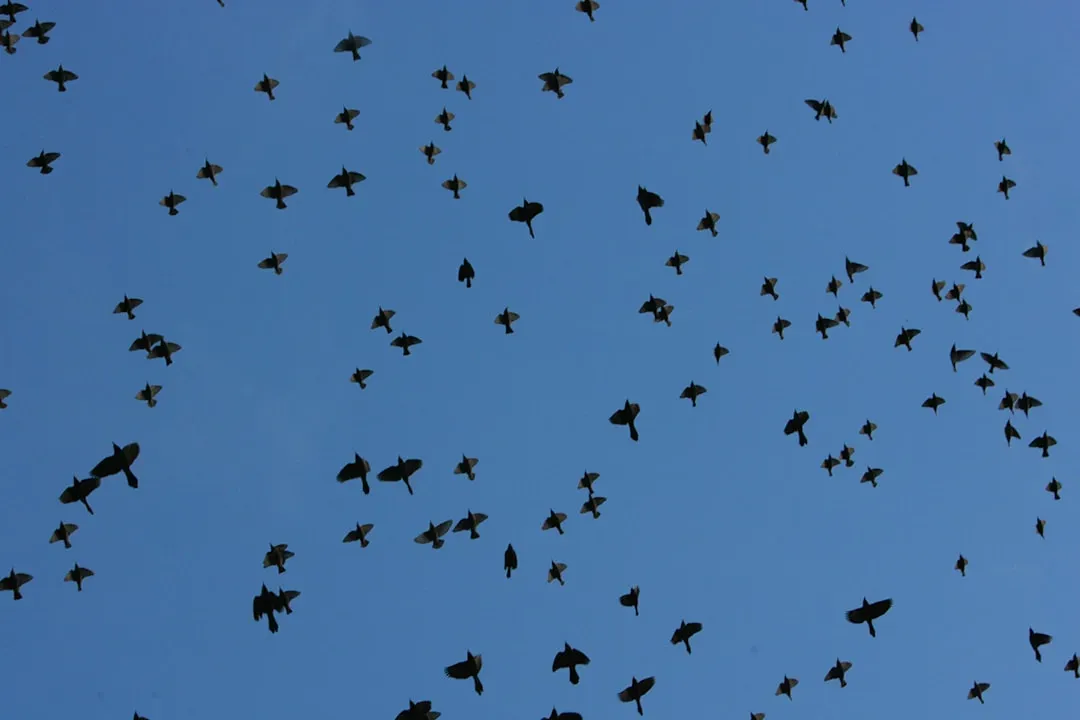
Honestly, the first time you see one, you might genuinely think you’re dreaming. A shape-shifting flock of thousands of starlings, called a murmuration, is truly stunning to witness. As many as 750,000 birds can join together in a single flight. That’s not a typo. Three quarters of a million birds moving as one.
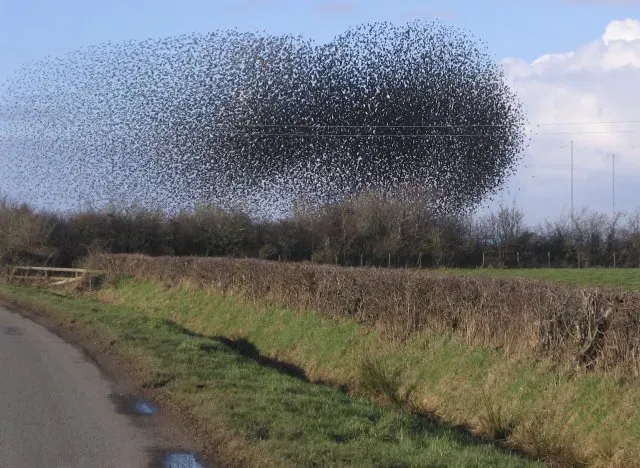
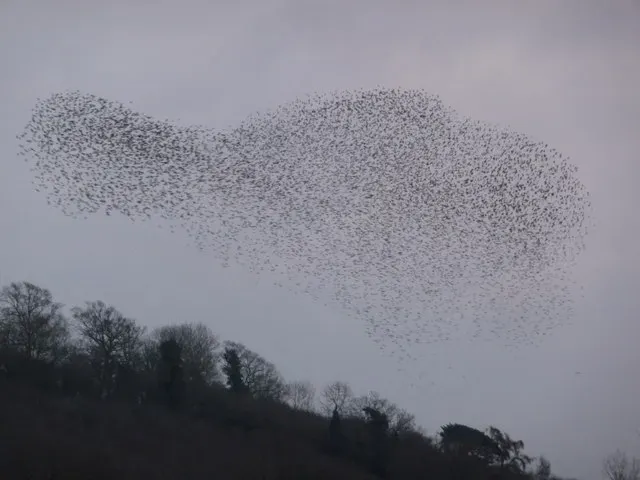
They look like swirling blobs, making teardrops, figure eights, columns and other shapes. One moment it’s a vast, billowing cloud. The next, it pinches itself into an impossibly thin waist before erupting outward again like an explosion in slow motion.
At sunset, huge groups of starlings take to the sky, swooping and swirling into spheres, planes and waves. The phenomenon is called a murmuration, and it’s named after the noise made by the many flapping wings. Think about that – the very name comes from the sound. It’s as much an experience for the ears as it is for the eyes.
A murmuration can move fast – starlings fly up to 50 miles per hour (80 kilometers per hour). At that speed, the coordination required is nothing short of extraordinary. Yet somehow, remarkably, they almost never crash into each other.
The Survival Secret Hidden Inside Those Beautiful Shapes
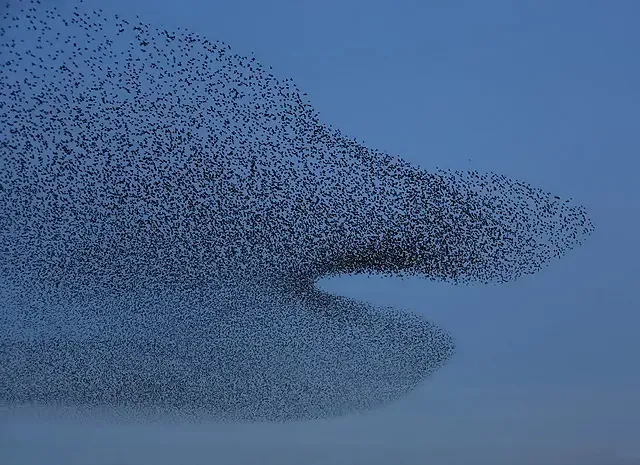
Here’s the thing – those breathtaking designs are not art. They’re armor. Almost always, these aerial spectacles are caused by a falcon near the edge of the flock. It turns out that the beauty of a murmuration’s movements often arises purely out of defense, as the starlings strive to put distance between themselves and the predator.
The more starlings in the flock, the lower the risk to any one bird of being the one snagged by a predator. Predators are more likely to catch the nearest prey, so the swirling of a murmuration could happen as individual birds try to move toward the safer middle of the crowd. Scientists call this the selfish herd effect. It sounds harsh when you put it that way, but survival rarely looks graceful from the inside.
A gigantic mass of whirling, swirling birds can make it hard to focus on a single target. A falcon or hawk can get confused and distracted by tricky wave patterns in the murmuration’s movements. It also must be careful not to collide with the flock and get hurt.
Beyond simple predator avoidance, murmurations may act as an advanced evasion strategy. The constant shifting of the flock’s shape and density can actively disorient predators such as peregrine falcons, making it much harder for them to track and strike a target. Think of it like a crowd of people in a room suddenly all switching directions – a chasing child would be completely lost.
The Rule of Seven: How Every Bird Knows What to Do
Murmurations have no leader and follow no plan. Instead, scientists believe movements are coordinated by starlings observing what others around them are doing. I find this genuinely mind-bending. No conductor. No choreographer. No WhatsApp group chat.
In 2008, researchers from the Centre for Statistical Mechanics and Complexity in Rome made significant breakthroughs in understanding murmurations. They filmed flocks of up to 4,000 starlings flying over the National Museum from multiple angles and created 3D reconstructions. Their findings challenged previous theories, which assumed that birds coordinated based on metric distance. Instead, they discovered that murmurations operate on topological distance: each bird interacts with a fixed number of neighbours – typically six or seven – regardless of how far apart they are.
Through recent video studies and scientific modelling, scientists discovered that if one starling moves, the seven closest starlings adjust their flight. Each small group of seven starlings imitates the nearest group by changing direction. Soon the whole flock is forming a new shape in the sky. It’s like a ripple in water, except the water is made of thousands of birds and travels at highway speeds.
Researchers also found that starlings can simultaneously process information from those seven neighbours, which is how they achieve something called scale-free correlation. Unlike geese flying in a V-formation, where a leader guides the flock, murmurations exhibit no central control. Instead, this scale-free correlation allows thousands of starlings to change direction simultaneously, without any single bird leading the movement. It’s a kind of natural democracy – fast, fluid, and frighteningly effective.
Warmth, Community, and Other Reasons They Gather
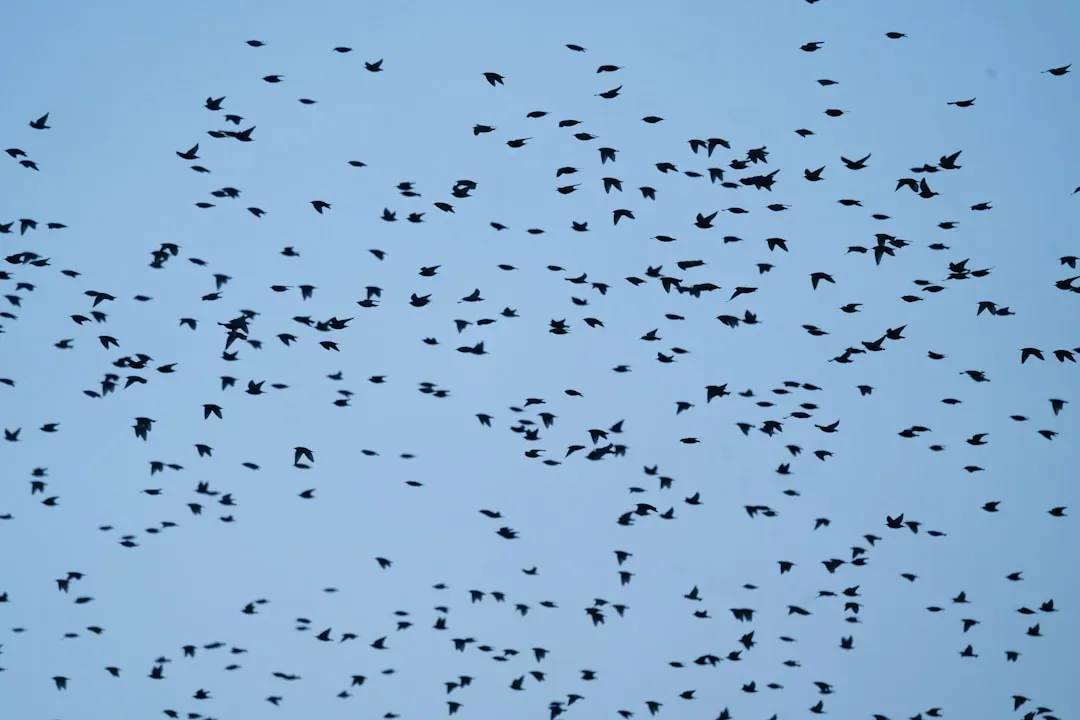
Predator defense is the big one, but it’s not the only thing driving these birds into the sky together. One simple explanation is the need for warmth at night during the winter: the birds need to gather together at warmer sites and roost in close proximity just to stay alive. Starlings can pack themselves into a roosting site at more than 500 birds per cubic metre, sometimes in flocks of several million birds. That’s a level of coziness most humans couldn’t handle.
It’s not the aerial display itself that generates heat. Instead, some zoologists have argued that as the sky dance happens just before roosting, it could simply be a signal for birds to gather ahead of a cold night. So in a way, the murmuration doubles as a biological alarm clock – time to huddle up.
An intriguing idea suggests that flocks may form so that individuals can share information about foraging. This “information centre hypothesis” suggests that when food is patchy and hard to find, the best long-term solution requires mutual sharing of information among large numbers of individuals. Just as honeybees share the location of flower patches, birds that find food one day and share information overnight will benefit from similar information another day.
As highly social birds, starlings may use these coordinated displays to reinforce group cohesion and maintain connections within large populations. For younger or less experienced birds, murmurations may serve as practice for flight coordination, helping them develop agility and improve their response times in complex aerial manoeuvres. Essentially, it’s also a flight school happening at dusk over your local countryside.
What Science Still Can’t Fully Explain – and Why That Matters
Here’s where it gets wonderfully humbling. Despite decades of research, high-speed cameras, 3D modelling, and entire physics departments throwing themselves at the problem, we don’t yet have one definitive explanation for starling murmurations. For something so visible, so spectacular, that’s a remarkable admission.
Some researchers also suggest that murmurations are influenced by environmental cues, including changes in air currents, light levels, or even electromagnetic fields. These external factors might prompt the flock to move in synchrony as part of a broader survival strategy. It’s hard to say for sure, but the idea that the birds might be reading invisible environmental signals feels almost supernatural.
When we watch a murmuration pulsate in waves and swirl into arrays of shapes, it often appears as if there are areas where birds slow and become thickly packed, or where they speed up and spread wider apart. In fact, this is largely thanks to an optical illusion created by the 3D flock being projected onto our 2D view of the world, and scientific models suggest that the birds fly at a steady speed. The artwork we think we see? Partly a trick of our own perception.
Possibly we can adapt our understanding and use it to improve the autonomous control of robotic systems. Perhaps the rush-hour behaviour of the automated cars of the future will be based on starlings, and their murmurations. Think about that the next time you’re stuck in traffic – the solution might already be written in the winter sky.
Conclusion
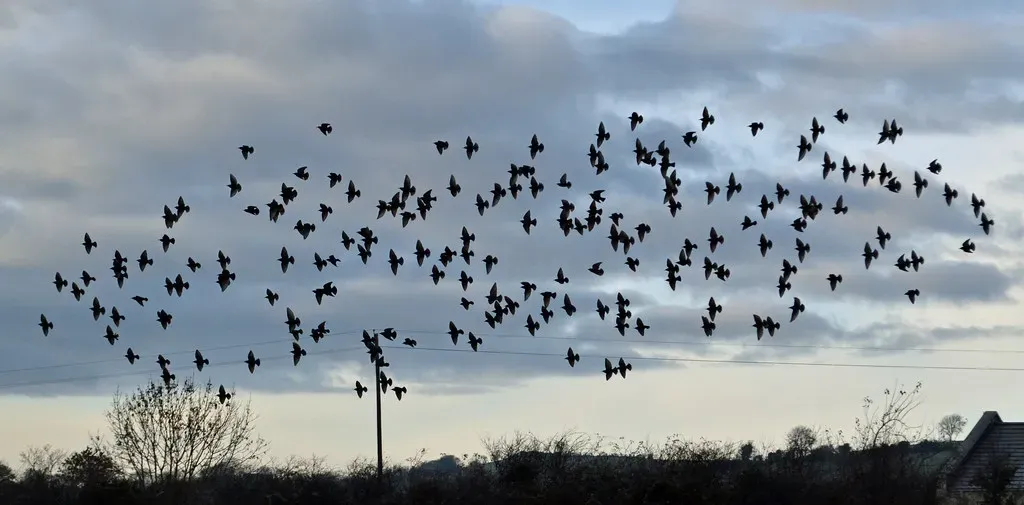
Starlings are, individually, fairly unremarkable birds. Common. Small. Noisy. Collectively, though, starlings transform into something else entirely. Together, , in mesmerizing flocks that sometimes number in the hundreds of thousands, they are a breath-stealing wonder – a pulsating, swooping, living, harmonized whole.
What they create in the sky is simultaneously a survival strategy, a community signal, a weather response, and quite possibly a phenomenon that science still hasn’t fully cracked. That last part, honestly, is the most exciting thing of all. Nature does not always owe us an explanation.
The next time you spot a murmuration rolling across a winter evening sky, pause for a moment. You’re watching millions of years of evolution play out in real time – no leader, no map, no plan. Just birds following the bird next to them, and somehow, impossibly, creating something magnificent. Have you ever seen one in person? If not, it may be the most beautiful thing on your bucket list that you didn’t know was already there.
