

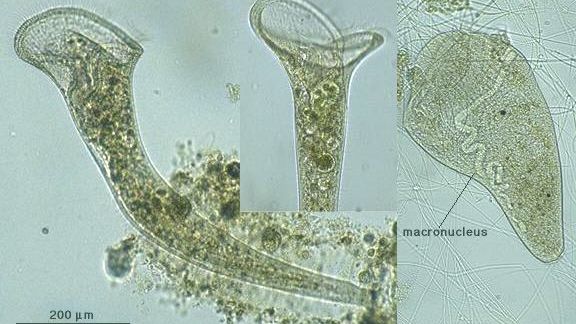
A trumpet-shaped swimmer glides through freshwater ponds, its vivid blue hue catching the light as it extends to feed. This is Stentor coeruleus, a single-celled protist that can grow up to two millimeters long – visible to the naked eye. Researchers at the University of California, San Francisco have now detailed the molecular underpinnings of its ability to learn, showing that even without neurons or a brain, the organism adapts to repeated harmless disturbances through processes reminiscent of human memory formation.[1][2]
The Remarkable World of Stentor Coeruleus
Stentor coeruleus belongs to the ciliates, a group of protists equipped with tiny hair-like structures for movement and sensing. Unlike multicellular animals, it operates as one vast cell, with a holdfast anchoring it to surfaces and a flared oral region for capturing food. When mechanical stimuli like taps disturb it, the cell contracts sharply, a defensive response that disrupts feeding but protects against potential threats.
This behavior has intrigued biologists for over a century, as early observations noted the creature’s tendency to ignore repeated, non-threatening prods after initial reactions. Recent studies confirmed this as habituation, a basic form of learning where responsiveness decreases over time. The discovery reframes what scientists consider possible for cellular life.[3]
Unpacking Habituation in a Single Cell
Habituation in Stentor occurs rapidly: a population of cells shows a graded decline in contraction probability with successive taps. Single-cell analysis reveals a step-like switch within each organism, where the cell shifts from high responsiveness to near-ignoring the stimulus. This process strengthens with more repetitions, demonstrating a form of memory at the cellular level.
Experiments manipulated environmental factors to test the mechanism. Increasing extracellular calcium accelerated learning, while inhibitors targeting kinases and phosphatases slowed it. A specific drug, KN-93, which blocks calcium channels and CaMKII activity, markedly reduced both the speed and degree of habituation – mirroring effects seen in more complex organisms.[2][3]
Calcium and CaMKII: The Core Machinery
At the heart of Stentor’s learning lies calcium signaling, a universal cellular messenger. Mechanical taps trigger mechanoreceptors, allowing calcium ions to flood into the cell. This influx activates calcium/calmodulin-dependent protein kinase II (CaMKII), an enzyme that phosphorylates – adds phosphate groups to – target proteins.
These modifications alter protein function, effectively tagging the cell’s “memory” of the stimulus. Transcriptomic studies identified candidates like EF-hand calcium-binding proteins and CaMKII homologs, supporting this pathway. With each jolt, the cumulative changes fine-tune sensitivity, enabling the cell to distinguish routine annoyances from dangers. Inhibitors confirmed CaMKII’s pivotal role, as blocking it prevented the adaptive shift.[2][4]
The process resembles synaptic plasticity in neurons, where calcium-driven phosphorylation strengthens or weakens connections. In Stentor, no synapses exist; instead, delocalized mechanoreceptors throughout the cell body integrate the signals. This decentralized approach suggests learning emerged early in evolution, before nervous systems evolved.
Further evidence came from pharmacological tests and genetic analyses in polycultures, reinforcing calcium and phosphorylation as key regulators. Forgetting, meanwhile, requires new protein synthesis, adding another layer to the cellular memory dynamic.[3]
Echoes in Human Brains and Beyond
The parallels to neuronal learning are striking. In humans, CaMKII drives long-term potentiation, the basis of memory consolidation. Stentor’s use of the same enzyme hints at conserved mechanisms across vast evolutionary distances. As one researcher noted, learning in both involves protein changes and calcium signaling, raising questions about whether brain cells inherited this toolkit from ancient unicellular ancestors.[1]
Published in Current Biology, the findings build on prior work demonstrating habituation and even hints of associative learning in Stentor.[5]00428-8) They challenge definitions of intelligence, suggesting basic cognition arises from molecular networks rather than neural complexity alone. For more details, see the full report on Phys.org.[1]
What This Means for Biology
This research expands the scope of learning beyond brains, prompting reevaluation of evolutionary timelines for adaptive behaviors. It also opens avenues for studying minimal systems that mimic neural functions, potentially informing synthetic biology or AI models inspired by nature.
While uncertainties remain – such as exact protein targets and long-term retention – the work underscores a profound simplicity in life’s adaptability. Stentor coeruleus reminds us that profound capabilities often hide in the unlikeliest forms.

- Urban Coyotes Show Remarkable Adaptability, Learning to Thrive in City Environments - July 22, 2026
- Beavers Are Nature’s Engineers, Creating Vital Habitats for Other Wildlife Species - July 21, 2026
- The Recovery of the California Condor Offers Hope for Other Critically Endangered Birds - July 21, 2026