

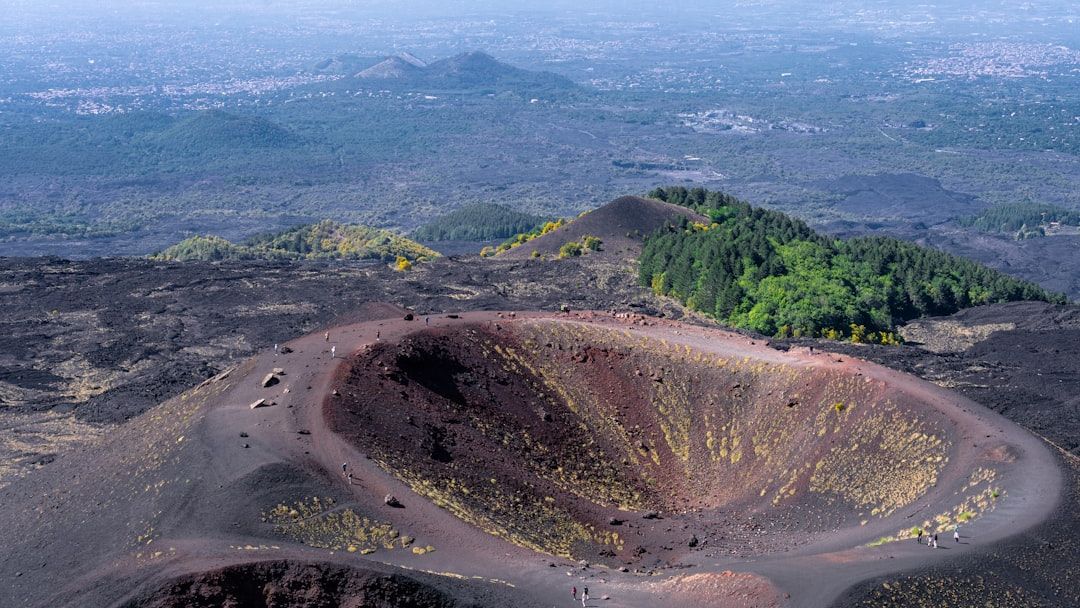
Mount Etna is like no other volcano on Earth, representing ‘a new type of volcanism,’ new research reveals – Image for illustrative purposes only (Image credits: Unsplash)
Sicily – Mount Etna towers more than 11,000 feet above the Mediterranean, Europe’s most active volcano with a history spanning 500,000 years.[1][2] Researchers have long questioned why its lavas defy standard classifications, resembling hotspot eruptions without an underlying plume. A recent study proposes the volcano draws from pre-existing magma pockets in the upper mantle, squeezed upward by tectonic stresses in a process akin to tiny submarine formations.[1]
Challenging Traditional Volcano Categories
Volcanologists traditionally grouped Earth’s volcanoes into three main types based on their settings and magma sources. Mid-ocean ridge volcanoes emerge where plates pull apart, allowing mantle material to well up and form new crust. Hotspot volcanoes, such as those in Hawaii, stem from fixed plumes of hot rock piercing stable plates. Subduction zone volcanoes like Mount Fuji arise inland from trenches, fueled by water-rich sediments melting in the mantle wedge.
Mount Etna fits none of these molds. It straddles the boundary where the African Plate subducts beneath the Eurasian Plate, yet its position sits directly atop the convergence zone rather than offset inland. Its lavas carry signatures of alkali-rich melts typical of low-degree partial melting in the mantle, yet no hotspot evidence appears beneath it. Early eruptions produced silica-rich magmas in modest volumes, followed by abundant alkali lavas – a sequence that inverted typical patterns.[1]
Magma from the Low-Velocity Zone
The breakthrough came from geochemical analysis of Etna’s lava layers spanning its history. Scientists traced the melts to a low-velocity zone, a partially molten layer atop the upper mantle around 80 kilometers deep where seismic waves travel slower. These zones hold small fractions of pre-melted rock, widespread but rarely surfacing elsewhere.[1]
At Etna, this magma ascends sporadically through a “leaking pipe” mechanism. Initial flows interacted with the silica-rich African continental crust, generating the early viscous lavas. Later phases established a straighter path, delivering purer mantle-derived alkali magmas in greater supply. This model explains the volcano’s persistent yet variable output over half a million years.
Echoes of Petit-Spot Volcanoes
Petit-spot volcanoes, first identified off Japan in 2006, offered a clue. These diminutive seamounts, mere hundreds of feet tall, dot bending oceanic plates near subduction zones. Plate flexure fractures the lithosphere, wringing out stored mantle melts much like squeezing a sponge.[2]
Mount Etna scales this process to extremes, emerging as the first known giant petit-spot volcano. “Our study suggests that Etna may have formed through a mechanism similar to the one that generates petit-spot submarine volcanoes,” said Sébastien Pilet, lead author from the University of Lausanne.[2][3] Though vastly larger, the shared reliance on lithospheric deformation to liberate deep melts bridges the gap between oceanic oddities and continental giants.
Tectonic Folding Fuels the Fire
Etna’s locale amplifies this dynamic. The African Plate’s subduction stalls partially, causing irregular bending and folding rather than smooth descent. These deformations crack the overlying rock, channeling mantle melts toward the surface.
“The folds are allowing the magma to rise up,” Pilet noted.[1] Crustal contamination early on enriched the magmas in silica, while later direct conduits preserved primitive compositions. This interplay highlights how plate boundary complexities can sustain long-lived volcanism without invoking plumes or wedges.
Broader Lessons for Earth’s Volcanoes
The findings, detailed in the Journal of Geophysical Research: Solid Earth on April 7, 2026, by Pilet and colleagues, elevate the lithosphere’s role in magma delivery.[1] “This actually represents a new type of volcanism,” observed petrologist Sarah Lambart of the University of Utah, who was not involved.[1]
While Etna stands alone in scale, its process may underpin other enigmatic sites. Underexplored lithospheric-magma interactions could influence eruptions worldwide, refining hazard models for this frequently active peak. As monitoring continues, Etna’s revelations promise to reshape how we view the planet’s fiery underbelly.

As a little kid, I fell in love with nature, wildlife, and animals. Living in the USA, South Africa, Italy, China and Germany gave me the opportunity to discover the world's Wildlife. My favorite animals are Mountain Gorillas, Siberian Tigers, and Great White Sharks.
I'm a certified PADI Open Water Diver, went to Everest Base Camp and Trekked Gorillas in Uganda. I hold a Master of Science in Economics and Finance.
Please send any feedback to feedback@animalsaroundtheglobe.com
- The Fearsome Komodo Dragon Earth’s Largest Lizard - August 18, 2026
- How Bears Are Adapting to Urban Life in the U.S. - August 18, 2026
- Animals and Wildlife in North America - August 18, 2026