Born from Catastrophe: How a Neutron Star Is Made
The birth of a neutron star is, by any measure, one of the most violent events the cosmos permits. It results from the supernova explosion of a massive star, combined with gravitational collapse, that compresses the core past white dwarf star density to that of atomic nuclei. The timescale for this collapse is not gradual – it happens in seconds, an implosion so fierce that the physics change character entirely.
As the core of a massive star is compressed during a Type II supernova, it retains most of its angular momentum, and because it has only a tiny fraction of its parent’s radius, sharply reducing its moment of inertia, a neutron star is formed with very high rotation speed and then, over a very long period, it slows. The resulting object carries an almost incomprehensible amount of rotational energy locked inside a body that fits within the boundaries of a single metropolitan area.
Born in a core-collapse supernova explosion, neutron stars rotate extremely rapidly as a consequence of the conservation of angular momentum, and have incredibly strong magnetic fields due to conservation of magnetic flux. The gravity on the surface of a neutron star is billions of times stronger than that on Earth. That combination – immense gravity, extreme rotation, and ferocious magnetism – is what makes these objects so scientifically singular.
The Numbers Behind the Density: Something That Can’t Be Held
Imagine taking the entire mass of our Sun – around 330,000 times the mass of Earth – and cramming it into a ball roughly 20 kilometers across. That is essentially what a neutron star is, and that single comparison carries more weight than almost any other in astrophysics.
Neutron stars have overall densities comparable to the approximate density of an atomic nucleus. A neutron star is so dense that one teaspoon of its material would have a mass over 5.5 trillion kilograms, about 900 times the mass of the Great Pyramid of Giza. Trying to picture that amount of mass in a spoon-sized volume is precisely where human intuition stops working.
In a neutron star, all of the empty space that matter usually has is completely occupied by neutrons, held together by the star’s gravity. The density increases with depth, varying from roughly a billion kilograms per cubic meter at the crust to an estimated far higher figure deeper inside. The deeper you go, the more extreme the conditions become, and scientists still debate what form of matter occupies the innermost core.
The Most Dense Object Science Has Directly Measured

The densest known stable object in the universe is a neutron star, packing between 1.4 and 2 times the Sun’s mass into a sphere only about 20 km across, where a single cubic centimeter of its matter weighs roughly 400 million tons. Black holes have higher implied density, but their matter is hidden behind an event horizon rather than existing as a solid object we can measure. That distinction matters enormously to science. A black hole’s interior is, by definition, beyond observation.
Neutron stars are so dense that their cores are the densest matter in the universe short of black holes, and the neutron star PSR J0952-0607 is thus the densest object within sight of Earth. That phrasing, “within sight,” is important – it means directly measurable, directly observable, and directly testable. No other category of object gives researchers that access at those densities.
Astronomers estimate mass and radius, then infer density. NASA’s NICER mission watches neutron stars in X-rays and uses their rotation to infer size, and one famous NICER result measured the mass and radius of the pulsar PSR J0030+0451 using waveform modeling. Those mass-radius constraints help narrow the equation of state, which directly connects to neutron star density. It’s painstaking, indirect work – but it’s producing real answers about matter under conditions no laboratory on Earth could ever replicate.
Spinning at 700 Times Per Second – and Staying in One Piece

If an ice skater tucks in her arms as she twirls, her spin will also speed up – it’s a basic law of physics that can make neutron stars the size of cities spin over 700 times per second. That analogy is surprisingly accurate. The collapse amplifies pre-existing rotation by orders of magnitude, the same underlying principle operating at a scale that strains comprehension.
We expect that young pulsars should rotate about once a second or perhaps as many as ten times or so per second, however, many pulsars with periods close to 1 millisecond have been discovered, which means they spin between 200 and 700 times per second. Pulsar PSR J1748-2446ad, discovered in 2004, is the fastest-spinning pulsar known as of 2025, spinning 716 times per second. One full rotation in less than one and a half thousandths of a second, sustained indefinitely.
Current models of neutron star structure and evolution predict that pulsars would break apart if they spun at a rate of around 1,500 rotations per second or more, and that at a rate above about 1,000 rotations per second they would lose energy by gravitational radiation faster than the accretion process would accelerate them. The fact that they approach but don’t exceed a natural speed ceiling is itself a profound statement about the stability of these objects and the physics constraining them.
How They Get So Fast: The Role of Binary Companions
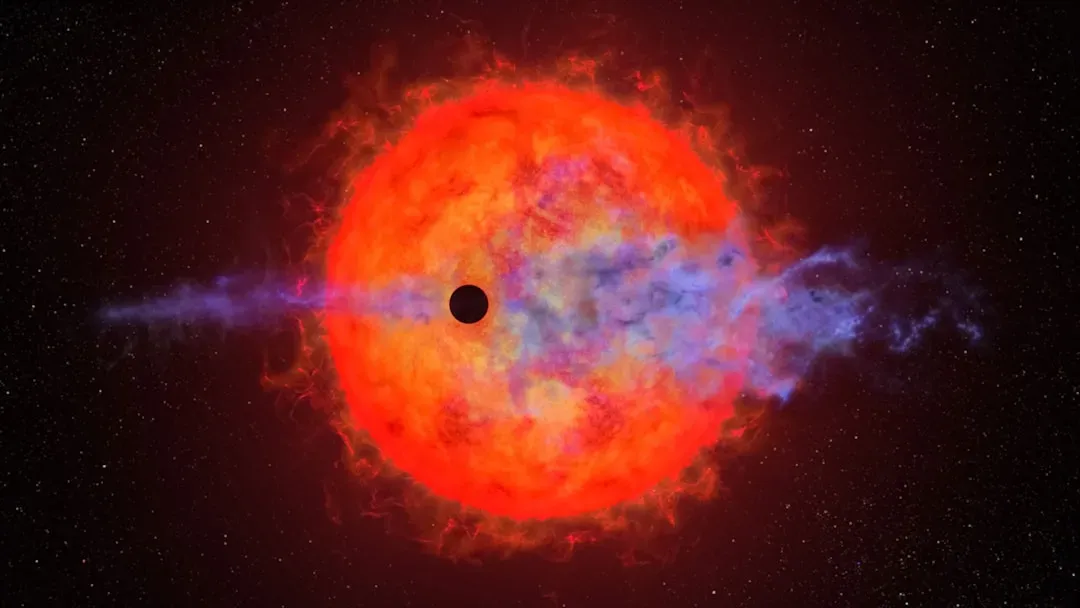
Millisecond pulsars are found to be in binary systems, and it appears that the accretion of matter has pushed on the surface of the neutron star in the direction of its rotation, causing it to rotate faster. It’s one of the more elegant recycling mechanisms in the universe – a dead star, slowly spun back to life by matter stolen from a neighbor.
The transfer of angular momentum from this accretion event can increase the rotation rate of the pulsar to hundreds of times per second, as is observed in millisecond pulsars. Scientists think millisecond pulsars must have formed by stealing energy from a companion. This makes these ultra-fast spinners not just remnants of a single dramatic death, but the products of a long, intimate cosmic relationship.
Many millisecond pulsars are found in globular clusters, which is consistent with the spin-up hypothesis of their formation, as the extremely high stellar density of these clusters implies a much higher likelihood of a pulsar having a companion. These ancient stellar cities, packed densely with old stars, turn out to be ideal nurseries for the universe’s fastest spinning objects.
The Lighthouse Model: Magnetism and Beams of Radiation

Stars also have magnetic fields, and if you squash a big spinning star, its magnetic field bunches up and becomes super concentrated and super strong. For a neutron star, this concentration is extreme. The pulsar is a rotating neutron star that emits light from the pole due to its vast magnetic field, which is between 100 million and 100 quadrillion times more potent than Earth’s magnetic field.
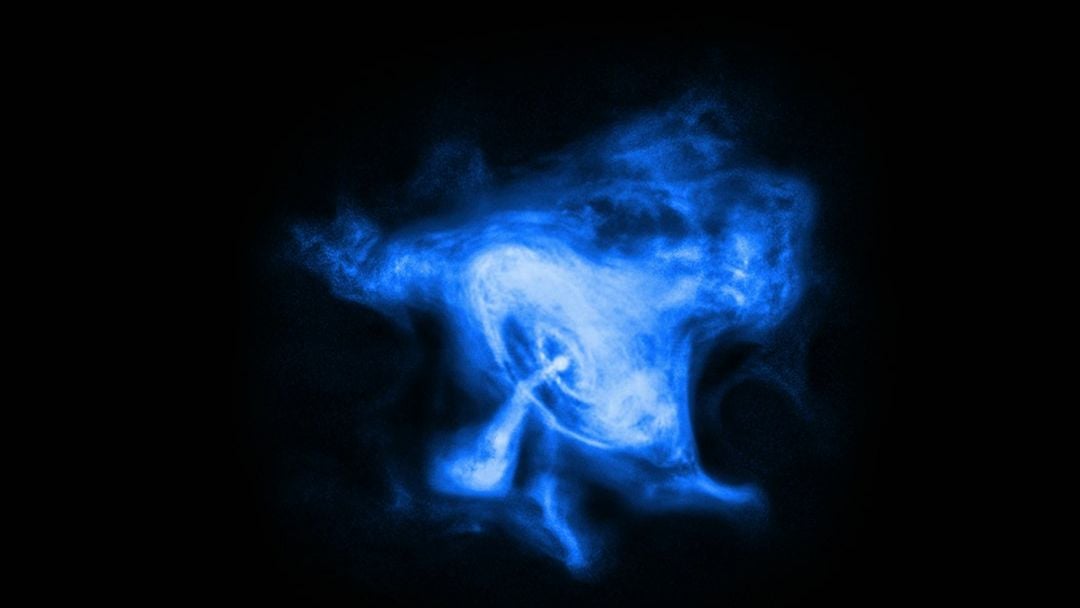
The magnetic poles on a neutron star act like fountains, an escape valve for charged particles that get trapped in the star’s enormously strong magnetic field. As a neutron star spins, its polar fountains turn with it like an interstellar lighthouse beam, and from Earth we see the beam as it quickly sweeps past us – there, gone, there, gone – many times a second. It’s not a flicker caused by any instability in the star. It’s the most orderly rotation imaginable, broadcasting on schedule.
Pulsars have strong magnetic fields that funnel particles along their magnetic poles, accelerating them to relativistic speeds, which produces two powerful beams of light, one from each pole. These twin beams, sweeping the sky with each rotation, are how astronomers detected these objects in the first place, and they remain our most reliable window into neutron star behavior today.
The Perfect Natural Clock – and What Scientists Do With It
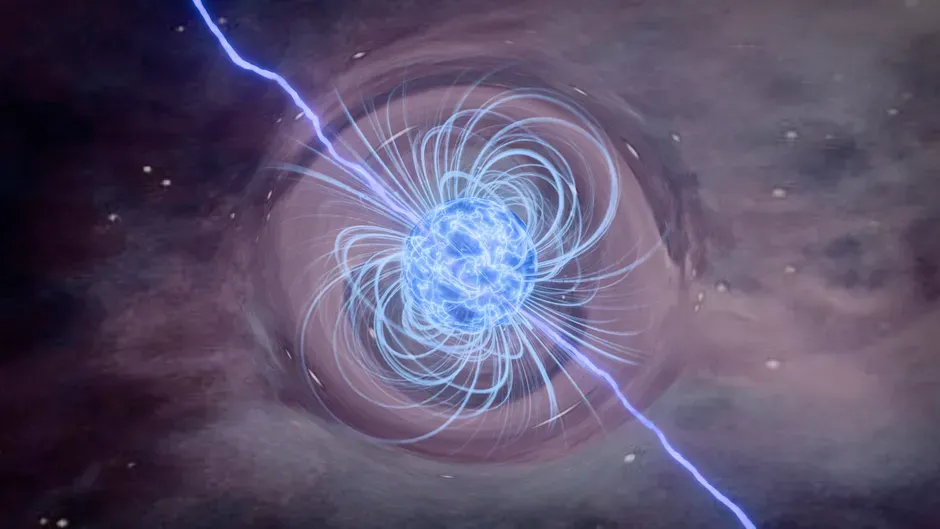
A neutron star’s pulses can come at us hundreds of times a second, ticking like a superfast clock with a millisecond hand. The times at which these pulses are detected by radio telescopes can be measured to within a millionth of a second. That precision isn’t incidental – it’s the entire scientific premise behind one of the most ambitious research programs in modern astrophysics.
The power of pulsar timing in testing fundamental physics comes from the highly stable rotation of millisecond pulsars and the ability to use them as precise astrophysical clocks. High-precision timing of millisecond pulsars offers the promise of detecting gravitational waves with periods of a few years, in the nanohertz band of the gravitational-wave spectrum. A dead star, spinning in a distant corner of the galaxy, is being used as a detector for the faintest ripples in spacetime.
NANOGrav uses a technique called pulsar timing to predict arrival times of the regular, clock-like pulses of rapidly rotating millisecond pulsars. Ripples from gravitational waves passing through our galaxy cause pulses to arrive too early or too late in a predictable and distinctive pattern, and by timing dozens of pulsars scattered throughout the galaxy as part of a pulsar timing array, NANOGrav uses a galaxy-sized gravitational wave detector to study low-frequency gravitational waves. There’s nothing else in the known universe that could serve this purpose at this scale.
What Neutron Stars Tell Us About Matter Itself
The incredible densities inside neutron stars push nuclear physics to the limit. They allow scientists to study how matter behaves when packed so tightly that new forms of matter may emerge. The question of what lives at the very center of a neutron star – whether it’s a sea of free quarks, exotic hyperon matter, or something not yet theorized – remains one of the genuinely open problems in physics.
When two neutron stars spiral together, they emit gravitational waves, and those waves carry information about how easily the stars deform, called tidal deformability, which depends on internal structure and density. The merger events detected by gravitational wave observatories aren’t just dramatic signals – they’re data points in a decades-long effort to decode the equation of state of ultra-dense matter.
Neutron stars provide an unparalleled laboratory for testing Einstein’s theory of general relativity. In the extreme gravitational environment around neutron stars, time slows down, and space curves dramatically. Binary pulsars – pairs of neutron stars orbiting each other – allow scientists to test gravitational theories with extraordinary precision, and these tests have confirmed Einstein’s predictions so far, but scientists are always on the lookout for discrepancies that might point toward new physics.
Conclusion: A Universe That Built Its Own Timekeeper