

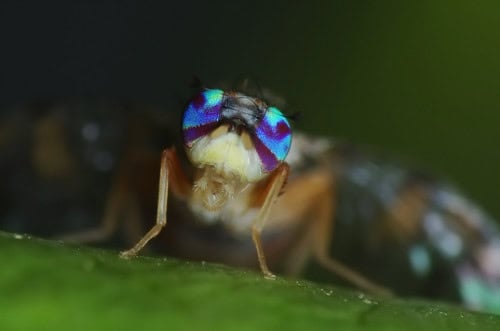
What if we told you that fruit flies—those tiny pests circling your fruit bowl—might actually play for fun? A new study published in Current Biology has unveiled a playful side to these insects, revealing behaviors that could redefine how we think about animal joy and curiosity. It turns out, even fruit flies might know how to have a little fun.
How Fruit Flies Proved They Might Be Thrill-Seekers

The study involved placing fruit flies in a contained arena equipped with rotating platforms under a thin glass cover. While many flies avoided the spinning disk, a select few repeatedly sought it out, choosing to hop on and take a spin. Researchers from the University of Leipzig and Northumbria University meticulously analyzed approximately seven years of film data to understand this behavior better.
Imagine a tiny carousel for insects—some fruit flies treated it like an amusement park ride. While most flies ignored the disk, a few brave souls chose a spin over a snack, suggesting they weren’t acting out of necessity or fear but rather out of a genuine desire for the experience.
Deliberate Fun or Random Behavior?

A critical element of the study was distinguishing between random and intentional behavior. Researchers observed not just whether the flies interacted with the disk but how they approached it. The flies that engaged with the disk often did so by deliberately walking onto it rather than accidentally stumbling upon it.
Co-author Dr. Clara H. Ferreira highlighted this distinction: “We were able to distinguish whether the flies had deliberately walked onto the carousel or jumped onto it in an uncoordinated way.” The consistent, purposeful approach by some flies underscored a level of intentionality and possibly a sense of enjoyment.
Body Awareness in Tiny Insects

The repeated interaction with the spinning disk may provide proprioceptive feedback—a fancy term for the body’s sense of its position and movement. This is a critical component of body awareness in more complex animals, including humans. The flies’ attraction to the disk might indicate that they were engaging in a form of sensory training, not unlike how young mammals play to hone their coordination and motor skills.
Dr. Wolf Huetteroth from the University of Leipzig suggested that this behavior might help scientists understand how efficient self-awareness of the body develops, even in much more complex beings like humans.
A Self-Directed Choice to Play

Unlike many animal studies where behaviors are induced by external triggers, the fruit flies in this experiment showed a self-directed choice to engage with the disk. There was no incentive or pressure for them to interact with the carousel. They simply seemed to enjoy it.
The setting of the experiment was designed to allow the flies to leave whenever they wanted. The fact that some consistently returned to the disk suggests a genuine preference, hinting at an insect version of playfulness and curiosity.
The Trade-Off: Fun Over Food

One of the study’s most intriguing findings was that some flies chose spinning over eating. The insects had constant access to food, water, and safe resting spots, yet they opted for the spinning disk. This trade-off indicates that the flies might derive an intrinsic reward from the activity, similar to how some animals engage in play purely for enjoyment.
In the animal kingdom, such behavior is not uncommon. Many mammals, including humans, enjoy activities like spinning, which help refine balance and spatial awareness. The fact that fruit flies might share this trait is a reminder of the fundamental nature of play in evolution.
What Does This Mean for Human Understanding?

While it might seem like a small discovery, the implications of this study are significant. If fruit flies, with their simple nervous systems, show signs of play, this could reshape our understanding of the evolution of play and body awareness.
“This could help us to find out how we humans also develop efficient self-awareness of our bodies,” Dr. Huetteroth noted. By studying the flies’ interactions with the spinning disk, researchers may unlock clues about how creatures, including humans, develop complex behaviors related to balance, movement, and spatial awareness.
Conclusion: The Playful World of Fruit Flies

The discovery that fruit flies might engage in playful behavior is a delightful reminder of the complexity and wonder of the natural world. These tiny creatures, often overlooked or considered mere nuisances, might possess a zest for life that echoes through the animal kingdom.
As researchers continue to explore this phenomenon, they may uncover new insights into how playfulness evolved and why it is such a powerful force in both the animal and human experience. Who would have thought that something as simple as a spinning disk could reveal so much about the intricate minds of even the smallest creatures?

For any feedback please message Feedback@animalsaroundtheglobe.com
- WATCH: Orca Sucker Punch Dolphin Out of the Water - July 18, 2026
- Girlfriend Insists Her Man Gets Rid Of His Cat But He Leaves Her Speechless - July 18, 2026
- Watch: River Otter Run and Slide over Frozen Lake for Over a Mile - July 17, 2026