


Throughout history, humans have relied on animal companions in times of war. While we celebrate human heroes with medals and monuments, countless animals have served alongside soldiers, often making the ultimate sacrifice without recognition. From carrier pigeons delivering crucial messages across enemy lines to dogs rescuing wounded soldiers, these heroic animals demonstrated remarkable courage, intelligence, and loyalty. Their contributions saved thousands of lives and sometimes even turned the tide of battle. This article explores the remarkable stories of forgotten animal heroes from major conflicts, honoring their service and sacrifice that too often goes unrecognized in the pages of military history.
Sergeant Stubby: America’s Most Decorated War Dog
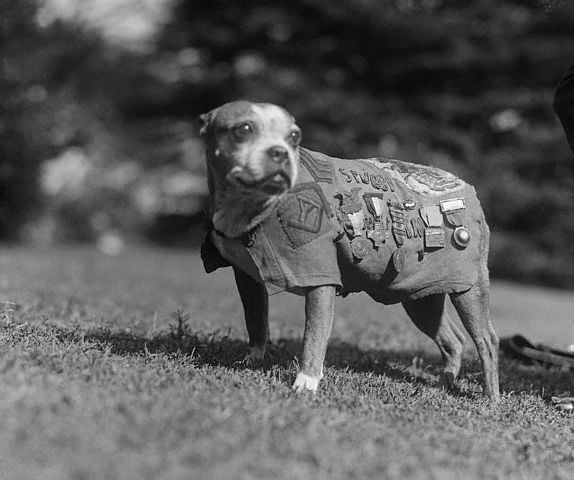
Perhaps the most famous animal soldier of World War I was Sergeant Stubby, a stray Boston Terrier mix who became the unofficial mascot of the 102nd Infantry Regiment. Stubby served for 18 months in the trenches of France, participating in 17 battles and four major offensives. His acute sense of smell allowed him to detect incoming gas attacks, giving soldiers precious time to don their masks. He could also locate wounded soldiers in no man’s land, listening for English amid the chaos of battle.
Stubby’s most remarkable feat came when he single-handedly captured a German spy. Upon discovering the infiltrator mapping American trenches, Stubby gave chase and bit the man on the leg, holding him until American soldiers arrived. For this act of bravery, he was promoted to sergeant, outranking his owner Corporal Robert Conroy. After the war, Stubby returned home a hero, meeting three sitting presidents and receiving numerous medals before his death in 1926. Today, his preserved remains are on display at the Smithsonian’s National Museum of American History, a testament to his extraordinary service.
Cher Ami: The Pigeon That Saved 194 Men
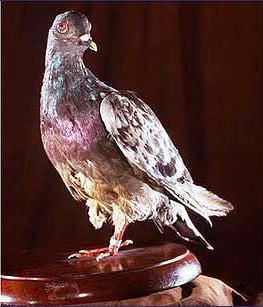
In October 1918, during the Meuse-Argonne Offensive of World War I, 550 men of the U.S. 77th Infantry Division, known as the “Lost Battalion,” found themselves surrounded by German forces. After two failed relief attempts resulted in friendly fire casualties, Major Charles Whittlesey dispatched his last carrier pigeon, Cher Ami, with a desperate message: “We are along the road parallel to 276.4. Our own artillery is dropping a barrage directly on us. For heaven’s sake, stop it.”
Despite being shot through the breast, blinded in one eye, and having a leg nearly severed, Cher Ami completed his 25-mile journey in just 25 minutes. The message reached headquarters, artillery fire was redirected, and 194 men were eventually rescued. Army medics worked tirelessly to save the heroic bird, crafting a wooden leg to replace the one lost in flight. For his service, Cher Ami received the French Croix de Guerre with Palm and was inducted into the Racing Pigeon Hall of Fame. His preserved body is displayed at the Smithsonian National Museum of American History, a reminder of how one small bird saved nearly 200 men from certain death.
Warrior: The Horse Who Couldn’t Be Killed
Known as “the horse the Germans couldn’t kill,” Warrior served throughout World War I with his owner, General Jack Seely. This remarkable thoroughbred survived some of the war’s most horrific battles, including the Battle of the Somme, where of the 150,000 horses that participated, only 80,000 returned. Warrior demonstrated exceptional bravery under fire, remaining calm amid shellfire and inspiring the troops who fought alongside him.
In 1918, Warrior led a cavalry charge at the Battle of Moreuil Wood, a critical engagement that helped halt the German spring offensive. Throughout his four years on the Western Front, Warrior survived numerous near-misses: his stable was shelled moments after he left it; he was buried in mud during bombardments; and he escaped a burning stable by kicking down the door. Unlike millions of horses that perished in the conflict, Warrior returned to the Isle of Wight after the war and lived until 1941, dying at the age of 33. In 2014, he was posthumously awarded the PDSA Dickin Medal, the “Victoria Cross for animals,” representing the millions of animals that served during the Great War.
Judy: The Only Official Canine Prisoner of War
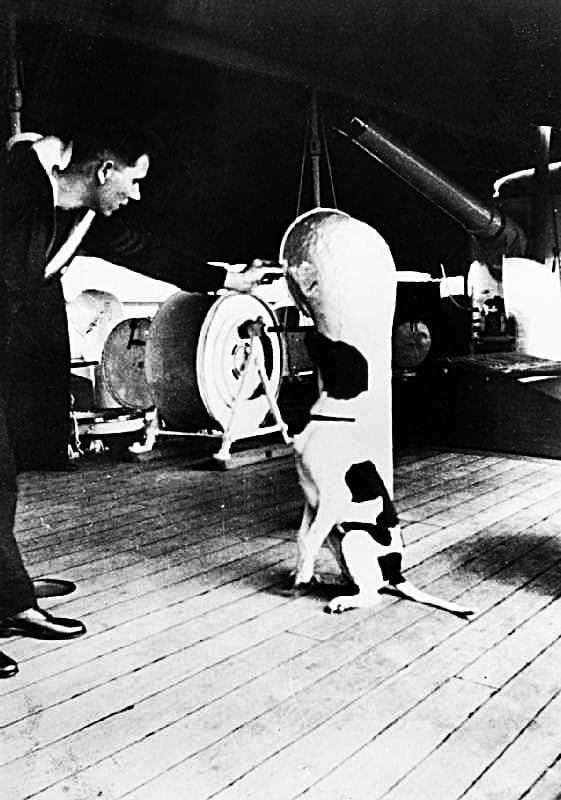
Judy, an English pointer, began her military career as the mascot aboard the HMS Gnat and later the HMS Grasshopper during World War II. When the Grasshopper was sunk by Japanese aircraft in 1942, Judy helped locate a freshwater spring on the deserted island where survivors had taken refuge, saving them from dehydration. After the group was captured while attempting to reach British lines, Judy entered Japanese captivity alongside her human companions.
In the prisoner-of-war camps, Judy became adept at detecting guards approaching for surprise inspections and would warn prisoners working on forbidden activities. She also foraged for food, bringing back rats and snakes to supplement the meager rations. Her most devoted relationship was with Leading Aircraftman Frank Williams, who convinced camp commandant Hiroshi Banno to officially register Judy as a prisoner of war, protecting her from execution. Given the POW number 81A, Judy became the only official canine prisoner of war in history.
When the prisoners were transported to a new camp aboard a cramped ship, Williams smuggled Judy aboard in a rice sack. When the vessel was torpedoed, Judy saved numerous drowning men by pushing pieces of wreckage toward them. After liberation in 1945, Judy was awarded the Dickin Medal “for magnificent courage and endurance in Japanese prison camps.” She eventually returned to Africa with Williams, where she died in 1950 from a tumor, having survived years of hardship that claimed thousands of human lives.
Wojtek: The Bear Soldier Who Carried Artillery Shells
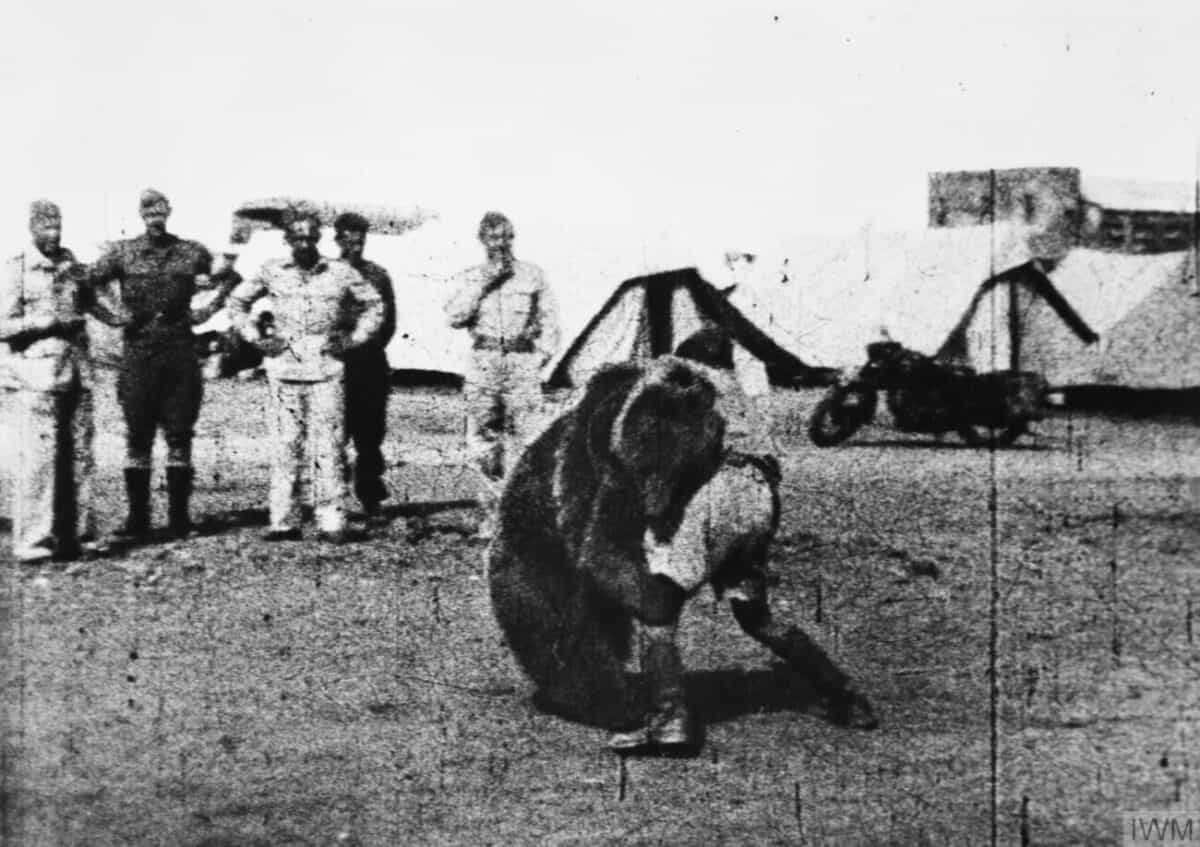
Perhaps the most unusual animal soldier of World War II was Wojtek, an orphaned Syrian brown bear cub adopted by Polish II Corps soldiers in 1943. As the Polish Army traveled through the Middle East, they raised the young bear, which grew to over 6 feet tall and 500 pounds. To allow him to accompany troops to Italy, Wojtek was officially enlisted as Private Wojtek, complete with his own pay book, rank, and serial number.
During the Battle of Monte Cassino in 1944, Wojtek made his most significant contribution to the war effort. Noticing his comrades struggling to unload heavy artillery shells, he began carrying crates of 25-pound shells from supply trucks to the artillery positions, each requiring four men to lift. Wojtek could carry these crates solo, transporting them without dropping a single shell. This remarkable feat inspired the official emblem of the 22nd Transport Company: a bear carrying an artillery shell.
After the war, Wojtek was housed at Edinburgh Zoo in Scotland, where he lived until 1963. Former comrades would visit him, sometimes jumping into his enclosure to wrestle with him as they had during wartime. Numerous memorials to Wojtek exist today, including statues in Edinburgh and at the Polish War Memorial in London, commemorating this unique ursine soldier who became a beloved symbol of Polish-Scottish friendship.
Reckless: The Marine Horse Who Outranked Her Owner
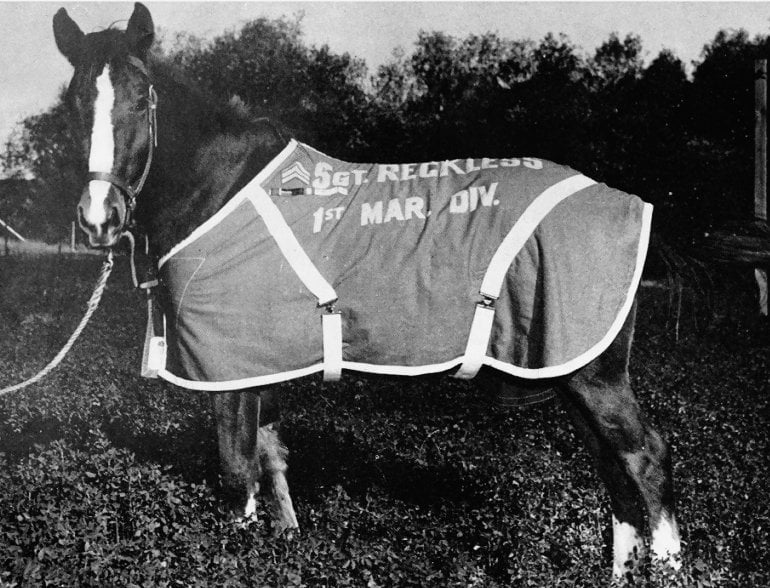
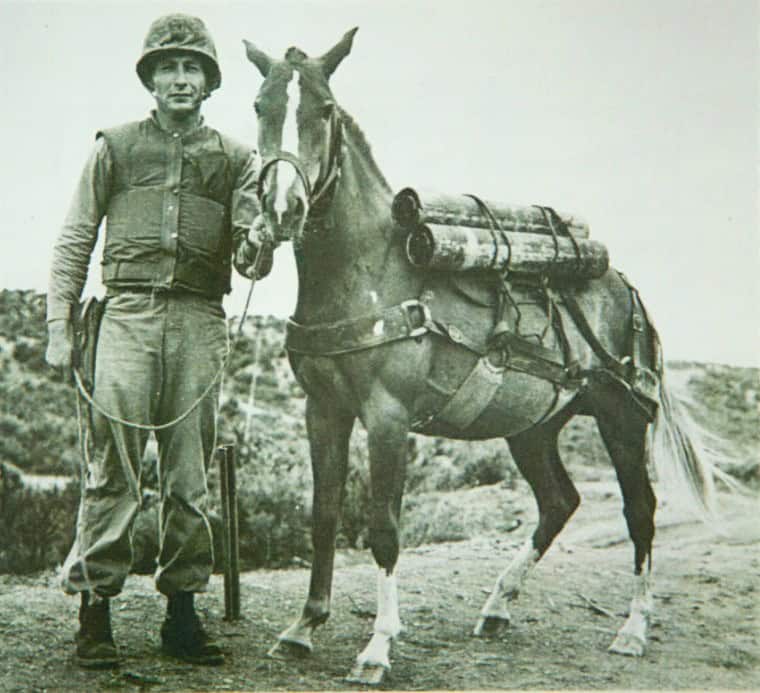
During the Korean War, a small Mongolian mare named Reckless became one of the most decorated war horses in American history. Purchased in 1952 for $250 from a Korean boy who needed money for his sister’s medical treatment, Reckless was trained by the U.S. Marine Corps to carry ammunition for 75mm recoilless rifles—heavy anti-tank weapons nicknamed “reckless rifles,” which gave the horse her name.
Reckless’s defining moment came during the Battle of Outpost Vegas in March 1953. Over the course of five days of intense fighting, she made 51 solo trips carrying ammunition up steep mountain terrain to the front lines and transporting wounded soldiers back down for medical treatment. In a single day, she carried 9,000 pounds of ammunition across 35 miles of open rice paddies and up steep mountain trails, often under enemy fire. She was wounded twice but never stopped working, sometimes sheltering in foxholes with Marines when shelling became too intense.
For her extraordinary service, Reckless received two Purple Hearts, a Marine Corps Good Conduct Medal, a Presidential Unit Citation, and was promoted to the rank of Staff Sergeant—outranking her trainer. After the war, she was brought to the United States, where she lived at Camp Pendleton until her death in 1968. In 2013, a life-sized bronze statue of Reckless was unveiled at the National Museum of the Marine Corps in Quantico, Virginia, honoring the small horse with an enormous heart who became a Marine Corps legend.
G.I. Joe: The Pigeon Who Saved a Thousand Lives
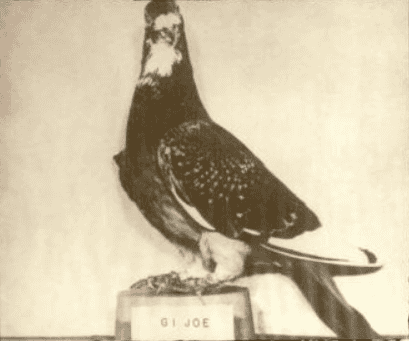
During World War II, the heroic actions of a carrier pigeon named G.I. Joe prevented a potential tragedy of friendly fire. On October 18, 1943, British troops had successfully captured the Italian town of Colvi Vecchia from German forces. With radio communications down, they had no way to inform Allied command of their victory. Meanwhile, U.S. Air Force bombers were en route to bomb the town, unaware it was now in Allied hands.
G.I. Joe was dispatched with an urgent message to cancel the air raid, flying 20 miles in just 20 minutes. He arrived at the air base literally as the bombers were taxiing for takeoff. The bombing was canceled immediately, saving the lives of at least 1,000 British soldiers and countless Italian civilians who would have been caught in the bombardment.
For this remarkable feat of timing and endurance, G.I. Joe became the first non-British animal to receive the Dickin Medal in 1946. The citation read: “For timely delivery of a message from British 10th Corps HQ on 18 Oct 1943, delivered in record time, thereby preventing a bombing of the town where 100 civilian casualties might have occurred.” G.I. Joe lived out his retirement at the Detroit Zoological Gardens until his death in 1961 at age 18. His preserved body is displayed at the U.S. Army Communications Electronics Museum at Fort Monmouth, New Jersey, honoring a small bird whose speed saved a thousand lives.
Simon: The Ship’s Cat Who Boosted Morale Under Siege
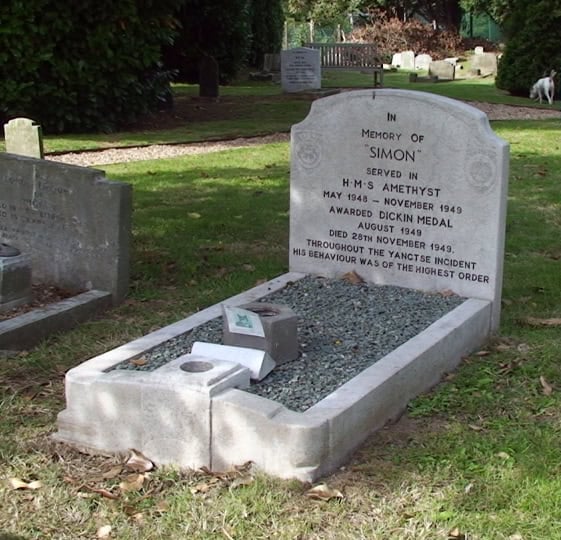
Simon, a black and white ship’s cat aboard the British Royal Navy frigate HMS Amethyst, earned his place in military history during the Yangtze Incident of 1949. When the Amethyst was shelled by Communist Chinese forces while traveling up the Yangtze River, Simon was severely wounded by shrapnel that tore through his legs and burned his face and chest. The ship’s captain and many crew members were killed in the attack, and the surviving sailors found themselves trapped on the damaged vessel for 101 days.
Despite his injuries, Simon recovered and returned to his duty of controlling the ship’s rat population, which had become critical as the rats were threatening the dwindling food supplies. Simon not only eliminated the rats but also provided vital morale support to the traumatized crew. He would visit wounded sailors in the sick bay, curling up on their bunks and offering companionship during the long siege.
When the Amethyst finally escaped under cover of darkness on July 30, 1949, Simon became a national hero. He was awarded the Dickin Medal in August 1949, the only cat to receive this honor, as well as the Blue Cross Medal and the Amethyst campaign medal. Tragically, while in quarantine in England, Simon developed an infection and died on November 28, 1949. Hundreds attended his funeral at the PDSA Animal Cemetery in East London, and his obituary appeared in Time magazine. His collar is displayed at the National Maritime Museum in Greenwich, commemorating a feline hero whose courage under fire and companionship during crisis exemplified the spirit of naval tradition.
Tirpitz: The Pig Who Survived a Naval Battle
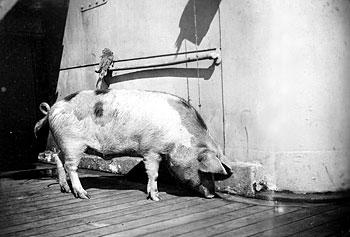
One of history’s most unusual animal war heroes was Tirpitz, a pig with the extraordinary distinction of surviving a major naval battle during World War I. In 1915, the German cruiser SMS Dresden was cornered by British ships off the coast of Chile near Juan Fernández Islands. As the ship began to sink following heavy bombardment, German sailors set Tirpitz, the ship’s mascot, free rather than let him drown with the vessel.
The determined pig swam through the battle-churned waters to reach the British HMS Glasgow, one of the ships that had just sunk his home vessel. Impressed by the swine’s survival instinct and swimming prowess, the British sailors hauled him aboard and adopted him as their own mascot, renaming him “Tirpitz” after German Admiral Alfred von Tirpitz. The pig had effectively “changed sides” in the middle of World War I.
Tirpitz lived out the remainder of the war aboard British vessels and eventually in England. Upon his natural death years later, his body was preserved and displayed at the Imperial War Museum in London. Even more remarkably, his skin was made into a leather-bound book that documented his unique story—possibly the only case of a war memoir literally bound in the hide of its protagonist. Tirpitz’s story highlights how even in warfare’s darkest moments, compassion for animals could transcend national divisions.
Salty and Roselle: Guide Dogs of 9/11
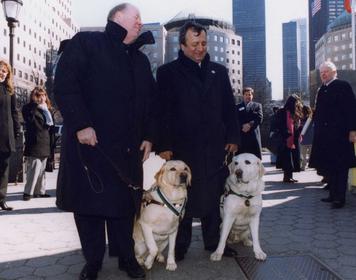
While not involved in conventional warfare, guide dogs Salty and Roselle demonstrated extraordinary heroism during America’s deadliest terrorist attack. On September 11, 2001, these two Labrador retrievers were at their posts with their visually impaired owners in the World Trade Center when the planes struck. Salty, with his owner Omar Rivera, was on the 71st floor of the North Tower, while Roselle was with Michael Hingson on the 78th floor of the same building.
As chaos erupted, both dogs calmly led their owners down dozens of flights of smoky, crowded stairwells. Roselle guided Hingson down 1,463 steps, navigating through falling debris, fires, and panicked crowds. Despite the overwhelming stress and confusion, she remained focused on her duty. Similarly, Salty stayed with Rivera even when Rivera briefly let go of his harness, insisting that Salty save himself. The loyal dog refused to leave, staying by Rivera’s side until they reached safety.
Both dogs successfully evacuated their owners minutes before the tower collapsed. For their life-saving actions, Salty and Roselle were awarded the Dickin Medal in 2002, the first American recipients since 1949. Their heroism during one of America’s darkest days demonstrated how service animals respond with unwavering devotion and composure even in the most extreme circumstances. Roselle’s story was later immortalized in Hingson’s bestselling book “Thunder Dog,” educating millions about the extraordinary capabilities of guide dogs under pressure.
Smoky: The Yorkie War Dog Who Saved Lives and Hearts
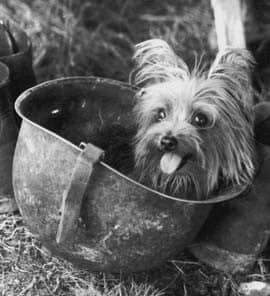
Perhaps the most unlikely war hero of World War II was Smoky, a four-pound Yorkshire Terrier who served in the South Pacific with the 5th Air Force, 26th Photo Reconnaissance Squadron. Found in a New Guinea jungle foxhole in 1944, Smoky was adopted by Corporal William Wynne after no owner came forward. Despite her tiny size, Smoky would become one of the most remarkable military dogs in history.
Smoky’s most significant contribution came when engineers needed to run communication lines under a crucial airfield on Luzon Island in the Philippines. Rather than dig up the runway, which would have exposed 40 planes to enemy fire and halted operations for days, Smoky was sent through a 70-foot-long, 8-inch-wide drainage culvert beneath the airstrip. She pulled a string attached to the communication wire through the narrow pipe, completing in minutes what would have taken three days of dangerous digging by human engineers.
Beyond this engineering feat, Smoky served as a therapy dog before the concept formally existed, visiting wounded soldiers in hospitals throughout the Pacific Theater. She flew 12 combat missions, parachuted from 30 feet in a specially designed container, and warned Wynne’s unit of incoming artillery shells, saving

- How Crickets Chirp Using Their Wings - July 20, 2026
- The Largest Sea Turtle Ever Rescued Off North Carolina - July 20, 2026
- The Ocean’s Escape Artist: Why Octopuses Outsmart Us All - July 20, 2026