


In an age where humans rely heavily on GPS technology to navigate even short distances, birds perform remarkable feats of navigation that continue to astonish scientists. Each year, billions of birds embark on epic migratory journeys spanning thousands of miles, crossing oceans, mountains, and deserts with pinpoint accuracy—all without smartphones or satellite guidance. Some species, like the Arctic Tern, travel from pole to pole annually, covering over 44,000 miles. The Bar-tailed Godwit can fly non-stop for nine days across the Pacific Ocean. How do these remarkable creatures accomplish such navigational precision? The answer lies in a sophisticated combination of biological adaptations, celestial cues, magnetic sensitivity, and environmental awareness that has evolved over millions of years. Let’s explore the extraordinary navigational capabilities that allow birds to traverse the globe with a precision that puts our best technology to shame.
The Magnetic Compass: Earth’s Field as a Navigation Tool
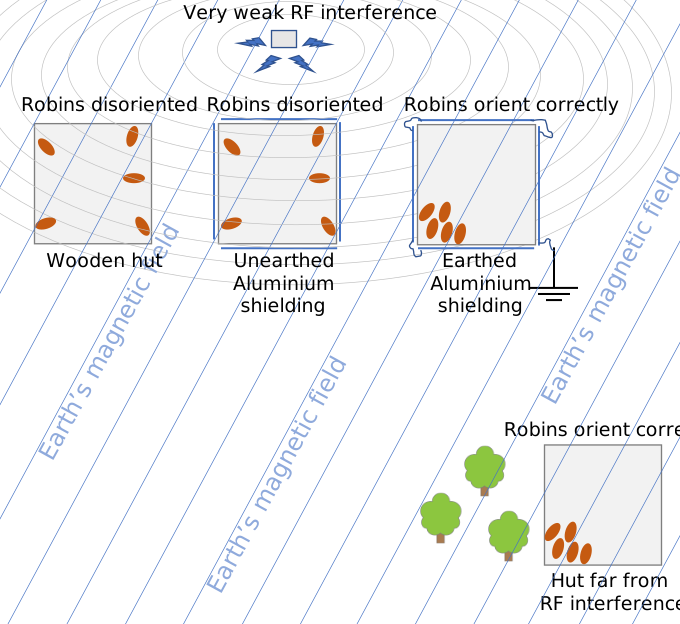
Birds possess a remarkable ability to detect Earth’s magnetic field, essentially giving them a built-in compass. This magnetic sense allows them to determine their orientation relative to magnetic north and south. Scientists have discovered that many migratory species have magnetite particles in their beaks, eyes, and ears that act as microscopic compasses. These magnetoreceptors connect to the bird’s nervous system, allowing them to literally “see” or “feel” magnetic fields. The European Robin, for instance, has demonstrated the ability to orient correctly even in complete darkness, relying solely on magnetic cues. Recent research suggests that some birds may even visualize magnetic fields as patterns superimposed on their visual field, creating a kind of augmented reality that guides their flight path. This innate magnetic compass works in conjunction with other navigational systems, providing birds with a redundant navigation mechanism that functions regardless of weather conditions or time of day.
Solar Navigation: Using the Sun as a Directional Guide

During daylight hours, many birds use the sun as a compass for directional guidance. This solar navigation system is more sophisticated than simply following the sun’s position—birds can compensate for the sun’s movement across the sky throughout the day. Studies have shown that birds possess an internal clock that allows them to adjust their directional calculations based on the time of day and the sun’s arc. The Indigo Bunting, for example, calibrates its orientation by observing the sun’s position relative to landmarks during dawn and dusk. Even more remarkably, young birds appear to learn this sun compass system during their early development, observing the daily pattern of the sun’s movement and incorporating it into their navigational toolkit. This solar compass works in tandem with other navigational mechanisms, providing birds with multiple reference points for maintaining their course during long-distance migrations.
Celestial Navigation: Stars as Nighttime Guides

When darkness falls, migratory birds don’t lose their way—they simply switch to stellar navigation. Many species use the patterns of stars to maintain their heading during night flights. Nocturnal migrants, like the Swainson’s Thrush, have demonstrated the ability to use star patterns for orientation, with particular emphasis on the North Star (Polaris) and its surrounding constellations, which provide a fixed reference point. Scientists have confirmed this ability through planetarium experiments, where birds adjust their orientation when the projected star field rotates. Perhaps most impressively, young birds appear to have an innate ability to recognize key stellar patterns without prior experience, suggesting that star recognition may be genetically encoded. This celestial navigation system is particularly important for species that migrate at night to avoid predators and take advantage of calmer air conditions. The combination of solar and stellar navigation ensures that birds can maintain their course throughout the entire 24-hour cycle.
Infrasound Detection: Feeling the Earth’s Vibrations

Some birds can detect extremely low-frequency sounds called infrasound, which humans cannot hear. These sound waves can travel thousands of miles through the atmosphere and are produced by ocean waves, wind patterns interacting with mountain ranges, and even distant storms. Research indicates that pigeons and other migratory birds may use these infrasonic cues as acoustic landmarks to create mental maps of their surroundings. For example, homing pigeons appear to detect the infrasound generated by their home loft from considerable distances, helping them navigate back with remarkable precision. Scientists believe that infrasound may provide birds with information about large-scale geographic features that remain constant over time, offering reliable navigational reference points. This sensitivity to Earth’s acoustic landscape adds another layer to birds’ multifaceted navigation toolkit, particularly useful when visual or magnetic cues are limited.
Olfactory Navigation: Following Scent Maps

The role of smell in avian navigation has gained increasing scientific attention. Research suggests that many birds create olfactory maps by memorizing the unique scent profiles of different regions. Seabirds like the Leach’s Storm Petrel have demonstrated remarkable sensitivity to specific oceanic odors that help them locate productive feeding grounds across vast stretches of seemingly featureless ocean. Studies with homing pigeons have shown that when their sense of smell is impaired, their navigational abilities suffer significantly, particularly in unfamiliar territory. Scientists believe birds may detect subtle changes in plant volatiles, microbial communities, and environmental compounds that create distinctive olfactory signatures for different geographic areas. This olfactory navigation system appears especially important for birds crossing oceans or deserts where visual landmarks are scarce. The ability to follow these “scent highways” represents yet another sophisticated component of birds’ multisensory navigation approach.
Visual Landmarks: Memorizing Terrain Features

While sophisticated internal compasses are impressive, birds also rely on good old-fashioned visual memory. Migratory species develop remarkable mental maps of terrain features like mountain ranges, coastlines, rivers, and even human structures like highways or distinctive buildings. Research with homing pigeons has demonstrated their ability to recognize and follow roads and other linear landscape features. Birds flying over familiar territory often use these memorized landmarks to make course corrections and maintain their heading. The Clark’s Nutcracker provides an extreme example of visual memory capability—these birds can remember the locations of up to 10,000 seed caches over winter periods. For many migratory species, visual landmark recognition becomes increasingly important as they approach familiar breeding or wintering grounds, allowing them to navigate with precision to specific locations like previous nesting sites. This visual mapping ability complements their other navigation systems, providing redundancy that ensures successful migration even if one system is compromised.
Polarized Light Perception: Reading Sky Patterns
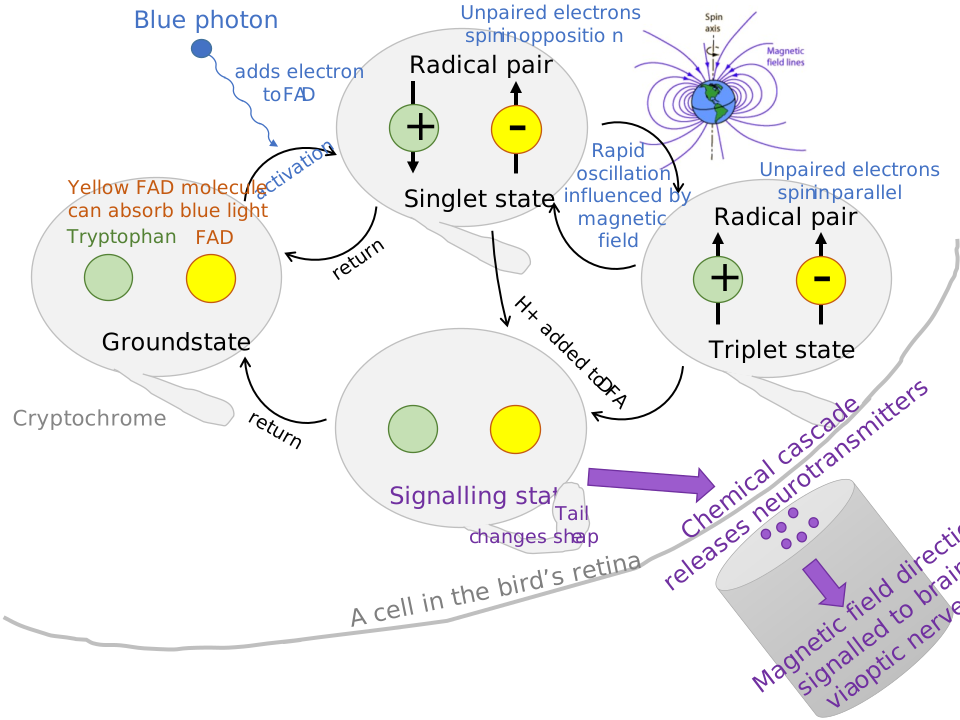
Many birds can perceive polarized light patterns in the sky, which humans cannot readily detect without special equipment. Sunlight becomes polarized as it passes through the atmosphere, creating consistent patterns that depend on the sun’s position, even when the sun itself is obscured by clouds. Research has shown that birds like the European Robin use these polarization patterns for orientation, especially during dawn and dusk when the patterns are most pronounced. Special photoreceptors in birds’ eyes contain proteins called cryptochromes that are sensitive to polarized light, allowing them to extract directional information from the sky even under cloudy conditions. This ability is particularly valuable during migration, as it enables birds to maintain their heading even when the sun isn’t directly visible. The polarized light compass works in conjunction with the magnetic sense, with studies suggesting that polarized light exposure helps calibrate the bird’s magnetic compass daily. This sophisticated light-detection system provides yet another layer of navigational capability that helps ensure migration success.
Atmospheric Pressure Sensing: Weather as a Navigation Aid

Birds demonstrate remarkable sensitivity to changes in barometric pressure and other atmospheric conditions that help them anticipate weather systems and adjust their migration accordingly. Studies have shown that many species will delay departure or alter course to avoid approaching storms that could endanger their journey. The Paratrigona lineata, a stingless bee, has even been shown to use air pressure differences as barometers. While this isn’t strictly navigation, this weather-sensing ability is crucial for successful long-distance migration, allowing birds to conserve energy by riding favorable winds and avoiding dangerous conditions. Bar-headed Geese, which migrate over the Himalayas, adjust their altitude based on wind patterns and air pressure to minimize energy expenditure during their incredibly challenging journey. This atmospheric pressure sensitivity contributes to migration timing decisions and route adjustments that optimize the chances of successful navigation across vast distances.
Genetic Programming: Inherited Migration Maps

Perhaps one of the most remarkable aspects of avian navigation is that many species appear to have genetically encoded migration routes and timing. Young birds of certain species can successfully complete their first migration without guidance from experienced adults, suggesting an inherited program directing their journey. The Common Cuckoo provides a striking example—these brood parasites are raised by host species that don’t migrate to the same wintering grounds, yet young cuckoos independently find their way to ancestral wintering areas in Africa. Research with captive-bred birds has shown that they will demonstrate migratory restlessness (Zugunruhe) at appropriate times of year and will orient in the direction their wild counterparts would fly, even when raised in isolation. Genetic studies have identified specific genes associated with migratory behavior and orientation, suggesting that complex navigational instructions can be passed through generations via DNA. This genetic programming provides the foundation upon which experience-based refinements build throughout a bird’s lifetime.
Experience and Learning: Refining Navigation Skills

While birds possess remarkable innate navigational abilities, experience plays a crucial role in refining their navigation precision. Studies tracking individual birds across multiple migrations show that adults typically navigate more efficiently than juveniles, suggesting that learning improves performance over time. Birds appear to memorize successful routes and correction factors for various environmental conditions they encounter. The White-crowned Sparrow, for instance, demonstrates increasingly precise navigation to specific wintering and breeding grounds after completing its first migration cycle. Social learning also contributes to navigational development, with young birds in some species following experienced adults during their initial migrations. This apprenticeship allows them to learn stable landmarks and refine their innate navigation systems through observation. The combination of genetic programming and experiential learning creates a remarkably adaptable navigation system that can respond to changing environmental conditions while maintaining the reliability needed for long-distance migration.
Multisensory Integration: Combining Navigation Systems

The true marvel of avian navigation lies not in any single mechanism but in birds’ ability to integrate multiple navigation systems simultaneously. Rather than relying on just one method, migratory birds employ a sophisticated hierarchical system that uses different navigational cues depending on their availability and reliability. When visual landmarks are visible, birds may prioritize those cues; when flying over open ocean, magnetic and celestial cues become more important. Research shows that when one system is experimentally disabled, birds can often compensate using their remaining navigational tools. This redundancy ensures successful migration even when certain cues are unavailable due to environmental conditions. Scientists have identified brain regions, particularly in the hippocampus, that appear specialized for integrating these diverse navigational inputs. The ability to synthesize information from multiple sensory systems creates a navigation capability far more robust than any single mechanism could provide, explaining how birds maintain such remarkable precision across diverse environments and conditions.
Navigational Challenges in the Modern World

Despite their sophisticated navigation systems, birds face increasing challenges in the modern world. Light pollution disrupts celestial navigation by obscuring star patterns and altering natural light cues. Many migratory birds become disoriented by artificial lights, particularly during foggy or cloudy conditions when other navigational cues are limited. Electromagnetic radiation from human technologies may potentially interfere with magnetic sensing, though research on these effects continues. Climate change poses another significant challenge, as shifting weather patterns and seasonal timing may disrupt the environmental cues birds use for migration timing. Additionally, habitat fragmentation eliminates familiar landmarks and creates navigational barriers. Research indicates that some species are showing remarkable adaptability—European Blackcaps, for instance, have established new migration routes to take advantage of winter bird feeders in the United Kingdom. Understanding how birds navigate is becoming increasingly important for conservation efforts aimed at protecting these remarkable migrants in our rapidly changing world.
Despite decades of scientific investigation, bird navigation remains partially shrouded in mystery, representing one of the most remarkable phenomena in the natural world. The precision with which billions of birds navigate global migratory routes year after year far exceeds what our current understanding can fully explain. Their ability to integrate multiple sensory inputs into cohesive navigational systems represents a biological achievement that continues to inspire technological innovation, from more efficient GPS systems to novel navigational tools for autonomous vehicles. As research techniques advance, including miniaturized tracking technology and genetic analysis, scientists are gradually uncovering more details about the mechanisms behind avian navigation. The remarkable navigational capabilities of birds remind us that nature has developed solutions to complex problems through evolutionary processes that still surpass human technology in many ways. By understanding and preserving these natural navigational marvels, we not only protect extraordinary migratory species but also maintain living examples of navigational systems that may continue to inspire human innovation for generations to come.

- The 15 Most Dangerous Creatures Lurking in the Deep Ocean - June 18, 2026
- 12 Animals That Changed the Course of Human History - June 18, 2026
- The Only Place Left to See the Vaquita Porpoise - June 18, 2026