

A towering Tyrannosaurus rex that once ruled the Late Cretaceous has now claimed another record—this time in the auction room. A remarkably complete T. rex skeleton nicknamed “Gus” sold for an astonishing $50.1 million at a Sotheby’s auction in New York City on July 14, 2026, making it the most expensive dinosaur fossil ever sold. While the sale highlights the growing fascination with prehistoric giants, it has also reignited a heated debate among paleontologists over whether scientifically significant fossils belong in private collections or public museums.
Gus Becomes the World’s Most Expensive Dinosaur Fossil
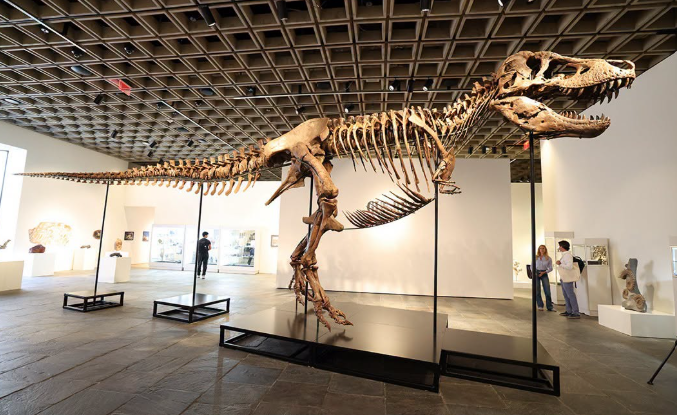
The record-breaking fossil far exceeded its pre-sale estimate of $20 million to $30 million, with bidding lasting roughly ten minutes before an anonymous buyer secured the specimen. The sale eclipsed the previous record set in 2024 by the stegosaurus “Apex,” which sold for $44.6 million, and surpassed the famous T. rex “Stan,” which fetched $31.8 million in 2020.
According to Sotheby’s, Gus represents one of the largest and best-preserved Tyrannosaurus rex specimens ever discovered, making it one of the most desirable dinosaur fossils to reach the auction market.
A Giant Predator Frozen in Time
Gus lived approximately 67 million years ago, during the final chapter of the Age of Dinosaurs. The fossil was discovered between 2021 and 2023 on private land in Harding County, South Dakota, by fossil excavation company Theropoda Expeditions.
The mounted skeleton stretches nearly 38 feet (11.6 meters) in length and stands around 12.5 feet (3.8 meters) tall. It preserves 183 fossilized bones, representing roughly 61% of the original skeleton, including an exceptionally well-preserved skull. Scientists have also noted evidence of healed injuries throughout the fossil, suggesting Gus survived multiple violent encounters during its lifetime.
Scientists Voice Concerns Over Private Ownership
While collectors celebrated the historic sale, many researchers expressed disappointment that such an important specimen could become inaccessible to science.
The Society of Vertebrate Paleontology has repeatedly urged buyers of exceptional fossils to place them in museums or other public institutions where researchers and the public can continue to study them. Experts argue that increasingly high auction prices make it nearly impossible for museums to compete with wealthy private collectors.
Paleontologists including Professor Richard Butler and Professor Stephen Brusatte have warned that removing scientifically valuable fossils from public collections risks slowing future discoveries, particularly as advanced imaging technologies continue to reveal new information from old specimens.
A Growing Multi-Million Dollar Fossil Market
The sale of Gus reflects a booming global market for rare dinosaur fossils. High-profile auctions have attracted billionaires, investors, and collectors willing to pay extraordinary sums for iconic prehistoric animals.
Supporters argue that private fossil hunting has led to the discovery and preservation of many important specimens that might otherwise have eroded away. Critics, however, contend that commercialization increasingly treats fossils as luxury assets rather than irreplaceable scientific resources.
A Record Worth Celebrating—or Worrying About?
Gus’s extraordinary sale demonstrates that dinosaurs continue to captivate the public imagination nearly 67 million years after their extinction. Yet the $50.1 million price tag raises a larger question that extends beyond paleontology: should Earth’s most significant natural treasures be commodities available to the highest bidder?
Private investment undoubtedly helps uncover remarkable fossils, but discoveries of this magnitude also represent chapters of our planet’s history. Their greatest value may ultimately lie not in their auction price, but in the knowledge they can provide to scientists and the inspiration they offer to future generations when displayed where everyone can experience them.
