

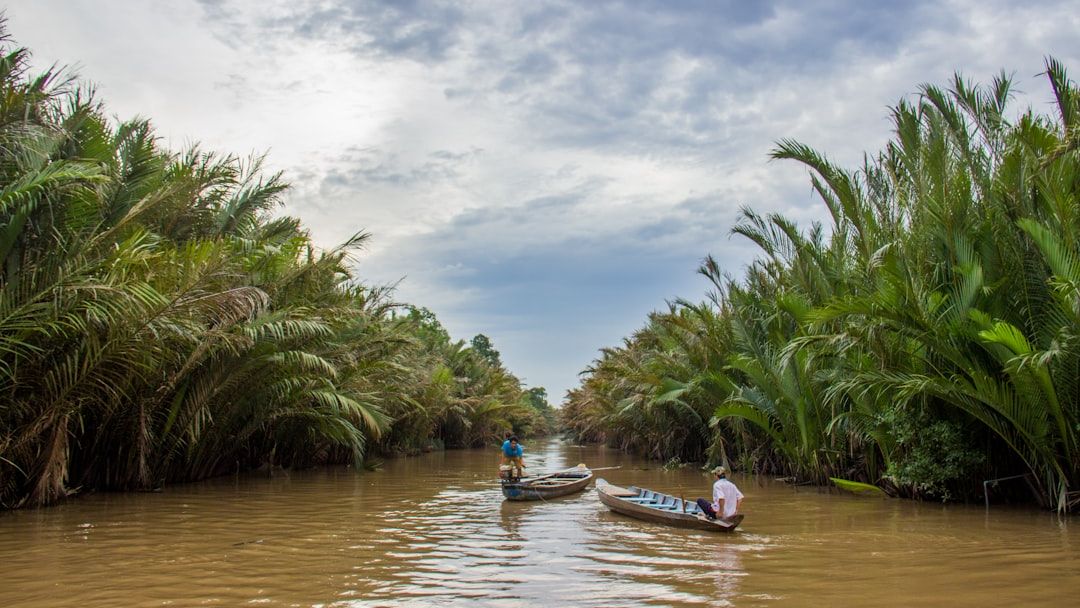
The world’s great deltas are sinking – and with them, a global food system – Image for illustrative purposes only (Image credits: Unsplash)
Cần Thơ, Vietnam – Lâm Thu Sang dreams of raising her children in the vibrant waterways of the Mekong Delta, a sprawling region that has sustained generations. Yet rising threats from depleted sediments and sinking land challenge that vision for her and millions of others. The delta, often compared in scale to the Netherlands, now grapples with environmental shifts that could reshape lives and global agriculture.
Declining Sediments Starve the Delta
The Mekong River once carried about 160 million metric tons of sediment each year along its 4,300-kilometer course through six Asian countries. This vital material built and replenished the 40,000-square-kilometer delta, creating fertile lands from Phnom Penh in Cambodia to Vietnam’s South China Sea coast. By 2024, however, annual deposition had dropped by 70 percent, leaving the ecosystem deprived of its foundational nourishment.
Residents like Sang, who helps lead the Anh Duong Community Development and Support Center in Cần Thơ – a city of more than two million near the river’s mouth – have witnessed these changes firsthand. The center focuses on poverty alleviation in remote delta areas, where shifting conditions exacerbate hardships. Without sufficient sediment, the land loses its natural buffer against erosion and intrusion from the sea.
Land Subsidence Compounds the Danger
Beyond sediment loss, the Mekong Delta suffers from land subsidence, where the ground itself sinks due to various human and natural pressures. This phenomenon, combined with ongoing sea level rise, amplifies vulnerabilities across the low-lying expanse. Floods, once a predictable part of the annual cycle, now linger longer and strike with greater intensity, disrupting farming and daily life.
Sang noted that community members increasingly feel the weight of these alterations. The delta’s intricate network of waterways, once a lifeline for rice paddies and fisheries, faces encroachment from saltwater. Such changes force families to adapt quickly, often at great cost to their stability and traditions.
Human Lives on the Front Lines
For Sang and her neighbors, the stakes extend far beyond environmental metrics. The delta supports dense populations reliant on its productivity for survival. As an NGO worker, she confronts poverty intensified by these ecological pressures, striving to build resilience in isolated communities.
“I would like for me and my children to live here forever,” Sang expressed, capturing a widespread sentiment amid uncertainty. Her efforts through the Anh Duong center highlight grassroots responses, yet broader systemic challenges persist. Families face decisions about relocation or intensified farming risks as the land transforms beneath them.
Global Ripples from a Regional Crisis
The Mekong Delta ranks among the world’s great river deltas, playing a pivotal role in feeding the planet. Its fertile soils produce vast quantities of rice and other crops, contributing significantly to international food supplies. A decline here reverberates through supply chains, potentially straining markets far beyond Asia.
Key factors driving the sediment reduction include upstream dams and altered river flows across the basin, which spans roughly 800,000 square kilometers. While local adaptations offer some hope, the convergence of subsidence, sea rise, and sediment scarcity demands coordinated action. Communities like Sang’s bear the immediate brunt, underscoring the human cost of these planetary shifts.
- Sediment delivery down 70 percent since historical levels.
- Delta area equivalent to the Netherlands, home to millions.
- Floods growing more severe and prolonged annually.
- Threats from subsidence and sea level rise accelerating.
As the delta continues to evolve under these pressures, the fate of places like Cần Thơ hangs in the balance. For residents holding onto their roots, the question remains whether interventions can restore equilibrium – or if displacement becomes inevitable for future generations.

As a little kid, I fell in love with nature, wildlife, and animals. Living in the USA, South Africa, Italy, China and Germany gave me the opportunity to discover the world's Wildlife. My favorite animals are Mountain Gorillas, Siberian Tigers, and Great White Sharks.
I'm a certified PADI Open Water Diver, went to Everest Base Camp and Trekked Gorillas in Uganda. I hold a Master of Science in Economics and Finance.
Please send any feedback to feedback@animalsaroundtheglobe.com
- The Best Ways to Introduce New Fish to an Existing Aquarium - July 30, 2026
- 10 Creatures With the Strongest Jaws on Earth - July 30, 2026
- 14 Animals Endangered in the U.S. And Whats Being Done - July 30, 2026