

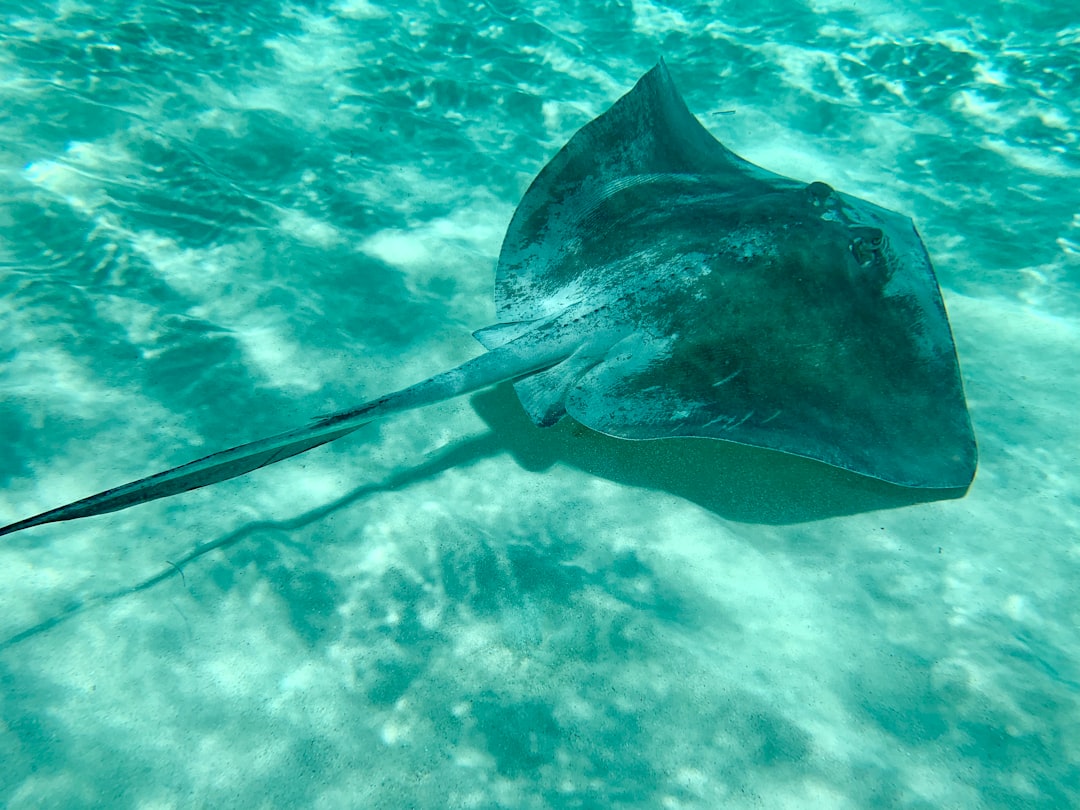
Powerful Rays Evade Traditional Trackers (Image Credits: Unsplash)
Researchers have overcome decades of tagging obstacles to capture unprecedented details on the lives of whitespotted eagle rays, powerful predators that crush shells for food in tropical waters.[1][2]
Powerful Rays Evade Traditional Trackers
Whitespotted eagle rays glide through coastal lagoons and reefs, their broad wings spanning over two meters and bodies weighing hundreds of kilograms. These durophagous hunters target hard-shelled clams and conch, yet scientists struggled to monitor them. Unlike sharks or whales with fins for easy attachment, stingrays feature ultra-smooth skin and flattened forms that slip free from devices in turbulent currents.[1]
Previous biologging efforts succeeded on dolphins and large sharks. Stingrays proved different. Their speed and power in high-energy environments dislodged tags within minutes. This gap left critical questions unanswered about their migrations, feeding, and role in marine ecosystems.[2]
Innovative Design Secures Long-Term Data
A team led by Ph.D. student Cecilia M. Hampton and senior researcher Matt Ajemian at Florida Atlantic University’s Harbor Branch Oceanographic Institute engineered a compact multisensor tag. Measuring 24 by 8 by 5 centimeters and weighing 430 grams in air, the buoyant device deploys in under 10 seconds. Silicone suction cups grip the dorsal surface, reinforced by soft straps looped through the spiracles – small gill openings behind the eyes – with timed galvanic releases.[1][2]
Field tests in Bermuda yielded retention times up to 59 hours, far exceeding prior records for pelagic rays. Captive trials confirmed the strap’s value, boosting averages from 6 to nearly 20 hours. The package integrates essential tools:
- Inertial motion unit for acceleration, gyroscope, and magnetometer data at 50 Hz.
- Video camera recording at 1080p and 30 frames per second.
- Broadband hydrophone capturing sounds up to 22 kHz.
- Satellite and acoustic transmitters for location tracking.
Such synchronization captures full behavioral sequences.[3]
Foraging Secrets Emerge from Depths
Deployments revealed 16 feeding bouts in one three-hour window. Rays descended to sand or macroalgal beds, browsed with their rostrum, dug for prey, then ascended to crush shells. Hydrophone recordings pinpointed fracture acoustics, while motion data showed pitching surges unique to predation.[2]
Machine learning models classified actions with high accuracy: swimming at nearly 100 percent, browsing at 84 percent. Video validated low-light events, exposing habitats from reefs to silt bottoms at depths to 22 meters. “We’re now able to observe not just where these rays go, but how they feed,” Ajemian noted.[1]
Path Forward for Endangered Species
Whitespotted eagle rays face growing threats, listed as endangered due to overfishing and habitat loss. These insights map their ecological niche and responses to change. Simplified tags could enable longer studies, turning rays into sentinels for ocean health.
Hampton emphasized the shift: “We’ve shown complex behaviors like clam-crunching can be identified using sound and movement alone.” Future adaptations may suit other rays, enhancing food web protections.[1]
Key Takeaways
- Spiracle straps extend tag retention to record highs, enabling rich datasets.
- Multimodal sensors decode feeding from motion, sound, and video.
- Tools promise better conservation for vulnerable marine predators.
This tagging triumph opens doors to deeper marine understanding. What behaviors surprise you most in these ocean giants? Tell us in the comments.

- Urban Coyotes Show Remarkable Adaptability, Learning to Thrive in City Environments - July 22, 2026
- Beavers Are Nature’s Engineers, Creating Vital Habitats for Other Wildlife Species - July 21, 2026
- The Recovery of the California Condor Offers Hope for Other Critically Endangered Birds - July 21, 2026