

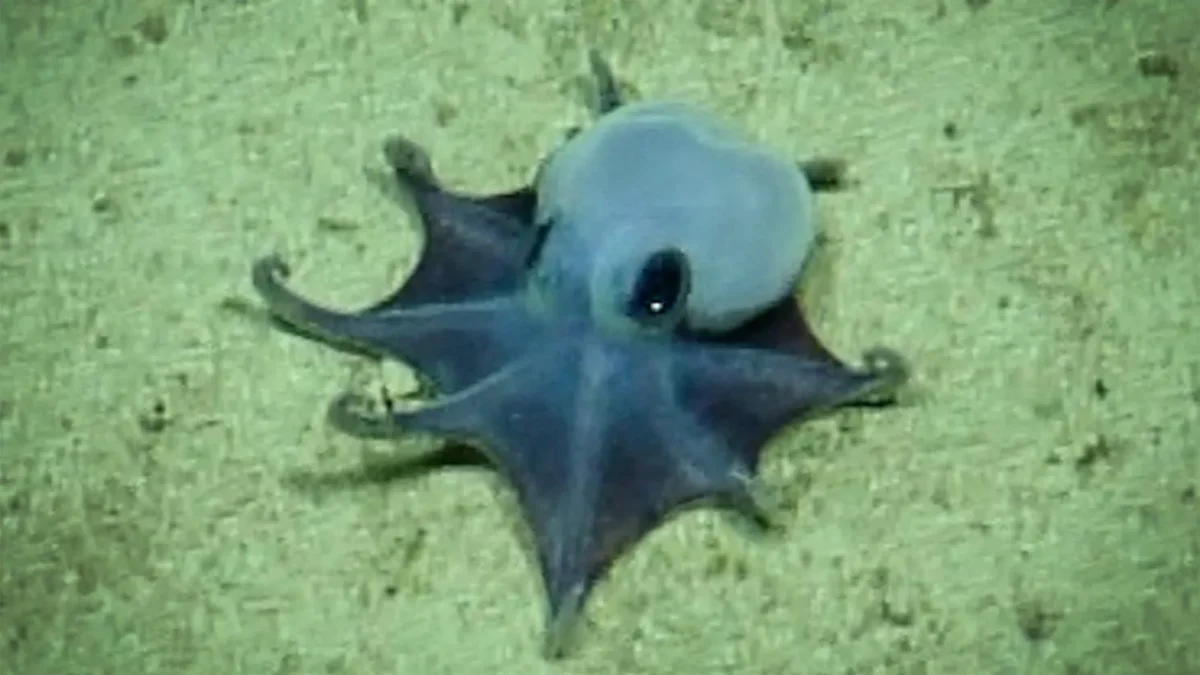
Galápagos waters yielded an unexpected discovery during a recent deep-sea expedition. Researchers captured footage of a tiny blue octopus, roughly the size of a golf ball, moving across the seafloor near an underwater mountain at nearly 6,000 feet. The creature has now been formally recognized as a species new to science.
The Deep-Sea Encounter
The octopus appeared suddenly on camera as the expedition team surveyed the remote area. Its small size and distinctive blue coloring stood out against the dark ocean floor. Such sightings remain rare because few expeditions reach these depths with the right equipment.
Expedition members watched the animal crawl steadily across the sediment. The location, close to an underwater mountain, offered a glimpse into habitats that stay largely unexplored. Conditions at that depth include near-freezing temperatures and crushing pressure.
Recognition as a Distinct Species
After reviewing the footage and any collected details, scientists determined the octopus did not match known species. Its combination of size, color, and behavior pointed to something previously undocumented. Formal identification required careful comparison with existing records of octopuses from the region.
The process highlights how even brief camera observations can lead to new classifications. Deep-sea environments continue to produce surprises because access remains limited. Further study will likely focus on whether additional individuals exist in similar settings.
Broader Context for Marine Research
Discoveries like this one underscore the vast gaps in knowledge about ocean life below 1,000 feet. The Galápagos region already supports high biodiversity, yet its deepest zones receive far less attention than shallower waters. Each new species adds to the picture of how life adapts to extreme conditions.
Researchers note that continued expeditions could reveal more about the octopus’s role in the ecosystem. Questions remain about its diet, reproduction, and range. These details matter for understanding food webs in the deep ocean and for guiding future conservation efforts in protected areas.
Advances in remotely operated vehicles and imaging technology make such finds more feasible than in past decades. Still, the full extent of deep-sea diversity stays unknown. Ongoing work in the Galápagos and elsewhere will help fill those gaps over time.

As a little kid, I fell in love with nature, wildlife, and animals. Living in the USA, South Africa, Italy, China and Germany gave me the opportunity to discover the world's Wildlife. My favorite animals are Mountain Gorillas, Siberian Tigers, and Great White Sharks.
I'm a certified PADI Open Water Diver, went to Everest Base Camp and Trekked Gorillas in Uganda. I hold a Master of Science in Economics and Finance.
Please send any feedback to feedback@animalsaroundtheglobe.com
- 10 Things That Calm Cats And 4 That Make Them Nervous - July 21, 2026
- The Most Colossal Whale Ever Spotted Off Alaska - July 21, 2026
- 15 PowerfulAnimals Where Females Rule the Male - July 21, 2026