

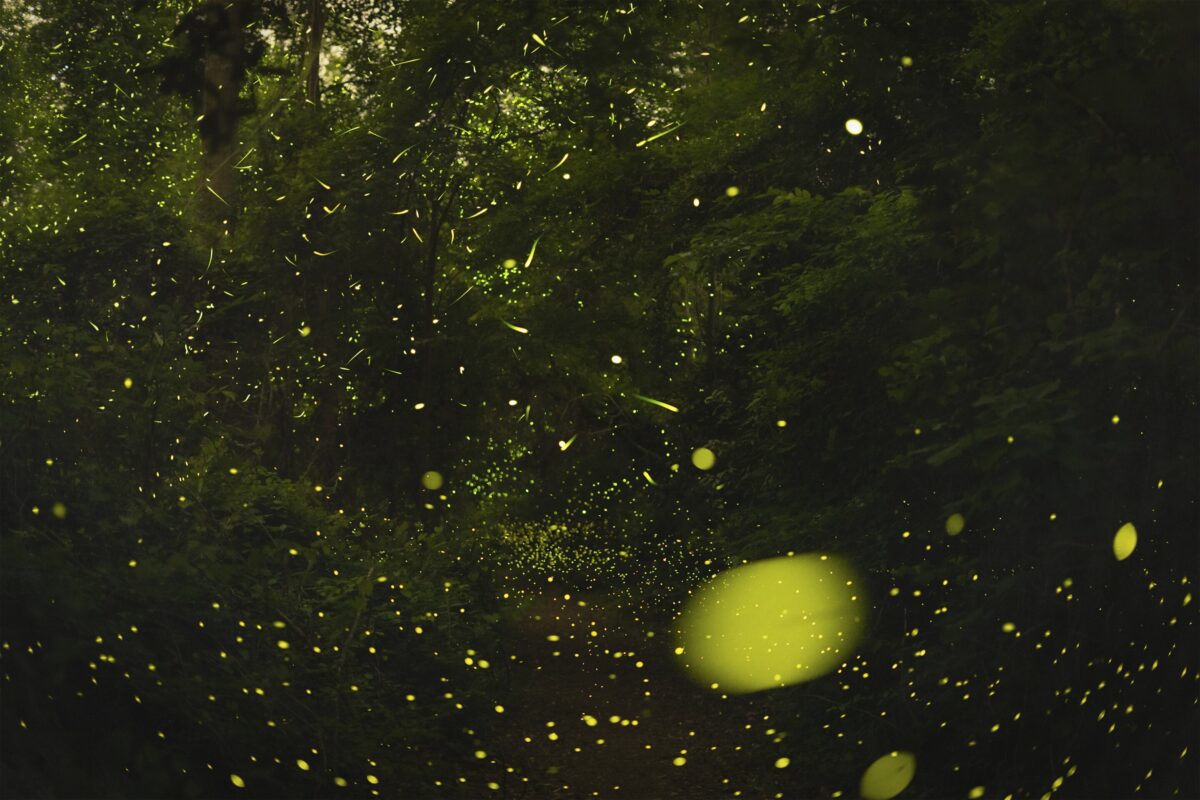
Long-exposure Photo of a Firefly Swarm in Congaree (Image Credits: Nolan Bonnie)
Deep inside the ancient floodplain forests of the southeastern United States, nature stages one of its most mesmerizing nighttime spectacles. Each spring, thousands of fireflies illuminate the dark wetlands in rhythmic pulses of light, creating a glowing display that appears almost choreographed.
For decades, scientists and visitors alike have wondered how these tiny insects manage to flash in near-perfect synchrony. Now, researchers studying a swamp ecosystem in Congaree National Park in South Carolina have uncovered new insights into the mathematical rules guiding this luminous coordination. The findings may help scientists understand not only firefly behavior but also broader forms of biological synchronization seen in systems ranging from neurons in the brain to coordinated robotic swarms.
A Swamp That Lights Up Every Spring
Every May, visitors to Congaree National Park witness a rare natural phenomenon. Thousands of male fireflies belonging to the species Photuris frontalis flash their bioluminescent signals at the same moment, producing waves of light across the swamp’s old-growth forest floor.
Unlike random flickering seen in many firefly species, this display follows a remarkably consistent pattern. The insects blink in synchronized bursts that ripple through the forest canopy, creating a visual rhythm that appears almost orchestrated.
Scientists have long suspected that this synchronization is tied to mating behavior, helping males attract females more efficiently. But exactly how thousands of insects coordinate their flashes without a central controller has remained a mystery.
Searching for the Rules of Synchrony
To uncover the mechanism behind this glowing phenomenon, researchers from University of Colorado Boulder conducted field observations and mathematical modeling in the swamp. Their goal was to determine whether fireflies rely on simple behavioral rules to coordinate their flashing patterns. By studying how individual insects react to nearby flashes, the team aimed to reveal how complex group behavior emerges from basic interactions.
The scientists discovered that synchronization does not require sophisticated communication. Instead, each firefly adjusts the timing of its flashes slightly when it sees nearby lights—gradually bringing the entire group into alignment.
Tiny Insects Following Mathematical Patterns
When researchers analyzed the flashing sequences, they found that the insects’ behavior closely matched mathematical models used to describe synchronization in physics and biology. Each firefly functions like a tiny biological oscillator—an organism that emits repeated signals at a certain interval. When many oscillators interact, they can gradually lock into a shared rhythm.
This principle is widely known in science and appears in surprising places. Similar synchronization patterns occur in electrical circuits, in groups of metronomes placed on the same surface, and even in populations of cells within living organisms.
A Natural Example of Collective Intelligence
The fireflies of Congaree National Park demonstrate how simple organisms can create highly organized group behavior without centralized control. Each insect follows straightforward rules: observe nearby flashes and slightly adjust its own timing. Yet when thousands of individuals do this simultaneously, the result is a spectacularly coordinated display.
This type of behavior is often described as emergent intelligence, where complex patterns arise from the interactions of many simple agents. Understanding such systems is important because they offer clues about how collective behavior evolves in nature.
Lessons for Technology and Robotics
The study’s implications extend far beyond entomology. Engineers studying swarm robotics are particularly interested in the fireflies’ ability to coordinate without centralized communication. Robotic swarms—groups of machines that work together autonomously—could benefit from similar synchronization rules. Instead of relying on complex control systems, robots might use simple interaction signals to align their movements.
Researchers believe that mimicking firefly synchronization could help design robotic fleets for tasks such as environmental monitoring, disaster response, or space exploration.
Biological Synchrony Beyond Fireflies
The patterns observed in these swamp insects also mirror processes found throughout biology. In the human brain, neurons often fire in synchronized bursts during certain types of neural activity. Similarly, many cells in the body coordinate their internal clocks to maintain circadian rhythms—the biological cycles that regulate sleep and metabolism.
The same mathematical principles appear to govern all these systems, suggesting that synchronization is a fundamental property of complex living networks. The fireflies’ light show therefore provides a living laboratory for studying how nature organizes collective timing.
Protecting the Habitat That Makes It Possible
While the spectacle attracts growing numbers of visitors each year, scientists emphasize the importance of preserving the fragile ecosystem where it occurs. Wetland habitats like Congaree National Park provide ideal conditions for firefly populations, including dense vegetation, stable moisture levels, and minimal artificial light.
Excessive light pollution, habitat loss, and climate change could disrupt the delicate environmental cues that allow fireflies to coordinate their flashing displays. Protecting these ecosystems ensures that both the insects and their remarkable natural phenomenon continue to thrive.
Conclusion: A Light Show That Reveals Nature’s Hidden Order
At first glance, the synchronized glow of thousands of fireflies in a swamp might seem like pure magic. But science reveals that the spectacle emerges from something even more fascinating—the universal mathematics of collective behavior.
The discovery that simple insects can follow basic rules to create such intricate coordination reminds us that complexity in nature often arises from humble beginnings. The fireflies do not plan their performance, yet together they create one of the most breathtaking biological displays on Earth.
Perhaps the most powerful lesson is this: nature’s greatest secrets are often hidden in plain sight. Sometimes, all it takes is a quiet swamp, a summer night, and the curiosity to ask why the lights blink in perfect harmony.

- Urban Coyotes Show Remarkable Adaptability, Learning to Thrive in City Environments - July 22, 2026
- Beavers Are Nature’s Engineers, Creating Vital Habitats for Other Wildlife Species - July 21, 2026
- The Recovery of the California Condor Offers Hope for Other Critically Endangered Birds - July 21, 2026