
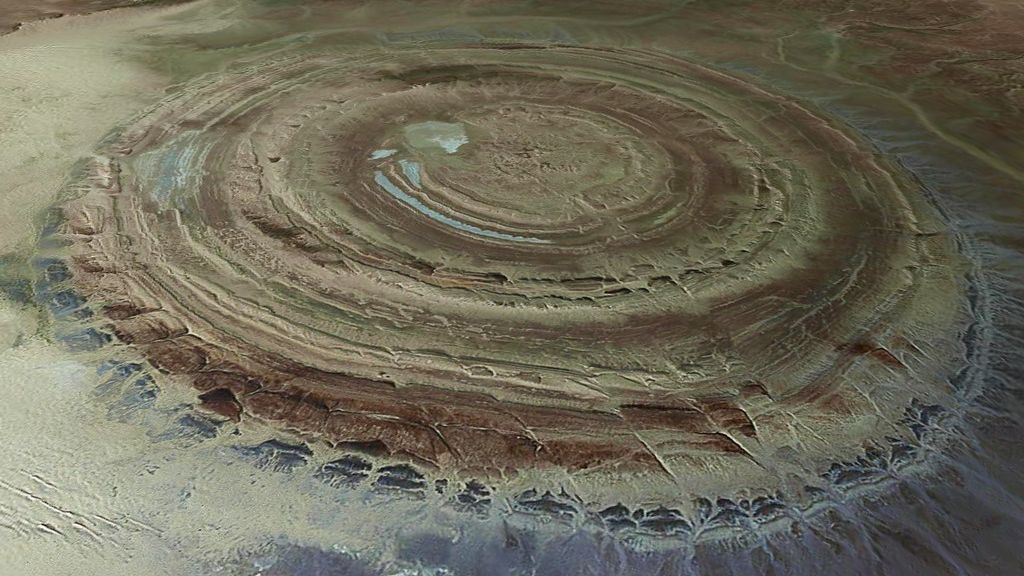
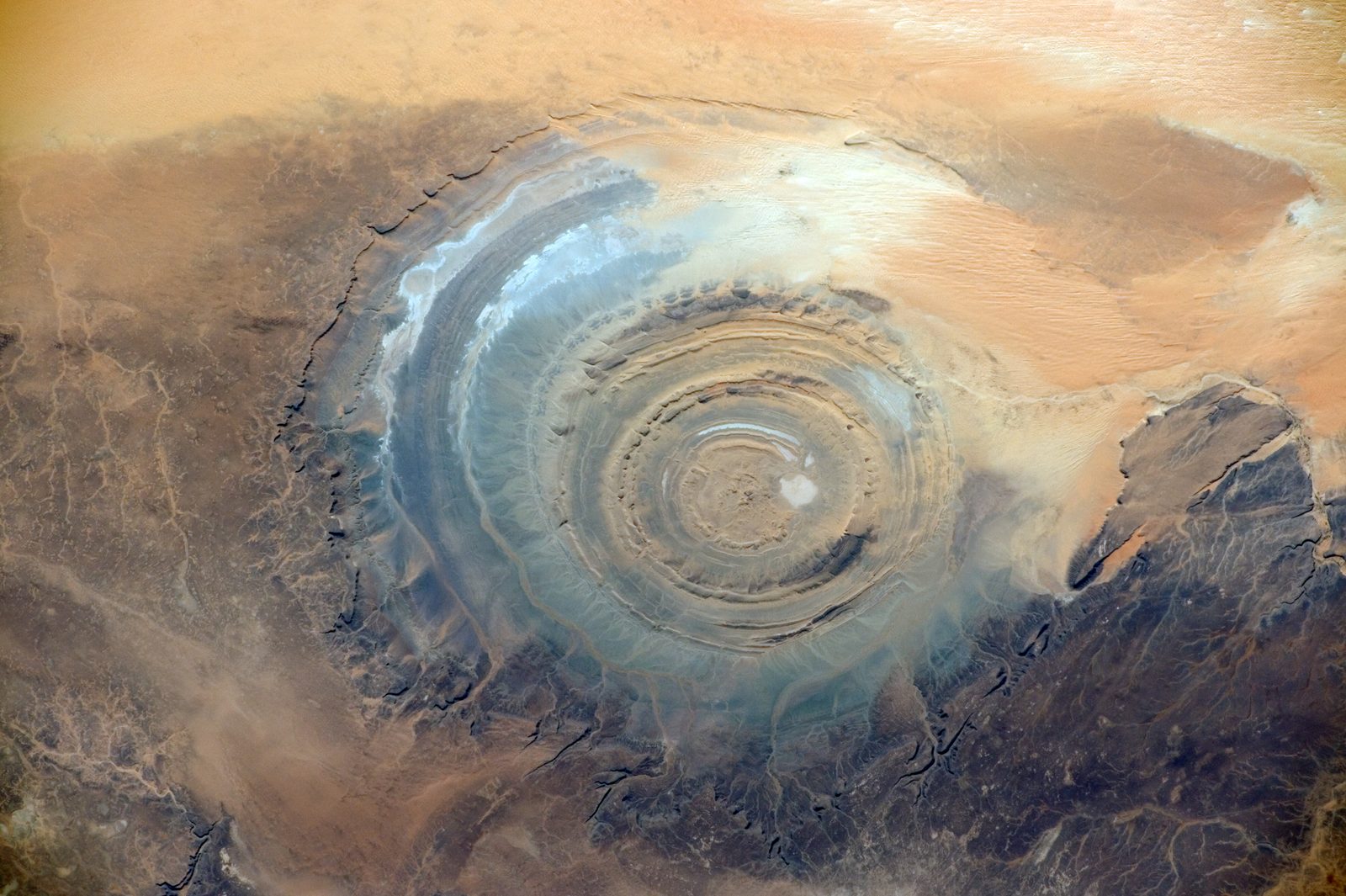
There’s a place in the Sahara so strange, so perfectly circular, that astronauts use it as a landmark when they’re orbiting Earth. Imagine floating hundreds of miles above our planet and spotting a massive bullseye in the middle of an endless desert. It looks almost unnatural, like something deliberately carved by an ancient civilization or blasted into the landscape by a cosmic collision. Yet this stunning formation is entirely the work of nature, shaped by forces deep within the Earth over unimaginable stretches of time.
The structure measures 40 kilometers in diameter, making it highly visible even from high above Earth. Standing on the ground, you might walk right through it without realizing its existence. The rings are so broad and subtle that their perfect symmetry only reveals itself from the air or space. Let’s dive into the fascinating story of this desert enigma that has puzzled scientists and captured imaginations for decades.
A Beacon in the Desert for Space Travelers
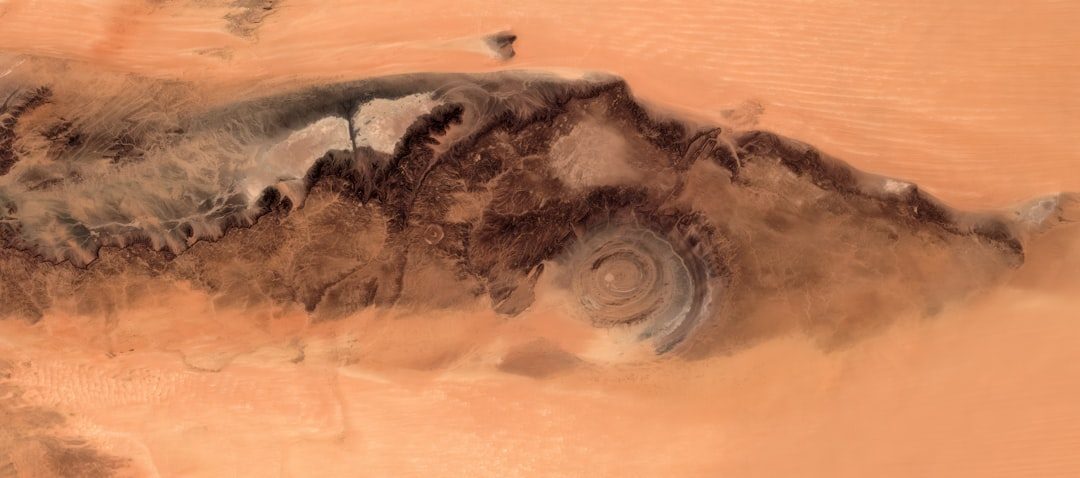
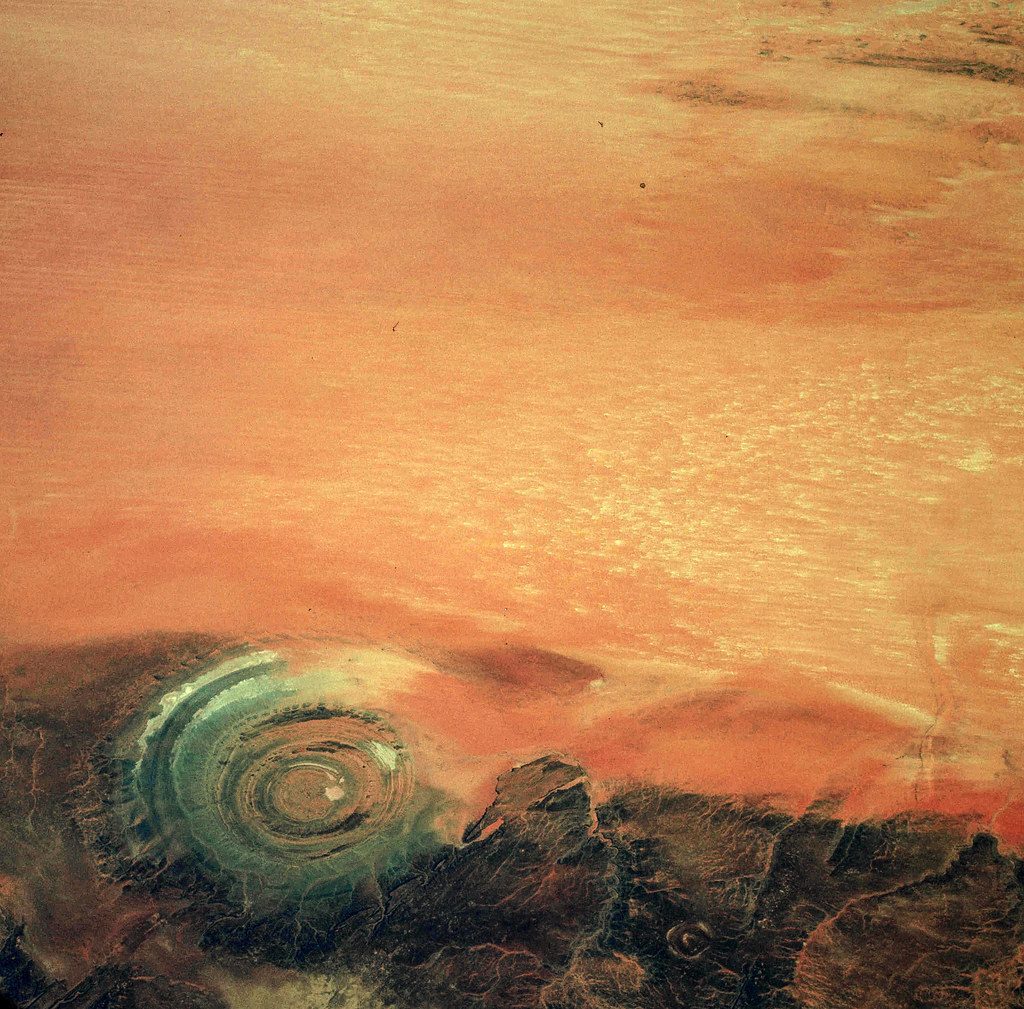
The first people to see this geological wonder were James McDivitt and Edward White, astronauts of the Gemini 4 mission, in 1965. Flying over the featureless expanse of the Sahara, they spotted something extraordinary. A perfect circle of concentric rings, visible only from their orbital vantage point, stood out like a target painted on the desert floor.
Astronauts aboard the International Space Station often use it as a landmark to navigate. Let’s be real, when you’re hurtling through space at thousands of miles per hour, you need reference points. The Richat Structure has been a familiar landmark for astronauts since the earliest manned missions. Its distinctive appearance makes it one of the most recognizable features on Earth when viewed from orbit.
The Meteor Myth That Wasn’t
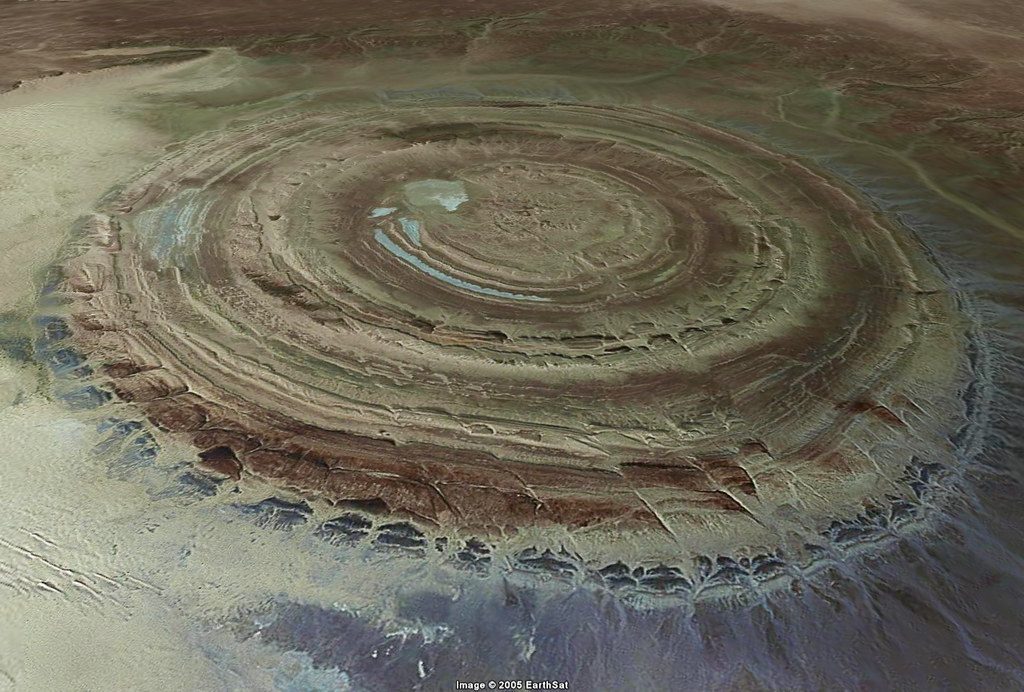
Initially, scientists were convinced they were looking at an impact crater. Experts initially thought the Eye of the Sahara to be an enormous impact crater. Honestly, who could blame them? The near-perfect circular shape seemed to scream extraterrestrial impact.
Here’s the thing, though: when geologists actually studied the rocks, something didn’t add up. No traces of shocked quartz, melted rock, or impact debris were ever found. These are telltale signatures that always appear at genuine meteor impact sites. The rocks here showed none of that violence. Studies concluded it was not an impact structure, but rather the result of ring faults which led to gabbroic ring dikes over a large intrusive body of magma, and the uplifting and later erosion of a dome.
Birth of a Dome: When Earth Pushed Upward
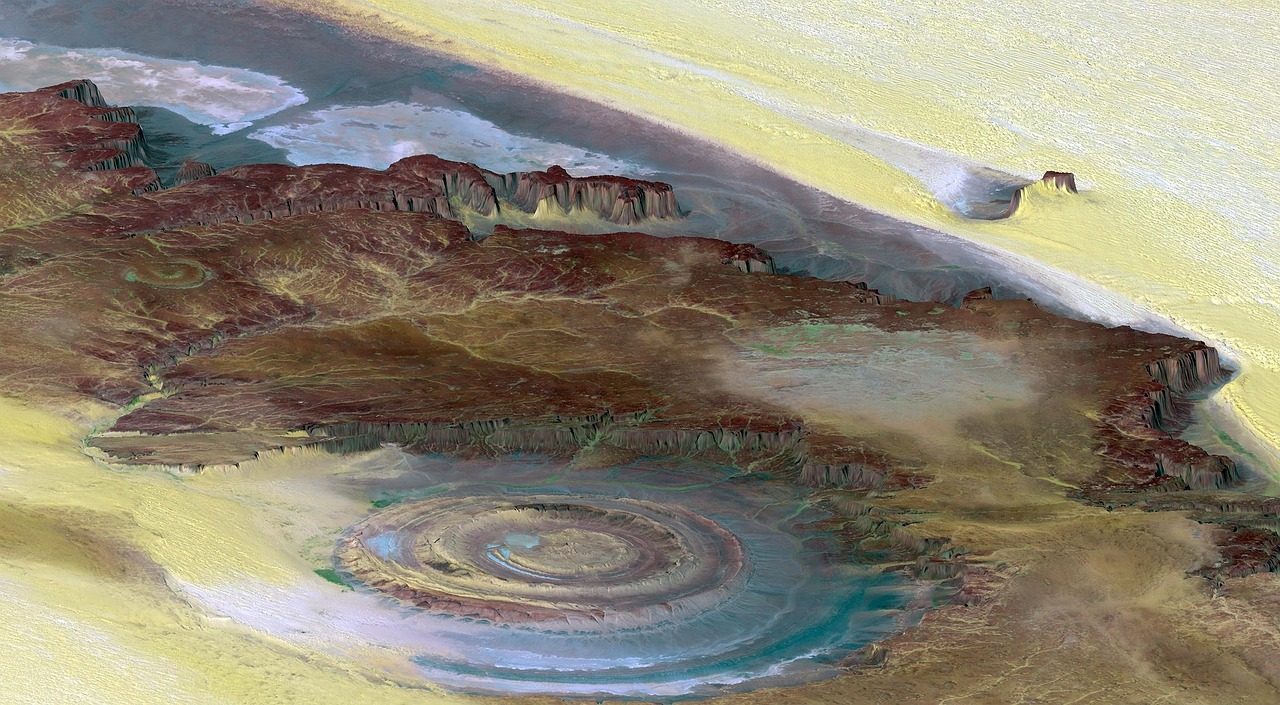
So what really created this mesmerizing formation? The answer lies deep underground, stretching back roughly one hundred million years. Nearly 100 million years ago, during the breakup of the supercontinent Pangaea, magma from deep within the Earth pushed upward, forcing layers of sedimentary rock into a massive dome. Think of it like a bubble slowly rising through thick syrup, warping everything above it.
Unlike a volcano, this magma never erupted. It just sat there beneath the surface, creating immense pressure that bulged the overlying rock layers upward into a dome shape. The hydrothermal alteration, which created breccia within the structure, has been dated to have occurred about 98 million years ago.
The center of this dome contains ancient rocks. The sedimentary rock exposed ranges in age from Late Proterozoic within the center to Ordovician sandstone around its edges. We’re talking about geological time capsules spanning hundreds of millions of years, all exposed in one spectacular cross-section.
Sculpted by Wind and Water Over Millennia
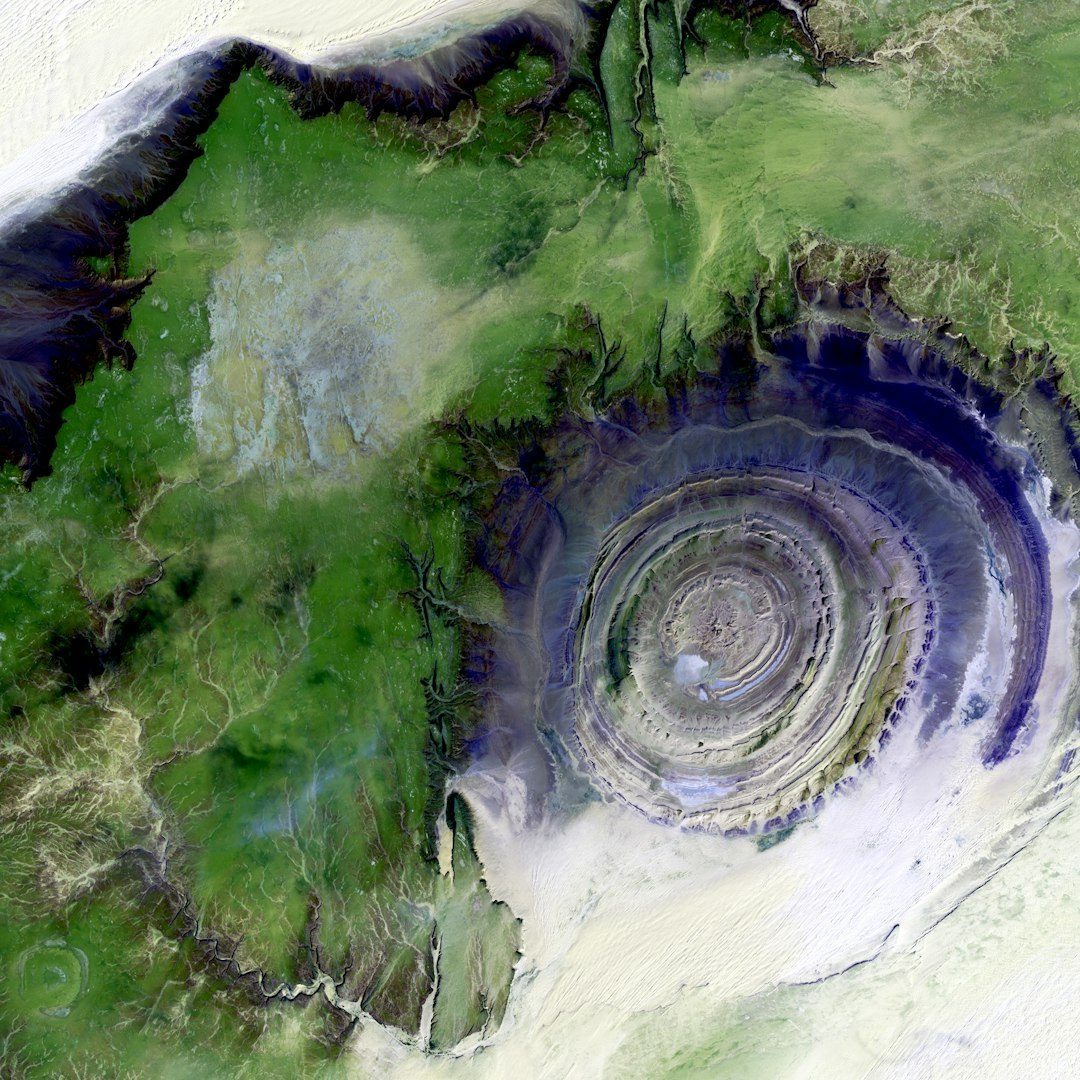
Creating the dome was only half the story. Over time, wind and water erosion stripped away the softer layers, leaving behind the harder rocks in concentric rings, with alternating layers of limestone, quartzite, and sandstone eroding at different speeds. I think this is where it gets really interesting.
Differential erosion rates between the softer and more resistant layers contributed to the striking appearance of the formation today. Imagine millions of years of Saharan winds scouring the surface, with ancient rivers carving through the rock. The circular ridges of the Richat Structure have helped scientists study both wet and dry periods in the area’s history. Hard to believe now, but this bone-dry desert was once much wetter.
The harder igneous rocks resisted erosion better, forming the elevated ridges we see today. The softer sedimentary layers wore away faster, creating the valleys between them. This natural sorting process produced the Eye’s distinctive concentric pattern.
The Atlantis Connection That Refuses to Die
There’s something about perfectly circular ancient structures that makes people think of lost civilizations. One theory suggested it was the site of the lost city of Atlantis. Some enthusiasts argue that the structure’s concentric rings match Plato’s description of Atlantis almost too perfectly to be coincidence.
Some have claimed it could be the lost city of Atlantis described by Plato, pointing to the Eye’s shape, its proximity to ancient riverbeds, and geological evidence of past flooding. The idea has a certain romantic appeal. Although this theory has gained considerable popularity in recent years, scientists and historians have widely rejected it.
Scientific evidence strongly debunks this notion, as the formation is entirely natural, with no signs of human-made structures or artificial design. Still, the myth persists, drawing curious travelers who want to believe there’s more to this Eye than meets, well, the eye. What’s the harm in a little mystery?
A Living Laboratory for Earth Sciences
In October 2022, the International Union of Geological Sciences included the Richat Structure in its assemblage of 100 geological heritage sites around the world, calling it “a spectacular example of a magmatic concentric alkaline complex.” That’s quite an honor in the geology world.
It provides valuable insights into Earth’s geological processes, including the effects of tectonic forces, erosion and magmatic activity, while the presence of sedimentary layers has yielded evidence of past environments and possibly even early human activity. Acheulean archaeological sites are located along wadis that occupy the outermost annular depression, with these sites associated with rubbly outcrops of quartzite that provided the raw material needed for the manufacture of artifacts.
Ancient humans clearly recognized the geological uniqueness of this place. They came here to collect stone for their tools, though they didn’t build cities here. The Richat Structure stands as both a masterpiece of geology and a window into Earth’s deep past, offering scientists a rare glimpse into processes normally hidden far underground.
Conclusion
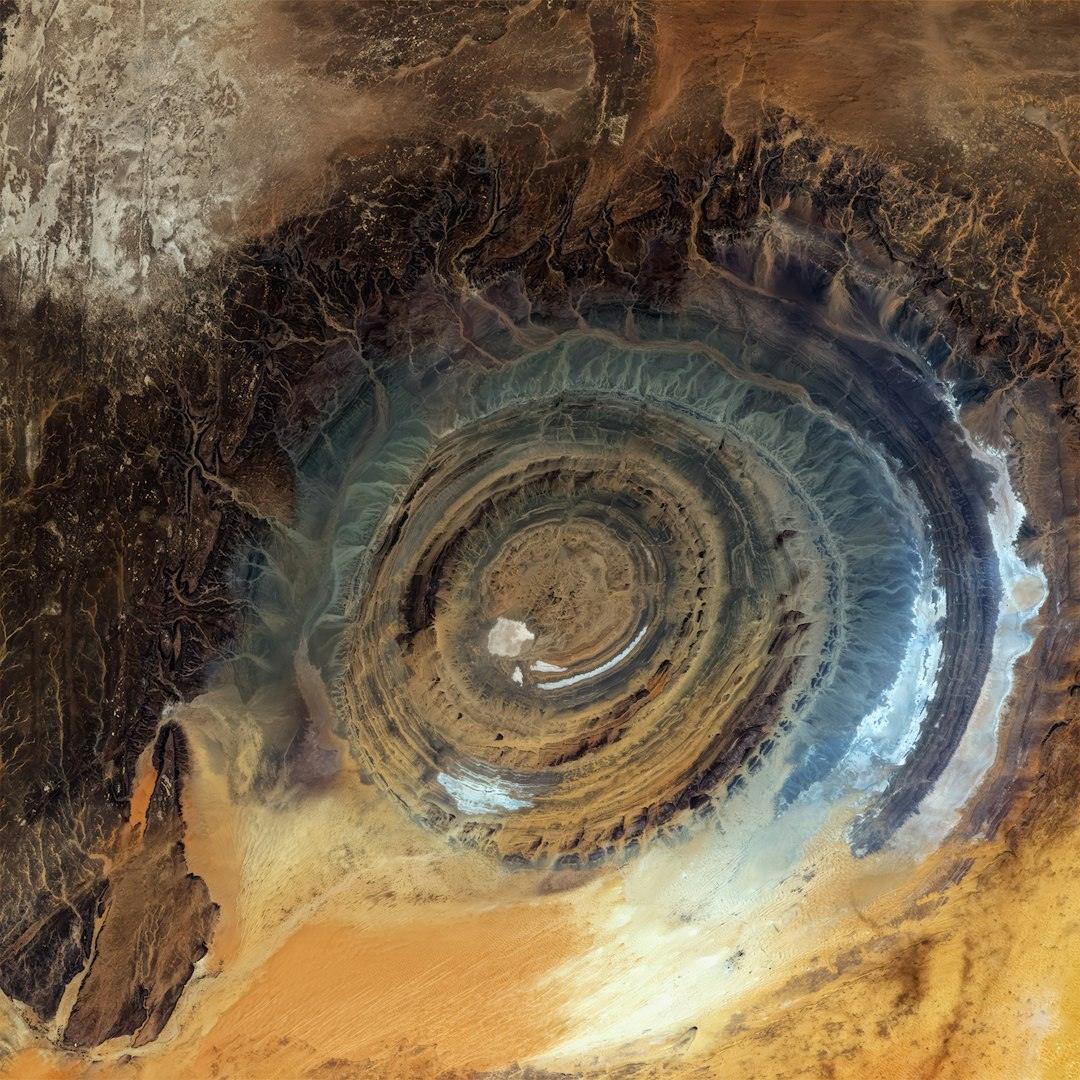
The Sahara’s Eye remains one of Earth’s most captivating natural wonders, visible from space yet nearly invisible from the ground. Born from the violent breakup of supercontinents and sculpted by millions of years of patient erosion, it tells a story far more remarkable than any fictional lost city. This geological marvel reminds us that our planet is constantly reshaping itself, revealing secrets that have been hidden for hundreds of millions of years.
Whether you’re an astronaut using it as a navigational landmark, a geologist studying Earth’s ancient processes, or simply someone who appreciates nature’s artistry, the Richat Structure commands respect and wonder. What do you think would be more thrilling: seeing it from the International Space Station or standing in its center on the desert floor? Share your thoughts.
