

In the vast depths of our oceans, a tiny creature challenges our fundamental understanding of life and death. The Turritopsis dohrnii, often called the “immortal jellyfish,” possesses a remarkable ability that has captivated scientists worldwide: it can, theoretically, live forever. This isn’t science fiction or exaggeration—this small, bell-shaped organism can revert from its mature stage back to its juvenile form, essentially resetting its biological clock and beginning its lifecycle anew. As humans continue seeking ways to extend our lifespans and improve health in later years, this unassuming sea creature may hold transformative secrets that could revolutionize medicine, our understanding of aging, and perhaps even our concept of mortality itself.
The Extraordinary Biology of Turritopsis dohrnii

Measuring only about 4.5 millimeters across, the Turritopsis dohrnii appears unremarkable at first glance. Its translucent bell houses a bright red stomach visible at its center, with tentacles numbering typically between 80-90. Native to the Mediterranean Sea but now found in temperate to tropical waters worldwide, this tiny hydrozoan belongs to the same phylum (Cnidaria) as corals, sea anemones, and other jellyfish species. What distinguishes this particular jellyfish, however, is its unprecedented cellular plasticity—the ability of its cells to transform from one type into another, enabling a process called transdifferentiation that’s at the heart of its “immortality.”
The Lifecycle That Defies Death

Most jellyfish follow a linear life path: they begin as fertilized eggs, develop into free-swimming planula larvae, attach to surfaces to become polyps, bud off as medusae (the adult, bell-shaped jellyfish form), reproduce, and then die. The Turritopsis dohrnii follows this pattern—until it faces environmental stress, injury, old age, or illness. When confronted with these challenges, instead of dying, it undergoes cellular transdifferentiation. Its cells transform and reorganize, reverting the mature medusa back to the polyp stage. This process is roughly equivalent to a butterfly turning back into a caterpillar, or a human adult reverting to an embryonic state. From this reverted polyp stage, the jellyfish can then produce new, genetically identical medusae, essentially beginning its life cycle again. This process can occur repeatedly, potentially allowing the organism to escape death indefinitely.
The Discovery of Immortality

The extraordinary capabilities of Turritopsis dohrnii weren’t recognized until relatively recently. In the 1990s, Christian Sommer, a German marine biology student, collected these tiny jellyfish while studying hydrozoans in Rapallo, Italy. He placed them in petri dishes for observation but was astonished when the adult medusae appeared to be regressing into polyps instead of dying. This observation led to further scientific investigation by researchers Ferdinando Boero, Stefano Piraino, and their colleagues, who published their findings about this unique lifecycle reversal in 1996. Their groundbreaking paper in the journal Biological Bulletin documented this phenomenon of cellular transdifferentiation in detail, introducing the world to the first known animal that could potentially live forever.
The Molecular Mechanisms Behind Rejuvenation

The immortality trick of Turritopsis dohrnii lies in complex cellular and genetic mechanisms. Recent research, including a 2022 study published in the Proceedings of the National Academy of Sciences, identified specific genetic modifications that may enable this remarkable feat. Scientists compared the genome of T. dohrnii with its close mortal relative T. rubra, finding key differences in genes associated with DNA repair, replication, stem cell population maintenance, and cellular division regulation. The immortal jellyfish appears to have twice as many copies of genes that protect and repair DNA, along with unique variations in genes controlling telomere maintenance—the protective caps on chromosomes that typically shorten with age in most organisms. Additionally, the jellyfish possesses enhanced ability to silence genes associated with cellular development and maturation, effectively allowing it to restart its developmental program. This sophisticated genetic toolkit enables the remarkable cellular plasticity that underlies its life cycle reversal.
Not Truly “Immortal” – Understanding the Limitations

Despite its popular nickname, the “immortal jellyfish” isn’t actually immortal in the strict sense. While it can theoretically live indefinitely by cycling between life stages, individual Turritopsis dohrnii still face threats from predation, disease, and environmental dangers. Many are consumed by larger marine animals before they can initiate their rejuvenation process. Additionally, the reversal process itself isn’t guaranteed—it doesn’t automatically occur in response to all stressors, and laboratory studies suggest the transformation success rate varies significantly depending on environmental conditions. Furthermore, while the genetic material continues through each cycle, it’s debatable whether the resulting polyp maintains the “identity” of the original medusa. This raises philosophical questions about what constitutes the “same” organism across transformations. Nevertheless, the jellyfish’s ability to potentially sidestep natural senescence (the biological aging process) makes it unique among known animal species.
Implications for Human Aging Research

The rejuvenation capabilities of Turritopsis dohrnii have profound implications for human aging research. Scientists are particularly interested in the jellyfish’s transdifferentiation process, where specialized cells can transform into different cell types—something that occurs only in limited circumstances in humans. Understanding how these jellyfish cells maintain such flexibility might help researchers develop therapies for age-related diseases or injuries where cellular regeneration is crucial. The jellyfish’s enhanced DNA repair mechanisms and telomere maintenance strategies are also of great interest, as telomere shortening is associated with human aging and age-related diseases. While human biology is vastly more complex than that of jellyfish, these fundamental cellular processes share evolutionary similarities, making the immortal jellyfish a valuable model organism for aging research.
Challenges in Studying the Immortal Jellyfish

Researching Turritopsis dohrnii presents significant challenges that have slowed scientific progress. The jellyfish’s microscopic size makes it difficult to collect and track in the wild, and its transparency further complicates observation. Laboratory cultivation requires specialized expertise and equipment, as these jellyfish have complex life cycle requirements that are difficult to replicate in captivity. Additionally, the transformation process from medusa back to polyp occurs randomly and unpredictably, making systematic study challenging. Few research laboratories worldwide maintain continuous cultures of T. dohrnii, limiting collaborative research opportunities. Despite these obstacles, technological advances in genetic sequencing, microscopy, and cell tracking are gradually enabling more detailed investigations. The completed genome sequencing of T. dohrnii in 2022 marked a significant milestone, providing researchers with a comprehensive genetic blueprint to analyze the mechanisms behind its remarkable capabilities.
The Global Spread of an Immortal Species

Originally native to the Mediterranean Sea, Turritopsis dohrnii has now been documented in waters across the globe, from Japan to Panama, the Caribbean, and both the Atlantic and Pacific coasts of the United States. This widespread distribution is believed to be the result of transport in the ballast water of shipping vessels. The jellyfish’s unique life cycle gives it a significant advantage for invasion and establishment in new territories. When environmental conditions become unfavorable during transport, the medusae can revert to polyps, surviving conditions that would kill most other jellyfish species. Once conditions improve, these polyps can produce new medusae, effectively establishing colonies in novel environments. Marine biologists are monitoring this spread, concerned about potential ecological impacts if these biologically “immortal” organisms establish dominant populations in new ecosystems. This global expansion also provides researchers with diverse populations to study genetic variations that might exist across different geographical strains.
From Jellyfish to Medicine: Potential Applications
The medical potential of Turritopsis dohrnii extends beyond aging research into multiple therapeutic areas. Researchers are investigating applications in regenerative medicine, where understanding the jellyfish’s cellular transdifferentiation mechanisms could potentially help develop treatments for tissue damage, organ failure, and degenerative diseases. The jellyfish’s methods of silencing developmental genes during its reversal process may offer insights for cancer research, as similar gene regulation gone awry plays a role in tumor development. Neurological disease researchers are also interested in the jellyfish’s abilities, as nerve cells typically don’t regenerate effectively in humans—understanding how the jellyfish regenerates its nerve net might provide clues for treating conditions like Alzheimer’s or Parkinson’s disease. While practical applications remain years or decades away, the fundamental biological insights gained from studying this organism continue to inform multiple branches of medicine.
Ethical Considerations of “Immortality” Research

As research into the immortal jellyfish’s capabilities progresses, it raises profound ethical questions about the implications of potentially extending human lifespan dramatically. If therapies derived from this research could significantly delay aging or extend human lifespans, societies would face unprecedented challenges regarding resource allocation, population growth, economic systems designed around current life expectancies, and potential disparities in access to life-extending technologies. Additionally, there are philosophical considerations about whether dramatically extended lifespans would fundamentally alter the human experience and our perception of life’s meaning. Bioethicists emphasize that such research should proceed with careful consideration of these broader societal implications, ensuring that scientific advancement is balanced with thoughtful reflection on how such technologies might be deployed responsibly. Most researchers in the field stress that the goal isn’t literal human immortality but rather extending “healthspan”—the period of life spent in good health, free from age-related disease.
Other Biological Models of Extraordinary Longevity

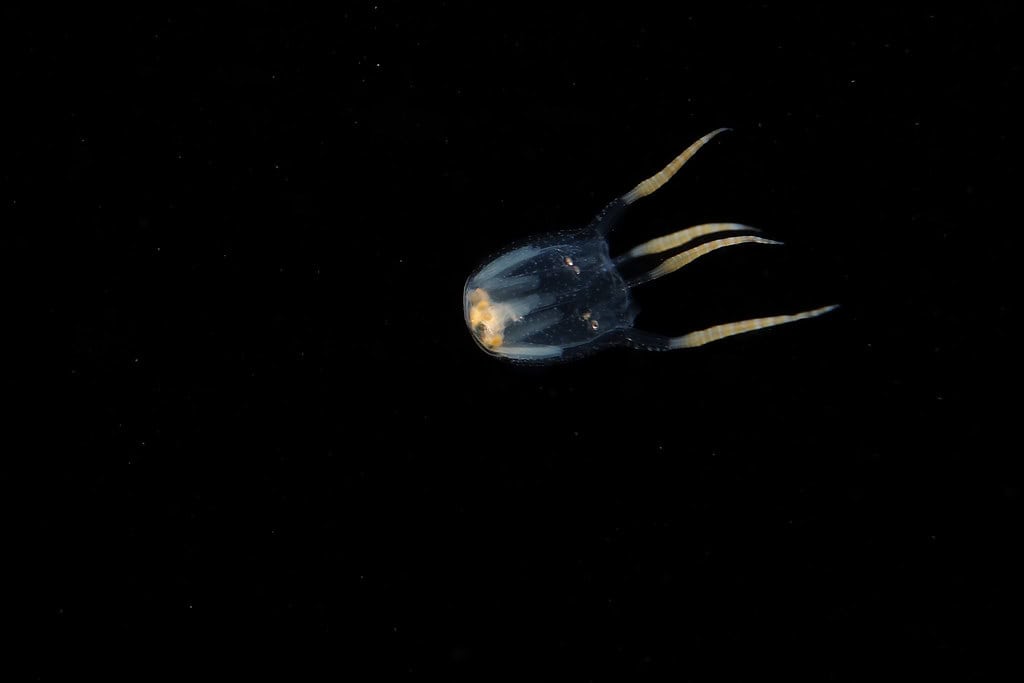
Jellyfish with black background. Image via Depositphotos.
While Turritopsis dohrnii stands alone in its ability to reverse its life cycle, other organisms exhibit remarkable longevity that researchers are studying in parallel. The hydra, another cnidarian, shows negligible senescence (biological aging) due to its continuously self-renewing stem cells. Certain species of planarian flatworms can regenerate entire bodies from tiny fragments, effectively achieving a form of biological immortality through division. Among vertebrates, the Greenland shark can live over 400 years, naked mole rats resist cancer and live up to 30 years (extraordinarily long for their size), and certain tortoise species regularly surpass 150 years of age. Each of these long-lived organisms offers unique insights into different mechanisms for combating the aging process. Comparative biology approaches that study these diverse models alongside the immortal jellyfish may yield complementary insights, potentially revealing multiple pathways to extend healthy lifespan that could be applicable to human medicine.
Future Directions in Immortal Jellyfish Research

Research on Turritopsis dohrnii is accelerating as new technologies enable deeper investigation. CRISPR gene editing technology offers possibilities for manipulating the jellyfish’s genome to test which genes are essential for its life cycle reversal. Single-cell sequencing is helping researchers track exactly how individual cells change their expression patterns during transdifferentiation. Advanced imaging techniques allow real-time visualization of cellular transformations during the rejuvenation process. Collaborative international efforts are focusing on establishing standardized laboratory populations and protocols to facilitate comparative studies. Some researchers are exploring whether the jellyfish’s remarkable properties could be expressed in simpler model organisms through genetic engineering, potentially creating more accessible research tools. As investment in aging research continues to grow globally, the immortal jellyfish is positioned to remain a central organism of interest, potentially yielding insights that could fundamentally transform our understanding of cellular aging and regeneration.
Conclusion: The Continuing Journey to Understand Biological Immortality

The Turritopsis dohrnii jellyfish stands as a biological marvel that challenges our fundamental understanding of life’s limits. Its ability to reverse its life cycle repeatedly—essentially hitting a cellular reset button when faced with adversity—represents one of the most extraordinary adaptations known in the animal kingdom. While we are still far from translating these insights into human longevity treatments, each advance in understanding this tiny creature’s genetic and cellular mechanisms brings us closer to addressing age-related diseases and potentially extending healthy human lifespans. The immortal jellyfish reminds us that nature often holds solutions to problems we’ve barely begun to formulate, waiting to be discovered through patient, persistent scientific inquiry. As research continues, this seemingly humble organism may ultimately transform our approach to some of medicine’s most challenging questions, demonstrating once again how the study of nature’s adaptations can illuminate pathways to human innovation.

- The Bird That Can Recognize More Faces Than a Human - July 29, 2026
- How Army Ants Coordinate Massive Raids Without a Leader - July 29, 2026
- 13 Largest Horses in the World - July 29, 2026