

In the vast theater of animal migration, one diminutive performer outshines all others with a journey so extraordinary it defies imagination. The Arctic Tern (Sterna paradisaea), weighing no more than a deck of cards, embarks on the longest migration of any known animal on Earth. This remarkable seabird traverses from pole to pole annually, following an endless summer and accumulating more lifetime travel distance than any other creature. As it soars above oceans and continents, this tiny avian navigator demonstrates one of nature’s most astounding feats of endurance, orientation, and evolutionary adaptation.
Meet the Arctic Tern: A Migration Champion

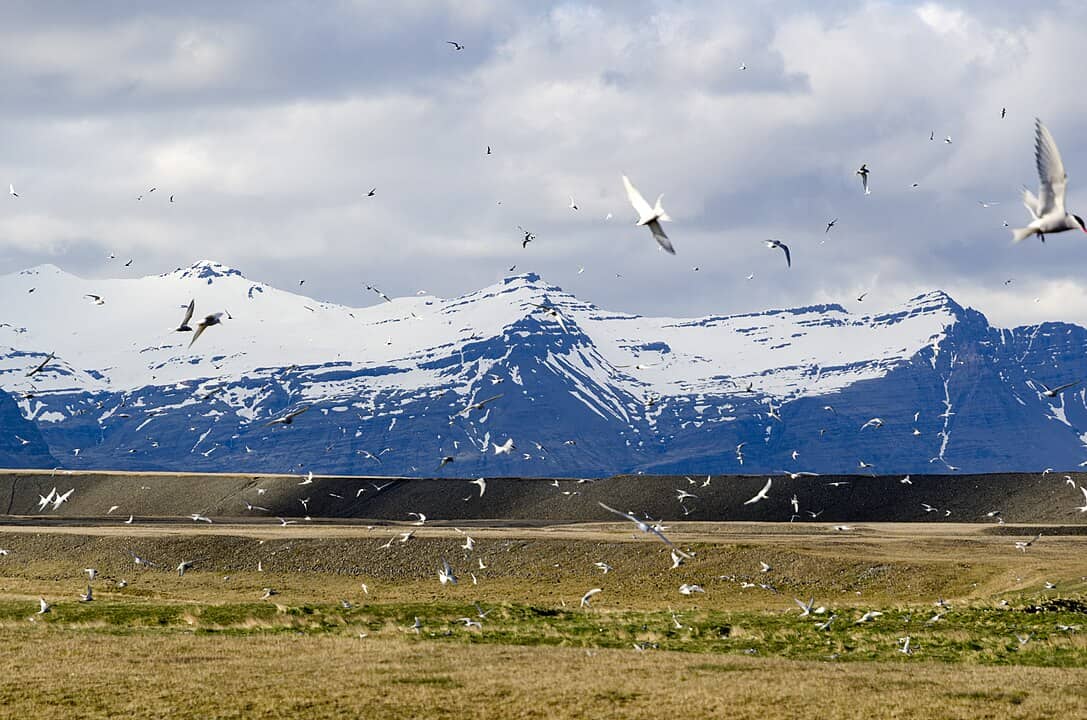
The Arctic Tern presents an unassuming appearance that belies its extraordinary capabilities. With a weight of just 100-120 grams (3.5-4.2 ounces) and a body length of 33-39 centimeters (13-15 inches), this medium-sized seabird sports a distinctive black cap, sleek gray upperparts, and white underparts. Its sharp, blood-red bill and legs provide striking contrast to its otherwise monochromatic plumage. Perhaps most remarkable are its wings—long, narrow, and perfectly adapted for sustained flight over incredible distances. These wings, spanning approximately 76-85 centimeters (30-33 inches), enable the tern to remain airborne for astounding periods as it navigates its record-breaking migratory route.
The Pole-to-Pole Journey: Breaking All Records

The Arctic Tern’s migration represents the longest known annual journey of any animal on Earth. These birds breed in the Arctic during the northern summer and then fly to the Antarctic to enjoy the southern summer, effectively experiencing more daylight than any other creature. Research using geolocators has confirmed that Arctic Terns travel approximately 70,900 kilometers (44,100 miles) annually in a roundtrip migration between their breeding and non-breeding grounds. Over a typical 30-year lifespan, an Arctic Tern might travel a cumulative distance equivalent to three round trips to the Moon—about 2.4 million kilometers (1.5 million miles). This staggering figure surpasses the lifetime travel distances of any other animal, including the great whales and other migratory birds.
Navigation Mastery: How Arctic Terns Find Their Way

How does a bird with a brain smaller than a walnut navigate with such precision across vast, featureless oceans? Arctic Terns possess a remarkable suite of navigational tools that scientists are still working to fully understand. Research suggests these birds rely on a complex, multi-sensory system. They can detect Earth’s magnetic field, likely through specialized cells containing magnetite in their beaks or eyes, providing them with an internal compass. Additionally, they utilize celestial navigation, orienting by the position of the sun and stars. Arctic Terns also appear to recognize oceanic landmarks, including distinctive smells, wave patterns, and even infrasound signals from distant land masses. This integrated navigational system allows them to return to the same breeding sites year after year with astonishing accuracy, despite traversing nearly half the globe between visits.
The S-Shaped Migration Route: A Strategic Path
Rather than flying in a direct line between the Arctic and Antarctic, Arctic Terns follow a fascinating S-shaped migration route. When leaving their northern breeding grounds in August and September, most populations initially head east across the Atlantic Ocean before turning south along the coasts of Europe and Africa. After reaching Antarctic waters, they often circle the continent in a clockwise direction before beginning their northward journey in March or April. On this return leg, many terns follow the coasts of South America and North America. This seemingly indirect route actually enables the birds to take advantage of global wind patterns, particularly the prevailing westerlies in the Southern Hemisphere and trade winds near the equator. By strategically positioning themselves within these wind systems, Arctic Terns reduce energy expenditure during their marathon migration.
The Ultimate Daylight Seekers

Arctic Terns have earned the nickname “birds of eternal light” due to their unique relationship with daylight. By migrating between the Arctic summer and Antarctic summer, these birds experience more daylight than any other creature on Earth. During their annual cycle, Arctic Terns may enjoy up to 24 hours of daylight for months at a time at both ends of their migration route, potentially experiencing more daylight in one year than most species see in two. This perpetual summer-chasing behavior enables them to take advantage of the seasonal abundance of food resources in both polar regions. The extended daylight also provides maximum foraging opportunities, which is crucial for birds that hunt visually for fish and marine invertebrates by plunge-diving from heights of up to 20 meters (65 feet) above the water’s surface.
Energy Conservation: The Secret to Long-Distance Flight

How does a bird so small accomplish such an enormous journey? Arctic Terns have evolved remarkable energy conservation strategies that make their migration possible. Unlike some migratory birds that accumulate substantial fat reserves before departure, Arctic Terns maintain relatively lean body conditions throughout their journey. They achieve this by feeding opportunistically along their route, particularly in highly productive oceanic regions where fish and krill are abundant. Furthermore, these birds are masters of dynamic soaring and gliding techniques, taking advantage of air currents to minimize wing flapping. Research indicates that Arctic Terns can enter shallow torpor states during flight, reducing their metabolic requirements. They also engage in split-sleep patterns, resting one hemisphere of their brain at a time while maintaining flight with the other hemisphere still alert—a phenomenon known as unihemispheric slow-wave sleep that allows them to rest without stopping.
Life in the Antarctic: The Non-Breeding Season

Upon reaching Antarctic waters, Arctic Terns don’t simply rest after their marathon journey. Instead, they enter a critical period of intensive feeding in one of the world’s most productive marine ecosystems. The Antarctic summer brings an explosion of phytoplankton, which attracts massive swarms of krill and small fish—perfect prey for hungry terns. During this non-breeding season, Arctic Terns spend most of their time at sea, rarely coming to land. They often follow the pack ice edge where upwelling currents concentrate their prey. This period allows the birds to replenish their energy reserves and prepare for the demanding northward migration. Unlike during the breeding season, when territorial behavior is pronounced, Antarctic-dwelling Arctic Terns often form loose feeding flocks with other seabirds, including Antarctic Terns and various petrel species, creating dynamic, multi-species hunting assemblages that more efficiently locate prey patches in the vast Southern Ocean.
Breeding in the Arctic: A Race Against Time

After completing their northward migration, Arctic Terns arrive at their breeding grounds in the circumpolar Arctic between April and June. Here, they engage in an intensive breeding season characterized by remarkable efficiency and synchronization. Males perform elaborate aerial courtship displays, carrying fish in their bills while executing precise flight maneuvers to attract females. Once paired, Arctic Terns establish territories on open ground near shorelines, constructing minimal nests that are often just shallow scrapes in the substrate. Females typically lay 1-3 camouflaged eggs, and both parents share incubation duties for approximately 21-27 days. After hatching, chicks develop rapidly, fledging within 21-28 days—an extraordinarily quick development compared to many seabirds. This accelerated breeding cycle is an adaptation to the brief Arctic summer, ensuring that young birds are sufficiently developed to begin their first southward migration by late August or early September.
Threats to the Marathon Migrator

Despite their remarkable adaptive capabilities, Arctic Terns face multiple threats across their global range. Climate change represents perhaps the most significant challenge, as warming oceans disrupt marine food webs and alter the timing and distribution of their prey species. This mismatch between tern breeding cycles and peak prey availability can reduce reproductive success. Additionally, rising sea levels threaten many low-lying coastal breeding sites. Commercial fishing operations that target the same small fish species that terns depend on can create resource competition. Pollution, particularly marine plastic debris that terns may ingest or become entangled in, poses another hazard. On their breeding grounds, increased human disturbance, predation from introduced mammals like rats and foxes, and more frequent extreme weather events all threaten nesting success. While Arctic Terns are currently classified as of “Least Concern” globally by the IUCN, some regional populations have experienced significant declines, highlighting the vulnerability of even this supremely adapted traveler.
Scientific Research: Tracking the Untraceable

Studying a species that spends most of its life over the open ocean presents enormous challenges, but technological advances have revolutionized our understanding of Arctic Tern migration. Early migration research relied primarily on bird banding, where a recovered band might provide only two data points in a tern’s complex journey. The breakthrough came with the development of miniature light-level geolocators weighing less than 1 gram, which could be attached to a tern’s leg without impeding flight. These devices record light levels, allowing researchers to calculate approximate latitude and longitude based on day length and local noon time. A landmark 2010 study led by Carsten Egevang used geolocators to reveal the full migration route of Arctic Terns for the first time, documenting their S-shaped path and record-breaking distances. More recently, even smaller GPS tags and satellite transmitters have provided increasingly precise movement data, while stable isotope analysis of feathers can reveal where terns have been feeding without requiring recapture. These technologies continue to unveil new aspects of Arctic Tern ecology, including previously unknown stopover sites that may be critical for conservation.
Cultural Significance: A Bird That Connects Continents

The Arctic Tern holds special cultural significance among many indigenous peoples of the circumpolar north, where its annual arrival has traditionally signaled the return of spring and the seasonal renewal of resources. In Inuit traditions, the Arctic Tern (known as “imaqtaġutilik” in Inupiaq) features in various stories and is admired for its fighting spirit and determination. The bird’s remarkable migration has also captured the imagination of poets, writers, and artists worldwide, becoming a powerful symbol of freedom, perseverance, and the interconnectedness of Earth’s ecosystems. In scientific and conservation circles, the Arctic Tern serves as an important bioindicator species—its breeding success and population trends providing valuable insights into the health of both polar and oceanic environments. The bird’s pole-to-pole journey physically connects distant ecosystems and reminds us that effective conservation requires international cooperation across political boundaries, as the fate of this tiny traveler depends on habitat protection at opposite ends of the Earth and everywhere in between.
The Evolutionary Puzzle: Why Such an Extreme Migration?

The evolution of the Arctic Tern’s extraordinary migration pattern presents a fascinating evolutionary puzzle. Scientists believe this extreme behavior developed gradually over thousands of years in response to several selective pressures. The most compelling explanation involves maximizing access to resources while minimizing competition. By breeding in the Arctic, Arctic Terns exploit the seasonal abundance of fish and the relatively lower density of competing seabird species compared to more temperate regions. The 24-hour daylight also provides maximum foraging time during the critical chick-rearing period. Similarly, by spending the non-breeding season in the Antarctic, they again access rich marine resources during the southern summer while avoiding the harsh northern winter when food would be scarce. Fossil evidence suggests that Arctic Tern ancestors likely began as more temperate breeders whose range gradually expanded northward following the retreat of ice sheets after the last glacial period. The current migration pattern probably became established within the last 10,000-20,000 years—relatively recently in evolutionary terms—making it a remarkable example of how quickly complex behaviors can evolve when strong selective advantages exist.
Conclusion: The Tiny Bird with the Biggest Journey

The Arctic Tern stands as nature’s ultimate marathon migrator, a living testament to the extraordinary adaptations that evolution can produce. Its pole-to-pole journey not only represents the longest known migration of any animal but also embodies one of the most perfect synchronizations with Earth’s seasonal rhythms. As these tiny birds trace their enormous figure-eight patterns across our planet year after year, they connect ecosystems, cultures, and continents in ways that transcend human boundaries. In an age where technology allows humans to circle the globe in hours, the Arctic Tern reminds us that long before our aircraft took flight, nature had perfected the art of global travel. Perhaps most importantly, as our changing climate presents new challenges to migratory species worldwide, the fate of this remarkable traveler may serve as a bellwether for the health of our interconnected global ecosystems.

- The Secret Language of Dolphins Decoded by Researchers - July 20, 2026
- 7 Animals That Can Survive Extreme Environments You Couldn’t - July 20, 2026
- The Longest Snake Ever Found in the U.S. - July 20, 2026