

In the vast ocean where size often correlates with dominance, one might assume the mighty great white shark reigns supreme in all aspects, including speed. However, nature loves exceptions. Hidden beneath the waves swims a small, unassuming fish that can—for brief but crucial moments—outpace even the ocean’s most feared predator. Welcome to the remarkable world of the California two-spot octopus fish, a creature that demonstrates how evolution has created specialized adaptations allowing even the smallest creatures to survive in a world of giants.
The David and Goliath of the Ocean

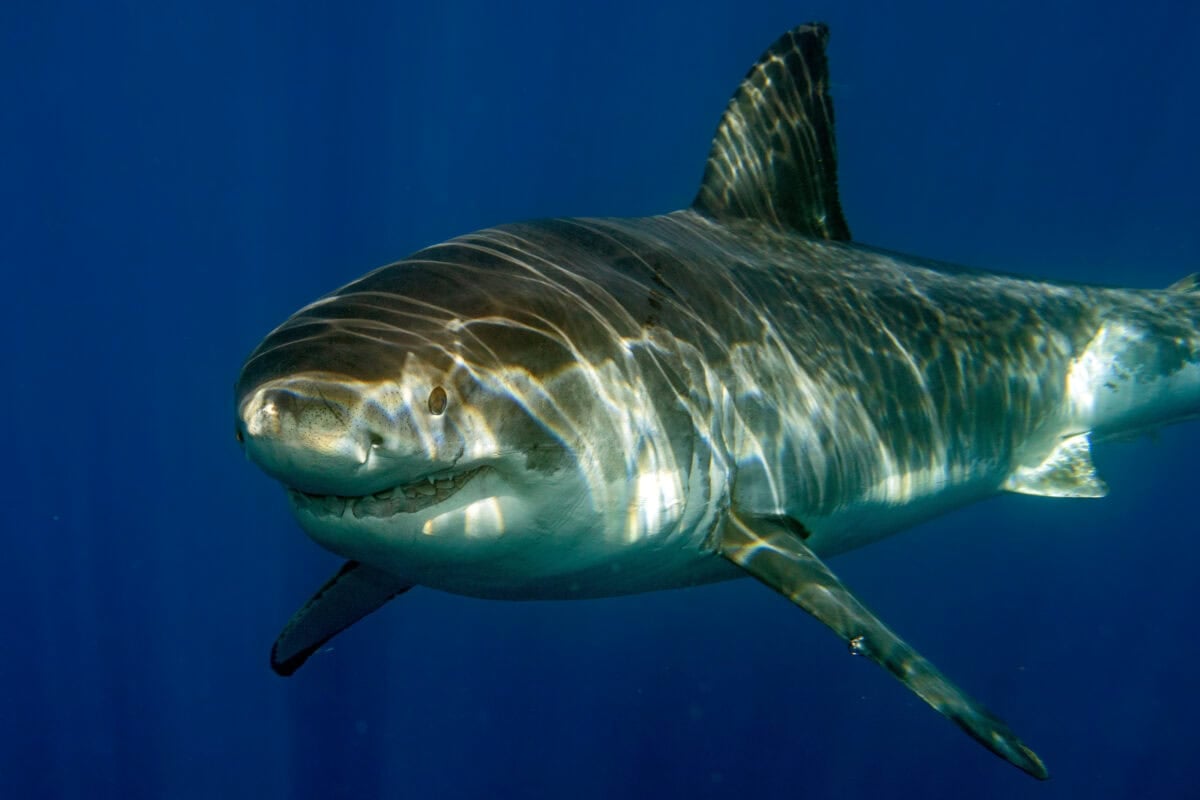
The great white shark (Carcharodon carcharias) stands as one of the ocean’s apex predators, reaching lengths of up to 20 feet and weights exceeding 4,000 pounds. With its powerful streamlined body, it can cruise at speeds of 15 mph and burst up to 35 mph when pursuing prey. In stark contrast, the California two-spot octopus fish (Paralabrax nebulifer) measures just 3-4 inches in length and weighs mere ounces. Yet when threatened, this tiny fish can accelerate to speeds surpassing 40 mph—a feat that, while lasting only seconds, can mean the difference between life and death in the predator-filled ocean.
The Science of Survival Acceleration

How does this miniature speedster achieve such remarkable bursts of velocity? The answer lies in specialized muscle fibers and a unique body structure evolved specifically for rapid acceleration. Unlike most fish that use their entire body to generate swimming force, the two-spot octopus fish possesses a high concentration of white muscle fibers—specialized tissue designed for explosive, anaerobic activity. These muscles can contract at extraordinary speeds, converting energy into motion far more efficiently than the red muscle fibers used for sustained swimming. Additionally, the fish’s streamlined body minimizes drag, while its tail fin has evolved a higher surface-area-to-mass ratio than other fish of similar size, providing greater thrust per tail movement.
The Metabolic Cost of Speed

This incredible burst speed comes at a significant metabolic cost. During these acceleration events, the fish’s muscles operate anaerobically—without oxygen—accumulating a substantial oxygen debt. Studies have shown that after a maximum burst, the two-spot octopus fish requires up to 15 minutes of recovery time, during which it must swim slowly while its body processes the lactic acid buildup. This limitation explains why the fish can only maintain its shark-beating speed for approximately 2-3 seconds before exhaustion sets in. It’s a perfect example of an evolutionary trade-off: extraordinary short-term performance at the expense of endurance.
Evolutionary Advantages of Burst Speed

The two-spot octopus fish’s remarkable burst capability developed as a direct response to predation pressure. In the competitive ecosystem of coastal California waters, this species evolved in an environment filled with larger predators. Rather than investing in defensive structures like spines or toxins, it developed the ability to escape through sheer acceleration. Research indicates that prey fish with superior burst speeds have significantly higher survival rates compared to slower counterparts, even when the speed advantage lasts just a fraction of a second. This evolutionary strategy has proven so successful that similar adaptations have independently evolved in several other small fish species across different ocean environments.
Great White Sharks: Built for Endurance

While great white sharks can’t match the two-spot octopus fish’s momentary burst speed, they represent the opposite end of the evolutionary spectrum: optimization for efficiency and sustained pursuit. A great white’s muscles are predominantly slow-twitch red fibers that utilize oxygen efficiently. Additionally, these sharks possess specialized adaptations like a countercurrent heat exchange system that maintains their body temperature slightly above the surrounding water, enhancing muscle efficiency. This allows great whites to patrol vast territories and pursue prey over extended distances—a strategy that proves highly effective against most prey species that fatigue quickly after their initial escape response.
The Physics of Fish Acceleration
The extraordinary acceleration capability of the two-spot octopus fish challenges our understanding of aquatic physics. According to hydrodynamic calculations, the fish experiences forces exceeding 5G during maximum acceleration—comparable to what fighter pilots endure during extreme maneuvers. This acceleration is achieved through a complex interaction between the fish’s specialized muscle contractions and the water’s resistance. The fish’s body temporarily stores elastic energy in its collagen fibers before releasing it all at once, similar to how a bow stores and releases energy when firing an arrow. This mechanism allows the fish to exceed the theoretical speed limits calculated solely based on muscle power, representing one of the most efficient energy-transfer systems in the animal kingdom.
Habitat and Distribution
The California two-spot octopus fish inhabits the eastern Pacific Ocean, primarily along the coast of California and Baja California. It prefers shallow, rocky reef environments with abundant hiding places—an environment that has shaped its evolutionary adaptations. These habitats provide both the necessary cover for ambush predation (as the fish itself hunts smaller organisms) and crucial shelter to hide in after executing its signature escape burst. This specialized habitat preference explains why the species has developed such extreme performance characteristics; in open water environments without shelter, burst speed alone would provide insufficient protection, as predators could simply maintain pursuit until the prey exhausted itself.
Studying Nature’s Speedsters

Documenting the remarkable abilities of the two-spot octopus fish presented significant challenges to marine biologists. Traditional observation methods proved inadequate for measuring such brief, explosive movements. Breakthrough research came with the development of high-speed underwater cameras capturing 1,000+ frames per second, combined with computer tracking algorithms that could follow the fish’s movement trajectory. These technologies revealed not only the fish’s maximum speed but also the precise body mechanics involved. The findings continue to inspire biomimetic engineering, with researchers studying how the fish’s unique propulsion mechanisms might inform the design of more efficient underwater vehicles and robotics.
Other Notable Speed Champions in the Ocean

The two-spot octopus fish isn’t the only underwater creature to evolve remarkable speed capabilities. The sailfish (Istiophorus) holds the record for sustained speed, reaching up to 68 mph, though it cannot accelerate as rapidly as the octopus fish. Meanwhile, the mantis shrimp delivers the fastest strike in the animal kingdom, with its specialized appendages accelerating at over 10,000 times the force of gravity—fast enough to create cavitation bubbles underwater. These diverse examples demonstrate how evolution has repeatedly favored extreme performance specialization in different organisms, each finding unique solutions to the universal challenges of hunting and avoiding being hunted.
Conservation Status and Concerns

While not currently endangered, the two-spot octopus fish faces increasing threats from habitat degradation and climate change. Rising ocean temperatures particularly impact species with specialized metabolic adaptations, as their finely-tuned physiological systems operate optimally within narrow temperature ranges. Research indicates that the fish’s maximum acceleration capability decreases by approximately 8% for every 1°C increase in water temperature—a concerning finding given current warming trends. Additionally, coastal development threatens the rocky reef habitats these fish depend on. Conservation efforts now focus on establishing protected marine zones encompassing critical habitat areas to ensure this remarkable species continues to thrive.
Biomimetic Applications

The exceptional performance capabilities of the two-spot octopus fish have attracted significant attention from engineers and designers seeking bio-inspired solutions. Researchers have studied the fish’s unique muscle arrangement and elastic energy storage system to develop more efficient propulsion systems for underwater vehicles. One promising application involves self-propelled underwater drones that mimic the fish’s burst-and-coast swimming pattern, potentially increasing operational range by up to 60% compared to conventional constant-thrust designs. Additionally, material scientists are investigating the molecular structure of the fish’s collagen fibers, which demonstrate remarkable elasticity and energy return properties that could inform the development of new synthetic materials for applications ranging from prosthetics to sporting equipment.
The Ultimate Oceanic Underdog

The story of the two-spot octopus fish serves as a powerful reminder that nature’s solutions often defy our expectations. In the constant evolutionary arms race between predator and prey, innovative adaptations emerge that can temporarily level the playing field between creatures of vastly different sizes. While the great white shark maintains its position as one of the ocean’s most formidable hunters, the humble octopus fish demonstrates that survival doesn’t always favor the largest or strongest—sometimes, it’s the most specialized that persevere. Its momentary advantage represents one of nature’s most elegant examples of niche adaptation, where performance is perfectly matched to survival requirements rather than pursuing speed as an end in itself.
Conclusion: Speed in Perspective

The remarkable case of the two-spot octopus fish outpacing a great white shark—if only for a moment—highlights the fascinating complexity of evolutionary adaptation. Rather than viewing speed as a simple linear scale with clear winners and losers, this example reveals how different organisms optimize for different performance profiles based on their ecological roles. The shark’s sustained power and the fish’s explosive acceleration represent two equally valid solutions to different survival challenges. As we continue to explore and understand the ocean’s countless inhabitants, such unexpected capabilities remind us that even the smallest creatures can achieve extraordinary feats through the power of specialized adaptation. In the grand competition of natural selection, there isn’t always a single “fastest” organism—only those perfectly adapted to their particular niche in the vast tapestry of ocean life.

- The Most Vulnerable Fish Species in U.S. Rivers Today - July 22, 2026
- Ancient Cave Art Reveals Forgotten Animal Species - July 22, 2026
- The Top 7 Animal Rivalries That Put Human Feuds to Shame - July 22, 2026