

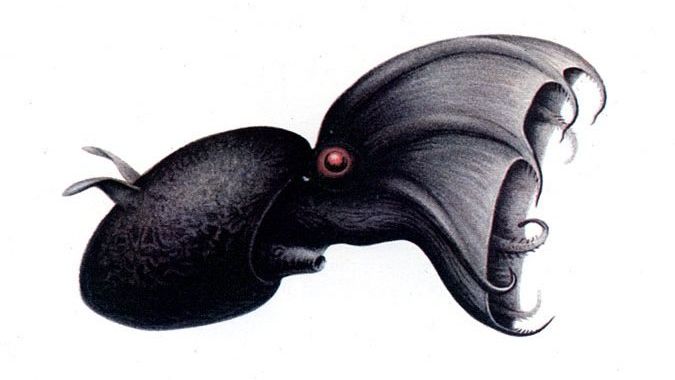
Few creatures on Earth are quite as haunting or mysterious as the vampire squid. It drifts through the deep ocean like a phantom, cloaked in a cape of webbed flesh, named after Dracula himself. Yet despite decades of fascination, its biology has remained stubbornly out of reach – until now.
Researchers have finally managed to sequence the complete genome of Vampyroteuthis infernalis, which translates, brilliantly, to “vampire squid from hell.” What they uncovered challenges long-held assumptions about evolution, intelligence, and what it really means to be a “living fossil.” Let’s dive in.
Meet the Creature Scientists Call a Living Fossil
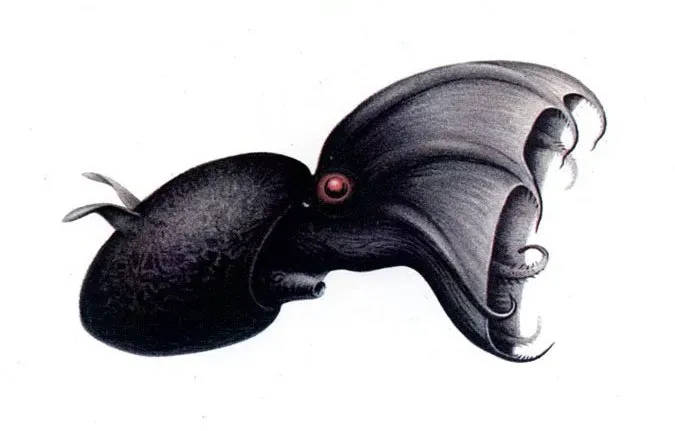
Here’s the thing about the vampire squid – it doesn’t quite fit anywhere. It’s not a true squid, not a true octopus. It occupies its own ancient order, Vampyromorpha, sitting somewhere in the evolutionary middle ground between the two. Scientists have long suspected it represents a very old lineage, something that branched off long before modern cephalopods took shape.
The term “living fossil” gets thrown around a lot, but in this case, it genuinely earns it. The vampire squid has survived largely unchanged for hundreds of millions of years, weathering mass extinctions and oceanic upheavals that wiped out far more celebrated creatures. Honestly, that alone should make it one of the most studied animals on the planet. Yet until recently, we barely scratched the surface of its genetics.
Why Sequencing This Genome Was Such a Big Deal
Sequencing a genome sounds straightforward enough in 2026, but the vampire squid made it genuinely difficult. Its genome is enormous – far larger than you’d expect from a deep-sea invertebrate. Think of it like trying to read a library book where someone randomly shuffled all the pages across thousands of volumes. The sheer size and complexity of the genetic material presented a serious technical challenge.
What made it worth the effort is the scientific payoff. By mapping out the complete genome, researchers could finally start asking precise questions about how this animal developed its unique adaptations, why it survived when others didn’t, and what its DNA says about the evolution of the entire cephalopod family tree. This is the kind of foundational work that unlocks years of follow-up research.
The Genome’s Surprising Size and What It Reveals
The vampire squid’s genome turned out to be staggeringly large, roughly comparable in size to the human genome, which is not something you’d casually predict for an animal living in the pitch-black depths of the ocean. This sheer genetic bulk hints at extraordinary biological complexity lurking beneath that dark, velvet exterior. Size in genetics often correlates with regulatory sophistication – the more genomic real estate an organism has, the more intricate the on-and-off switches controlling its development can be.
Researchers identified a massive expansion of certain gene families, particularly those connected to nervous system function and sensory processing. For an animal navigating total darkness at depths exceeding 3,000 feet, highly tuned sensory genes make perfect evolutionary sense. It’s hard to say for sure exactly how each of these genetic expansions translates into behavior, but the patterns are striking and point toward a level of neurological complexity that scientists hadn’t fully appreciated before.
Secrets of Survival: How It Thrives in the Deep
One of the most fascinating things the genome revealed is genetic evidence for highly efficient metabolic pathways. The vampire squid doesn’t hunt aggressively like many of its cephalopod relatives. Instead, it feeds on marine snow – tiny particles of organic debris drifting down from above – a strategy that requires almost no energy expenditure. Its genome seems to be wired to support exactly this kind of low-burn lifestyle.
There’s also evidence written into the DNA for exceptional tolerance to low-oxygen environments. The deep ocean zones where the vampire squid lives are often severely oxygen-depleted, which would kill most animals outright. The fact that its genome carries specific adaptations for surviving these hypoxic conditions goes a long way toward explaining why it has persisted while so many other species did not. It essentially evolved to thrive in environments that are inhospitable to competition.
What the Genome Tells Us About Cephalopod Evolution
Let’s be real – cephalopod evolution has always been one of the more confusing corners of the animal kingdom. Octopuses, squids, and cuttlefish are all remarkably intelligent, but how they got that way, and how they’re all related, has been disputed for years. The vampire squid’s genome acts like a Rosetta Stone here, offering a deep ancestral reference point that researchers can use to map out the broader cephalopod family tree with far greater accuracy.
The data supports the idea that the vampire squid split from other cephalopod lineages extremely early, before the evolutionary divergence of modern squids and octopuses. This means it carries genetic signatures that the others have since lost or modified. Studying those preserved ancient sequences could shed light on the original “recipe” for cephalopod intelligence and body structure – things that, until now, were largely guesswork.
Brain Genes and the Intelligence Question
Perhaps the most thought-provoking finding involves the genes associated with neural development and brain complexity. The vampire squid carries an expanded toolkit of neurological genes, some of which show similarities to those found in vertebrates – a remarkable case of convergent evolution. I think this is the detail that will spark the most debate in the scientific community, because it challenges tidy narratives about where complex brains come from.
It raises a genuinely exciting question: is the vampire squid smarter than we’ve given it credit for? Its behavior has always seemed relatively passive compared to the problem-solving acrobatics of octopuses. Yet the genetics suggest there’s serious neural architecture there, potentially capable of more than we’ve observed. Maybe we just haven’t been asking the right questions, or looking in the right places.
Why This Discovery Matters Beyond One Strange Animal
Zooming out, the sequencing of the vampire squid genome is significant for marine biology as a whole. Deep-sea ecosystems remain among the least understood environments on Earth, and any detailed biological insight into their inhabitants helps build a bigger picture. The vampire squid is essentially a living record of ancient ocean life, and its genome is the archive.
There are also potential applications in biotechnology and medicine. Genes adapted to extreme low-oxygen environments, for instance, are of genuine interest to researchers studying conditions where oxygen deprivation plays a role – think stroke research or organ preservation science. Nature has already solved many of the problems humans are still working on, and the vampire squid might hold a few unexpected answers buried in its enormous, strange, and finally decoded DNA.
Conclusion: The Deep Ocean Still Has Secrets Worth Chasing
The sequencing of the vampire squid’s genome is one of those scientific achievements that feels both technically impressive and genuinely poetic. Here is a creature that has outlasted dinosaurs, ice ages, and countless mass extinctions – and we’re only now beginning to understand why.
What strikes me most is the humbling reminder that the ocean still holds enormous mysteries. We’ve mapped the surface of Mars with greater resolution than much of our own ocean floor. The vampire squid, floating in the dark for hundreds of millions of years, was practically whispering that to us all along. Its genome doesn’t just reveal the secrets of one weird, wonderful creature. It opens a window into deep time, into the ancient machinery of life itself.
What other deep-sea creatures are out there, carrying genomic secrets we haven’t even begun to decode? Tell us what you think in the comments.

- Urban Coyotes Show Remarkable Adaptability, Learning to Thrive in City Environments - July 22, 2026
- Beavers Are Nature’s Engineers, Creating Vital Habitats for Other Wildlife Species - July 21, 2026
- The Recovery of the California Condor Offers Hope for Other Critically Endangered Birds - July 21, 2026