

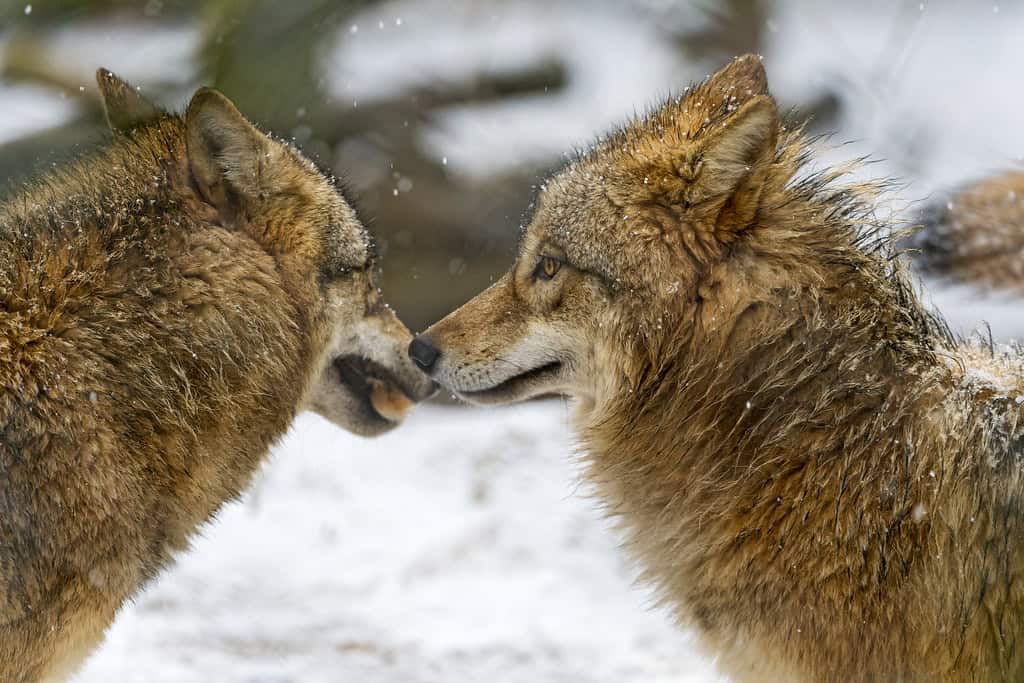
Picture this: centuries ago, the haunting howl of wolves echoed across nearly every corner of what we now call America. From the pine forests of Maine to the vast grasslands of Texas, these magnificent predators commanded respect and ruled their territories with an authority that shaped entire ecosystems. But what happened to them? The story of wolves in America is both heartbreaking and hopeful, a tale of destruction followed by one of the most remarkable conservation comebacks in modern history.
Not so long ago, wolves roamed nearly all of the United States, with between 250,000 and 500,000 wild wolves living in harmony with Native Americans and the rest of the ecosystem. Originally, the gray wolf occupied all of North America north of about 20°N, occurring all over the mainland, except for the southeastern United States and the tropical and subtropical areas of Mexico. Today, we’ll journey through twelve states where these apex predators once called home, exploring their lost kingdoms and the echoes of their ancient presence.
California – The Golden State’s Hidden Wolf History

Most people think of California as a land of beaches and Hollywood glamour, but this state once harbored thriving wolf populations that few tourists ever imagine. The historical range of wolves in California spanned most of the state, including the coastal range from San Diego to Sacramento, as well as inland in the Sierra Nevadas. These wolves prowled through redwood forests and mountain meadows, hunting deer and elk in landscapes that seemed endless and untamed.
Wolves were declared extinct in California in 1924, but in August of 2015, California Department of Fish and Wildlife confirmed that California had its first wild wolf pack in almost a century. The story of OR-7, a lone male wolf who traveled over 1,000 miles from Oregon, captivated the nation when he became the first confirmed wild wolf in California since the 1920s. It’s like nature’s own version of a cross-country road trip, except this traveler was looking for love and a new territory to call home.
The repopulation of wolves in California was recognized in late December 2011, when OR-7, a male wolf from Oregon, became the first confirmed wild wolf in California since 1924, with the first resident wolf pack confirmed in 2015. Today, around 50 wolves roam the state, proving that sometimes the most surprising comebacks happen when we least expect them.
Texas – Where Lobos Once Ruled the Lone Star State

Everything’s bigger in Texas, and that once included wolf populations that would make your jaw drop. The originally recognized red wolf range extended throughout the southeastern United States from the Atlantic and Gulf Coasts, north to the Ohio River Valley and central Pennsylvania, and west to Central Texas and southeastern Missouri. But Texas was also home to another subspecies that locals called “lobo” – the Mexican gray wolf.
Commonly called “lobo,” the Mexican gray wolf historically ranged throughout Arizona, New Mexico, Texas, and Mexico. These wolves were smaller than their northern cousins but just as fierce, adapted to the harsh desert and scrubland environments of the Southwest. In 1940, the biologist Stanley P. Young noted that the red wolf was still common in eastern Texas, where more than 800 had been caught in 1939 because of their attacks on livestock.
The irony is thick here – Texas, known for its independent spirit and wild frontier heritage, systematically eliminated the very predators that embodied those same qualities. By the late 1960s, red wolves occurred in small numbers in the Gulf Coast of western Louisiana and eastern Texas. Today, no wild wolves remain in the Lone Star State, making it a ghost of its former wild self.
Pennsylvania – The Keystone State’s Lost Wolves

Pennsylvania might surprise you – this state that’s now known for its cities and industrial heritage once hosted robust wolf populations in its vast wilderness areas. The gray wolf was last spotted in Pennsylvania in 1882 and is considered to be extirpated from the state. Think about that date for a moment – 1882 was when the last confirmed wolf disappeared, around the same time the state was becoming an industrial powerhouse.
Three or more maps agreed in the Northeast, but agreement decreased in the east-central part of the country in New Jersey, Pennsylvania, Ohio, Indiana, Illinois, Missouri, Oklahoma, and Texas. The mountainous regions of Pennsylvania, particularly the Appalachians, provided perfect wolf habitat with dense forests and abundant prey. Recent reports of gray wolves in Pennsylvania have been unsubstantiated, but there is evidence to suggest that there may be a few hybrid wolves living in the state.
What’s fascinating is how quickly Pennsylvania’s wolves vanished compared to more remote states. The combination of European settlement, deforestation, and organized wolf persecution meant that these apex predators couldn’t adapt fast enough to survive the rapid changes to their world.
New York – When Wolves Prowled the Empire State

Before the bright lights of Broadway and the hustle of Wall Street, New York’s wilderness echoed with wolf howls that would send shivers down your spine. Extirpated from New York in the early 1900s, the last gray wolf was killed in 1904. The Adirondack Mountains, in particular, were a wolf stronghold that supported these predators for centuries before human expansion pushed them out.
By the mid-1800s, wolves were eliminated in northern Maine, New Hampshire, and Vermont. By 1900, they were gone from the Adirondacks. But here’s where it gets interesting – wolves haven’t completely given up on New York. A robust, genome-wide ancestry analysis concluded that the Otsego County wolf likely originated from the Great Lakes wolf population, with analyses finding that the animal was a 4-year-old adult male wolf that had a diet consistent with that of a wild canine throughout its life.
The possibility of wolves naturally recolonizing New York isn’t just a fantasy. It is possible that this animal was a free-ranging wolf that may have dispersed from the Great Lakes population, a distance of over 500 miles, though the average Great Lakes wolf dispersal distance is only approximately 50 miles. Sometimes nature writes the most incredible adventure stories.
Minnesota – The Last Stand That Became a Success Story

Minnesota holds a special place in American wolf history because it’s the one state in the lower 48 where wolves never completely disappeared. By the 1970s, the only known wolves that remained in the conterminous United States were in northeastern Minnesota. This wasn’t by accident – Minnesota’s vast wilderness areas, particularly in the Boundary Waters region, provided the perfect refuge for these survivors.
Minnesota currently hosts 2,919 wolves according to the Winter 2022-2023 count, with the population having federally endangered status. What’s remarkable is how this population became the foundation for wolf recovery across the Great Lakes region. After federal protections were established for wolves via the Endangered Species Act in 1973, the wolf population in Minnesota began to increase and expand their range, with wolves in the Western Great Lakes region surpassing federal recovery goals by the year 2000.
Minnesota’s wolf story proves that sometimes holding onto just a sliver of what we once had can lead to incredible recoveries. These hardy survivors in the north woods became the genetic foundation for wolf populations that now span multiple states, showing nature’s incredible resilience when given a fighting chance.
Wisconsin – From Extinction to Controversial Comeback

Wisconsin’s wolf story reads like a roller coaster of extinction, recovery, and ongoing controversy. The state that gave us cheese and the Green Bay Packers once supported substantial wolf populations before they were completely wiped out. Wisconsin currently has 1,007 wolves according to 2022-2023 counts, with federally endangered status after being delisted in January 2021 and relisted in February 2022.
The recovery in Wisconsin happened thanks to wolves naturally dispersing from Minnesota’s stable population. The Great Lakes population continued to grow, spreading into northern Wisconsin. But Wisconsin’s wolf recovery has been anything but smooth sailing. As of 2020, Wisconsin had 1000-2000 wolves, but a February 2021 wolf hunt killed 216 wolves.
What makes Wisconsin’s situation particularly complex is the ongoing legal battles over wolf management. The state represents the tension many places face between conservation success and local concerns about livestock predation and hunting opportunities. It’s a reminder that bringing back apex predators isn’t just a biological challenge – it’s a deeply human one too.
Michigan – Wolves Return to the Wolverine State

Michigan, ironically nicknamed the Wolverine State despite having few wolverines, has become a crucial stronghold for wolf recovery in the Great Lakes region. Michigan currently supports 762 wolves as of 2023, with federally endangered status after being delisted in January 2021 and relisted in February 2022. The state’s Upper Peninsula, with its vast forests and sparse human population, provides ideal wolf habitat.
One of the most fascinating aspects of Michigan’s wolf story involves Isle Royale National Park, an island in Lake Superior that became a natural laboratory for wolf-prey dynamics. In September 2018, the National Park Service began its wolf relocation project – a planned “genetic rescue” of Isle Royale’s dwindling wolf population, with a total of 19 wolves relocated to Isle Royale from the mainland US and Canada between 2018-2019.
Michigan’s wolves face unique challenges compared to their mainland cousins. The island population had suffered from severe inbreeding, while mainland wolves deal with vehicle strikes and occasional conflicts with humans. Yet the state has proven that coexistence is possible with proper management and public education.
Missouri – Where Red Wolves Once Roamed the Ozarks

Missouri might seem like an unlikely place for wolves today, but this “Show Me State” once showed impressive wolf diversity. Research into paleontological, archaeological and historical specimens of red wolves by Ronald Nowak expanded their known range to include land west to Missouri and mid-Illinois. The Ozark Mountains and Missouri’s river bottoms provided perfect habitat for red wolves for centuries.
In 1851, naturalists recorded the “Black American Wolf” as existing in southern Missouri, Louisiana, and northern Texas, while the “Red Texan Wolf” existed from northern Arkansas, through Texas, and into Mexico. These wolves adapted to Missouri’s diverse landscapes, from prairie edges to dense forests.
What’s particularly interesting about Missouri is the ongoing genetic legacy of its former wolves. Coyotes from Missouri, Illinois, and Florida exhibit 5–10% wolf ancestry. This means that while pure wolves are gone, their genetic signature lives on in the coyote population, creating hybrid animals that are larger and more wolf-like than their western coyote cousins.
Ohio – Buckeye State’s Forgotten Predators

Ohio, now known for its farmland and cities, once supported wolves throughout its diverse ecosystems. Red wolves historically ranged north to the Ohio River Valley and central Pennsylvania, making Ohio a significant part of the eastern red wolf’s territory. The state’s mix of forests, prairies, and wetlands created ideal conditions for these predators.
Agreement among historical range maps decreased in the east-central part of the country in New Jersey, Pennsylvania, Ohio, Indiana, Illinois, Missouri, Oklahoma, and Texas. This suggests that Ohio was on the edge of the primary wolf range, where populations might have been less stable or more seasonal.
The rapid agricultural development of Ohio in the 1800s spelled doom for its wolf populations. Unlike the more remote northern states, Ohio’s relatively gentle terrain and fertile soils made it attractive to settlers who quickly transformed the landscape. The state that would later become famous for its corn and soybeans once echoed with howls that would make your blood run cold on a winter night.
Montana – Big Sky Country’s Wolf Renaissance

Montana represents one of the greatest conservation success stories in American history. Montana currently hosts 1,096 wolves as of 2023, with state-managed population status and an annual harvest season. But getting to this point required an incredible journey of recovery and reintroduction.
Canadian wolves began to naturally recolonize northern Montana around Glacier National Park in 1979, with the first wolf den in the western U.S. in over half a century documented there in 1986, growing to about 48 wolves by the end of 1994. This natural recovery was supplemented by one of the most famous reintroduction efforts in conservation history. In 1995 and 1996, 66 wild wolves were translocated from Canada to central Idaho and Yellowstone National Park.
Montana’s success proves that large-scale wolf recovery is possible with proper planning and management. The state now manages its wolf population through regulated hunting seasons, demonstrating that conservation and traditional hunting culture can coexist when science guides policy decisions.
New Mexico – Land of Enchantment’s Lobo Legacy

New Mexico’s wolf story centers on the Mexican gray wolf, or “lobo,” the most genetically distinct subspecies of gray wolf in North America. Commonly called “lobo,” the Mexican gray wolf historically ranged throughout Arizona, New Mexico, Texas, and Mexico, and are the most genetically distinct subspecies of gray wolf and are unique to North America.
Between 1977 and 1980, the last few surviving Mexican wolves were captured and bred, and some of their progeny were reintroduced into Arizona and New Mexico. This captive breeding program literally saved the subspecies from extinction, though it came at the cost of reduced genetic diversity.
Today, New Mexico shares its Mexican wolf population with Arizona as part of ongoing recovery efforts. The reintroduced population of Mexican gray wolves into the Blue Range Wolf Recovery Area in east-central Arizona is shared between both Arizona and New Mexico. It’s a testament to how desperate the situation became – and how dedicated conservationists refused to let these unique wolves disappear forever.
Arizona – Desert Wolves Against All Odds

Arizona might seem like an impossible place for wolves – all that desert heat and sparse prey. But this state was crucial habitat for Mexican gray wolves, the desert-adapted subspecies that proved wolves could thrive in some of the harshest conditions North America had to offer. Arizona currently has 124 wolves according to 2024 population surveys, with federally protected status as a nonessential experimental population.
After being hunted to the brink of extinction in the wild by the early 20th century, 11 Mexican gray wolves were released into a federally designated Blue Range Wolf Recovery Area in east-central Arizona in 1998, with Arizona now being one site of ongoing Mexican gray wolf recovery.
Arizona’s wolves represent hope against incredible odds. These desert survivors prove that wolves are among the most adaptable predators on Earth, capable of thriving in mountain forests, grasslands, and even the Sonoran Desert. Their recovery in Arizona shows that even the most specialized subspecies can bounce back when humans decide to give them a chance.
Conclusion

The story of wolves in these twelve states reads like an epic novel – filled with tragedy, hope, conflict, and redemption. The wolf is the only species to be deliberately driven to the brink of extinction by humans, with the US government winning its battle against nature through systematic extermination. Yet today, wild wolves have made a remarkable comeback over the past 50 years, and if recovery efforts continue, we may one day see wild wolves successfully coexisting with humans in over twenty states.
From California’s surprising return of OR-7 to Montana’s thriving populations, from Minnesota’s crucial refugia to the desert recovery in Arizona and New Mexico, these states tell a story bigger than just wolves. They remind us that the landscapes we think we know often hide incredible histories of wildness and loss. But they also prove that sometimes, just sometimes, we humans can fix our mistakes and bring back what we almost destroyed forever.

As a little kid, I fell in love with nature, wildlife, and animals. Living in the USA, South Africa, Italy, China and Germany gave me the opportunity to discover the world's Wildlife. My favorite animals are Mountain Gorillas, Siberian Tigers, and Great White Sharks.
I'm a certified PADI Open Water Diver, went to Everest Base Camp and Trekked Gorillas in Uganda. I hold a Master of Science in Economics and Finance.
Please send any feedback to feedback@animalsaroundtheglobe.com
- Why the Great Barrier Reef Is the Best Place to Spot Sea Turtles - June 3, 2026
- 2 Animals With Super Sized Body Parts and What They are For - June 3, 2026
- Explore The Azores - June 3, 2026