


Worried about unexpected vet bills?
Pet insurance can cover thousands in unexpected vet costs. Get a free quote from Lemonade in under 2 minutes.
Get My Free Quote →Sponsored · Opens Lemonade.com
The ocean depths remain one of Earth’s final frontiers, teeming with extraordinary life forms that defy imagination. Beyond the familiar dolphins, sharks, and colorful reef fish exists a realm of bizarre, fascinating creatures that rarely enter the public consciousness. From the crushing pressures of the hadal zone to the twilight depths of the mesopelagic, these animals have evolved remarkable adaptations to survive in extreme environments. Their strange appearances, unusual behaviors, and remarkable survival strategies offer us glimpses into the true diversity of life on our planet. In this exploration of the ocean’s most enigmatic inhabitants, we’ll venture beyond the familiar to discover thirteen underwater creatures that most people have never encountered—living proof that reality often outshines fantasy when it comes to marine biodiversity.
13. The Barreleye Fish Nature’s Transparent-Headed Wonder
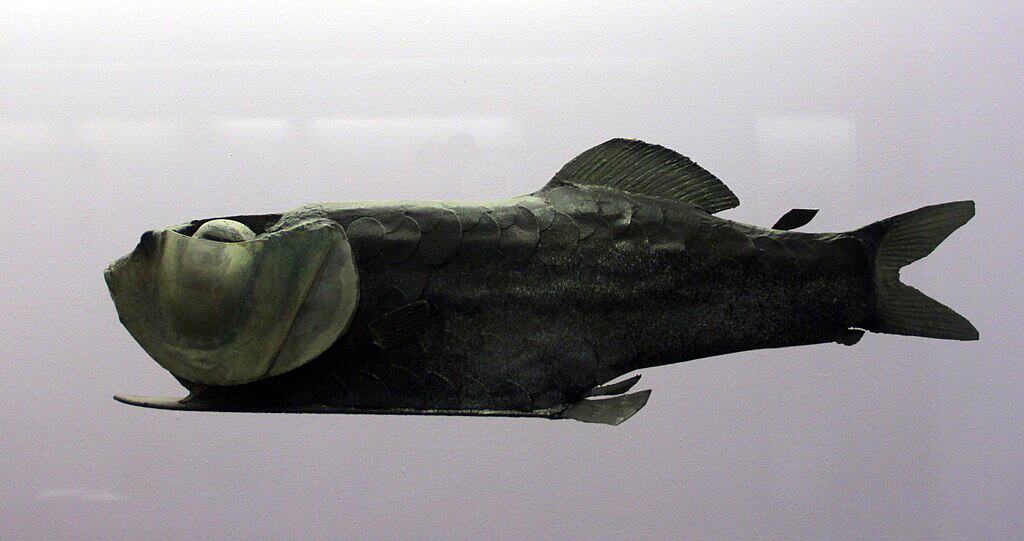
The Pacific barreleye fish (Macropinna microstoma) possesses one of the most unusual anatomical features in the animal kingdom: a transparent dome-shaped head that reveals its tubular, highly-sensitive eyes. These specialized eyes can rotate within the fluid-filled shield, allowing the fish to look upward for potential prey while maintaining a horizontal swimming position. First discovered in 1939, the barreleye’s transparent cranium wasn’t properly documented until 2004 when researchers from the Monterey Bay Aquarium Research Institute captured live specimens. Living at depths between 2,000 and 2,600 feet (600-800 meters), these fish grow to about 6 inches long and feed primarily on small crustaceans and jellyfish. Their remarkable eye adaptation helps them detect the silhouettes of potential prey against the faint light filtering down from above, giving them a crucial advantage in the dimly lit midwater zone.
12. The Yeti Crab Hairy Denizen of Hydrothermal Vents

Discovered only in 2005, the Yeti crab (Kiwa hirsuta) earned its nickname from the dense, hair-like setae covering its claws and limbs. These “hairy” appendages aren’t just for show—they serve as gardens for symbiotic bacteria that the crab cultivates and then consumes by combing through its setae with specialized mouthparts. Living exclusively around hydrothermal vents in the South Pacific Ocean at depths approaching 7,500 feet (2,300 meters), these crabs thrive in one of Earth’s most hostile environments where temperatures can shift from near-freezing to over 400°F (200°C) within inches. Growing to about 6 inches (15 cm) long, Yeti crabs represent a perfect example of evolution’s capacity to produce specialized organisms for extreme environments. Since the discovery of Kiwa hirsuta, scientists have identified several additional species of Yeti crabs, demonstrating how much remains unknown about deep-sea biodiversity.
11. The Vampire Squid Ancient Relic of the Deep
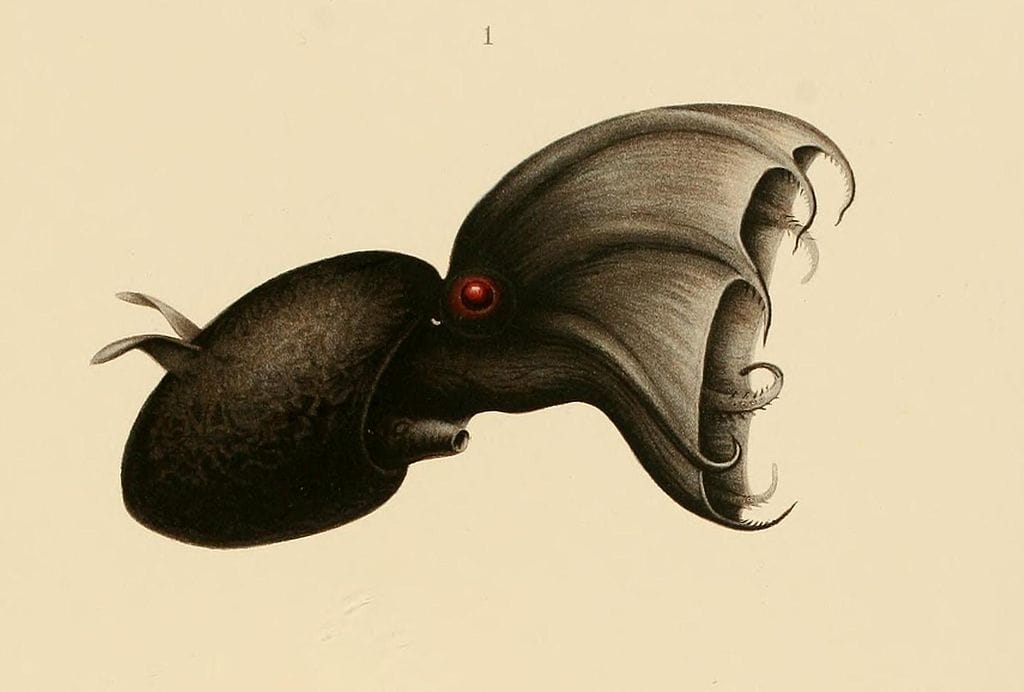
Despite its ominous name, the Vampire Squid (Vampyroteuthis infernalis, literally “vampire squid from hell”) is neither a true squid nor particularly vampiric. This ancient relic represents the sole surviving member of the order Vampyromorphida, occupying an evolutionary position between octopuses and squids. Living in the oxygen-minimum zones at depths of 2,000 to 3,000 feet (600-900 meters), these creatures have developed remarkable adaptations for their extreme habitat. When threatened, the Vampire Squid can invert its webbed arms over its body, revealing rows of spines that give it a thorny appearance. Its most spectacular defense mechanism involves bioluminescent displays—it can eject clouds of bioluminescent mucus to confuse predators while making its escape. With the lowest metabolic rate of any cephalopod, these 6-inch (15 cm) creatures conserve energy in their low-oxygen environment, primarily feeding on marine snow—a continuous shower of organic detritus sinking from upper waters.
10. The Mantis Shrimp Owner of Nature’s Most Complex Eyes

Though some mantis shrimp species inhabit relatively shallow waters and might be familiar to marine enthusiasts, these remarkable crustaceans deserve inclusion for their extraordinary visual system—arguably the most complex in the animal kingdom. Mantis shrimp possess compound eyes with up to 16 different photoreceptor types (humans have just three), allowing them to perceive ultraviolet, infrared, and polarized light invisible to most other creatures. This incredible visual acuity serves two main purposes: finding prey and communicating with other mantis shrimp through complex body patterns only they can fully perceive. Beyond their visual prowess, mantis shrimp pack a literal punch—their specialized appendages can strike with the acceleration of a .22 caliber bullet, generating forces exceeding 1,500 newtons, enough to smash aquarium glass or crack crab shells. These 4-12 inch (10-30 cm) crustaceans represent evolutionary marvels that continue to inspire biomimetic technologies, including advanced camera sensors and impact-resistant materials.
9. The Dumbo Octopus Deep-Sea Ears and Umbrella Arms

Named for their resemblance to Disney’s flying elephant, Dumbo octopuses (genus Grimpoteuthis) feature distinctive ear-like fins protruding from their mantles that they use to propel themselves through the water with graceful, undulating movements. Unlike most octopuses, Dumbo species live at extreme depths—typically between 9,800 and 13,000 feet (3,000-4,000 meters), with some specimens documented at nearly 23,000 feet (7,000 meters) below the surface. These deep-sea dwellers grow to approximately 12 inches (30 cm) in length and possess unique adaptations for the high-pressure, low-energy environment of the deep ocean. Rather than hunting actively like their shallow-water relatives, Dumbo octopuses hover above the seafloor, using their umbrella-like webbed arms to capture small crustaceans, worms, and other invertebrates. Their gelatinous bodies lack the ink sacs found in most cephalopods—a reflection of the minimal predation pressure in their deep-sea habitat where complete darkness renders visual defenses unnecessary.
8. The Coffinfish Living Lure of the Abyss
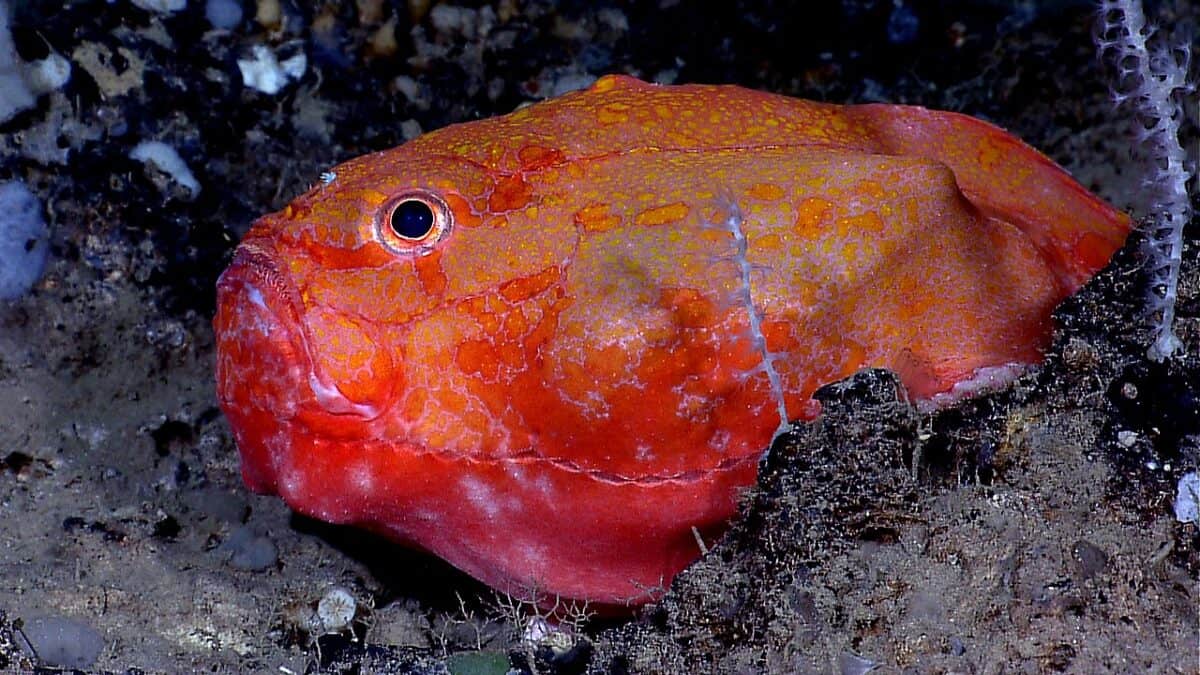
The Coffinfish (Chaunax endeavouri) belongs to the anglerfish family but presents a uniquely macabre appearance that earned it its funereal name. Native to deep waters off Australia’s coast at depths between 820 and 2,300 feet (250-700 meters), these fish possess prickly skin, a flattened head, and a bloated body that can inflate when threatened—similar to pufferfish but far more grotesque in appearance. Like other anglerfishes, the Coffinfish uses a modified dorsal spine as a bioluminescent lure (illicium) to attract prey, but uniquely, it can also produce a pulsing bioluminescent glow from its mouth cavity, creating the appearance of a flashing beacon in the darkness. Growing to about 12 inches (30 cm) in length, these ambush predators move by walking on modified pectoral and pelvic fins rather than swimming, conserving energy on the seafloor where food can be scarce. Their ability to inflate their bodies serves as protection against the few predators capable of swallowing such an awkwardly-shaped meal.
7. The Fangtooth Fish Owner of the Ocean’s Largest Teeth-to-Body Ratio

The Fangtooth fish (Anoplogaster cornuta) possesses the largest teeth in proportion to body size of any fish in the ocean, with fangs so long they cannot fully close their mouths. These fierce-looking creatures inhabit the mesopelagic and bathypelagic zones at depths between 1,600 and 6,500 feet (500-2,000 meters) and grow to only about 6 inches (15 cm) in length despite their fearsome appearance. Their massive teeth serve a critical purpose in the food-scarce deep ocean: they enable these fish to capture and secure prey items that might otherwise escape, including fish and squid significantly larger than themselves. Fangtooths have specialized socket-like structures in their jaws to accommodate their enormous teeth when their mouths close. Their bodies are covered in armor-like scales and possess extremely large heads with cavernous, highly extendable jaws. Although terrifying in appearance, these fish pose no threat to humans, as they live far deeper than human divers can reach without specialized submersibles.
6. The Bobbit Worm Ambush Predator of the Seafloor

The Bobbit worm (Eunice aphroditois) represents one of the ocean’s most efficient and terrifying ambush predators. Growing to lengths exceeding 10 feet (3 meters) but only about an inch (2.5 cm) in diameter, these segmented polychaete worms hide most of their bodies beneath the seafloor with only their antenna-like sensors and partial head exposed. When prey approaches, they strike with lightning speed, using powerful, scissor-like jaws capable of slicing fish in half or dragging larger prey beneath the sand. Their attack velocity is so rapid that it sometimes creates a pressure wave capable of stunning nearby fish. Bobbit worms possess a complex nervous system that allows them to process sensory information and coordinate their ambush attacks with remarkable precision. Most active at night, these predators inhabit tropical and subtropical waters worldwide at depths ranging from 30 to 130 feet (10-40 meters). Their presence often goes unnoticed until they appear unexpectedly in marine aquariums, having hitched rides on live rock collected from the ocean.
5. The Halitrephes Maasi Jellyfish Living Fireworks Display
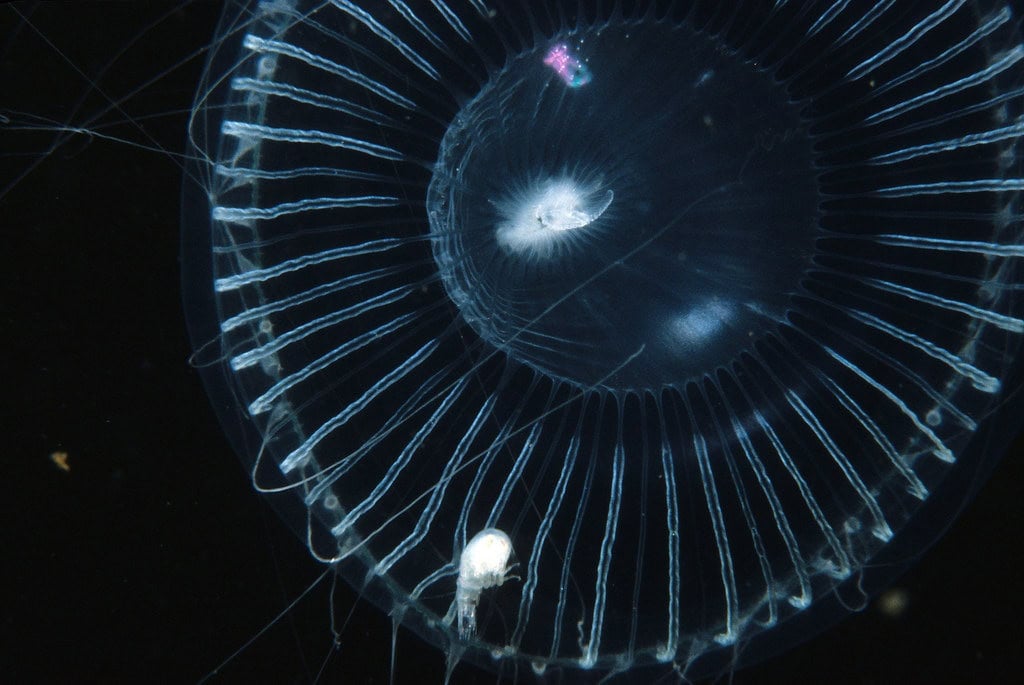
The Halitrephes maasi jellyfish creates one of the most spectacular bioluminescent displays in the deep ocean, resembling an underwater fireworks explosion when illuminated by submersible lights. This rarely-seen creature inhabits the bathypelagic zone at depths between 3,300 and 6,600 feet (1,000-2,000 meters) and possesses a translucent bell adorned with radiating canals that reflect light in rainbow-like patterns. Growing to about 4 inches (10 cm) in diameter, these jellyfish were largely unknown to the public until 2017, when researchers with the Nautilus exploration program captured stunning footage that quickly went viral online. Unlike many jellyfish that passively drift with currents, Halitrephes maasi can pulse its bell to move vertically through the water column, allowing it to access different feeding zones. While their stinging cells are mild by jellyfish standards, they effectively immobilize the small zooplankton and crustaceans that constitute their diet in the nutrient-poor deep ocean environment.
4. The Chimaera Living Fossil from the Age of Dinosaurs

Chimaeras, often called “ghost sharks” or “ratfish,” represent some of the oldest living vertebrate lineages, having diverged from sharks over 400 million years ago during the Devonian period. These cartilaginous fish (order Chimaeriformes) possess distinctive features including a single gill opening covered by a flap, smooth skin without scales, and large, specialized tooth plates instead of rows of teeth. Male chimaeras develop a retractable sex organ on their heads called a frontal tenaculum, used for grasping females during mating. Most species inhabit deep waters between 660 and 8,500 feet (200-2,600 meters), with the spotted ratfish (Hydrolagus colliei) occasionally venturing into shallower depths. Growing to lengths of 5 feet (1.5 meters), these ancient creatures feed primarily on hard-shelled invertebrates, which they crush with their specialized dental plates. Recent deep-sea explorations have discovered numerous previously-unknown chimaera species, suggesting this group remains significantly understudied despite representing a crucial evolutionary link in vertebrate development.
3. The Gulper Eel Expandable Mouth of the Midnight Zone

The Gulper Eel (Eurypharynx pelecanoides), also known as the pelican eel, possesses one of the most disproportionate mouths in nature—capable of expanding to swallow prey larger than the eel itself. This remarkable deep-sea fish inhabits the bathypelagic zone between 3,000 and 10,000 feet (900-3,000 meters) and features a tiny body trailing behind an enormous head and jaw structure. Growing to about 2.5 feet (75 cm) in length, the Gulper Eel’s most distinctive feature is its massive mouth supported by loosely-hinged jaws and expandable skin that forms a pouch-like structure similar to a pelican’s bill. Unlike many deep-sea predators that use bioluminescent lures, the Gulper Eel’s tail tip contains light-producing photophores that likely attract prey. Their diet consists primarily of crustaceans and small fish, which they engulf rather than bite. The extreme modification of their jaw structure represents a specialized adaptation to the deep ocean’s feast-or-famine environment, allowing these eels to capitalize on rare feeding opportunities when they arise.
2. The Frilled Shark Prehistoric Serpent of the Deep

Often described as a “living fossil,” the Frilled Shark (Chlamydoselachus anguineus) has remained virtually unchanged for 80 million years, representing one of the most primitive shark species still swimming in our oceans. With an elongated, eel-like body growing up to 6.6 feet (2 meters) in length, this deep-sea predator inhabits depths between 390 and 4,200 feet (120-1,280 meters) across the Atlantic and Pacific Oceans. Their most distinctive features include six pairs of frilly gill slits (most sharks have five), a terminal mouth positioned at the front of the head rather than underneath, and 300 trident-shaped teeth arranged in 25 rows. These specialized teeth function like backward-facing barbs, making it impossible for prey to escape once captured. Frilled sharks employ a unique hunting strategy—they bend their bodies and strike like a snake, using their extreme flexibility to capture squid, fish, and other sharks. Their primitive reproductive system involves internal fertilization with gestation periods potentially exceeding three years—among the longest of any vertebrate.
1. The Sarcastic Fringehead Territorial Mouth-Wrestler
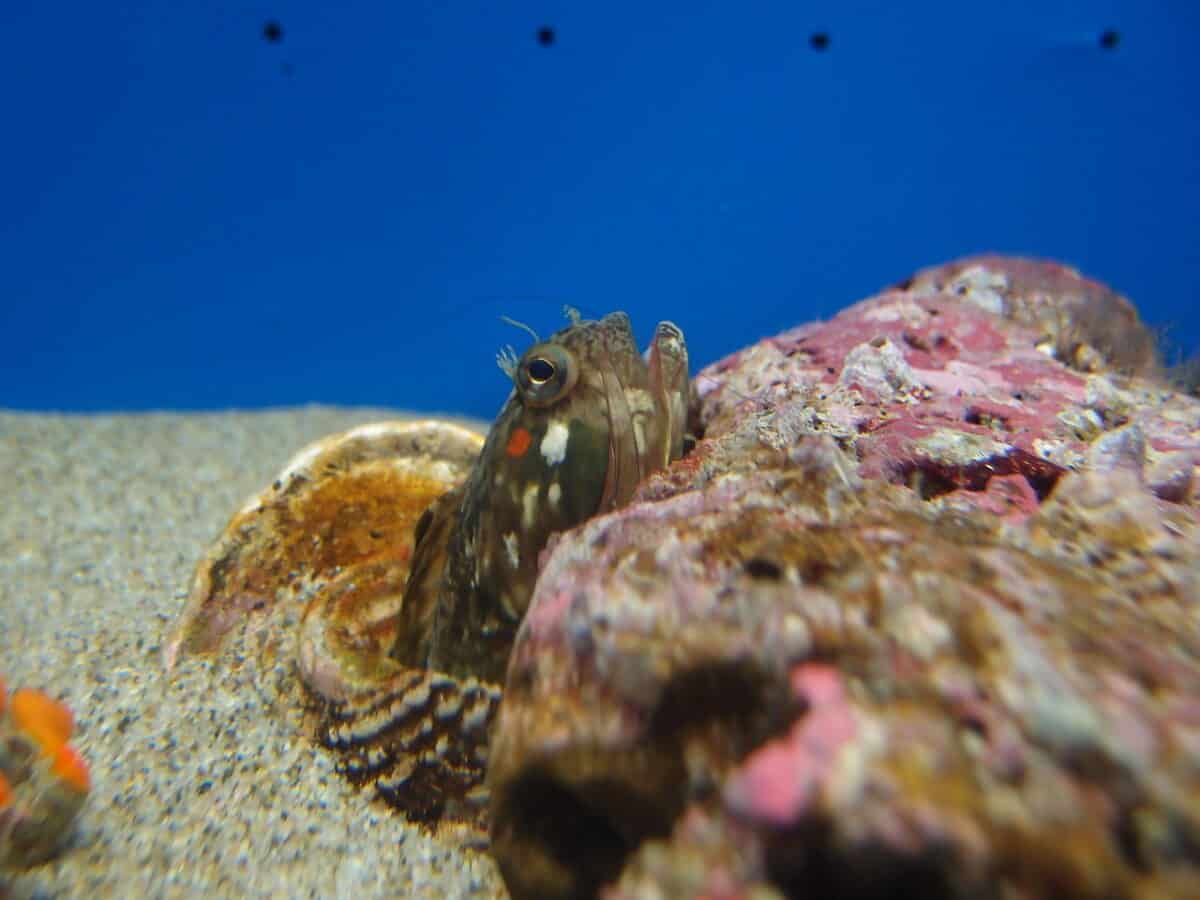
The Sarcastic Fringehead (Neoclinus blanchardi) might have the most unusual name on our list, but its remarkable territorial display justifies its inclusion. Native to the Pacific coast from San Francisco to central Baja California, these fish typically inhabit depths between 10 and 240 feet (3-73 meters), making them the shallowest-dwelling creature in our collection. Growing to about 12 inches (30 cm), these fish appear unremarkable until threatened—at which point they display one of the ocean’s most spectacular defensive behaviors. When confronted by a competitor or threat, the Sarcastic Fringehead unfurls an enormous colorful mouth lined with sharp, fang-like teeth in a display reminiscent of science fiction monsters. When two males encounter each other, they engage in “mouth wrestling”—pressing their open mouths against each other until one competitor retreats. These highly territorial fish make their homes in abandoned shells, crevices, or man-made objects like bottles and pipes, which they defend vigorously against all intruders. Despite their aggressive displays, they pose no threat to humans unless provoked through handling.
Conclusion: The Vast Unknown Why Deep-Sea Exploration Matters

The thirteen deep-sea marvels explored in this article are not just biological oddities—they are testaments to the resilience, adaptability, and sheer wonder of life on Earth. Dwelling far beyond the reach of sunlight, these creatures have evolved ingenious strategies to survive in some of the most hostile environments on the planet. Their existence challenges our understanding of biology and continues to push the boundaries of science, technology, and imagination. Yet, as fascinating as these species are, they also underscore how little we truly know about our planet. With over 80% of the ocean still uncharted, the deep sea represents a vast reservoir of untapped discovery. Each new exploration reveals not only the strangeness of these creatures but also their ecological importance in maintaining the balance of marine ecosystems. As human activity increasingly threatens even the most remote ocean regions—through climate change, pollution, and resource extraction—the need for responsible exploration and conservation becomes urgent.
Worried about unexpected vet bills?
Pet insurance can cover thousands in unexpected vet costs. Get a free quote from Lemonade in under 2 minutes.
Get My Free Quote →Sponsored · Opens Lemonade.com

As a little kid, I fell in love with nature, wildlife, and animals. Living in the USA, South Africa, Italy, China and Germany gave me the opportunity to discover the world's Wildlife. My favorite animals are Mountain Gorillas, Siberian Tigers, and Great White Sharks.
I'm a certified PADI Open Water Diver, went to Everest Base Camp and Trekked Gorillas in Uganda. I hold a Master of Science in Economics and Finance.
Please send any feedback to feedback@animalsaroundtheglobe.com
- 14 Incredible Ways Animals Outsmart Humans in the Wild - June 11, 2026
- 12 Wild Animal Misconceptions We Got from Movies - June 11, 2026
- 12 Species That Have Not Changed in Millions of Years - June 11, 2026