

Nature has a funny way of humbling us. We’ve mapped the human genome, landed rovers on Mars, and built machines that can imitate the human brain – yet there are things happening right here on Earth, and just above it, that remain completely unexplained. Glowing orbs floating through living rooms. Rocks that move on their own. Mysterious lights dancing above quiet Norwegian valleys for over a century. The universe, it seems, is not done surprising us.
What’s particularly fascinating is that these aren’t ancient myths or folklore passed down by people without science. Many of these phenomena have been filmed, measured, and studied by serious researchers with serious equipment. The data exists. The mystery, though, stubbornly refuses to dissolve. Let’s dive in.
Ball Lightning: The Floating Fire That Defies Physics
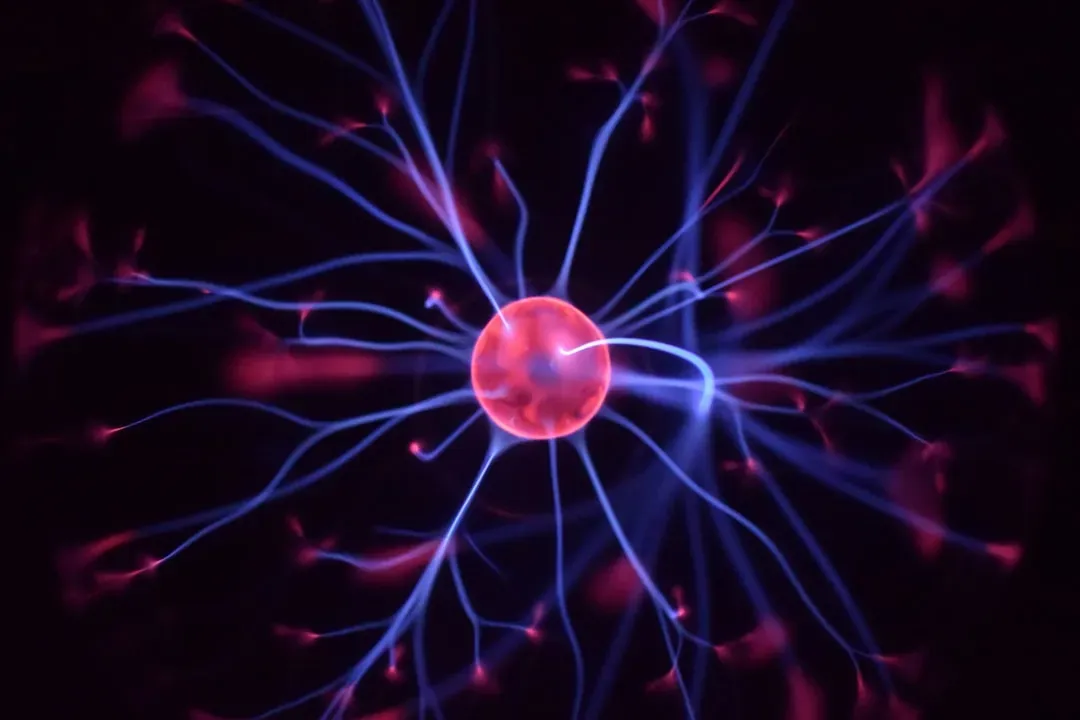
Imagine sitting in your living room during a thunderstorm when a glowing sphere of light slowly floats through your closed window, drifts across the room, and then vanishes with a faint hiss. Sounds like something from a horror film, right? Ball lightning is a rare and unexplained phenomenon described as luminescent spherical objects that vary from pea-sized to several meters in diameter, and though usually associated with thunderstorms, the observed phenomenon reportedly lasts considerably longer than the split-second flash of a lightning bolt.
Ball lightning is often described as moving erratically, sometimes slowly floating through the air or even passing through solid objects like windows or walls, and some accounts mention a hissing or crackling sound accompanying the phenomenon, while others report an acrid smell, possibly from ozone or burning materials. Honestly, the fact that it can reportedly pass through solid objects is where even the most grounded scientists have to pause and admit they’re stumped.
There is at present no widely accepted explanation for ball lightning, and several hypotheses have been advanced since the phenomenon was brought into the scientific realm by the English physician and electrical researcher William Snow Harris in 1843. Theories have ranged from plasma bubbles to vaporized silicon. Over the years, theories have ranged from electromagnetic radiation to plasma bubbles, and some scientists even suggest that ball lightning consists of mini black holes formed during the big bang or charged particles interacting with the atmosphere. One researcher even published a preprint suggesting it might be a kind of wormhole. Ball lightning is incredibly rare and unpredictable, making it difficult to study in a controlled environment. For something witnessed since ancient times, that’s a remarkable scientific gap.
The Hessdalen Lights: Norway’s Unexplained Glow

Picture a quiet, unremarkable valley in rural Norway. Former mining town. Low hills. Sparse population. Now imagine that for decades, brilliant glowing orbs have been appearing in the sky above it, moving slowly, splitting apart, darting at incredible speeds, and sometimes hovering completely still for over an hour. The Hessdalen lights are unidentified lights which have been observed in a 12-kilometre-long stretch of the Hessdalen valley in rural central Norway periodically since at least the 1930s, appearing both by day and by night, and seeming to float through and above the valley in colors of bright white, yellow or red.
With an appearance frequency that once peaked at twenty times a week, these enigmatic lights have puzzled both locals and scientists alike, becoming one of the most consistent and enduring unidentified aerial phenomena in recent history. That’s not a one-time sighting. That’s a repeating, measurable, photographed event.
Despite ongoing research, there is no consensus for an explanation of the phenomenon, and a number of potentially plausible theories have been put forward. One theory, put forward in a 2010 paper published in the Journal of Atmospheric and Solar-Terrestrial Physics, suggests that the phenomenon is caused by radon decaying in the atmosphere; an even more striking idea first proposed in 2006 is that the phenomenon could be caused by the landscape itself acting as a natural battery, which then discharges at regular intervals. Cameras, radars, and spectrometers have all been deployed. The lights keep showing up. The explanation still doesn’t.
The Sailing Stones of Death Valley: Rocks That Move Themselves
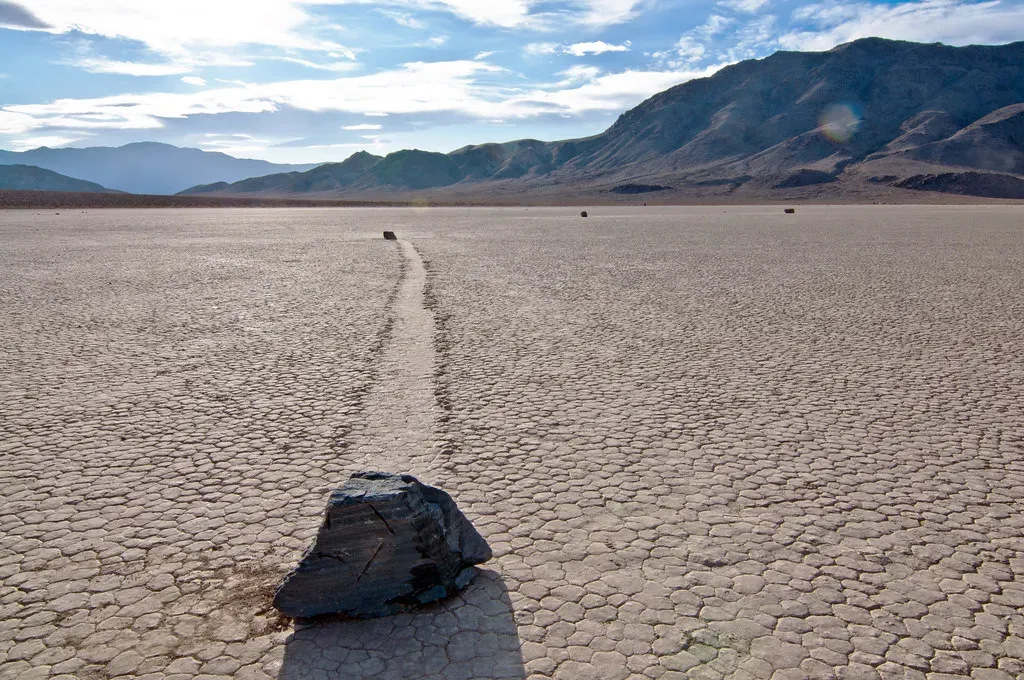
Here’s the thing – rocks don’t move. That’s basically the definition of a rock. Yet in the Racetrack Playa of Death Valley, California, they absolutely do. In the Racetrack Playa of Death Valley, California, large stones are observed to move across the desert floor leaving long tracks behind them, these sailing stones can weigh up to hundreds of pounds, and their movement has baffled scientists for years, with the stones’ tracks often appearing during dry periods when no obvious force is visible.
In recent years, researchers have proposed that a rare combination of ice, wind, and water may cause the stones to slowly slide across the playa. That partial explanation, though, still doesn’t fully satisfy. Think of it like blaming “weather” for a car moving across a parking lot. The mechanism remains incomplete. Scientists found that thin ice sheets form on the ground and light winds push the rocks when the ice melts, but why only some rocks move while others stay put is still unanswered, and a 2025 study suggested tiny ground vibrations might play a role, but it’s not confirmed.
It’s a phenomenon I find oddly poetic. Massive boulders carving trails through a desert with no witnesses, no apparent force, and no fully satisfying scientific explanation. Nature doing something quietly bizarre and then shrugging at us when we ask why.
The Fairy Circles of the Namib Desert: Nature’s Perfect Geometry

Scattered across one of the oldest deserts on Earth, there are thousands upon thousands of perfectly circular patches of bare, barren ground. No plants. No explanation. Just bare circles, repeating endlessly across the landscape like something a giant stencil left behind. Scattered across the arid Namib Desert are thousands of circular patches of barren land surrounded by rings of grass, known as Fairy Circles, ranging from a few meters to over 20 meters in diameter, with theories about their origin ranging from termite activity to underground gas pockets, but neither has been definitively proven.
Local Himba tribes attribute the circles to supernatural forces, calling them the “footprints of the gods,” and these enigmatic patterns continue to puzzle researchers, with no single explanation satisfying all observations. It’s hard to say for sure, but there’s something quietly unsettling about the fact that both termite scientists and plant ecologists have argued fiercely over these circles for years, and neither side has conclusively won.
What makes them even stranger is their regularity. The circles are spaced with an almost mathematical precision across vast areas, as if the desert itself is following some unknown rule of pattern formation. Some researchers draw comparisons to Turing patterns – mathematical structures that arise in nature, from leopard spots to seashell markings. The parallel is fascinating. The answer, as of 2026, is still wide open.
The Mpemba Effect: Why Hot Water Sometimes Freezes Faster Than Cold

Let’s be real – this one sounds like it should have been solved by a first-year physics student decades ago. We understand thermodynamics. We have equations for heat transfer. So why, after centuries of investigation, can’t scientists definitively explain why hot water sometimes freezes faster than cold water? Under some conditions, hot water appears to freeze faster than cold water, and modern studies keep finding that the effect is real sometimes, but maddeningly sensitive to setup.
Supercooling, evaporation, convection, dissolved gases, container geometry, and freezer cycling all change the race, and some recent experiments argue the “win” often comes from stochastic freezing times near the nucleation point, with the upshot being that there’s no single mechanism; rather, a bundle of competing processes can occasionally give the hotter sample a head start. In other words, the answer seems to be “it depends” – which, honestly, is not an answer.
It is a centuries-old curiosity now probed with high-speed cameras and statistical physics, still refusing a final verdict, and a reminder that even water can surprise us. I think there’s something almost philosophical about this one. Water. The most studied substance on Earth. Still keeping secrets. Sometimes the most familiar things are the most mysterious.
Earthquake Lights: The Sky Glows Before the Ground Shakes

Imagine watching the sky light up with strange flashes and glowing orbs – then realizing, moments later, that an earthquake is tearing through the ground beneath you. These mysterious luminescent phenomena have been reported to sometimes occur before or during an earthquake, typically appearing as bright flashes in the sky, and in some cases have been observed weeks ahead of the actual earthquakes; for centuries, these lights have confounded scientists, but one possible explanation is that they are caused by earthquake-induced stress, which releases electrical charges from certain types of rocks.
These charges then travel up into the atmosphere, where they interact with the air and produce light, and a similar explanation has also been offered for the equally mysterious lightning associated with volcanic eruptions, though the debate surrounding these occurrences still remains charged, with some researchers even questioning their actual existence. That last part is remarkable – some scientists still aren’t sure the phenomenon is entirely real, even though documented accounts span multiple continents and thousands of years.
Ball lightning has also been associated with earthquakes, and the rare flashes of light sometimes seen around earthquakes can take many forms: bluish flames that appear to come out of the ground at ankle height; quick flashes of bright light that resemble regular lightning strikes except they originate from the ground instead of the sky; and the floating orbs known as ball lightning. The fact that this overlaps with another phenomenon on this very list suggests the Earth might be playing an interconnected game we haven’t even begun to fully understand.
The Universe Refuses to Be Fully Understood – And That’s the Point
What strikes me most about these six phenomena is not the mystery itself, but how long it persists. These aren’t fresh puzzles from last week’s research. They are old, stubborn, well-documented, and still open. From silent, unexplained sounds resonating across the globe to the strange energy density of empty space, bizarre mysteries continue to baffle researchers in 2026, proving that the more we know, the weirder the universe gets.
There’s something both humbling and thrilling about that. Science isn’t a finished book. It’s more like an enormous, sprawling investigation with new chapters constantly being opened, and some very old ones stubbornly refusing to close. Rocks creeping across desert floors. Lights dancing above Norwegian valleys for over a hundred years. Hot water freezing faster than cold. The sky lighting up before earthquakes. Each of these phenomena reminds us that our understanding of the natural world, impressive as it is, has genuine gaps.
Maybe that’s the real takeaway here. Not that science has failed, but that nature is gloriously, endlessly, stubbornly complex. The questions that survive the longest are often the ones that eventually lead to the biggest breakthroughs. Which of these six mysteries surprises you the most – and what do you think the answer might be? Drop your thoughts in the comments.
