


North America is home to some of the world’s most spectacular birds of prey, offering wildlife enthusiasts and casual observers alike the chance to witness these magnificent hunters in their natural habitats. From the iconic Bald Eagle soaring over pristine lakes to the silent, deadly sweep of an owl at twilight, America’s raptors represent the perfect combination of power, precision, and evolutionary adaptation. This article explores the most majestic birds of prey that can be observed within the United States, detailing their unique characteristics, hunting behaviors, habitats, and conservation status. Whether you’re a dedicated birder or simply appreciate the wonder of wildlife, understanding these remarkable predators enhances any outdoor experience and deepens our connection to the natural world around us.
The Bald Eagle: America’s National Symbol

No discussion of American birds of prey would be complete without beginning with the Bald Eagle (Haliaeetus leucocephalus). As the national bird and symbol of the United States since 1782, this magnificent raptor represents freedom, strength, and resilience. With a wingspan reaching up to 7.5 feet and weighing between 6.5 and 14 pounds, Bald Eagles are unmistakable with their white heads and tails contrasting against chocolate-brown bodies and wings. They primarily inhabit areas near large bodies of water, where they feed predominantly on fish, though they’re opportunistic and will scavenge or steal prey from other birds.
Once endangered due to habitat destruction, hunting, and the effects of DDT pesticides, Bald Eagles have made a remarkable comeback. Their population has increased from just 417 nesting pairs in the 1960s to more than 71,400 nesting pairs today. Bald Eagles can be observed year-round in Alaska and parts of the Pacific Northwest, while winter migrations bring them to concentrations in the Mississippi and Missouri River valleys, the Great Lakes, and other major waterways across the lower 48 states. Popular viewing locations include the Klamath Basin in Oregon/California, the Skagit River in Washington, and the Mississippi River along the Illinois-Iowa border.
The Golden Eagle: Ruler of Western Skies

The Golden Eagle (Aquila chrysaetos) is often considered the quintessential eagle worldwide and one of North America’s most impressive birds of prey. Slightly larger than the Bald Eagle, Golden Eagles can have wingspans approaching 7.5 feet and weigh up to 14 pounds. Their name comes from the distinctive golden-brown feathers on the back of their head and neck. Unlike Bald Eagles, Golden Eagles prefer open country, particularly in mountainous regions, grasslands, and deserts of the western United States.
These powerful hunters are known for their exceptional hunting prowess, capable of taking prey as large as deer fawns, though they typically target jackrabbits, ground squirrels, and other medium-sized mammals. They’re also known to hunt in pairs, with one eagle flushing prey toward its waiting partner. Golden Eagles can be observed year-round throughout much of the western United States, with notable viewing opportunities in Colorado’s Rocky Mountain National Park, Wyoming’s Yellowstone National Park, and various locations throughout California’s mountains and foothills. Unlike many raptors, they’re relatively shy around humans, making a sighting particularly special for wildlife enthusiasts.
The Peregrine Falcon: Nature’s Perfect Hunter

The Peregrine Falcon (Falco peregrinus) holds the title of the fastest animal on Earth, capable of diving at speeds exceeding 240 mph during hunting stoops. This medium-sized falcon, weighing between 1.5 and 3.3 pounds with a wingspan of 3.3 to 3.6 feet, is distinguished by its blue-gray back, barred white underparts, and black “mustache” markings on its face. Peregrines have made a remarkable adaptation to human environments, now nesting on skyscrapers and bridges in major cities across America, where they hunt pigeons and other urban birds.
Like the Bald Eagle, Peregrine Falcons faced near-extinction in the mid-20th century due to DDT contamination, which caused eggshell thinning and reproductive failure. Following the 1972 DDT ban and extensive recovery efforts, including captive breeding and releases, Peregrines have made one of wildlife conservation’s greatest comeback stories. Today, they can be spotted in diverse habitats from coastal cliffs to urban centers. Some of the best viewing locations include New York City (where nest cams are often set up on skyscrapers), Acadia National Park in Maine, Yosemite National Park in California, and the Mississippi River bluffs. Urban Peregrines often develop celebrity status among local residents who follow their nesting activities each year.
The Red-tailed Hawk: America’s Most Widespread Raptor

The Red-tailed Hawk (Buteo jamaicensis) is arguably America’s most recognizable and commonly seen bird of prey, found in virtually every habitat type across the continental United States. Medium to large in size, with a wingspan of approximately 4 feet and weighing between 1.5 and 3.5 pounds, these hawks are named for their distinctive rusty-red tail, visible from below when they soar. They display remarkable color variation across their range, from nearly white morphs in the Great Plains to dark chocolate-brown individuals in the Pacific Northwest.
Red-tailed Hawks are frequently spotted perched on telephone poles and fence posts along highways, or soaring in wide circles while hunting. Their distinctive raspy scream is so iconic that it’s often used in movies and television as the call for any bird of prey, regardless of species. These adaptable hunters primarily target rodents and other small mammals, making them valuable allies for farmers and ecosystem managers. They can be observed year-round throughout most of the United States, with populations in the northernmost states moving south for winter. Their ubiquity makes them excellent “starter” birds of prey for beginning birders, while their varied plumages and behaviors keep them interesting even for experienced observers.
The Great Horned Owl: Feathered Tiger of the Night
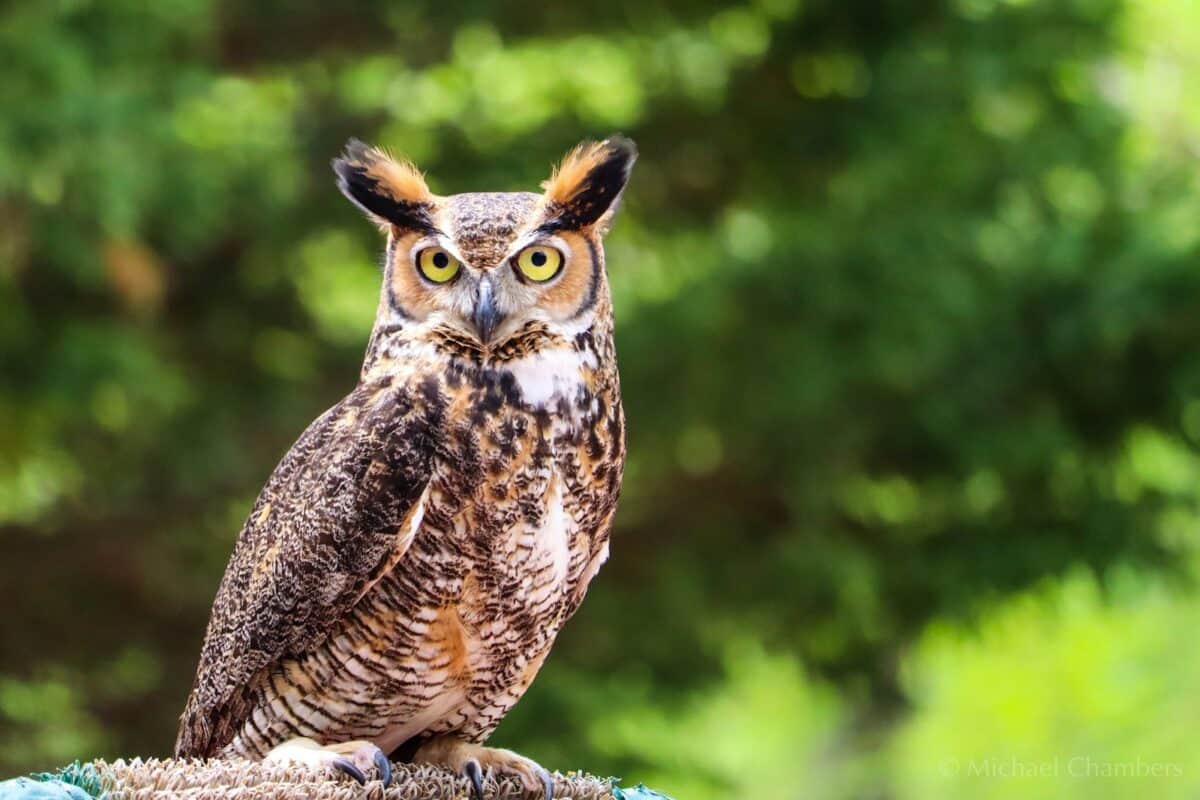
The Great Horned Owl (Bubo virginianus) is North America’s largest and most powerful owl, sometimes called the “tiger of the sky” for its ferocity and hunting prowess. Weighing between 2 and 5.5 pounds with a wingspan of 3 to 5 feet, these imposing nocturnal hunters are easily identified by their large size, prominent ear tufts (which aren’t actually ears but feather tufts), and deep hooting calls that echo through forests and suburbs alike. Their piercing yellow eyes and facial disk help them locate prey in near-total darkness.
Great Horned Owls are apex predators with one of the most diverse diets of any North American raptor, hunting everything from tiny rodents to skunks, rabbits, and even other raptors like Osprey and smaller owl species. They’re extraordinarily adaptable, found in habitats ranging from dense forests to desert canyons and suburban parks across the entire continental United States. Unlike many birds of prey that build their own nests, Great Horned Owls typically take over abandoned nests of other large birds or nest in tree cavities. They begin nesting extraordinarily early, often in January even in northern states, with females incubating eggs while snow still covers the landscape. These magnificent owls can be spotted year-round throughout their range, though their nocturnal habits make them more challenging to observe than diurnal raptors.
The Osprey: The Fish Hawk

The Osprey (Pandion haliaetus) is one of North America’s most specialized birds of prey, with adaptations perfectly suited for hunting fish. Weighing 2.5 to 4.5 pounds with a wingspan of 5 to 6 feet, Ospreys are distinctive with their white underparts, dark brown upperparts, and conspicuous dark eye stripe. They possess unique physical characteristics for their fishing lifestyle: reversible outer toes, closable nostrils for diving, and specialized barbed pads on their feet that help them grip slippery fish.
Ospreys are fish-catching specialists, with fish comprising about 99% of their diet. Their hunting technique is spectacular to witness—they hover 30 to 100 feet above water, then plunge feet-first to grab fish, sometimes completely submerging themselves before emerging with their prey. They’re one of the most widely distributed raptors in North America, found near lakes, rivers, reservoirs, and coastal areas during breeding season (March to September in most areas). Conservation efforts, including the construction of nesting platforms, have helped Osprey populations recover from mid-20th century declines. Today, they can be reliably observed near almost any major body of water during the breeding season, with particularly good viewing at locations like Blackwater National Wildlife Refuge in Maryland, Florida’s Everglades, and along the Pacific Northwest coast during salmon runs.
The Northern Harrier: The Marsh Ghost
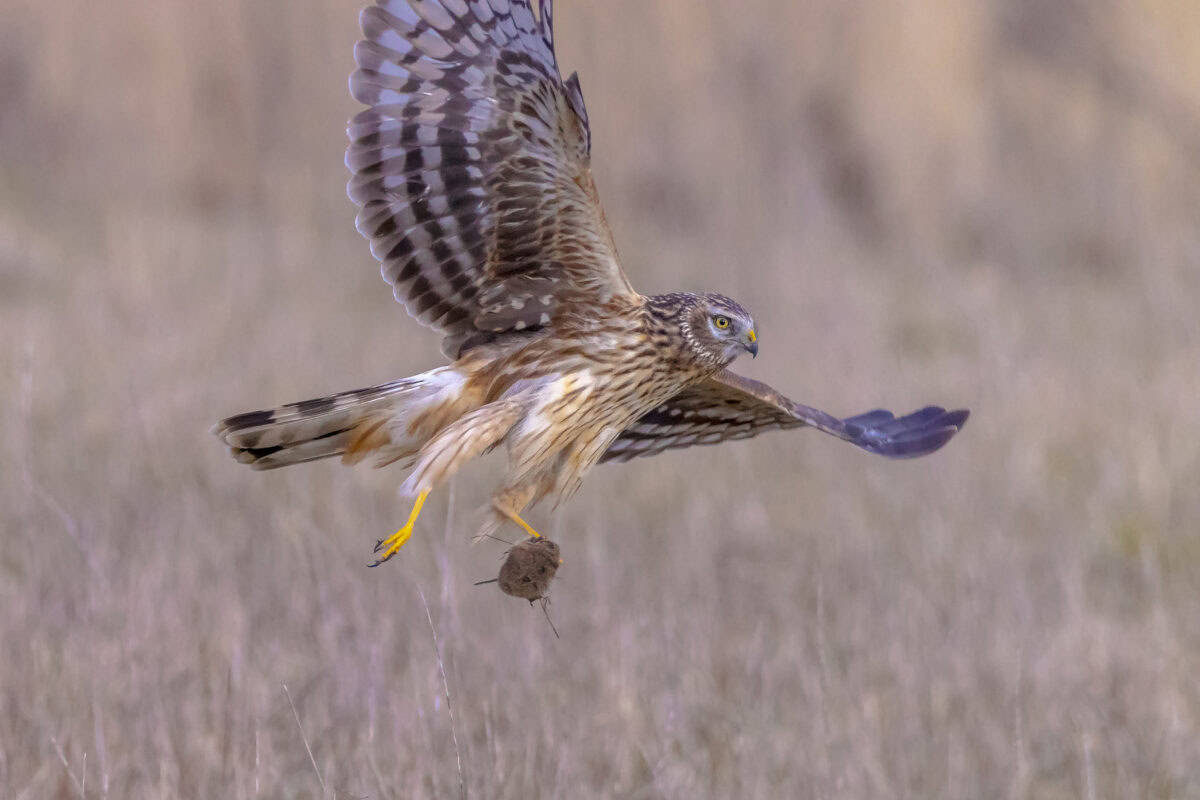
The Northern Harrier (Circus hudsonius) is one of North America’s most distinctive and elegant birds of prey, recognized by its owl-like facial disk, low-flying hunting style, and V-shaped wing posture as it glides. Medium-sized, with a wingspan of about 3.5 feet and weighing 10 to 26 ounces, harriers display strong sexual dimorphism—males are pale gray above and white below, while females and immatures are brown above and streaked below. Both sexes show a distinctive white rump patch visible during flight.
Unlike most hawks that rely primarily on vision, Northern Harriers use both sight and hearing to locate prey, similar to owls. This adaptation allows them to detect mice and voles moving through dense grass that would be invisible to other raptors. They hunt by flying low over open fields and marshes, typically 3 to 30 feet above ground, in a distinctive, buoyant, methodical pattern. Northern Harriers can be found throughout the continental United States, though they’re more common in the northern states during summer breeding season and southern states during winter. They prefer wetlands, grasslands, and agricultural areas. Some of the best viewing locations include Assateague Island National Seashore in Maryland/Virginia, Bosque del Apache National Wildlife Refuge in New Mexico, and various prairie preserves throughout the Midwest.
The Snowy Owl: Arctic Visitor to American Shores

The Snowy Owl (Bubo scandiacus) is among the most dramatic and sought-after bird sightings for American birders. These magnificent Arctic visitors weigh 3.5 to 6.5 pounds with wingspans approaching 5 feet, making them one of North America’s largest owls. True to their name, Snowy Owls are primarily white, with males becoming nearly pure white as they age, while females and juveniles display varying amounts of dark barring. Unlike most owls, Snowy Owls are diurnal, hunting during daylight hours—an adaptation to the continuous summer daylight of their Arctic breeding grounds.
Though they breed in the Arctic tundra of Alaska and northern Canada, Snowy Owls periodically venture south into the continental United States during winter, particularly during what ornithologists call “irruption years.” These irregular southern migrations typically occur when lemming populations (their primary prey) crash in the Arctic, forcing the owls to seek alternative hunting grounds. During major irruptions, Snowy Owls may appear as far south as Florida, though they’re most regularly seen in the northern tier of states from Maine to Washington. They prefer open habitats that resemble their tundra home, including coastal dunes, airports, large fields, and even beaches. Notable viewing locations during irruption years include Plum Island in Massachusetts, Montauk Point on Long Island, and the Boundary Waters region of Minnesota. The winter of 2013-2014 saw one of the largest recorded irruptions, with thousands of Snowy Owls appearing across the United States.
The California Condor: A Conservation Triumph

The California Condor (Gymnogyps californianus) represents both America’s largest bird of prey and one of its most remarkable conservation stories. With a wingspan approaching 10 feet and weighing up to 26 pounds, these massive vultures are an awe-inspiring sight. They’re easily identified by their bald, reddish-orange heads, predominantly black plumage with distinctive white triangular patches under their wings, and their enormous size—when soaring, they’re often mistaken for small aircraft by observers unfamiliar with them.
California Condors once ranged widely across North America but were driven to near-extinction by the late 1980s, when only 22 individuals remained in the world. Through intensive captive breeding efforts and reintroduction programs, their population has grown to over 500 birds today, with more than half living in the wild. While still critically endangered, condors can now be observed at several locations, primarily in California, Arizona, and Utah. The best viewing opportunities include the Ventana Wilderness in Big Sur, California; Pinnacles National Park, California; and the Vermilion Cliffs area of northern Arizona, where regular releases of captive-bred birds take place. Unlike many raptors, condors are scavengers rather than hunters, feeding exclusively on carrion, which they locate using their exceptional eyesight while soaring at high altitudes.
The Swallow-tailed Kite: Aerial Acrobat
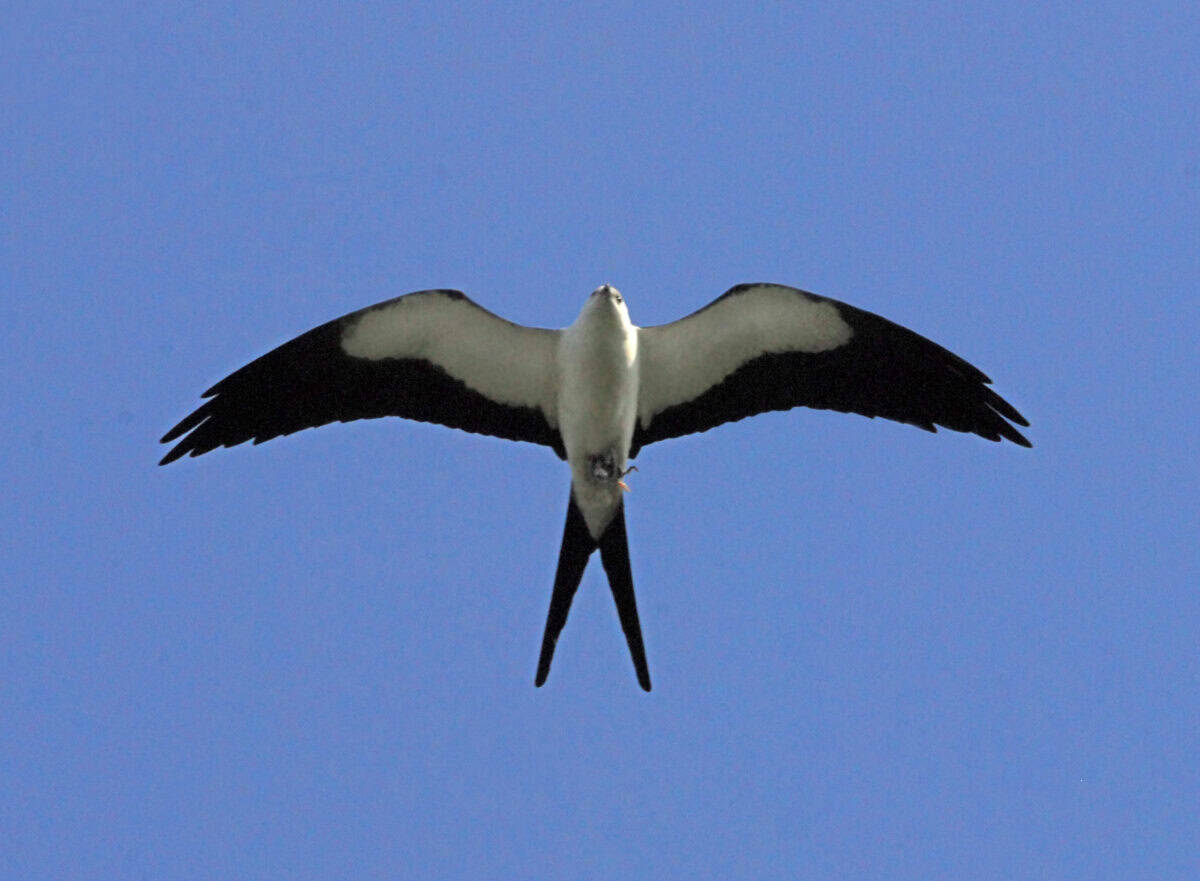
The Swallow-tailed Kite (Elanoides forficatus) may be the most graceful bird of prey in North America, with a distinctive appearance that makes it unmistakable even to novice birders. These medium-sized raptors, weighing only 13 to 21 ounces with a wingspan of 4 feet, are characterized by their deeply forked tails and contrasting black-and-white plumage—glossy black backs and white heads and underparts. Their flight is extraordinarily buoyant and acrobatic, with individuals capable of executing tight turns, rolls, and other aerial maneuvers as they hunt.
Once common across much of the southeastern United States, Swallow-tailed Kites today breed primarily in Florida and portions of neighboring states, though they’re slowly expanding their range northward again. They arrive from South American wintering grounds in late February and March, departing by early September. These unique raptors hunt on the wing, snatching insects, small reptiles, frogs, and even hummingbirds from treetops without landing. They also drink and bathe by skimming water surfaces during flight. Prime viewing locations include Florida’s Everglades National Park, Paynes Prairie Preserve State Park near Gainesville, Florida, and coastal wildlife refuges in South Carolina and Georgia. Late summer roosts, where dozens or even hundreds of kites gather before migration, offer particularly spectacular viewing opportunities, with sites like Lake Okeechobee, Florida, sometimes hosting over 1,000 birds.
The Ferruginous Hawk: Giant of the Plains
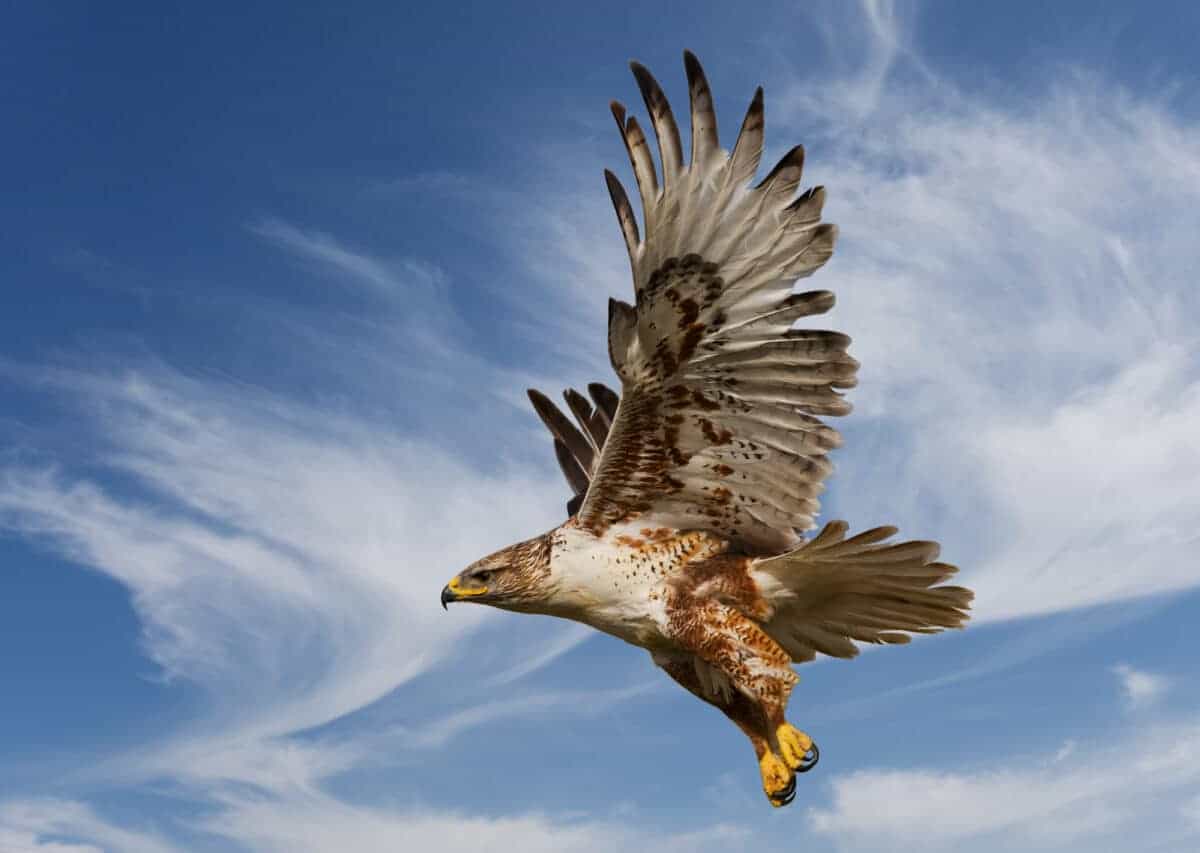
The Ferruginous Hawk (Buteo regalis) is the largest hawk in North America, with a wingspan approaching 5 feet and weighing up to 4.5 pounds. Named for their rusty (ferruginous) coloration on their backs, shoulders, and legs, these impressive birds come in two color morphs—a light form with predominantly white underparts and a dark form that appears chocolate-brown throughout. Their legs are feathered all the way to their toes, an adaptation shared with Golden Eagles and rough-legged hawks that helps distinguish them from other buteos.
Ferruginous Hawks are birds of open country, inhabiting the prairies, grasslands, and deserts of western North America from the Great Plains to the Great Basin. They specialize in hunting ground squirrels, prairie dogs, and jackrabbits, sometimes walking or running along the ground to pursue prey—unusual behavior for hawks. Their population has declined due to habitat loss as prairies have been converted to agriculture, making them a species of conservation concern. The best viewing opportunities occur in states like Wyoming, Colorado, Montana, and New Mexico, particularly in areas with healthy prairie dog colonies. Prime locations include Wyoming’s Thunder Basin National Grassland, Colorado’s Pawnee National Grassland, and Montana’s Charles M. Russell National Wildlife Refuge.
Conclusion

North America’s birds of prey represent some of the most awe-inspiring and ecologically significant wildlife on the continent. From the commanding presence of the Bald Eagle and the stealth of the Great Horned Owl to the high-speed stoops of the Peregrine Falcon and the aerial elegance of the Swallow-tailed Kite, these raptors embody a diversity of form, function, and survival strategies shaped by millennia of evolution. Observing them not only provides thrilling encounters with nature’s finest hunters but also offers a powerful reminder of our responsibility to protect their habitats and ensure their continued survival. Whether glimpsed in a remote wilderness or a city skyline, these birds deepen our understanding of the wild and our place within it—one soaring silhouette at a time.

From exploring the marine wonders in the Azores and witnessing the vast savannas of Kenya, to delving deep into the rich biodiversity of South Africa and traversing iconic landscapes in Australia and the US like Yellowstone, Chris's experiences are vast.
With a penchant for diving alongside sharks, the ocean holds a special place in his heart.
Through his academic insights, he champions wildlife conservation, striving with 'Animals Around The Globe' to cultivate a profound connection between humans and animals, enhancing our mutual appreciation.
Connect with him at Feedback@animalsaroundtheglobe.com.
- Why Spiders Don’t Get Stuck in Their Own Webs - July 20, 2026
- What Scientists Found in a 10,000-Year-Old Beehive - July 20, 2026
- This Spider Builds Fake Decoys of Itself - July 20, 2026