


In the fascinating world of animal behavior, few phenomena are as heartwarming as the unexpected friendships that develop between different species. Among these, ducks stand out for their remarkable ability to form deep, lasting bonds with animals outside their species. These waterfowl, known primarily for their waddling gait and quacking vocalizations, possess a surprising capacity for cross-species socialization that can last a lifetime. From farm animals to household pets, ducks have demonstrated time and again that friendship knows no species boundaries. This article explores the science, psychology, and heartwarming stories behind ducks’ extraordinary ability to develop life-long friendships with other animals.
The Social Nature of Ducks

Ducks are inherently social creatures, a characteristic that forms the foundation of their cross-species bonding abilities. In the wild, most duck species live in flocks, with complex social hierarchies and communication systems. This social predisposition makes them naturally inclined to seek companionship. Mallards, for instance, can form flocks numbering in the hundreds during migration seasons, while domestic ducks typically establish smaller, tight-knit communities.
Research has shown that ducks possess cognitive abilities that support social learning and recognition of individual companions. Their need for social connection is so strong that isolated ducks often exhibit signs of distress and loneliness, including decreased activity, increased vocalization, and even health issues. This innate sociability creates the perfect foundation for forming bonds not just with other ducks, but with entirely different species when the opportunity arises.
Imprinting and Early Development

The phenomenon of imprinting plays a crucial role in ducks’ ability to form cross-species friendships. First identified by ethologist Konrad Lorenz in the 1930s, imprinting occurs when ducklings form an attachment to the first moving object they see shortly after hatching—usually their mother. This critical period typically occurs within the first 24-72 hours of life. During this time, a duckling’s brain is particularly receptive to forming strong attachments that will guide their social behavior throughout life.
In natural settings, this ensures ducklings follow their mother and learn essential survival behaviors. However, this same mechanism allows ducklings raised around other species—whether dogs, cats, chickens, or humans—to form powerful bonds with these non-duck caregivers. These early imprinted relationships often develop into lifelong attachments, explaining why ducks raised from hatchlings by humans or alongside other animals often maintain those bonds throughout their 8-12 year lifespan.
Duck-Dog Friendships: A Common Bond
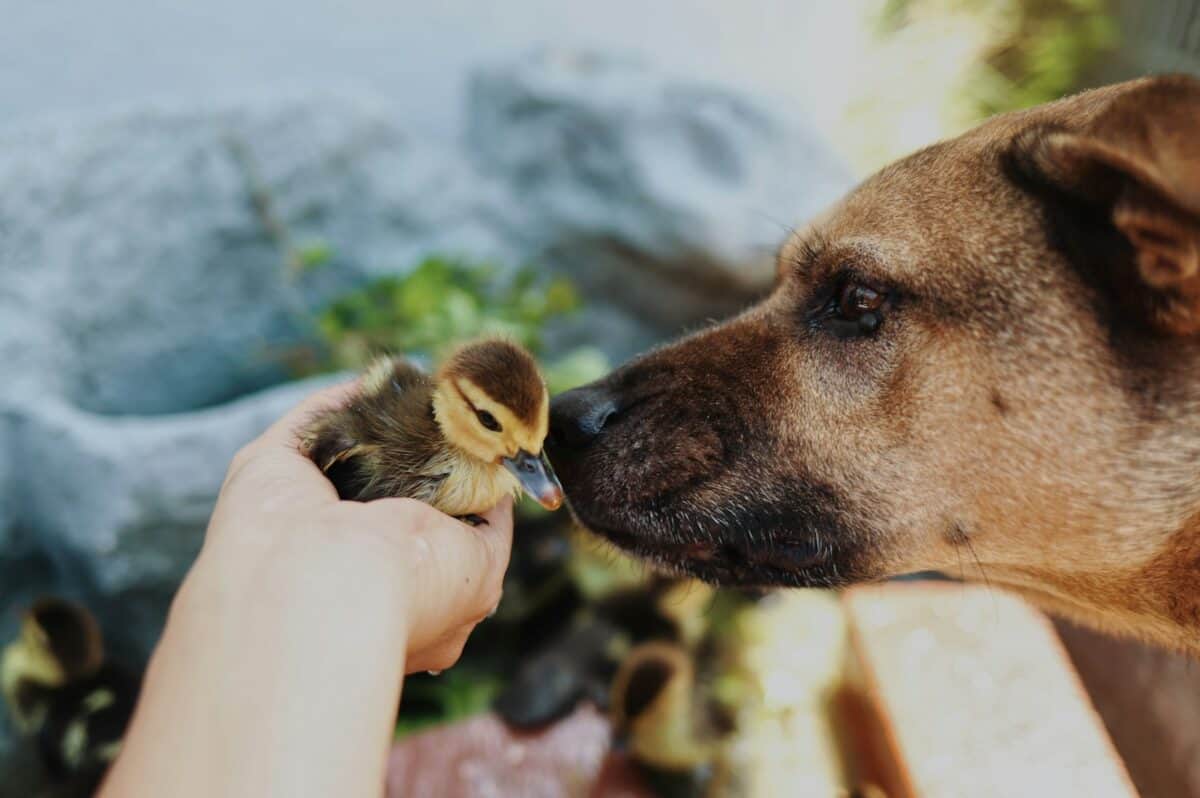
Among the most documented cross-species friendships involving ducks are those formed with dogs. Despite being predator and prey in the wild, domesticated environments allow these unlikely friendships to flourish. The dynamics often begin cautiously but can develop into profound connections. Dogs, particularly gentle breeds like Labradors and Golden Retrievers, seem especially compatible with ducks. These relationships typically feature protective behaviors from the dog and trusting responses from the duck.
Remarkably, studies have shown that both species experience increased oxytocin levels—the “bonding hormone”—when in each other’s company, similar to what occurs in human friendships. Many duck-dog friendships include shared activities like swimming, with ducks naturally leading the way in water while dogs follow along. Conservation photographer Tanja Brandt captured worldwide attention with her documentation of a friendship between her Harris’s hawk and a duckling, demonstrating that even hunting breeds can form protective bonds with waterfowl when raised together from an early age.
Feline Companions: When Ducks and Cats Connect

The friendship between ducks and cats represents one of nature’s more surprising alliances, given cats’ natural predatory instincts toward birds. Yet, numerous documented cases show these species developing deep bonds, particularly when introduced during the cat’s early developmental stages. These relationships often exhibit fascinating behavioral adaptations. Cats in duck friendships typically suppress their hunting instincts around their feathered friends, while ducks show remarkable comfort in feline company.
Research from animal behaviorists suggests that early socialization is key—kittens exposed to ducks before their hunting behaviors fully develop are more likely to view them as companions rather than prey. One notable case documented by the Journal of Applied Animal Behavior Science described a female mallard and domestic cat that not only tolerated each other but engaged in mutual grooming behaviors. The mallard would preen the cat’s fur, while the cat would gently clean the duck’s feathers—a remarkable example of cross-species care. These relationships often feature shared resting spaces, with ducks and cats frequently found napping together in sunlit spots.
Farm Friendships: Ducks and Livestock

On farms around the world, ducks form some of their most enduring relationships with various livestock animals. These agricultural settings provide natural opportunities for long-term cross-species socialization. Particularly notable are the bonds formed between ducks and larger farm animals like horses, cows, and goats. These relationships often develop distinctive patterns: ducks may follow their larger friends throughout pastures, eating insects disturbed by hoofed movement. Meanwhile, the larger animals frequently demonstrate protective behaviors toward their smaller companions.
A 2018 study published in Applied Animal Behaviour Science documented several cases where ducks formed attachments to sheep, with the ducks adopting the sheep’s daily routines and sleeping near or even on their woolly companions. On hobby farms, ducks have been observed forming particularly close bonds with goats, with whom they share playful behaviors and resting areas. These farm-based friendships offer mutual benefits—ducks often consume parasites that might otherwise bother livestock, while gaining protection from predators through their association with larger animals.
The Science Behind Cross-Species Bonding

The biological underpinnings of ducks’ cross-species friendships involve fascinating neurological and hormonal processes. Research in comparative neurobiology has revealed that ducks possess highly developed limbic systems—brain regions associated with emotion and attachment. When ducks form bonds, whether with their own species or others, their brains release significant amounts of oxytocin and vasopressin, neurotransmitters associated with trust and bonding across the animal kingdom.
A 2019 study in the Journal of Comparative Psychology found that ducks in established cross-species friendships show elevated levels of these “bonding chemicals” when reunited with their non-duck friends after separation. Additionally, the mallard duck’s brain contains a relatively large amygdala for its size, the region responsible for emotional learning and memory. This neurological feature may enable ducks to form stronger emotional attachments and remember their friends over extended periods. Behaviorally, researchers have observed that ducks engaged in cross-species friendships display many of the same affiliative behaviors they show toward their own kind—following, vocalizing, and seeking proximity—suggesting the emotional experience of these friendships may be similar regardless of species boundaries.
Communication Across Species Lines
One of the most remarkable aspects of ducks’ interspecies friendships is their ability to develop communication systems with animals that vocalize and behave very differently from themselves. Ducks naturally communicate through a variety of calls—from the familiar quacking to softer contact calls and warning sounds. When bonding with other species, they adapt these vocalizations and develop new communication patterns specific to those relationships. Research has documented ducks using different call patterns when interacting with their non-duck friends compared to when they communicate with other ducks.
For example, a duck bonded with a dog might develop a specific greeting call used only for that canine companion. Equally fascinating is their ability to interpret other species’ communication signals. Ducks in long-term friendships with cats have been observed responding appropriately to feline body language, distinguishing between playful pouncing and actual threats. This mutual adaptation of communication styles represents a sophisticated form of social learning. A study from the University of Vienna found that ducks can learn to associate specific sounds from other species with particular outcomes, allowing them to navigate complex cross-species social interactions despite the absence of a shared natural language.
Environmental Factors Influencing Cross-Species Bonds

The environment plays a crucial role in facilitating and strengthening ducks’ friendships with other animals. Spaces that allow for safe, positive interactions are essential for these unlikely bonds to develop. Environments with reduced stress, adequate resources, and appropriate shelter create the secure foundation necessary for cross-species trust to develop. Water features are particularly important, as they allow ducks to engage in natural behaviors while potentially introducing other animals to water-based activities.
Research from the University of California found that cross-species friendships involving ducks were more likely to form and endure in environments offering varied terrain—including both water and land areas—where different species could interact while engaging in their natural behaviors. The presence of common resting areas also strengthens these bonds, with many duck friendships involving shared sleeping arrangements. Climate also plays a role; in colder regions, the thermal benefits of huddling with a larger, warmer animal may initially attract ducks to form relationships with mammals, though these connections often evolve beyond mere utility into genuine social bonds. Human management practices significantly impact these friendships as well, with gentle introduction protocols and supervision during early interactions substantially increasing the likelihood of successful long-term bonds.
Famous Duck Friendships That Captured Hearts

Several remarkable duck friendships have captured public attention and helped scientists better understand cross-species bonding. Perhaps the most famous is the story of Flame the duck and Jemima the dog, whose friendship at a farm animal sanctuary in New York lasted over eight years. Their bond began when Flame was rescued as a duckling and Jemima, a Border Collie, adopted her. Documentary footage showed Flame following Jemima everywhere, sleeping curled against her, and even attempting to mimic her barking with enthusiastic quacks.
In Australia, a Muscovy duck named Donald formed an unlikely bond with a kangaroo named Joey at the Alice Springs Desert Park. Staff documented how Donald would ride on Joey’s back during morning explorations of their enclosure. Another heartwarming case involves Max the duck and Quackers the horse from Minnesota, whose friendship spanned nearly a decade. Local residents became accustomed to seeing the small duck walking or swimming alongside his much larger equine companion, with the pair becoming so inseparable that the horse would often lower his head to allow Max to climb onto his back. These documented friendships provide valuable insights into the depth and longevity of cross-species bonds involving ducks, demonstrating that these relationships aren’t merely temporary alignments but can constitute significant life-long attachments.
When Ducks Befriend Wild Animals

While most documented duck friendships occur in controlled environments like farms or sanctuaries, there are fascinating instances of ducks forming bonds with wild animals. These relationships are particularly noteworthy as they occur without human facilitation. Wildlife researchers have documented cases of wild mallards forming associations with beavers, with the ducks benefiting from the protected environments of beaver ponds while the beavers appear to tolerate or even welcome their presence. Marine biologists in coastal regions have observed interesting relationships between sea ducks and harbor seals, with the birds often resting on floating seals or swimming in close proximity without signs of fear.
In wetland environments, wild ducks have been seen forming loose associations with deer that come to water sources, with some documentary footage showing wood ducks perching on deer backs to reach higher berries. These wild friendships typically differ from domestic ones in their nature—they tend to be more utilitarian and less intimate than the deep bonds formed in captivity. However, they demonstrate that the tendency for ducks to form cross-species relationships extends beyond domesticated settings into natural ecosystems. Wildlife conservation efforts increasingly recognize these natural associations, with some restoration projects now considering how to preserve habitats that support these remarkable wild friendships.
The Role of Humans in Facilitating Duck Friendships

Human intervention often plays a pivotal role in creating environments where ducks can form bonds with other species. Animal sanctuaries and rehabilitation centers frequently witness the formation of unexpected friendships when they house different species in shared or adjacent spaces. These controlled introductions, when done thoughtfully, can lead to lasting relationships. Veterinarians and animal behaviorists recommend specific protocols for introducing ducks to potential animal friends, emphasizing gradual exposure, positive reinforcement, and close supervision. Research from the University of Pennsylvania’s School of Veterinary Medicine suggests that the most successful cross-species introductions occur in neutral territory with careful attention to each animal’s body language.
For duck owners hoping to foster such friendships, experts recommend beginning socialization when animals are young whenever possible. Providing shared enrichment activities—like supervised swimming sessions for ducks and water-friendly dogs—can strengthen developing bonds. However, professionals caution against forcing interactions, as genuine friendships must develop voluntarily. Responsible human facilitation also involves ongoing monitoring for signs of stress or changed dynamics as animals mature. When done correctly, human-facilitated introductions can lead to lifelong companionships that enrich the lives of all animals involved while providing valuable insights into cross-species social behavior.
Health and Behavioral Benefits of Cross-Species Friendship

The health advantages of ducks’ cross-species friendships extend beyond simple companionship. Veterinary research has documented numerous physiological benefits for ducks engaged in positive relationships with other animals. Studies show that ducks with animal companions exhibit lower baseline stress hormone levels (specifically corticosterone) compared to isolated ducks. This reduced stress translates to tangible health outcomes—bonded ducks typically display stronger immune function, better feather condition, and longer lifespans, often living 1-3 years beyond the average for their species. The behavioral benefits are equally significant.
Ducks in cross-species friendships frequently demonstrate increased environmental exploration, more diverse foraging behaviors, and reduced fearfulness. A 2020 study published in Animal Cognition found that ducks with non-duck companions showed enhanced problem-solving abilities compared to those housed only with other ducks, suggesting that cross-species socialization may provide cognitive benefits through exposure to different behavioral models. For their non-duck friends, the relationships offer benefits as well. Dogs paired with ducks often show reduced separation anxiety when their owners are away, while larger farm animals with duck companions have been observed to demonstrate lower stress responses during veterinary procedures when their feathered friends are nearby. These mutual health benefits underscore the biological significance of these seemingly unusual friendships.
Conclusion: The Profound Significance of Duck Friendships
The capacity of ducks to form life-long friendships with other animal species represents one of nature’s most heartwarming phenomena, challenging our understanding of animal cognition and emotional lives. These cross-species bonds—whether between a duck and dog, cat, horse, or other creature—demonstrate that the foundations of friendship transcend biological categories. They reveal sophisticated social capabilities in ducks that were once thought unique to primates and other highly complex mammals.
For scientists, these relationships provide valuable windows into the neurobiology of attachment, the flexibility of social learning, and the evolutionary advantages of cooperation across species lines. For the rest of us, these unlikely friendships serve as powerful reminders that connection and companionship are fundamental needs spanning the animal kingdom, manifesting in remarkable ways when given the opportunity to flourish.

From exploring the marine wonders in the Azores and witnessing the vast savannas of Kenya, to delving deep into the rich biodiversity of South Africa and traversing iconic landscapes in Australia and the US like Yellowstone, Chris's experiences are vast.
With a penchant for diving alongside sharks, the ocean holds a special place in his heart.
Through his academic insights, he champions wildlife conservation, striving with 'Animals Around The Globe' to cultivate a profound connection between humans and animals, enhancing our mutual appreciation.
Connect with him at Feedback@animalsaroundtheglobe.com.
- The Largest Clam Ever Dredged Up From U.S. Waters - July 22, 2026
- How Animated Films Shape What Kids Believe About Animals - July 22, 2026
- The Most Iconic Animals Saved from Extinction in the U.S. - July 22, 2026